Two weeks before this adult Bald Eagle rose above the tree line and disappeared back into the wild, the bird was lying on a stainless-steel examination table while a veterinary team carefully assessed injuries believed to have been sustained during a violent aerial confrontation with another eagle.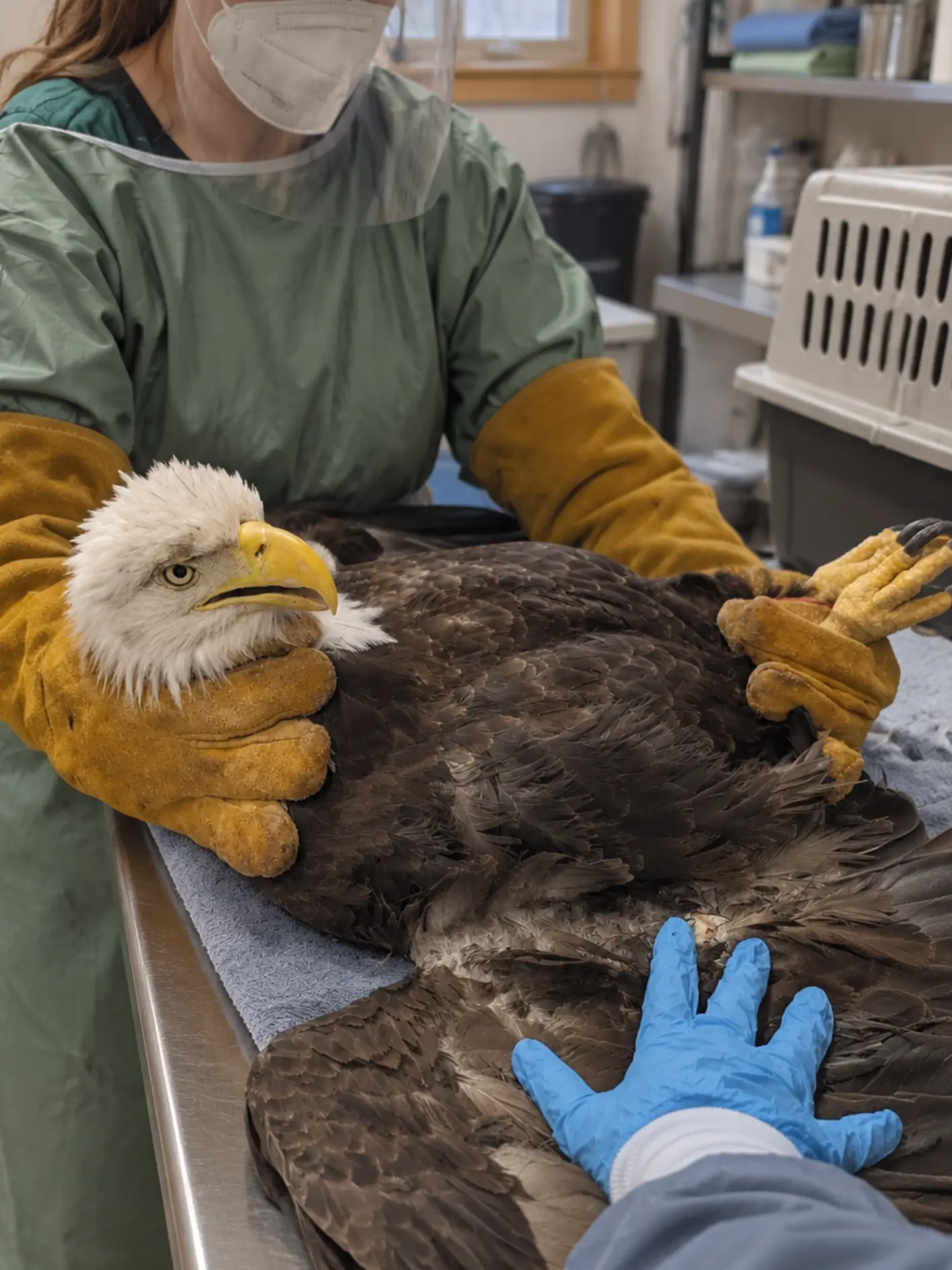
The bird was still alert.
Its eyes followed movement around the room.
Its feet remained powerful enough that staff needed heavy protective gloves to control the talons safely.
But something was clearly wrong.
The eagle had been found grounded after witnesses reported seeing two large raptors engaged in an aggressive aerial encounter. After the confrontation ended, one of the birds came down and did not return to the air.
When rescuers approached, the eagle was unable to fly normally.
One wing was carried lower than expected. The bird appeared exhausted, and several small wounds were visible around the shoulder and chest.
At first, the injuries raised concern for a fracture.
But full-body radiographs produced the first important piece of good news.
No major wing fracture was identified.
No shoulder dislocation was found.
There was no catastrophic injury to the pelvis or spine.
Instead, the veterinary team found substantial soft-tissue trauma, bruising and multiple puncture wounds consistent with the type of injuries that can occur when two large raptors make close physical contact.
The prognosis was guarded.
But unlike a badly displaced fracture, these injuries offered a realistic possibility of full recovery.
Fourteen days later, the same eagle would leave a transport carrier under its own power, open both wings and climb back into the sky.
The Confrontation Began in the Air
Bald Eagles are often observed soaring peacefully over rivers, lakes and forested landscapes.
But peaceful coexistence is not guaranteed.
Adult eagles may become highly territorial around established nesting areas, feeding sites or favored sections of habitat.
Most disputes never progress beyond displays.
One bird may call.
Another may change direction.
There may be a short chase before the confrontation ends.
Occasionally, however, the encounter escalates.
Two birds may pursue one another at high speed.
They can dive.
Turn sharply.
Extend their feet.
And during the closest encounters, talons designed to seize prey can strike another eagle.
The entire event may last only seconds.
The injuries can last much longer.
In this case, witnesses reported seeing two Bald Eagles interacting aggressively in the air before one bird lost altitude and came down near a wooded river corridor.
No one had a perfect view of every moment of the encounter, so wildlife staff described the incident cautiously as a suspected territorial fight rather than presenting the cause as proven fact.
But the pattern of injuries later found during examination was considered compatible with close contact involving another large raptor.
The Eagle Did Not Fly After It Reached the Ground
When the bird was first observed after the incident, it remained on the ground rather than immediately leaving.
That was the first indication that the encounter had caused more than temporary disruption.
A healthy adult Bald Eagle normally wants distance from people.
Even after a stressful event, an otherwise uninjured bird will usually regain orientation and leave once it feels threatened.
This eagle did not.
It watched its surroundings.
It attempted to reposition itself.
But it did not launch.
One wing seemed slightly guarded.
Its breathing appeared faster than expected.
The bird also seemed reluctant to move.
That was enough to prompt a call to wildlife authorities.
Rescuers Did Not Try to Force the Eagle to Fly
One of the worst things a person can do with a grounded raptor is repeatedly chase it in an attempt to make it “prove” that it can fly.
If the bird has muscle trauma, a joint injury, internal bruising or neurological impairment, forced activity can make the damage worse.
Instead, trained responders approached carefully.
Heavy gloves were used.
The feet were controlled first.
The body was supported.
Both wings were held close enough to prevent uncontrolled flapping.
The bird was then placed into a padded transport carrier.
The eagle remained alert during capture.
That was encouraging.
But the lack of flight meant a veterinary evaluation was necessary.
The Initial Examination Looked for Hidden Trauma
At the rehabilitation center, the bird was placed on a padded treatment surface while staff began a complete physical examination.
Photographs from the examination show the adult eagle lying on the table as one rehabilitator controls the head and body while another safely manages the feet.
The bird appears alert.
That does not mean it was medically normal.
Wild raptors often remain intensely aware of their surroundings even while injured.
The veterinary team evaluated:
the head,
eyes,
neck,
shoulders,
both wings,
chest,
keel,
pelvis,
legs,
feet,
and spine.
The most concerning findings were concentrated around the shoulder and upper chest.
Several puncture wounds were present.
There was bruising beneath the feathers.
The bird reacted when the area was palpated.
One wing showed reduced willingness to extend fully.
The question was whether those external signs represented a deeper orthopedic injury.
X-Rays Ruled Out the Worst-Case Scenario
Full-body radiographs were obtained.
The team looked closely at the humerus, radius, ulna, shoulder joint and surrounding structures.
No major fracture was identified.
The shoulder remained in normal alignment.
There was no evidence of a catastrophic skeletal injury that would automatically make release unlikely.
That was the first major turning point in the case.
The eagle had been badly hurt.
But the fundamental architecture required for flight remained intact.
“The absence of a fracture was very encouraging,” the attending veterinarian said. “But it did not mean the bird was ready to fly. There was significant soft-tissue trauma, and the shoulder region was painful.”
That distinction mattered.
A bird can have intact bones and still be functionally unable to fly.
Soft-Tissue Injuries Can Be Severe
Muscles power flight.
Tendons transmit force.
Ligaments stabilize joints.
Blood vessels supply tissue.
When those structures are bruised or punctured, normal movement can become extremely painful even if the bones remain unbroken.
In an eagle, the large pectoral muscles and shoulder structures must generate repeated high-force contractions.
A bird may be able to flap lightly inside a small room but still be unable to produce the power needed for takeoff.
That was the concern here.
The team needed the inflammation to decrease before it could know how much wing function would return.
The Puncture Wounds Required Careful Attention
The small wounds visible around the shoulder and chest were not ignored simply because they were not large.
Puncture wounds can be deceptive.
The surface opening may be small while the tract beneath it extends deeper into tissue.
That creates potential for contamination and infection.
The wounds were carefully cleaned and flushed.
Any debris was removed.
The surrounding tissue was monitored for swelling, heat, discharge or discoloration.
Antibiotic treatment was used when clinically indicated.
Pain management was also an important part of the plan.
The goal was to reduce inflammation, prevent infection and allow the bird to rest while the damaged muscles and soft tissues began to recover.
The First 48 Hours Were Quiet
The eagle was placed in a low-stress medical enclosure.
High perches were avoided initially.
The floor was padded.
Handling was minimized.
During the first two days, the bird remained subdued.
It stood only intermittently.
The injured side was still guarded.
The eagle did not extend the affected wing fully.
Its appetite was present but inconsistent.
The rehabilitation team watched closely for signs that swelling might worsen.
A soft-tissue injury can evolve after trauma.
Bruising may become more apparent.
Pain can increase.
A bird that looks stable immediately after rescue can deteriorate later.
For that reason, the first 48 hours remained important.
The First Sign of Improvement Was Posture
By the second day, the eagle began holding itself more upright.
It spent less time resting low on the padded floor.
Both feet were placed more normally beneath the body.
The bird also began watching staff more aggressively when they entered the enclosure.
That was considered a positive sign.
A recovering wild eagle should become increasingly unwilling to tolerate people.
The rehabilitation team wanted the bird to behave like a wild predator, not a cooperative patient.
Grip Strength Remained Strong
The feet had remained functional throughout the case, but staff continued checking grip symmetry.
Both talons needed to close strongly.
A Bald Eagle relies on its feet for more than hunting.
The feet are essential to landing, balancing and handling food.
Normal grip also gave the team confidence that there was no significant neurological problem associated with the original event.
Appetite Improved by the Third Day
The eagle soon began eating more consistently.
That was another important milestone.
Healing tissue requires energy.
The bird needed adequate nutrition to recover from muscle injury and maintain flight condition during a period of restricted activity.
The rehabilitation team provided appropriate whole-food items and monitored whether the eagle could manipulate them normally.
It could.
The bird secured food with its feet and tore pieces with the beak without assistance.
That suggested normal coordination and helped support the decision to advance rehabilitation relatively quickly once the shoulder improved.
The Wounds Began Closing
Over the next several days, the puncture wounds became progressively less inflamed.
No spreading infection was identified.
The surrounding tissue looked healthier.
Swelling decreased.
The eagle became increasingly difficult to handle during follow-up examinations.
That was good news.
It meant medical confinement was rapidly becoming more frustrating to the bird — exactly what staff expect as a wild raptor regains strength.
Shoulder Movement Became the Main Question
By the end of the first week, the external wounds were no longer the biggest concern.
The team needed to know whether the injured wing could move through a normal range.
The bird was observed carefully when stretching.
Could it extend both wings evenly?
Did the injured side lag behind?
Was there any wing droop?
Did the eagle immediately pull the affected wing back in?
Were there signs of pain?
At first, the movement was slightly guarded.
Then, day by day, symmetry improved.
The eagle began extending both wings more fully.
The shoulder position appeared normal.
There was no obvious loss of mechanical range.
That was a major step toward flight testing.
Two Weeks Is a Short Rehabilitation Period — But Not Impossible for This Type of Injury
A badly fractured wing may require many weeks or months of treatment.
This case was different.
The bird had serious bruising and puncture wounds, but the major flight bones and joints remained intact.
Once pain and swelling decreased, recovery could progress much faster.
The rehabilitation team still did not rush.
The bird advanced only when objective function supported the next step.
But because there was no fracture requiring prolonged bone healing, a two-week recovery period remained realistic.
The Eagle Moved Into a Larger Enclosure
As soon as the wounds were stable and the shoulder movement improved, the bird was moved from the medical enclosure into a larger rehabilitation space.
The new environment allowed more natural movement.
Perches were positioned at different heights.
The eagle could stretch both wings.
It could move between locations without immediately being required to perform sustained flight.
The team watched the bird from a distance.
Human contact remained minimal.
The eagle quickly began using the enclosure normally.
The First Short Flights Were Encouraging
The bird initially moved between nearby perches.
Those short movements provided the first functional test of the recovering wing.
Both wings opened symmetrically.
There was no obvious hesitation.
The eagle did not drop toward the injured side.
It was able to land normally.
Those were good signs, but the team did not consider one or two short flights sufficient.
A releasable Bald Eagle has to do much more.
Takeoff Was the First Major Flight Test
Takeoff places substantial demand on the shoulders and pectoral muscles.
The bird has to generate lift rapidly from a stationary position.
If the injured side remained painful or weak, takeoff would likely reveal it.
The eagle launched strongly.
Both wings completed full strokes.