On the sixteenth morning, Ruth Elkins pulled a dead rye plant from the earth and finally admitted that something had gone badly wrong.
The roots should have been pale and fibrous. Instead, they were brown, shriveled, and slick with damp soil that smelled sharply enough to sting the back of her throat.
Ammonia.
Ruth sat back on her heels.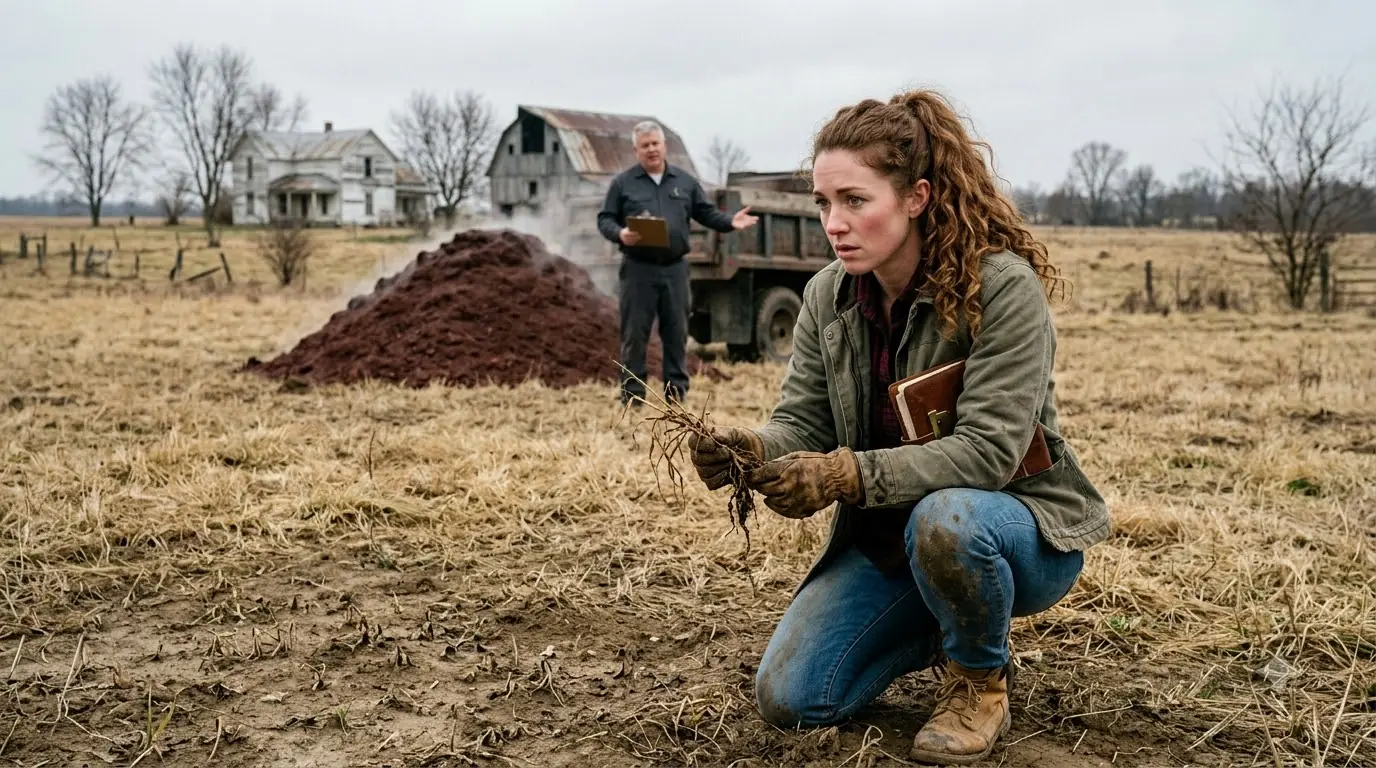
Across the quarter-acre test plot, hundreds of seedlings lay curled against the ground. Only five days earlier, the field had been covered in enough green to make her believe the impossible might actually work.
Now it looked burned.
Behind her, a truck door slammed.
Ruth did not need to turn around.
She knew the walk.
Heavy boots through dead grass. Slow enough to seem casual. Confident enough to assume there was no reason to hurry.
Dale Pressler stopped approximately twenty feet behind her.
“Well,” he said.
Ruth kept examining the plant.
Dale gave a short laugh.
“I suppose sixteen days is longer than I expected.”
Only then did Ruth look over her shoulder.
He stood beside his dump truck wearing a gray work shirt stretched across a heavy stomach, dark trousers, mud-blackened boots, and the smug expression of a man who had arrived hoping to see exactly what he was looking at.
Behind him rose the five-ton pile of dark reddish-brown material he had brought from Pressler Meats.
Blood meal.
Five tons of slaughterhouse waste.
Five tons Ruth had accepted because Dale had offered to pay her two hundred dollars simply for allowing him to dump it on her farm.
Most people in Grayson County had thought she was insane.
Right now, Ruth was beginning to understand why.
Dale looked across the dead rye.
“You ready to admit everybody was right?”
Ruth stood slowly.
At thirty-one, she had the strong, lean build of a woman who had spent most of her adult life carrying feed sacks, climbing tractors, dragging fence wire, and doing work nobody photographed because real farm labor was rarely picturesque.
Her thick auburn hair had been tied into a loose ponytail that morning, though several curls had already escaped around her flushed face.
Mud covered both knees of her jeans.
Her olive canvas jacket smelled like damp soil.
She held the dead plant between two gloved fingers.
“No.”
Dale smiled.
“Those plants look pretty dead.”
“They are.”
“So your grandfather was wrong.”
Ruth’s eyes sharpened.
Dale had been careful during every conversation not to mention Glenn Elkins unless he wanted to provoke her.
This time he had done it deliberately.
Ruth looked down at the dead roots again.
“Grandpa wasn't wrong.”
Dale moved closer.
“Then what killed them?”
Ruth rubbed a pinch of soil between her gloved fingers.
Greasy.
Dense.
Almost airless.
She had spread too much nitrogen-rich material too fast over soil that had already been damaged by decades of tobacco, erosion, compaction, and neglect.
She had known blood meal was strong.
She had not understood how violently dead soil might respond to being overwhelmed with it.
“I did.”
Dale frowned.
“What?”
“I used it wrong.”
His smile returned.
“That sounds like another way of saying it didn't work.”
“No.”
Ruth lifted the dead rye.
“It means the field couldn't breathe.”
Dale snorted.
“You're talking about dirt like it has lungs.”
“It does, in a way.”
“Ruth.”
His voice became almost paternal.
“Your grandfather filled notebooks with ideas because he had more time than money.”
She went still.
Dale continued.
“You have fourteen thousand dollars in debt.”
“A tractor that belongs in a museum.”
“A farmhouse roof that leaks.”
“And now a field full of dead rye.”
He gestured toward the pile.
“You tried.”
“No shame in admitting it.”
Ruth looked at him.
“Why do you care?”
The question changed something in his face.
Only for a second.
Then the smile returned.
“Because I knew Glenn.”
“You knew everybody.”
“True.”
“And I don't enjoy watching his granddaughter ruin what little he left her.”
Ruth almost laughed.
Dale Pressler had never been known for protecting anybody else's inheritance.
His slaughterhouse sat three miles west, beyond a line of sycamores and an abandoned limestone quarry. Pressler Meats had grown from a small family operation into the largest animal processing business in the county.
Dale had money.
Not city money.
County money.
The kind that bought trucks, land, favors, silence, and seats at charity dinners.
Ruth looked at the dead field.
“Thanks for your concern.”
Dale understood the dismissal.
He tapped the clipboard against his leg.
“You still have four and a half tons of that material.”
“I know.”
“If you want me to haul it away, it'll cost you.”