The first thing Judge Kesha Langford noticed was not the patrol car.
It was the shopping bag tearing.
The heavy paper handles gave way as the officer snatched at her wrist, and a pair of carefully boxed shoes, a silk scarf, and a bottle of perfume tumbled onto the pavement beside the open rear hatch of her black SUV.
For half a second, Kesha simply stared at the mess.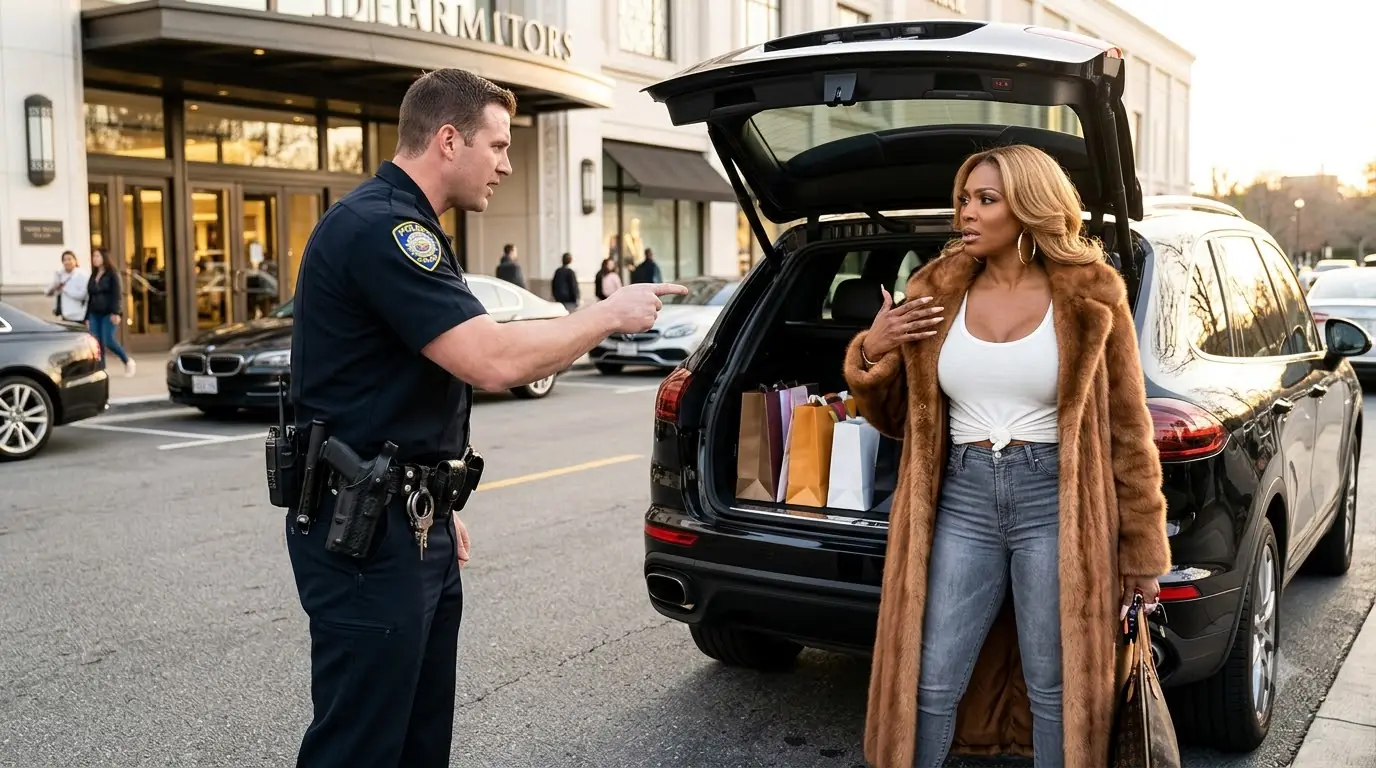
She had spent nearly two hours inside Bellmore Department Store choosing gifts for her mother’s seventieth birthday. The perfume had been the hardest item to find. Her mother had worn the same discontinued fragrance since Kesha was in college, and a sales associate had finally located one unopened bottle in storage.
Now it lay sideways near the officer’s boot.
“What exactly do you think you’re doing?” Kesha asked.
The officer’s jaw tightened.
He was white, late thirties, broad across the shoulders, with short blond hair and the kind of rigid posture that seemed less like discipline than a permanent argument with the world.
His nameplate read:
DANIEL HOLT.
Westbridge Police Department.
Kesha registered the details automatically.
She had spent nineteen years in courtrooms learning to notice what people assumed nobody else noticed.
Hands.
Eyes.
Tone.
Distance.
Sequence.
The officer stood too close.
Not accidentally.
His right hand hovered near the front of his duty belt.
His left held the key fob he had just taken from her.
Behind him, holiday shoppers slowed as they approached the parking structure.
A few pretended not to watch.
Others watched openly.
December wind moved through the concrete garage and lifted the collar of Kesha’s copper-brown fur coat.
She had dressed for her mother’s dinner afterward, not for a police encounter.
White fitted top.
Faded gray-blue jeans.
Heeled boots.
Gold earrings.
Her honey-blonde layered hair had been professionally blown out that morning and now moved softly around her face in the cold air.
Nothing about any of that mattered.
Apparently it mattered to Officer Holt.
He turned the key fob over in his palm.
“This yours?”
Kesha looked at the SUV.
Its rear hatch was open.
Her shopping bags were inside.
Her coat was draped partly over the bumper.
Her purse sat beside them.
“Yes.”
“You sure?”
She looked at him.
There were questions that were questions.
And questions that were accusations disguised as punctuation.
“That is an unusual thing to ask someone actively loading her own vehicle.”
Holt gave a humorless smile.
“Registration.”
“In the glove compartment.”
“Go get it.”
Kesha did not move.
“You just took my keys.”
His smile disappeared.
“Then ask nicely.”
Something inside Kesha went very still.
Not frightened.
Not yet.
Experienced.
She had presided over enough suppression hearings and civil-rights cases to recognize when an interaction had stopped being about information.
“What was the reason for the stop?” she asked.
“You weren’t stopped.”
“Then why are you detaining me?”
“I didn’t say you were detained.”
“You took my keys.”
“Because I’m conducting an investigation.”
“Into what?”
Holt looked toward the vehicle.
“We had reports of suspicious activity.”
“What activity?”
“Vehicle-related.”
Kesha almost laughed.
“Vehicle-related?”
“You want to keep getting smart with me?”
“I want you to identify the legal basis for taking my property.”
That sentence changed him.
Not because of the content.
Because she said legal basis.
Kesha saw the reaction immediately.
His shoulders squared.
His voice sharpened.
“You an attorney?”
She considered lying.
Not because she was ashamed of her position.
Because once people learned she was a federal judge, conversations stopped becoming honest.
Suddenly everyone remembered manners.
Policies.
Cameras.