The storm had swallowed the world.
Beyond the windows of Eli Mercer’s cabin, Wyoming had vanished beneath a furious white darkness. Snow swept across the open prairie in long, slanting sheets, erasing the narrow trail from the county road and burying the fence posts one by one. The wind came down from the mountains with a terrible, hollow moan, rattling the shutters and driving powder through every crack in the old log walls. Somewhere beyond the barn, a loose board banged and banged again, like a fist demanding entrance.
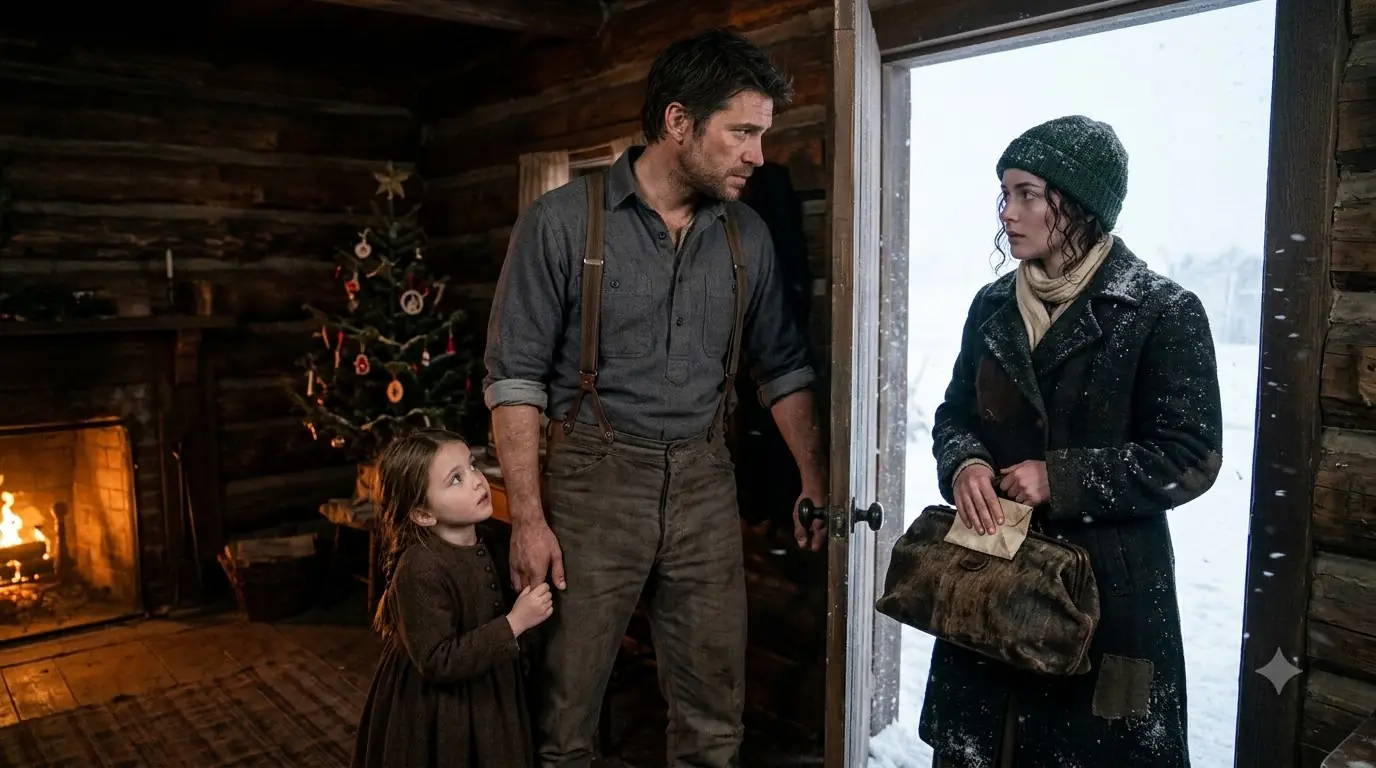
Inside, the fire burned low and golden.
Eli Mercer stood beside the open front door, one hand braced against its heavy timber frame, his broad shoulders blocking much of the warmth from reaching the woman on the threshold. He was thirty-four years old, though the winter had carved deeper lines around his tired hazel eyes than his age deserved. His dark hair, usually combed back before breakfast, had fallen across his forehead. Rough stubble shadowed his jaw, and his charcoal work shirt was rolled to the elbows, exposing forearms browned and strengthened by years of ranch labor. Weathered brown suspenders crossed his chest, holding up the trousers he had worn since dawn.
He had expected a practical arrangement.
A woman who could cook, mend, keep a house, and perhaps, in time, help him raise his daughter. He had expected a sensible face, a firm handshake, and the cautious politeness of two strangers agreeing to make a life together because neither could manage alone.
He had not expected Margaret.
She stood outside in the snow, clutching a battered carpetbag with both hands. Her patched dark coat was stiff with frost, and a cream scarf was wrapped around her neck, though the wind had loosened it until one end whipped against her shoulder. Beneath a snow-covered knit cap, wet dark curls clung to her cheeks. Her pale skin had turned red from the cold, and her brown eyes were bright with exhaustion. Snow had gathered on her lashes, her shoulders, and the narrow brim of the cap.
She looked as though the storm had nearly taken her.
Yet she held his gaze with a dignity that unsettled him more than any pleading might have done.
Behind Eli, a small hand tugged at his suspenders.
“Papa,” his daughter whispered.
He glanced down.
Clara was six years old, small for her age, with soft brown hair tied loosely at the nape of her neck and a solemn face that could become radiant in the space of a breath. She wore a plain brown wool dress, patched at one elbow, and thick stockings that had slipped down around her ankles. She had been watching the stranger since the first knock came through the storm.
“Papa, please let her in—she’s shaking, and Christmas shouldn’t leave people outside.”
Eli’s jaw tightened.
“Clara, go back to the stove.”
“But she’s cold.”
“I can see that.”
“Then let her come in.”
The girl’s fingers curled around his suspenders. Her eyes moved from her father to the woman on the threshold, and something in her expression made Eli feel suddenly, painfully ashamed.
Margaret lifted her chin. Her lips trembled, but her voice remained steady.
“If you still want a wife, I can work, cook, mend, and help raise your little girl… I just ask you not to pity me.”
The words struck him with the force of a slap.
He had been preparing to refuse her. He had rehearsed the explanation on the long ride back from the station: the weather had turned too dangerous, the arrangement had been made under mistaken assumptions, and he could pay for her return journey once the roads were passable. He would be civil. He would not humiliate her. He would make certain she had shelter for the night.
But now, standing before her, he could not bring himself to speak.
He saw the frost on her hair. The trembling she was trying to conceal. The stubborn way she held the carpetbag as if it were the only thing in the world she could trust. And beneath all that, he saw the unmistakable fear of a woman who had traveled a thousand miles and arrived at a door that might close in her face.
He knew that fear.
He had felt it when his wife’s breathing grew shallow and the doctor stopped promising that the fever would break. He had felt it when he stood over a tiny grave in the spring thaw, unable to explain to a child why her mother would not come home. He had felt it every morning afterward, when the cabin seemed too large and too quiet, and every evening when he heard Clara whispering to the empty room.
He had not felt it as a stranger’s responsibility.
Not until now.
“You walked through a Wyoming blizzard to reach my door,” he said, his voice low, “and now I can’t tell whether I should protect my house from you… or open my whole life.”
Margaret’s eyes softened for the briefest instant.
“Then perhaps you ought to ask what I came here for.”
“I thought I knew.”
“So did I.”
She shifted the carpetbag, and the movement revealed a pale, trembling hand beneath the worn leather handle. Her fingers brushed the flap, then slipped inside. Eli’s gaze followed them.
She drew out a sealed envelope.
The paper was yellowed, its edges softened by time and travel. A small blue ribbon had been tied around it, and the wax seal bore the faint impression of a flower.