The youngest girl was barely two years old when she fell into the mud in front of the Willow Creek courthouse.
She did not cry.
That was what made the rancher stop.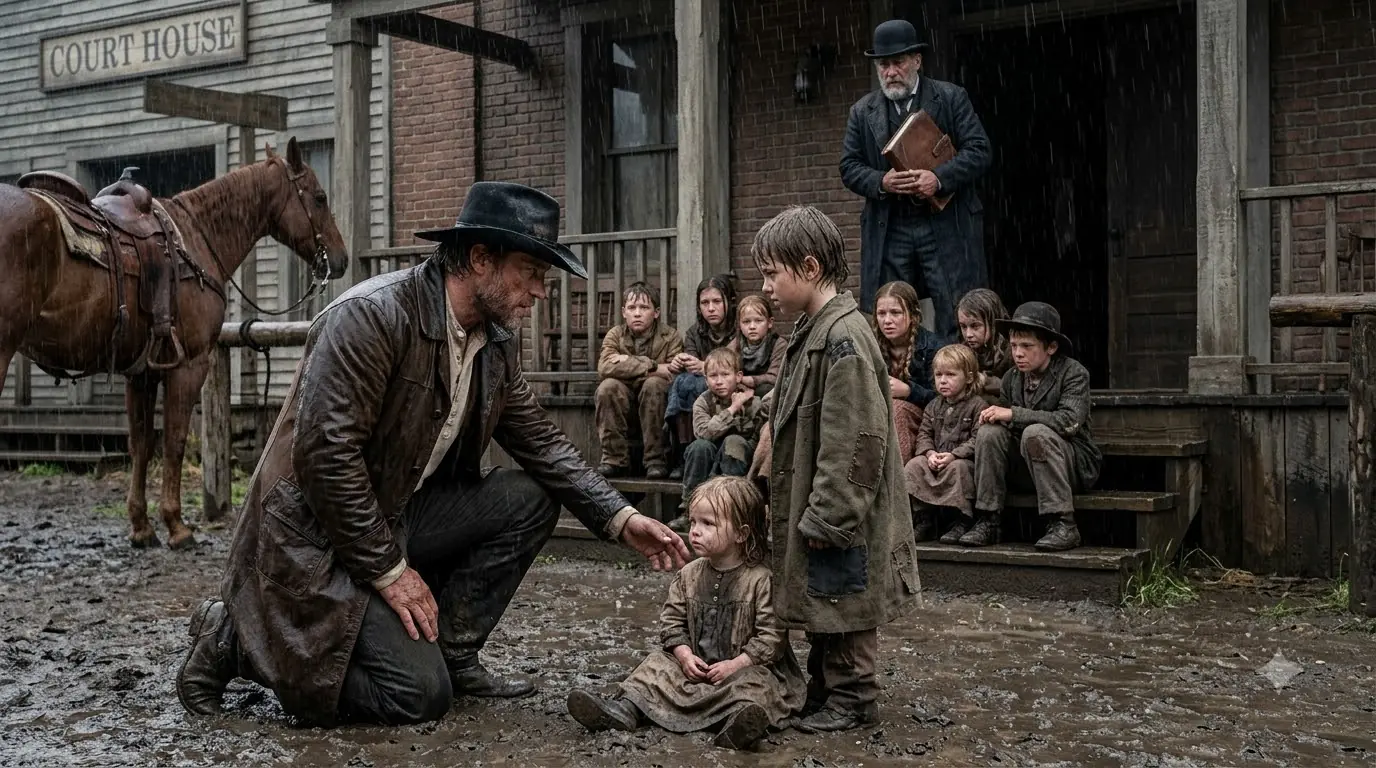
Rain had fallen over northern Montana for three straight days, turning the road through town into two brown rivers divided by a narrow ridge of churned earth. Horses stood beneath awnings with their heads lowered. Wagon wheels sank almost to their hubs near the hitching posts. Shopkeepers kept their doors barely open because every customer carried half the street inside on their boots.
Any sensible person had found a stove.
The rancher had every intention of doing the same.
He had ridden twelve miles through cold rain to sign papers at the livestock office, purchase lamp oil, collect a repaired saddle buckle, and return to his cattle ranch before the creek rose high enough to make the east crossing dangerous.
He was thirty-nine years old, broad-shouldered from twenty years of ranch work, and accustomed to problems that could be solved with fencing wire, patience, money, or a rifle kept nearby for predators.
Children belonged to none of those categories.
That was one reason he had spent nearly ten years arranging his life so that none lived beneath his roof.
Then he saw nine of them on the courthouse steps.
The oldest boy looked about twelve.
Thin.
Wet hair stuck to his forehead.
His coat was too small across the shoulders, and one sleeve had been patched with cloth of a slightly different brown. Yet he stood a half-step in front of the others, feet planted as though he believed a twelve-year-old boy could become a wall simply by wanting it badly enough.
Behind him stood an older girl perhaps eleven.
Then another boy.
Two girls.
Twin boys.
A smaller girl.
And the toddler.
Nine children gathered so tightly that the boundaries between their soaked clothes seemed to disappear.
The rancher noticed them only because the smallest one slipped.