The first thing she noticed was the heat.
Not the officer.
Not the cruiser.
Not even the pressure twisting her right arm high between her shoulder blades.
The heat.
The black hood of the police car had been sitting beneath the late-August sun long enough to turn metal into something close to a stovetop, and when the senior officer shoved her forward, the side of her face struck it hard enough that her cheek seemed to stick there for half a second.
She sucked in a breath.
Hot metal.
Motor oil.
Sun-baked pavement.
Sweat.
Then pain.
“Quit resisting.”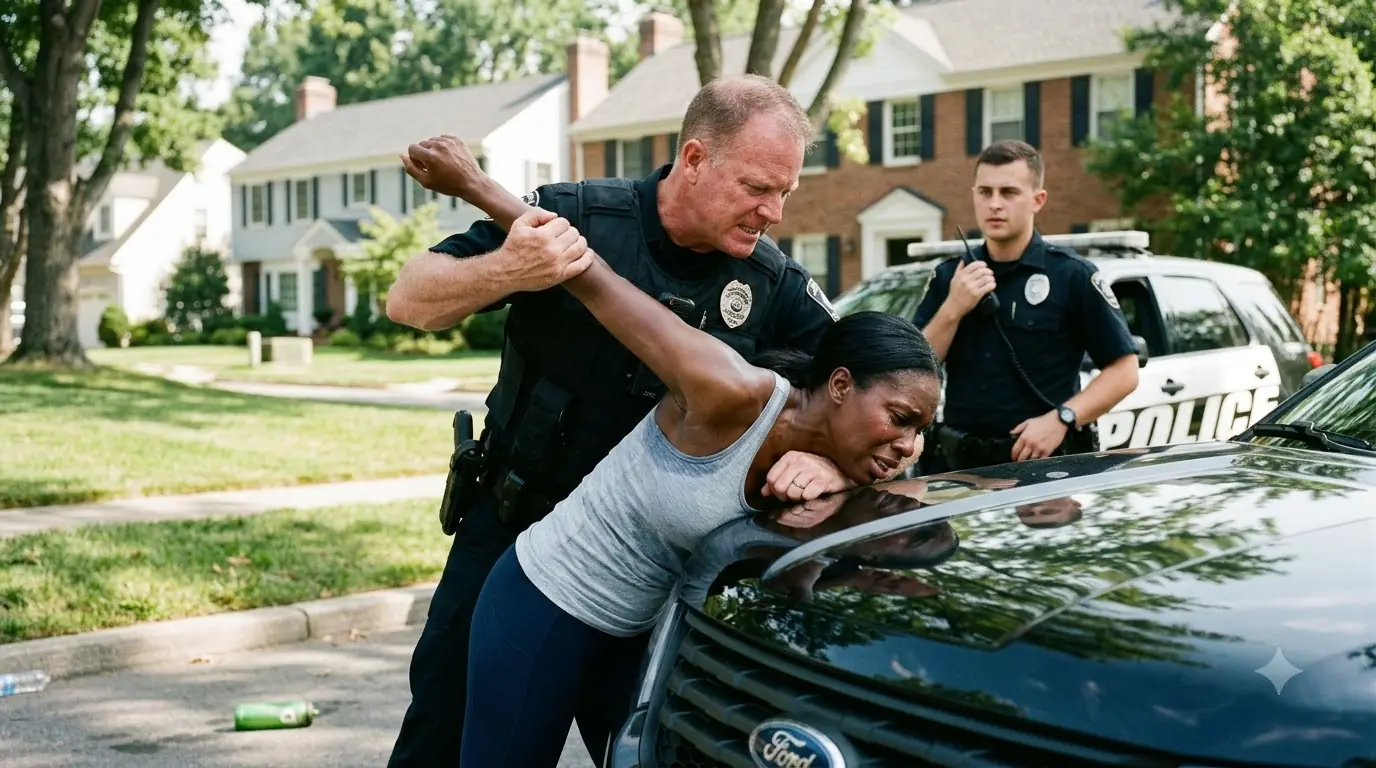
The senior officer’s voice came close to her ear.
She was not resisting.
She knew because she had prosecuted enough use-of-force cases to understand exactly how important that word could become later.
Resisting.
A word that could describe a real physical act.
Or a story somebody needed to tell after force had already been used.
Her right hand was trapped behind her.
The senior officer pushed it higher.
Pain shot through the back of her shoulder.
Her left palm remained flat against the cruiser.
Visible.
Still.
She forced herself to breathe.
“I’m not resisting.”
The senior officer’s knee pressed against the back of her thigh.
“Then stop moving.”
“I’m breathing.”
“Stop talking.”
She closed her eyes.
That was when she heard the younger officer’s radio crackle.
Static.
A dispatcher’s voice.
Then silence again.
The younger officer was standing somewhere behind them.
She could not see him without turning her head, and every time she moved even slightly, the senior officer interpreted it as defiance.
So she stared at the narrow reflection in the cruiser’s windshield instead.
Two uniforms.
One close.
One farther away.
Her own face distorted across curved glass.
Gray tank top.
Dark navy running leggings.
Hair pulled into a low ponytail.
No wallet.
No identification.
No federal credential.
No government phone.
Nothing that would tell these men who she was.
Only a Black woman sweating beside a suburban road.
Three blocks from her house.
Ten minutes earlier, the morning had been ordinary.
She had left home at 7:08.
No headphones.
She rarely wore them while running because she preferred hearing traffic.
The route was familiar: down the hill, right onto Cedar Brook, through the small park beside the elementary school, then back along Hawthorne Avenue.
Four miles if she took the long loop.
Three if humidity became intolerable.
The temperature was already climbing.
She had nearly turned around after the first mile.
Then she passed an older man walking a golden retriever, and pride made her continue.
She smiled at them.
The dog ignored her.
A minute later, a black-and-white patrol cruiser rolled slowly past.
She noticed because she noticed police vehicles everywhere now.
That had nothing to do with fear.
Not then.
It was professional habit.
For six months, she had been leading a federal civil-rights review involving the department that patrolled this exact part of the county.
The investigation had started small.
Three complaints.
Then eleven.
Then twenty-seven.
Most involved allegations that sounded unremarkable when summarized in one sentence.
Traffic stop became argumentative.
Pedestrian refused commands.
Driver attempted to create distance.
Subject became physically resistant.
But when her team began requesting video, something bothered her.
Cameras were often activated late.
Reports used remarkably similar wording.
Complaints from people who did not know each other described nearly identical sequences.
Question.
Escalation.
Command.
Force.
Then “resisting.”
Her office had not accused the department publicly.
Nothing had been filed.