Officer Ryan Keller was not supposed to stop at the house on Alder Creek Drive.
He was not responding to a 911 call. He was not dispatched there. No neighbor had reported a break-in, no alarm company had called, and no frantic voice had told dispatch that someone was hurt inside. At 1:17 in the morning, Ryan was simply driving a slow patrol loop through the north side of Pasadena, California, moving through streets lined with old sycamore trees, quiet ranch-style homes, and porch lights that made every front yard look safer than it really was.
The house at 1836 Alder Creek Drive had one light on.
That was what caught his eye first.
Not because a light at night was strange, but because this one flickered in a rhythm that felt wrong. It came from a large front window, blinking between warm yellow and darkness as if someone inside was moving past it again and again. Ryan slowed the patrol SUV without thinking much of it. Police officers notice small things the way fishermen notice the surface of water. Most ripples mean nothing. A few mean something is moving underneath.
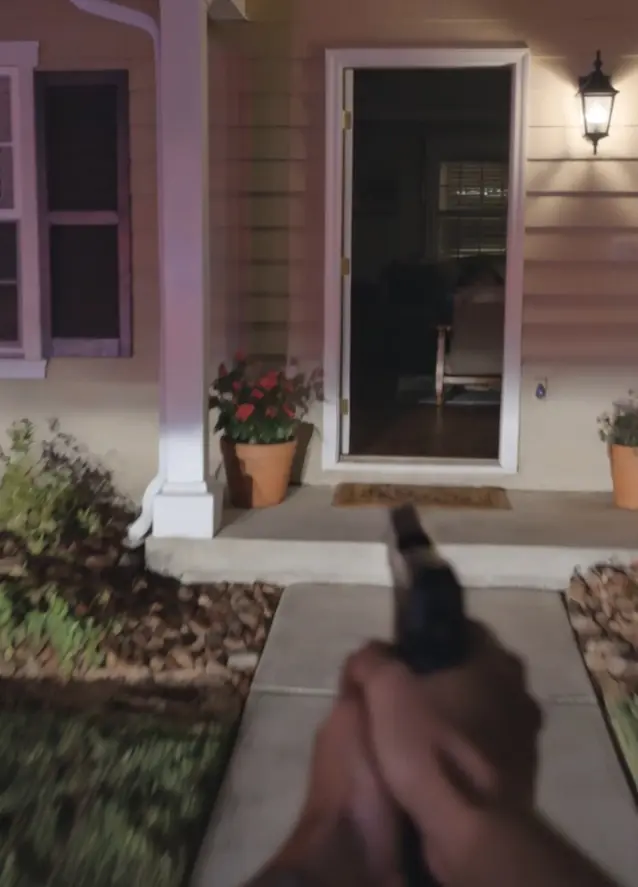
Then he saw a man inside the house drop to the floor.
It happened in the narrow slice of living room visible through the front window. One second, the man was upright, staggering backward with one hand pressed against the wall. The next, his knees folded, his shoulder struck a side table, and his body disappeared below the window line. A lamp fell with him. The flickering light went out.
Ryan hit the brakes.
For half a second, the street was silent except for the ticking engine of his patrol SUV and the low static of the radio. Then he opened his door and stepped out, one hand already on his flashlight, the other moving to his service weapon.
“Dispatch, Unit 31,” he said into his shoulder mic. “I’m at 1836 Alder Creek Drive. I just observed a male collapse inside the residence. Unknown medical or criminal. I’m checking now. Start EMS and another unit.”
Dispatch answered, but Ryan was already moving up the walkway.
The house looked ordinary in every way that mattered. White stucco walls. Dark roof tiles. Two-car garage. A small porch with a potted fern beside the door. A wind chime hung near the entrance, barely moving in the warm night air. A black sedan sat in the driveway, clean and still. No broken windows. No obvious forced entry. No screaming. No running footsteps.
That made it worse.
Violence without noise always felt staged by the time you arrived, as if the house had already swallowed the important sounds.
Ryan reached the front door and tried the handle.
Unlocked.
He drew his weapon, kept it low but ready, and pushed the door open with his boot.
“Police!” he shouted. “Pasadena Police Department! Anyone inside?”
No answer.
The entryway was dark except for the beam of his flashlight. The air smelled faintly of coffee, dust, and something metallic Ryan could not place at first. A set of keys lay on the floor near the entry rug. A pair of men’s reading glasses had been stepped on, one lens cracked. A framed photograph of a little girl in a yellow dress sat crooked on a hallway table, as if someone had grabbed the table to keep from falling.
Ryan moved toward the living room.
The man was on the floor beside the sofa, partly hidden behind a fallen lamp. He was in his mid-fifties, wearing a gray T-shirt and sweatpants, barefoot, one arm tucked beneath his body. His face was pale. His mouth opened and closed as if he were trying to speak but had forgotten how to make sound.
There was no obvious weapon near him.
Ryan kept his flashlight moving across the room before kneeling.
“Sir,” he said. “Can you hear me?”
The man’s eyes shifted toward him.
Alive.
Ryan holstered just enough to check the man quickly while still keeping awareness of the hallway and staircase. The pulse was weak but present. The man’s breathing was shallow. A dark stain spread across the side of his shirt near the ribs, but Ryan avoided staring at it. He had learned that the body on the floor is only half the scene. The person who put him there may still be in the house.
“What’s your name?” Ryan asked.
The man’s lips moved.
Ryan leaned closer.
“Say it again.”
“Elliot,” the man whispered.
“Elliot, help is coming. Who did this?”
The man’s eyes rolled upward.
At first, Ryan thought he was losing consciousness. Then he realized Elliot was looking past him, above him, toward the ceiling.
“Up,” Elliot breathed.
Ryan froze.
A soft thud came from overhead.
Not from the second floor, because the house had no full second floor. From the roof.
Ryan looked up.
Ryan rose, weapon drawn again, flashlight snapping toward the ceiling. The living room had a high angled roofline with a rectangular skylight above the far side of the room. Through the glass, Ryan saw a shape move across the moonlit roof.
A person.
Dressed in black.
Running.
For one impossible second, the figure passed directly over the skylight — black hoodie, black pants, face hidden, one gloved hand touching the roof tile for balance. Then the figure vanished beyond the frame.
Ryan shouted into the radio.
“Dispatch, I have a suspect on the roof. Black clothing, face covered, fleeing across the roofline. I have one injured male inside. Send units now.”
He moved toward the front door, then stopped.
Elliot made a sound behind him.
Not a word. A wet, desperate breath.
Ryan looked back at the man on the floor. Then up again toward the roof.
That was the first decision of the case.
Chase the figure.
Or stay with the victim.
Ryan had been a patrol officer long enough to know that every decision looks obvious to people who arrive after the danger is gone. In the moment, it felt like splitting himself in two. The suspect was getting away. The victim was fading. The roof runner might be the attacker, or might be a second person, or might be bait. Ryan did not know.
He chose the man on the floor.
“Stay with me, Elliot,” he said, dropping beside him again. “You hear me? Stay with me.”
Outside, somewhere above the garage, there was a sharp crack of tile. Then a heavy landing. Then footsteps moving fast along the side of the house.
Ryan stayed down, pressing gauze against Elliot’s wound with one hand while keeping his other hand free. The living room suddenly felt too open, too full of angles. The hallway to the kitchen. The stairs to a small loft storage area. The dark doorway near the back of the house. The roof above him.
Elliot’s fingers grabbed weakly at Ryan’s sleeve.
“Not…” he whispered.
“Not what?”
“Not alone.”
Then his eyes closed.
The first backup unit arrived ninety seconds later.
Officer Melissa Crane came through the front door with her weapon raised, followed by Officer Devon Reed from the side walkway. Ryan directed them quickly.
“Injured male here. Suspect fled roofline toward east side. Black clothing, face covered. Check perimeter. Watch roof access.”
Melissa moved toward the backyard. Devon swept the hallway. EMS staged outside until officers could clear enough of the house. Ryan stayed with Elliot until paramedics entered, knelt, and took over.
The house did not become safer with more people in it.
It became stranger.
There were no obvious signs of a burglary in the living room. No drawers dumped. No television missing. No jewelry boxes opened in plain view. The front door had not been forced. The back door was locked. The windows were closed. Yet a man had been attacked inside, and someone had escaped across the roof like he had entered from above.
The first full sweep found the likely entry point in a small upstairs storage loft over the garage.
The loft had a low ceiling and an access door leading to a crawlspace beneath the roofline. A vent cover near the roof edge had been removed from the outside. Not smashed. Unscrewed. Set aside neatly on the tiles. Inside the crawlspace, insulation had been disturbed, and fresh dust tracked across wooden beams toward a pull-down panel that opened into the loft.
Whoever came in knew where to go.
Or had studied the house.
Detective Lena Ortiz arrived at 2:03 a.m.
She had been with the homicide unit for nine years, though at that point nobody knew if Elliot Vance would live or die. She wore jeans, a dark jacket, and the expression of someone who had been woken from sleep but had left softness at home. She listened to Ryan’s account in the driveway while crime scene technicians photographed the entryway.
“You saw him through the skylight?” she asked.
“Yes.”
“Face?”
“No. Hood up. Dark mask or shadow. I couldn’t see.”
“Build?”
“Average. Maybe male. Moved fast. Comfortable on the roof.”
“Comfortable how?”
Ryan thought about it.
“He didn’t stumble until he hit the garage edge. He knew the slope. Used one hand low on the tiles. Didn’t look like someone panicking on a roof for the first time.”
Lena wrote that down.
Comfortable on roof.
Then she asked about Elliot’s words.
Ryan repeated them carefully.
“Up. Then later, not alone.”
Lena looked toward the house.
“Not alone,” she said.
The phrase would stay at the center of the investigation.
Elliot Vance was identified through his driver’s license and the mail on the kitchen counter. Fifty-six years old. Forensic accountant. Divorced. One adult daughter living in Oregon. No criminal record. No recent police calls to the address. He worked as an independent financial investigator, mostly civil cases involving fraud, estate disputes, and business embezzlement. To neighbors, he was quiet and polite. To attorneys, he was precise and irritating. To people hiding money, he was dangerous.
That became important before sunrise.
At 4:18 a.m., while Elliot was in emergency surgery, Detective Ortiz and her partner, Detective Marcus Hill, found the home office.
It was at the back of the house, behind a sliding pocket door that had been left half open. Unlike the living room, the office had been searched violently. File drawers were pulled open. Paperwork covered the floor. A desktop computer was still on, but the monitor had been cracked. A small fireproof safe sat under the desk, unopened but scratched near the lock. On the wall above the desk were three framed certifications, a calendar, and a corkboard full of notes connected by colored pins.
Lena moved closer to the corkboard.
At first, it looked like a financial case diagram. Names, company titles, addresses, trust accounts, property transfers, shell corporations. One name appeared several times.
HarborLight Guardianship Services.
Another name appeared in a red circle.
Raymond Cole.
Detective Hill looked over her shoulder.
“Fraud case?”
“Maybe.”
“Personal?”
Lena studied the board.
“Maybe both.”
On Elliot’s desk, beneath a stack of folders, they found a handwritten note.
If anything happens, check the roof.
Hill looked at it, then at the ceiling.
“Victim expected this.”
Lena did not answer immediately.
The note changed the case.
It meant the roof was not random. It was part of something Elliot feared before the attack. Either he knew someone might enter that way, or he had hidden something there, or both.
Crime scene technicians returned to the roof after sunrise.
In daylight, the path became clearer.
The suspect had climbed from a side wall to the lower garage roof, crossed to the main roof, removed the vent cover, entered the crawlspace, and moved down into the house through the loft panel. On the way out, he ran across the same route, jumped down to the garage, then dropped into the neighbor’s side yard and disappeared through a back gate.
He left behind three things.
A partial boot print in roof dust near the vent.
A torn piece of black fabric caught on a rough tile edge.
And a small smear of gray roofing sealant on the inside of the crawlspace panel.
The sealant bothered the roof technician assisting investigators. He said it was not from Elliot’s house. The roof had red clay tiles and standard flashing. The gray sealant was a specialized compound used on flat commercial roofs and some solar panel installations.
That made Lena think of Ryan’s first impression.
Comfortable on roof.
At 8:12 a.m., Elliot Vance survived surgery.
Barely.
Doctors said he would not be able to answer questions for some time. He had lost too much blood and suffered a head injury from falling against the side table. But survival changed the emotional temperature of the case. The man on the floor was no longer only a victim. He was a witness waiting to return.
By midmorning, detectives began pulling Elliot’s recent work.
His laptop was damaged, but not destroyed. His cloud accounts were secure behind two-factor authentication. His phone had been smashed in the kitchen, but data recovery was possible. His email showed intense communication with an attorney named Clara Moss, who represented two families suing HarborLight Guardianship Services.
HarborLight claimed to help elderly clients manage property, medical bills, and long-term care decisions.
According to Elliot’s notes, someone inside the company had been moving assets through layered accounts, forcing vulnerable clients to sell homes below market value, and routing profits through related real estate firms. Several elderly clients died with estates far smaller than their families expected. The paperwork looked legal. Elliot believed it was not.
The red-circled name on the board, Raymond Cole, was HarborLight’s founder.
Raymond Cole was wealthy, polished, and very public about charity. He funded senior housing initiatives. He appeared on local panels about elder care. He gave interviews about protecting families from financial abuse while, according to Elliot’s notes, his own company may have been built around it.
That gave the case motive.
It did not yet give them the man on the roof.
The first suspect came too easily.
Raymond Cole had motive to silence Elliot. He also had money to hire someone. His company was under legal pressure. Elliot was scheduled to meet Clara Moss the next morning to deliver a final report. That report, according to emails, contained “the piece they cannot explain.”
Detective Hill wanted to pick Raymond up immediately.
Lena wanted to be careful.
Rich suspects do not make better suspects just because people want them to fall. Evidence still had to walk from the roof to the man.
Raymond’s attorney responded before detectives even reached him. Raymond agreed to an interview but denied any involvement. He was at a private dinner in Newport Beach at the time of the attack, with eight people who could confirm. Security cameras placed him there until nearly midnight. His phone location matched. He had not left early.
“Alibi is strong,” Hill said.
“Too strong?” Lena asked.
“Meaning?”
“Meaning if he hired someone, he made sure he was visible.”
Hill smiled slightly.
“That’s why you don’t sleep.”
Lena did not smile back.
They shifted to the roof angle.
Who had recently worked on Elliot’s house? Who knew the crawlspace? Who knew the roof vent could be removed? Who had access to the property without alarming neighbors?
The answer came from a receipt in the kitchen drawer.
Six weeks before the attack, Elliot had hired a small contractor called Summit Line Solar to inspect roof wiring related to older solar panels installed by a previous owner. The worker assigned to the inspection was named Nolan Price.
Nolan Price was thirty-two. Former roofer. Former solar installer. Two misdemeanor burglary arrests, one dismissed, one reduced. He had experience moving across rooftops at night because, according to an old arrest report, he once stole copper wiring from commercial buildings after hours. He lived in Azusa, drove a dark pickup, and had recently received several cash deposits under $2,000.
When detectives went to his apartment, he was gone.
His girlfriend said he had left before dawn with a backpack and told her not to answer unknown numbers. She said he seemed scared. She also said he came home late the night before with scratches on his forearm and gray sealant on his sleeve.
The search warrant found black clothing in the washer, still damp. A pair of boots with a damaged tread pattern. A roll of black athletic tape. A receipt for prepaid phones. And in the trash, a small piece of red clay roof tile.
The boot print was not a perfect match yet.
It was close enough for a warrant.
Nolan was arrested that evening at a motel near Barstow, trying to pay cash for a room under a false name.
He did not confess at first.
He said he had been with friends. Then he said he had been working late. Then he said he went to Elliot’s house but did not hurt him. That was the first crack.
Detective Ortiz leaned forward.
“You were on the roof.”
Nolan stared at the table.
“You don’t know that.”
“We have the roof. We have the vent. We have your boots. We have your clothes. We have your girlfriend. We have enough to put you there.”
“I didn’t touch him.”
“Then why run?”
“Because a cop came in with a gun.”
Lena watched him carefully.
That detail had not been released publicly.
“What did you go there for?”
Nolan rubbed both hands over his face.
“I was supposed to get a drive.”
“What drive?”
“I don’t know. A little black drive. He said it was hidden near the roof access.”
“Who said?”
Nolan hesitated.
Lena let the silence work.
Finally, he said, “I never met him.”
“Name.”
“I don’t know.”
“You climbed onto a man’s roof in the middle of the night for a stranger?”
“He paid ten grand.”
Hill let out a short laugh.
Nolan looked at him with anger.
“You ever been behind on rent with a kid coming? Ten grand becomes a name.”
Lena said, “How did he contact you?”
“Prepaid phone. Texts only.”
“Why you?”
“He knew I’d been to the house. Knew I knew the roof. Said the owner had stolen something.”
“Did he tell you Elliot would be home?”
“No.”
“Was Elliot alive when you entered?”
Nolan’s face changed.
There it was.
Memory.
“He was standing,” Nolan said quietly.
“Where?”
“In the living room. He saw me come down from the loft. I told him I didn’t want trouble.”
“What happened?”
“He grabbed a lamp. I told him I wasn’t there for him.”
“Then?”
“Someone else came in.”
Lena did not move.
“From where?”
“The front.”
“Who?”
“I don’t know. A man. Older. Not old, but older than me. He knew Elliot.”
“How do you know?”
“Because Elliot said his name.”
“What name?”
Nolan swallowed.
“Ray.”
That put Raymond Cole back in the room.
But Nolan was not done.
“He said, ‘Ray, you brought him here?’ Then they argued. I went back toward the loft because I wasn’t getting in the middle. Then I heard Elliot fall. I looked down and Ray was standing over him.”
“You expect us to believe you left a dying man on the floor?”
“I didn’t know he was dying.”
“You ran over the roof.”
“The cop came in.”
“That officer saved Elliot’s life.”
Nolan looked down.
“I know.”
“Did you get the drive?”
“No.”
That answer came too fast.
Lena noticed.
“Where is it?”
“I said I didn’t get it.”
Lena leaned back.
“Nolan, you are already inside the house. You already ran. You are tied to the scene. If Elliot dies, you are in a murder case. If you hide the thing they attacked him for, you become more useful to the person who paid you than to yourself.”
Nolan said nothing.
So Lena tried another direction.
“Elliot told Officer Keller two words. Not alone.”
Nolan looked up.
“He said that?”
“Yes.”
After a long silence, Nolan said, “I dropped it.”
“What?”
“The drive. I found it in the crawlspace. Then I saw Ray. Then the cop came. I panicked. I dropped it on the roof.”
“Where on the roof?”
“By the chimney.”
The search team returned to the roof at 11:40 p.m.
Near the chimney, wedged under a loose tile, they found a small black flash drive wrapped in electrical tape.
It was the piece they could not explain.
The drive contained a spreadsheet and scanned documents linking HarborLight Guardianship Services to a chain of property transfers. But the most important file was not a spreadsheet. It was a video recorded from Elliot’s office computer three days earlier.
In the video, Elliot sat at his desk speaking to the camera.
“My name is Elliot Vance. If this file is being viewed, it means the material I gathered may have put me in danger. The evidence points not only to HarborLight, but to Raymond Cole personally. He has been using private guardianship arrangements to force distressed property sales, then routing purchases through companies controlled by relatives and former employees.”
He looked tired in the video.
Angry too.
But careful.
“I believe someone accessed my office on March 7. I also believe my roof inspection was not random. The contractor saw the crawlspace. If someone comes for this drive, they may come from above.”
Ryan’s patrol stop flashed through Lena’s mind when she watched that line.
If someone comes for this drive, they may come from above.
Elliot had known.
Not enough to prevent it.
Enough to leave a trail.
Raymond Cole was arrested two days later.
His alibi in Newport Beach remained technically true. He had been at dinner until 11:42 p.m. But Elliot was attacked at 1:17 a.m., and the drive from Newport Beach to Pasadena could be made in under an hour at night. Raymond’s phone stayed at the restaurant because, according to investigators, he left it in the coat of an associate who remained behind. Toll cameras placed a vehicle matching his secondary car near Pasadena shortly before the attack. A neighbor’s camera caught that same car turning onto Alder Creek Drive at 1:08 a.m.
Then there was Nolan’s statement.
And the drive.
And Elliot, who finally woke enough to speak.
The first interview with Elliot was short. Doctors allowed five minutes. Lena and Hill stood beside his hospital bed while Ryan Keller waited in the hallway, not part of the interview but unable to leave until he knew whether the man he had found would remember.
Elliot’s voice was weak, but his mind was clear.
“Ray came in through the front,” he said.
“Was Nolan Price already inside?”
Elliot closed his eyes.
“Yes.”
“Did Nolan hurt you?”
“He scared me. But Ray…” Elliot swallowed carefully. “Ray did it.”
“What did Ray want?”
“The drive.”
“Did he know where it was?”
“No.”
“Did he bring Nolan?”
“Yes.”
“How do you know?”
Elliot turned his head slightly.
“Because I asked him. I said, ‘Ray, you brought him here?’”
That matched Nolan’s account.
Lena asked, “Why did you say not alone to Officer Keller?”
Elliot’s eyes shifted toward the door, where Ryan stood unseen.
“Because I saw the man on the roof. But I wanted him to know there was another one. Downstairs. Someone I knew.”
He paused.
“I was afraid he would chase the wrong man.”
Ryan heard that later from Lena.
For a moment, he said nothing.
All night, he had replayed the decision not to chase the roof runner. Now he understood that staying with Elliot had not only saved his life. It had preserved the first clue that the roof runner was not the whole case.
Raymond Cole’s defense was predictable.
He denied being at the house. Then, when video evidence placed his vehicle nearby, he said he had gone to confront Elliot about “false accusations” but found him already injured. Then, when Nolan’s statement and Elliot’s own testimony contradicted him, he claimed Nolan was lying to reduce his charges and Elliot was confused from trauma.
The problem for Raymond was that rich men often believe complexity protects them.
Sometimes it does.
Not when the simple facts align.
Elliot had predicted the roof entry. Nolan had been hired to enter through the roof. Raymond had motive to retrieve the drive. Raymond’s car was near the house. His phone alibi was false. Nolan knew details only someone inside the house would know. Elliot named him. The drive contained evidence of Raymond’s financial crimes. The roof entry and front entry formed two halves of one plan.
At trial, prosecutors did not present the case as a random home invasion.
They presented it as a failed evidence recovery operation that became an attempted murder when Elliot refused to surrender the drive.
Officer Ryan Keller testified first.
The jury watched his bodycam footage from the moment he stepped into the house. They heard him shout “Police.” They saw the living room flashlight beam shake as he found Elliot on the floor. They heard Elliot whisper “up.” Then they saw Ryan’s camera snap toward the skylight, catching the dark figure moving across the roof for less than two seconds.
It was not a clean image.
It was not dramatic.
It was better than dramatic.
It was real.
The defense tried to suggest Ryan could not know what he saw.
Ryan agreed.
“I could not identify the person by face.”
The defense attorney nodded.
“So when you say someone was on the roof, that is based on a very brief visual impression under stress?”
Ryan looked at the jury.
“It is based on seeing a person run across the skylight, hearing movement on the roof before and after, finding the roof entry point, and later evidence confirming someone entered that way.”
The attorney moved on.
Detective Ortiz testified about the investigation. The roof vent. The boot print. The sealant. Nolan Price. The drive by the chimney. Raymond’s false alibi. Elliot’s video. The financial records.
Nolan testified under a plea agreement.
He was not likable. Prosecutors did not try to make him likable. He admitted taking money to break into a house. He admitted entering from the roof. He admitted running when police arrived. He admitted leaving Elliot on the floor. But he also testified that Raymond Cole had hired him, directed him to the drive, and entered through the front door after Nolan was already inside.
The defense called him a thief.
He said, “Yes.”
A liar.
He said, “Sometimes.”
A coward.
He said, “That night, yes.”
Then the defense asked why the jury should believe him.
Nolan looked toward Elliot, who sat in the courtroom with a cane beside him.
“Because the drive was where I said I dropped it,” Nolan said. “And because Mr. Vance is alive to tell you Ray was there.”
That answer did damage.
But Elliot’s testimony did more.
He walked slowly to the stand with help from a bailiff. He had lost weight. One side of his face still showed faint nerve damage. His voice was softer than in the video, but steady.
He told the jury he had been working on HarborLight for months. He told them he discovered patterns that were too deliberate to be mistakes. He told them he feared someone had accessed his files. He told them he hid the flash drive near the roof because he believed a thief would search the office first.
The prosecutor asked why he wrote, “If anything happens, check the roof.”
Elliot gave a tired smile.
“Because I am paranoid professionally, and that night, it paid off.”
Some jurors smiled.
Then he described the attack.
Hearing the crawlspace panel shift. Seeing Nolan come down from the loft. Grabbing the lamp because he thought he was being robbed. Then hearing the front door open and seeing Raymond Cole step inside as if he owned the house.
The prosecutor asked, “What did you say?”
“I said, ‘Ray, you brought him here?’”
“What did he say?”
“He said, ‘You should have stayed out of other people’s business.’”
The courtroom went still.
“What happened next?”
“He wanted the drive. I said no. He said people like me always think paper makes us brave. Then he hit me.”
Elliot’s daughter began crying quietly in the gallery.
The prosecutor asked, “Do you remember Officer Keller arriving?”
“Pieces.”
“What do you remember?”
“A light. A voice. I remember thinking he was going to chase the roof man.”
“Why did that matter?”
“Because the roof man was not the one I knew.”
Raymond stared straight ahead.
Elliot turned slightly toward the jury.
“I needed him to know there were two.”
The jury convicted Raymond Cole of attempted murder, conspiracy, burglary, assault, and financial crimes tied to the HarborLight scheme. Nolan Price received prison time under his plea, shorter than Raymond’s but not small. HarborLight collapsed under civil and criminal investigations. Families who had been ignored for years finally saw records reopened.
The case became known in local media as the Roof Runner Case.
Ryan hated that name.
It made it sound like the man in black was the center of the story. To him, the center was Elliot on the floor, trying to speak. Or maybe it was the note under the files. Or the drive under the roof tile. Or the moment he decided not to chase and later learned that decision had allowed Elliot’s warning to survive.
Months after the trial, Elliot invited Ryan to the house.
Ryan almost declined. Officers do not usually return to crime scenes for personal closure. But Elliot insisted, and Lena Ortiz told him it might do both of them good.
The house looked different in daylight. Repaired door. New lamp. Fresh paint in the living room. The skylight replaced. The roof vent secured with a visible alarm sensor. Still, Ryan felt the night return when he stepped inside. The fallen lamp. Elliot’s hand gripping his sleeve. The figure crossing overhead.
Elliot walked him to the living room.
“This is where I dropped,” he said.
Ryan said nothing.
Elliot looked up at the skylight.
“And that is where you looked.”
“Yes.”
“You wanted to chase him.”
“I did.”
“But you didn’t.”
“No.”
Elliot nodded.
“Good.”
A simple word.
It landed harder than praise.
Ryan looked at him.
“I keep thinking if I had gone after him—”
“You would have found Nolan faster,” Elliot said. “Maybe.”
Ryan nodded.
“And Ray might have walked out the front while I was on the roof.”
“Maybe.”
“And I might not have told you not alone.”
Ryan took a breath.
“Maybe.”
Elliot looked around the room.
“Police work must be an awful profession for people who like clean answers.”
Ryan smiled faintly.
“It is.”
Elliot handed him a folded copy of the note from his desk.
If anything happens, check the roof.
“I keep the original framed in my office now,” Elliot said. “Makes me look dramatic.”
“You earned dramatic.”
“No. I earned alive.”
They both looked at the skylight again.
The official case file began with Ryan’s observation from the patrol SUV: male subject seen collapsing inside residence. It was a simple line, flat and administrative. It did not capture the heat of the night, the flicker of the lamp, the unlocked door, the weight of the weapon in Ryan’s hand as he stepped inside, or the impossible sight of a man in black running across the roof above him.
But reports are not built to carry everything.
That is why people keep telling the story.
A patrol officer looked through a window and saw a man fall. He entered the house expecting a medical emergency and found the edge of a planned crime. He looked up and saw the person everyone would chase first. But the victim, barely alive, gave him the words that kept the investigation from becoming too simple.
Up.
Not alone.
Those words turned a roof runner into an accomplice, a respected businessman into a mastermind, and a quiet house on Alder Creek Drive into the place where a financial fraud case became attempted murder.
The man in black ran across the roof because he thought darkness and height would make him unreachable.
He was wrong.
The roof kept his footprints.
The crawlspace kept his fibers.
The chimney kept the drive.
The victim kept breathing.
And the officer on the floor kept listening long enough to hear that the person fleeing above him was only half the truth.