A Starving Dog Arrived Too Weak to Stand—and His Bloodwork Revealed an Even Greater Danger
The dog was discovered curled beneath the back steps of an abandoned house.
A property worker initially saw only a patch of dirty brown fur between several broken boards. When he moved closer, the dog opened his eyes but made no attempt to escape.
He was alive, but barely.
His ribs, spine and hip bones were clearly visible beneath his patchy coat. Much of the fur along his legs and abdomen had fallen out, leaving irritated skin, scabs and several open sores.
An empty plastic container was lying nearby, but there was no food or clean water.
The worker contacted a local rescue and remained with the dog until help arrived.
Rescuers began calling him Amos.
Amos tried to stand when they approached, but his front legs folded beneath him. He was wrapped in a blanket and carried to the rescue vehicle because he no longer had enough strength to walk.
At the clinic, Amos was placed directly on the treatment table.
He remained on his side while the medical team checked his breathing, heart rate and temperature. One technician supported his head as another inserted an IV catheter into his front leg.
Amos was severely dehydrated and dangerously underweight.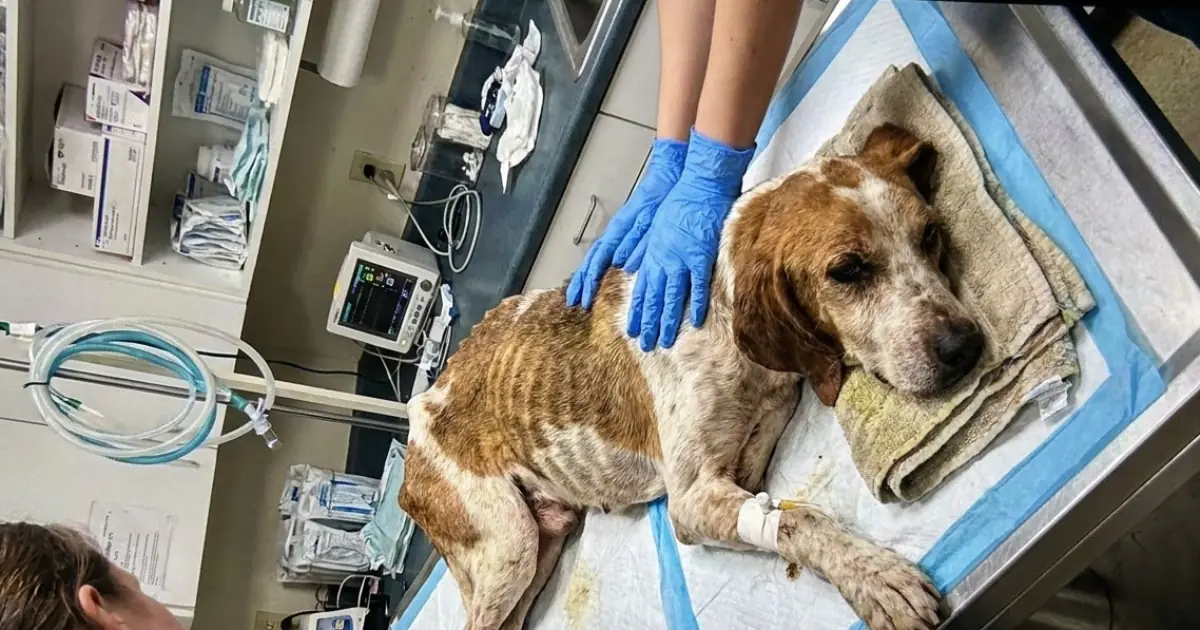
His gums were almost white, his body temperature was low and his heartbeat was weaker than expected. Staff could feel every bone beneath his damaged coat.
But starvation was not the only problem.
Blood tests revealed profound anemia and extremely low protein levels. Amos was also carrying a heavy burden of fleas, ticks and intestinal parasites, all of which had taken more from a body already deprived of nutrition.
Several of the wounds on his skin had become infected.
His abdomen was painful during the examination, and additional testing showed inflammation in his digestive system. Veterinarians worried that his weakened body might not be able to absorb nutrients properly even after food was provided.
Amos needed immediate care, but feeding him too much could also be dangerous.
After prolonged starvation, a sudden large meal can cause severe changes in electrolytes and place additional stress on the heart and other organs. The team created a controlled feeding plan using tiny portions given throughout the day.
During the first feeding, Amos smelled the food and tried to move toward it.
He managed only a few bites before his head dropped back onto the pad.
A technician kept the bowl near his face and allowed him to rest. Several hours later, he ate another small portion.
His wounds were cleaned, and medication was started for pain and infection. Because his skin was so fragile and his temperature remained low, staff could not give him a full bath.
Instead, they used warm cloths to clean one small area at a time.
The first night was critical.
Amos’s blood pressure dropped repeatedly, and his blood sugar required close monitoring. The team administered warmed fluids slowly while watching for signs that his heart or kidneys were struggling.
He slept almost constantly.
Whenever someone opened a food container, however, Amos lifted his nose from the blanket. Even when he could not raise his head, he still reacted to the smell.
By the following morning, his temperature had improved slightly.
His anemia remained serious, but repeat testing showed that his red blood cell count had stopped falling. The veterinary team continued monitoring him while preparing for a possible transfusion if his condition worsened.
Amos ate every measured portion offered that day.
He searched the empty dish after each feeding, but staff had to resist giving him more than his body could safely process.
On his third day, Amos attempted to stand.
His legs shook beneath him, and a technician supported his abdomen with a padded sling. He remained upright for only a few seconds before lowering himself back onto the bedding.
It was still progress.
Treatment for his parasites began in stages. His infected skin required daily cleaning, antibiotics and protective dressings over the deepest sores.
No microchip was found.
The rescue shared Amos’s photograph with nearby shelters and neighborhood groups, but no one came forward to identify him. It remained unclear whether he had been abandoned at the property or had crawled beneath the steps while searching for shelter.
His condition suggested that the neglect had continued for weeks, possibly longer.
Over the following days, Amos became more alert.
He began lifting his head when caregivers entered and could sit upright long enough to finish a meal. His gums slowly regained color, and his digestive system started tolerating slightly larger portions.
One week after his arrival, Amos took his first supported steps outside.
He moved slowly, with the sling carrying much of his weight. After crossing a short section of grass, his legs began trembling and he was carried back inside.
His recovery will take months.
Amos must regain weight gradually, rebuild lost muscle and continue treatment for anemia, parasites, infection and damaged skin. Veterinarians are also monitoring his liver and kidneys for complications caused by prolonged malnutrition.
He is now stable enough to recover in a medical foster home.
Amos still sleeps for much of the day, but he can stand to eat and walk several careful steps without collapsing. New fur has begun growing over some of the bare areas on his body.
No one knows exactly how long he survived without dependable food.
When Amos arrived, the team could not promise that his weakened body would make it through the night. Now, whenever his foster caregiver enters with one of his carefully measured meals, he slowly pushes himself upright and waits beside the bowl.
He is still painfully thin, and the damage caused by neglect has not disappeared.
But Amos is alive—and for the first time in a very long while, he no longer has to wonder when he will eat again.