The little girl's crying stopped the moment her father opened the front door.
Not because she was relieved.
Because she was frightened that the woman standing over her might become even angrier if she made another sound.
"How many times do I have to tell you? Everything in this house isn't yours!"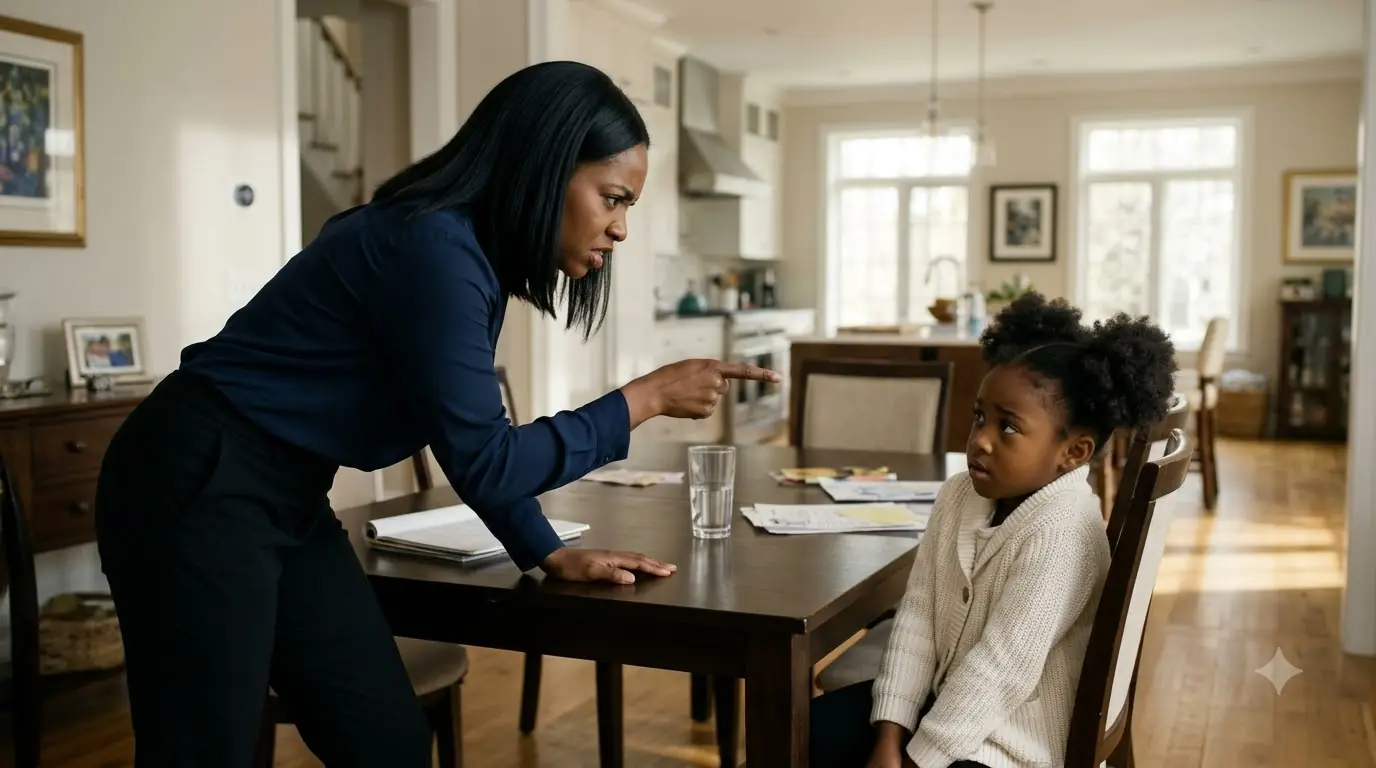
Vanessa's voice cracked through the dining room as she leaned over a tiny five-year-old girl sitting beside an empty plate. Her right hand pointed inches from the child's face, while her left rested against the edge of the wooden table. She was thirty-eight, a beautiful Black American woman with straight, shoulder-length dark hair, wearing an elegant navy-blue blouse and black trousers.
The little girl wore a cream-white knitted cardigan, faded pink leggings, and white socks decorated with tiny yellow flowers. Her natural black hair was gathered into two soft afro puffs, one on each side of her head. Tears ran down her deep-brown cheeks as she pressed one small hand against her face and tried desperately not to make another noise.
Her name was Lily.
She was five years old.
And the only thing she'd asked for was something to eat.
"I didn't take anything," she whispered.
Vanessa straightened, her expression hardening.
"Then why were you standing in front of the pantry?"
Lily looked toward the kitchen doorway.
For a moment, she seemed to consider answering. Then she lowered her eyes and clutched the edge of her cardigan, twisting the soft fabric between trembling fingers.
"Because my tummy hurts."
Vanessa gave a short, impatient laugh.
"Your stomach doesn't hurt. You're just being greedy."
The little girl flinched.
At the far end of the hallway, Marcus stood motionless, still holding his leather briefcase.
He was forty-one, a tall, muscular Black American man with closely cropped hair, a neatly trimmed beard, and the broad shoulders of someone who still found time to exercise despite running a demanding construction engineering company. His charcoal-gray business suit was immaculate, his white shirt remained buttoned neatly at the collar, and his expensive wristwatch showed 3:17 p.m.
He was supposed to be in a client meeting until six.
A sudden cancellation had allowed him to come home early.
He'd been planning to surprise Lily with ice cream.
Instead, he was watching his wife point angrily at his crying daughter.
For several seconds, he didn't move.
He needed to understand what was happening before his anger made the situation worse.
Then Vanessa spoke again.
"Go upstairs. You can wait until dinner like everyone else."
Lily slowly slid from her chair.
Her small feet touched the floor.
She looked toward the kitchen.
Then toward the staircase.
"Please," she whispered. "Just one cracker?"
Vanessa slapped her palm against the table.
"No!"
Lily recoiled.
That was when Marcus finally spoke.
"Vanessa."
His voice was quiet.
But it stopped her immediately.
She turned toward the hallway.
For a fraction of a second, genuine panic crossed her face.
Then her expression changed, and she smiled with the sudden warmth of someone greeting an unexpected guest.
"Marcus! You're home early."
He didn't return the smile.
His eyes remained fixed on Lily.
The child had turned toward him, but she hadn't run forward the way she usually did.
She stood beside the table with one hand against her cheek, staring as though she wasn't certain whether she was allowed to approach.
Marcus placed his briefcase on the floor.
"Lily?"
Her lower lip began trembling.
Then she ran.
He crouched just in time to catch her as she threw both arms around his neck.
"Daddy!"
Her voice broke.
He held her tightly.
"Hey, sweetheart. What's wrong?"
Lily buried her face against his shoulder.
For several seconds, she couldn't answer.
Then she whispered the words that would change the entire course of his afternoon.
"Daddy, I was just hungry."
Marcus closed his eyes.
His daughter was trembling.
He could feel it through the soft cardigan.
He looked over her shoulder toward Vanessa.
"What happened?"
Vanessa folded her arms.
"She was trying to steal food from Mason."
Marcus frowned.
"Steal food?"
"Yes. I told her to wait, but she keeps sneaking into the kitchen and taking things that belong to other people."
He looked down at the little girl.
Lily shook her head against his shoulder.
"I didn't steal."
Marcus rubbed her back.
"Okay, sweetheart. Nobody's saying you're in trouble right now."
Vanessa sighed dramatically.
"Marcus, please don't encourage this."
He looked toward her.
"Encourage what?"
"She knows exactly what she's doing. Every time I establish a rule, she cries until someone gives her what she wants."
Marcus studied his wife's face.
Then glanced toward the empty plate.
"What has she eaten today?"
Vanessa hesitated.
"Breakfast."
"And lunch?"
The woman looked away.
"She wasn't hungry at lunch."
Lily lifted her head.
For the first time, she spoke clearly.
"I was hungry."
Marcus felt something tighten inside his chest.
He looked toward the kitchen clock.
3:19 p.m.
Then back at Vanessa.
"When did she have breakfast?"
"Around seven-thirty."
He stared.
"You're telling me she hasn't eaten since seven-thirty this morning?"
Vanessa raised her hands.
"Don't make this sound dramatic."
Marcus didn't answer.
He carried Lily toward the kitchen, intending to prepare something immediately.
Then he stopped.
The pantry door had a padlock attached to a metal fastening near the handle.
A heavy silver padlock.
Inside his own kitchen.
Marcus stared.
For several seconds, he couldn't make sense of what he was seeing.
Then he turned toward Vanessa.
"Why is there a lock on the pantry?"
She looked irritated.
"Because Lily keeps taking food without asking."
He looked at his daughter.
Her arms tightened around his neck.
Marcus spoke slowly.
"She's five years old."
Vanessa folded her arms.
"And five is old enough to learn boundaries."
He looked toward the locked door again.
Then asked a question so quietly that Vanessa almost didn't hear it.
"Does she have access to food when I'm not home?"
Vanessa's expression changed.
Before she could answer, another voice came from the hallway.
"No, Dad."
Marcus turned.
Twelve-year-old Mason stood near the staircase, wearing a dark-green T-shirt and jeans. He was Vanessa's son from her previous marriage, a thoughtful boy with short black curls, serious brown eyes, and the slightly awkward posture of a child growing faster than he was comfortable with.
Marcus had been raising him for four years.
Mason called him Dad.
And until that moment, Marcus believed the boy was happy.
Now Mason's face looked unusually pale.
Vanessa immediately straightened.
"Mason, go upstairs."
He didn't move.
She pointed toward the staircase.
"I said go."
The boy swallowed.
Then looked directly at Marcus.
"Dad, that's not the worst thing she does when you're at work."
Vanessa went completely still.
For a moment, the kitchen seemed silent except for the low hum of the refrigerator.
Marcus stared at Mason.
Then looked toward Vanessa.
"What does he mean?"
She laughed nervously.
"He's being dramatic."
Mason shook his head.
"No, I'm not."
His voice trembled.
Vanessa took a step toward him.
"Mason, enough."
The boy instinctively moved backward.
Marcus noticed.
That small movement frightened him more than the argument.
Mason wasn't merely nervous about being scolded.
He looked like someone expecting a consequence he knew too well.
Marcus adjusted Lily against his shoulder.
Then stepped between Vanessa and the boy.
"Mason, you can tell me."
The child looked toward his mother.
Then slowly reached into his pocket.
He removed a black smartphone.
His fingers were shaking so badly that he nearly dropped it.
"I recorded something."
Vanessa's face lost all color.
"Mason, give me that phone."
He pulled it closer to his chest.
"No."
She lunged forward.
Marcus immediately moved between them, keeping Lily securely in his arms.
"Stop."
Vanessa halted.
For the first time since he entered the house, she seemed genuinely frightened.
Not embarrassed.
Not irritated.
Terrified.
Mason looked up at Marcus.
His eyes filled with tears.
Then he whispered.
"She doesn't just lock the food, Dad."
Marcus felt his heart pounding.
The boy unlocked the phone.
A video appeared.
The opening frame showed Lily sitting at the same dining table, crying beside an empty plate.
Vanessa's voice could be heard behind the camera.
And the next sentence made Marcus feel as though the floor had disappeared beneath him.
"Look at the camera, Lily. Tell them your daddy never feeds you."
Eight months earlier, Marcus believed his family was finally beginning to heal.
His first wife had died three years before, leaving him alone with their two-year-old daughter and a house that suddenly felt much too large. He remembered the night he returned from the hospital with Lily asleep against his shoulder, walked into the kitchen, and found an unfinished grocery list still attached to the refrigerator with a small purple magnet.
Milk.
Bananas.
Bread.
Lily's favorite yogurt.
His wife had written the list two days before her final hospitalization.
He stood staring at it until his legs became weak.
Then he sat on the kitchen floor, holding his sleeping daughter while crying harder than he had during the funeral.
Marcus had always been a problem solver.
He studied structural engineering, built a successful consulting company, and spent years managing complex construction projects where delays could cost clients millions of dollars. He knew how to make plans, evaluate risks, and assemble teams when something went wrong.
But grief wasn't an engineering problem.
He couldn't calculate a solution.
Couldn't hire someone to fix it.
And couldn't work late enough to make the empty half of his bed feel normal.
For months, he tried to function.
He took Lily to daycare, attended meetings, and returned home before bedtime whenever he could. His older sister helped during difficult weeks, and his mother visited regularly to cook meals and keep the house from becoming another place where grief settled permanently.
Still, Marcus struggled.
There were evenings when Lily asked for her mother, and he had to leave the room for a moment because the sound of her voice broke something inside him.
He tried not to let the child see.
He didn't realize that a small girl could notice sadness even when adults did their best to hide it.
Then Vanessa entered their lives.
Marcus met Vanessa at a community fundraising event.
She was thirty-seven, recently divorced, and raising Mason, then eleven, largely on her own. She worked in administrative operations for a private healthcare company and carried herself with a calm confidence that Marcus found reassuring.
She asked thoughtful questions about his daughter.
She listened when he spoke about his late wife.
And she never seemed uncomfortable when Lily interrupted their conversations to ask her father for help.
During their early dates, Vanessa appeared patient and understanding.
Once, Marcus cancelled dinner because Lily developed a fever.
Vanessa arrived at his house with soup, medicine recommended by the child's pediatrician, and a small stuffed rabbit.
Marcus was touched.
He watched her sit beside Lily's bed and read a picture book while the little girl rested against her pillow.
For the first time in years, he imagined that happiness might return without requiring him to forget the woman he'd lost.
Mason and Lily also seemed to get along.
The older boy enjoyed building toy vehicles and solving puzzles. Lily liked sitting beside him, asking questions about every piece he connected.
He was gentle with her.
When she couldn't pronounce a word, he helped rather than laughing.
When she wanted to play, he occasionally abandoned his video games to build elaborate towers from colorful blocks.
Marcus loved watching them together.
He'd worried that Lily would grow up without the close companionship of siblings.
Now he imagined both children having someone they could depend on.
Vanessa encouraged that hope.
She spoke often about creating a stable home.
About shared meals.
Family traditions.
And the importance of children learning to respect one another.
When Marcus proposed, she cried.
She said she'd never expected to find someone willing to love Mason as his own son.
Marcus embraced her.
"I already do."
He meant it.
He didn't realize that, months later, Mason would be the person who saved Lily from a situation Marcus had been too distracted to recognize.
Their marriage began quietly.
Vanessa and Mason moved into Marcus's spacious home in a comfortable Atlanta suburb. The house had pale exterior walls, wide windows, an open kitchen, and a bright dining room that overlooked a landscaped backyard.
Lily loved showing Mason around.
She took him into the garden.
Pointed out the small birdhouse her father had installed.
And proudly demonstrated how she could ride her bicycle along the driveway with the training wheels removed.
Marcus watched them from the porch.
For several weeks, he felt grateful.
The house no longer seemed painfully silent.
Someone played music in the kitchen.
Mason's school projects appeared on the dining table.
And Lily began asking whether the family could have pancakes every Sunday.
Vanessa took responsibility for many household routines.
She organized grocery deliveries, scheduled appointments, and managed the children's school communications.
Marcus appreciated the help.
His engineering company had recently won a major contract involving several regional medical facilities, and he was spending long hours coordinating construction schedules.
He believed Vanessa enjoyed managing the home.
She said she did.
At dinner, she often described the children as wonderful.
Mason was doing well at school.
Lily was learning new words.
And everyone was adjusting.
Marcus listened.
Then smiled.
He was relieved to hear things were going smoothly.
But gradually, Vanessa's behavior began changing whenever he wasn't home.
It started with small rules.
Lily needed permission before opening the refrigerator.
She couldn't take snacks without asking.
She had to finish cleaning her toys before receiving dessert.
Some structure was ordinary for a five-year-old.
But Vanessa's rules became inconsistent.
Mason could choose a piece of fruit after school.
Lily had to wait.
Mason could pour cereal if he was hungry.
Lily was scolded for touching the box.
When Lily complained, Vanessa accused her of being spoiled.
She claimed Marcus had allowed the girl to develop bad habits after losing her mother.
And because Marcus felt guilty about the grief his daughter experienced, he sometimes believed Vanessa when she said clearer boundaries would help.
He didn't understand that the problem wasn't ordinary household structure.
It was the way Vanessa was using food, attention, and access to comfort as punishment.
The first serious incident occurred on a Monday afternoon.
Lily returned from preschool with a small craft project she'd made using colored paper and cotton balls. She was excited to show her father, but he was attending a meeting in Charlotte and wouldn't return until late.
Vanessa was preparing dinner.
Mason sat at the kitchen island completing mathematics homework.
Lily approached holding her craft.
"Look what I made!"
Vanessa glanced at it.
"Very nice."
The little girl smiled.
"It's a cloud."
Vanessa nodded without turning around.
"Put it on the counter."
Lily placed it carefully beside the fruit bowl.
Then she noticed a small plate of crackers near the refrigerator.
"Can I have one?"
Vanessa looked at her.
"Did I say you could?"
Lily shook her head.
"No."
"Then why are you asking while I'm busy?"
The girl became quiet.
Mason looked up from his homework.
"Mom, she's just hungry."
Vanessa turned.
"Mason, finish your work."
He lowered his eyes.
Lily remained beside the refrigerator.
For several seconds, she stared at the crackers.
Then she whispered.
"Please?"
Vanessa took the plate.
Placed it inside a cupboard.
And shut the door.
"No snacks until dinner."
Lily nodded.
But dinner was delayed.
Vanessa received a phone call, then spent nearly an hour discussing a problem at work.
By the time she returned to the kitchen, Lily was sitting at the table with her head resting on folded arms.
Mason quietly pushed half his sandwich toward her.
She looked grateful.
Then Vanessa walked in.
"What are you doing?"
Mason immediately straightened.
"Nothing."
Vanessa looked at the sandwich.
Then at Lily.
Her expression hardened.
"I told you no snacks."
Lily looked frightened.
"Mason gave it to me."
Vanessa turned toward the boy.
"And you know better."
She removed the sandwich.
Then told Lily to go upstairs.
That evening, Marcus called from Charlotte.
Vanessa answered cheerfully.
"Everything's fine. The children had a wonderful day."
Marcus smiled.
He believed her.
Upstairs, Lily lay awake with her stomach growling.
And Mason sat beside his bedroom door, wondering whether he should tell the man he called Dad what had happened.
He didn't.
Not yet.
Over the following weeks, Vanessa became increasingly concerned with how the family appeared to outsiders.
She wanted the house immaculate when guests visited.
She insisted on coordinated clothing for family photographs.
And she often reminded Marcus how much work it took to manage two children while he traveled.
Marcus appreciated her efforts.
He began sending her messages during the day, thanking her for caring for Lily.
Sometimes he surprised her with flowers.
Other times he arranged weekend trips.
Vanessa enjoyed the attention.
But she also seemed increasingly resentful of Lily.
The little girl asked questions.
Needed help dressing.
Occasionally spilled juice.
And sometimes cried when she missed her mother.
Vanessa interpreted those ordinary needs as deliberate attempts to monopolize Marcus's affection.
One evening, Lily brought a photograph of her mother to the dinner table.
It showed the woman smiling beside a beach umbrella, holding Lily when she was a baby.
The child placed it near her plate.
Vanessa looked at it.
"Why did you bring that downstairs?"
Lily smiled.
"Mommy can eat with us."
Mason looked toward the photograph.
Then smiled gently.
"That's nice."
Vanessa's expression tightened.
She removed the picture.
"Photographs don't belong at the dinner table."
Lily reached toward it.
"Please don't take Mommy."
Vanessa sighed.
"Your mother isn't in the photograph, Lily. It's just a picture."
The girl's eyes filled.
Mason stared at his mother.
For the first time, he felt anger toward her that he didn't know how to express.
Later that night, he returned the photograph to Lily's room.
She was sitting on her bed.
He handed it to her.
The little girl smiled through tears.
"Thank you, Mason."
He nodded.
Then whispered.
"You can keep it under your pillow if you want."
Lily hugged him.
For several seconds, the boy stood awkwardly, unsure what to do.
Then he hugged her back.
And quietly promised himself that he wouldn't let his little stepsister face everything alone.
The pantry lock appeared three weeks before Marcus discovered it.
Vanessa bought it on a Saturday morning while Marcus was attending a construction meeting outside the city. She returned home carrying several household supplies, including cleaning products, storage containers, and a small metal fastening she said would help organize the kitchen. Mason watched her remove it from the bag, but he didn't ask questions.
By Monday, the pantry door was locked.
Vanessa explained that Lily had begun taking snacks without permission and that the lock would prevent unnecessary waste. Mason found the explanation strange because he'd never seen Lily take more than a cracker, a banana, or a small handful of cereal when she was hungry.
He asked whether the lock applied to him too.
Vanessa looked toward him.
"You're old enough to behave responsibly."
Mason frowned.
"She's only five."
His mother stopped what she was doing.
"Exactly. She needs to learn."
The boy stared at the pantry.
Then looked toward Lily, who was sitting on the floor arranging plastic animals beside a toy farmhouse.
She didn't seem to understand why her snacks had suddenly become forbidden.
That afternoon, Mason returned from school and found Lily sitting beside the kitchen doorway.
Her face was pale.
She looked toward him.
"Can you get me an apple?"
Mason opened the refrigerator.
The fruit drawer was nearly empty.
He checked the countertop.
Nothing.
Then he looked toward the pantry.
The lock was closed.
Vanessa was upstairs.
For a moment, Mason considered calling her.
Then he remembered how angry she'd become the last time he questioned the food rules.
He found a yogurt in the refrigerator.
He checked the date.
Then placed it beside Lily with a spoon.
The little girl smiled.
"Thank you."
Mason sat beside her.
He watched her eat quickly.
Then asked whether she'd had lunch.
Lily nodded.
But when he asked what she ate, she couldn't remember.
Mason felt uneasy.
He was twelve, old enough to recognize when something didn't make sense but still young enough to wonder whether adults understood things he didn't.
For several days, he tried to observe quietly.
Sometimes Lily received lunch.
Other times Vanessa told her she'd already eaten enough.
Sometimes she could have fruit.
Other times she was accused of asking for food too often.
There was no consistent rule.
Only Vanessa's mood.
And the uncertainty made Lily increasingly nervous around meals.
Mason began noticing how differently his mother behaved when Marcus was home.
On evenings when Marcus returned early, Vanessa prepared dinner, placed a full plate before Lily, and spoke affectionately about how much the little girl enjoyed helping in the kitchen.
She cut her food into manageable pieces.
Asked about preschool.
And smiled when Marcus praised the meal.
But when he traveled, the atmosphere changed.
Vanessa sometimes delayed meals for hours.
She ignored Lily's requests.
And she became angry whenever Mason offered his stepsister something from his own plate.
The boy couldn't understand why.
At first, he thought his mother was tired.
Then he thought she was stressed about work.
But eventually, he recognized something more troubling.
Vanessa seemed to enjoy deciding when Lily could eat.
The rules changed depending on whether the little girl pleased her.
If Lily cleaned her toys quickly, she might receive a snack.
If she cried for her mother, she could be told to wait.
If she interrupted a phone call, food sometimes became another thing she wasn't allowed to have.
Mason knew something was wrong.
He just didn't know how to make an adult believe him.
One evening, he approached Marcus while the older man was reviewing blueprints in his home office.
"Dad?"
Marcus looked up.
"What's up, buddy?"
Mason hesitated.
"Does Lily eat lunch when you're at work?"
Marcus frowned.
"Of course. Why?"
The boy stared at the floor.
"I was just wondering."
Marcus smiled.
"Vanessa makes sure you both have everything you need."
Mason looked toward the hallway.
His mother was standing near the staircase.
She hadn't said anything.
But she was watching.
The boy swallowed.
Then nodded.
"Okay."
He returned to his room.
That evening, Vanessa entered without knocking.
She closed the door.
Then looked at him.
"What were you asking Marcus?"
Mason sat upright.
"Nothing."
She folded her arms.
"Don't lie."
He looked down.
"I asked about Lily's lunch."
Vanessa's expression became cold.
For several seconds, she studied him.
Then she spoke quietly.
"If you keep trying to make me look bad, you'll ruin this family."
Mason's throat tightened.
He loved Marcus.
Marcus attended his school events, helped him build model airplanes, and had promised to teach him how to drive when he was old enough.
The boy couldn't imagine losing him.
Vanessa seemed to understand that.
She leaned closer.
"Do you want Marcus to leave us?"
Mason shook his head.
"No."
"Then stop causing problems."
She walked out.
And Mason sat on his bed for nearly an hour, wondering whether telling the truth could somehow destroy the only stable family he'd known.
The first recording happened by accident.
Mason had been using his phone to film a model car he'd built for a school technology project. He placed it on a shelf near the dining room so he could capture the wheels moving across the floor.
The phone was still recording when Vanessa entered the kitchen.
Lily followed her.
"Can I have lunch?"
Vanessa sighed.
"You already asked."
Lily stood beside the table.
"My tummy hurts."
"Then drink water."
The girl looked toward the refrigerator.
Mason heard her whisper.
"Can I have my sandwich?"
Vanessa turned.
Her expression changed.
Then she walked toward the dining table and placed an empty plate in front of Lily.
"Sit down."
The child obeyed.
For several seconds, Vanessa studied her.
Then she reached into her pocket and removed her own phone.
Mason was standing near the hallway, partly hidden by the wall.
He watched his mother position the phone against a small decorative stand.
Then she looked toward Lily.
"Tell me why you're crying."
The girl stared at the camera.
"I'm hungry."
Vanessa nodded.
"Who didn't give you lunch?"
Lily looked confused.
For a moment, she glanced toward the pantry.
Then she whispered.
"You."
Vanessa's face hardened.
"No. Listen carefully."
Mason felt a chill move through him.
His mother leaned closer.
"Tell the camera your daddy doesn't feed you."
Lily frowned.
"But Daddy gives me pancakes."
Vanessa's expression changed.
She stopped recording.
For several seconds, she stared at the child.
Then said something Mason would never forget.
"You're making this harder than it needs to be."
Lily began crying.
Vanessa turned the camera on again.
And Mason's phone continued recording from the shelf.
Later, when he reviewed the footage, the boy realized he'd captured the moments before and after his mother's carefully selected video.
He hadn't been trying to investigate her.
But now he had evidence that what she recorded didn't match what actually happened.
Mason watched that first recording three times.
Then he stopped.
His stomach felt strange.
He wanted to believe he'd misunderstood his mother.
Maybe she was making a pretend video.
Maybe she needed the footage for a parenting discussion.
Maybe there was an explanation he hadn't heard.
But none of those possibilities made sense.
Lily was genuinely hungry.
She had been crying.
And Vanessa wanted her to say something about Marcus that wasn't true.
The next afternoon, Mason asked his mother about the video.
Vanessa became angry immediately.
She wanted to know why he had been filming.
He explained that the phone was recording his model car.
She demanded that he delete the clip.
Mason hesitated.
For a moment, he considered obeying.
Then he remembered Lily's face.
He told Vanessa he'd already deleted it.
That wasn't true.
He kept a copy in the protected folder where he stored school projects.
He didn't know whether he'd ever show it to someone.
But he felt he should keep it.
Over the next two weeks, he noticed more recordings.
Vanessa positioned her phone near the dining table.
She sometimes asked Lily the same questions repeatedly.
And she became frustrated when the little girl's answers didn't match what she wanted.
Once, Mason heard her say that the footage would help people understand what kind of father Marcus really was.
The boy didn't understand.
Marcus wasn't perfect.
He worked too much.
Sometimes he forgot small promises.
But he fed Lily when he was home.
He read bedtime stories.
And he always kissed her forehead before leaving for work.
Mason knew that.
So why did his mother want the little girl to say otherwise?
He began keeping notes.
Dates.
Times.
And what he'd personally seen.
He didn't tell Lily to act differently.
He didn't ask her to repeat frightening conversations.
He simply preserved what he observed because he was afraid no one would believe him if he spoke without evidence.
He was twelve.
And he had begun doing the work the adults in the house should have done.
The explanation came through a conversation Mason overheard late one night.
Vanessa was standing in the kitchen speaking to someone on her phone.
Marcus was traveling for work.
Lily was asleep.
Mason came downstairs for water and stopped when he heard his mother's voice.
"I'm telling you, the footage will be enough."
He remained near the hallway.
Vanessa listened.
Then continued.
"He leaves her with me all day. If I can show how distressed she gets, he'll have to negotiate."
For several seconds, Mason stood motionless.
His mother lowered her voice.
"I don't want another six months arguing about money. I want a settlement before he realizes how much leverage I have."
The boy didn't understand every word.
But one phrase frightened him.
Leverage.
He'd heard Marcus use the word during business conversations.
It meant having something another person needed.
Mason looked toward the staircase.
Then heard Vanessa speak again.
"He's terrified of losing that little girl. You know that."
The boy felt his chest tighten.
He knew she was talking about Lily.
Then his mother added.
"If he thinks someone might accuse him of neglect, he'll sign whatever keeps the situation quiet."
Mason stepped backward.
His foot caught against the edge of a rug.
The floor creaked.
Vanessa stopped speaking.
"Who's there?"
Mason froze.
For a moment, he considered answering.
Then he hurried upstairs.
His mother called his name.
He didn't stop.
He reached his bedroom, closed the door, and sat on the floor beside his bed.
His hands were shaking.
Now he understood something he'd been afraid to believe.
His mother wasn't merely punishing Lily.
She was trying to create evidence against Marcus.
And the little girl was being used as part of a plan she couldn't possibly understand.
Vanessa had been preparing to leave the marriage for weeks.
Her relationship with Marcus had deteriorated in ways she rarely acknowledged openly.
She resented his devotion to Lily, complained that his business received too much attention, and believed he controlled more financial resources than she could ever access independently.
At first, she'd hoped the marriage would provide lasting security.
But financial problems from her previous life continued following her.
A failed investment.
Outstanding personal debts.
And several expensive obligations she'd hidden before the wedding.
Marcus knew she had ordinary financial responsibilities.
He didn't know their full extent.
Vanessa feared that if she disclosed everything, he would begin asking questions about her judgment and the money she spent.
So she began exploring what she might receive if the marriage ended.
She contacted a private divorce-planning consultant recommended by an acquaintance.
The consultant wasn't a lawyer and couldn't make legal determinations, but advertised services involving financial organization and separation planning.
During their discussions, Vanessa described Marcus as wealthy, emotionally distant, and constantly traveling.
She claimed she was the primary caregiver for both children.
The consultant advised her to preserve records of her responsibilities and obtain proper legal advice before making decisions.
But Vanessa became fixated on one particular possibility.
If she could convince Marcus that his parenting might be questioned, she believed he would be willing to pay a large settlement to avoid a public dispute.
She began collecting selective photographs.
Screenshots of Marcus's travel schedule.
Messages showing he returned home late.
And videos of Lily crying.
In some of those videos, the little girl was genuinely distressed because Vanessa had denied her food or comfort.
But Vanessa intended to describe the distress as evidence that Marcus had neglected his daughter.
She wasn't documenting the child's actual experience.
She was constructing a story.
And when ordinary footage didn't support that story, she began directing Lily to say things that weren't true.
The most revealing video was recorded four days before Marcus came home early.
Mason had been helping Lily assemble a wooden puzzle in the living room.
Vanessa entered and told Lily she needed to practice answering questions.
Mason looked up.
"What questions?"
His mother gave him a cold look.
"Adult questions."
Then she turned toward Lily.
"If someone asks whether Daddy leaves you hungry, what do you say?"
Lily frowned.
"Daddy gives me food."
Vanessa sighed.
"No, Lily. Think about today."
The child looked confused.
For a moment, she glanced toward Mason.
He could see she wanted help.
Vanessa continued.
"You were hungry today, weren't you?"
Lily nodded.
"And Daddy wasn't here."
Another nod.
"Then tell the camera Daddy left you hungry."
The little girl began twisting her cardigan.
For several seconds, she seemed uncertain.
Then she whispered.
"But you were here."
Vanessa's expression hardened.
Mason stood.
"Mom, stop."
She turned toward him.
"What?"
"She's not understanding because it's not true."
For a moment, Vanessa looked shocked.
Then she stepped closer.
"You are twelve years old. You don't get to tell me how to handle my family."
Mason swallowed.
"Lily's my family too."
That made Vanessa angrier.
She ordered him upstairs.
When he hesitated, she threatened to take his phone and cancel a school trip he'd been looking forward to for months.
Mason left.
But he didn't go far.
He stopped in the hallway, frightened and angry.
Then he heard Lily crying again.
Later, he wrote down what happened.
He also preserved a short recording showing his mother telling Lily to blame Marcus for food she was deliberately withholding.
That was the video he would eventually show his stepfather.
And by then, he had begun understanding that silence wouldn't protect anyone.
It would only give his mother more time.
Now, standing in the dining room with Lily in his arms, Marcus understood that the video on Mason's phone wasn't an isolated moment.
He looked at Vanessa.
She stood near the pantry, her beautiful face tense, one hand resting against the back of a chair.
For several seconds, no one spoke.
Then Marcus turned toward Mason.
"Is there more?"
The boy nodded.
"A lot."
Vanessa stepped forward.
"Marcus, you cannot seriously believe a twelve-year-old's interpretation of private family conversations."
Marcus didn't answer her.
He looked toward the boy.
"Before you show me anything else, I need to take care of Lily."
Mason nodded immediately.
Marcus carried his daughter toward the refrigerator. There were eggs, fruit, bread, yogurt, and other food available outside the locked pantry, so he didn't need to spend time arguing about the key. He took out a yogurt and a banana, then asked Lily whether she'd like something more substantial after she'd had a chance to settle.
The little girl looked toward Vanessa.
Marcus noticed.
"Sweetheart, you can answer me."
Lily whispered.
"Can I really eat it?"
He felt tears gathering.
"Yes."
She looked at the yogurt.
Then toward her stepmother again.
For a moment, Vanessa seemed ready to speak.
Marcus raised his hand.
"Please don't."
His voice remained controlled, but the boundary was unmistakable.
He carried Lily to the breakfast table and sat beside her while she began eating.
She held the spoon carefully.
At first, she took tiny bites.
Then she became more comfortable.
Marcus watched.
He didn't rush her.
Didn't ask her to explain herself while she ate.
And didn't make her feel as though accepting food required proving she'd been mistreated.
After several minutes, Lily looked up.
"Daddy?"
"Yeah, sweetheart?"
"Am I bad?"
The question struck him harder than anything he'd heard since coming home.
He leaned closer.
"No."
She studied his face.
"But Vanessa says bad girls take food."
Marcus took a slow breath.
"Needing food doesn't make you bad. Asking an adult for food doesn't make you bad either."
Lily looked toward her bowl.
Then whispered.
"I was trying to be good."
He gently brushed a loose curl away from her forehead.
"I know you were."
For several seconds, he sat quietly beside her.
He could hear Vanessa moving around the kitchen behind him.
But he wasn't going to let another argument interrupt Lily's meal.
When Lily finished, Marcus asked Mason to sit with her in the living room while he made several calls.
He didn't ask the boy to supervise a dangerous situation or take responsibility for his sister's safety. He simply wanted the children together somewhere comfortable while he arranged for another trusted adult to come to the house.
His first call was to his older sister.
She lived fifteen minutes away and had been a constant presence in Lily's life since the girl's mother died.
Marcus explained that he'd discovered serious concerns involving Vanessa's treatment of the children and needed his sister to come immediately.
Her voice changed.
"Are they safe right now?"
"Yes. I'm with them."
"Is anyone hurt?"
"No obvious injuries. But Lily hasn't been getting meals properly, and Mason has evidence of other things."
His sister didn't hesitate.
"I'm coming."
Marcus thanked her.
Then he contacted Lily's pediatrician's office to explain the concern about missed meals and ongoing emotional distress. He was advised on obtaining prompt medical assessment and what symptoms would require urgent care.
He arranged an appointment.
After that, he contacted the appropriate child-protection reporting service to describe what he'd observed and ask for guidance.
He didn't want the matter handled solely as a marital disagreement.
Lily was five.
Mason was twelve.
And both children had described being frightened in their own home.
The situation needed attention independent of his relationship with Vanessa.
When he finished the calls, he returned to the kitchen.
Vanessa stood with her arms folded.
"You called your sister?"
"Yes."
Her expression darkened.
"You're involving the entire family in something you don't understand."
Marcus looked at her.
"I understand that Lily was hungry, the food was locked away, and Mason recorded you telling her to make false statements about me."
Vanessa shook her head.
"You're twisting everything."
He remained calm.
"Then we'll preserve the full recordings and let the appropriate professionals examine what happened."
For a moment, she stared at him.
Then she glanced toward the living room.
"Give me Mason's phone."
Marcus shook his head.
"No."
Her face reddened.
"He's my son."
"I know."
"Then I have a right to his phone."
Marcus looked toward the child sitting on the sofa beside Lily.
Then back at Vanessa.
"You're not taking evidence from him while we're trying to understand what happened."
Vanessa opened her mouth.
For a moment, she seemed ready to shout.
Then she stopped.
The doorbell rang.
Marcus's sister had arrived.
His sister entered the living room and immediately crouched beside Lily.
The little girl ran into her arms.
For several seconds, she clung to the older woman's shoulders.
Marcus watched from the doorway.
He remembered how his sister helped after his first wife's death.
How she cooked meals, folded laundry, and sat beside him during nights when Lily wouldn't stop asking why Mommy wasn't coming home.
Now she was here again.
But the situation was different.
His daughter wasn't grieving a loss she couldn't understand.
She had been living with an adult who deliberately made her feel unsafe.
Marcus's sister looked toward Mason.
The boy stood awkwardly beside the sofa.
She opened one arm.
"Come here, sweetheart."
He hesitated.
Then moved toward her.
She hugged him too.
For a moment, his shoulders shook.
Then he began crying.
Marcus looked away briefly, trying to steady himself.
Mason had spent weeks believing that telling the truth would destroy the family.
Now he'd finally spoken.
And the fear he'd been carrying seemed almost too large for his twelve-year-old body.
When the children settled, Marcus's sister took them into the family room.
She prepared a quiet activity, offered water, and made sure neither child was being questioned repeatedly.
Marcus appreciated that.
He wanted the children to feel safe before anyone asked them to describe painful experiences.
Then his sister returned to the kitchen.
She looked toward the pantry lock.
For several seconds, she remained still.
Then she turned toward Marcus.
"How long has that been there?"
He shook his head.
"I don't know."
She looked at him.
There was sadness in her eyes.
And a question she didn't need to ask aloud.
How had he missed it?
Marcus lowered his head.
"I should've known."
His sister touched his arm.
"You need to focus on what happens now."
He nodded.
She glanced toward the living room.
"Those children need you to be steady."
Marcus looked toward Mason.
The boy was helping Lily arrange colored blocks.
For a moment, the scene appeared ordinary.
Then Marcus remembered the video.
His daughter's tears.
Vanessa's instructions.
And the way Mason looked frightened when his mother demanded his phone.
He took a slow breath.
Then asked his sister to remain with the children while he spoke with his attorney.
Marcus's family attorney had handled his late wife's estate and several personal legal matters.
The lawyer knew the household structure.
He knew that Marcus was Lily's father and that Mason was Vanessa's biological son.
He also knew Marcus had made financial arrangements intended to protect Lily's future after her mother's death.
When Marcus described the incident, the attorney became serious.
He advised Marcus to preserve the recordings, avoid altering messages or files, and cooperate with the child-protection and medical processes already underway.
He also recommended that Marcus obtain legal advice concerning separation and the children's immediate living arrangements.
The attorney didn't promise that a video automatically proved every allegation.
Nor did he suggest Marcus could resolve Mason's situation simply by deciding the boy should remain in the house.
Mason's legal relationship to Marcus was different from Lily's.
That required careful handling.
But the lawyer made one point clear.
The children should not be placed back into a situation where they were being pressured or punished for reporting concerns.
Marcus understood.
He arranged for Vanessa to stay elsewhere temporarily while the immediate concerns were assessed, with the details handled through legal advice and any necessary protective measures.
Vanessa initially refused.
She accused him of trying to throw her out of her own home.
Then she threatened to call the police and claim he was preventing her from seeing Mason.
Marcus didn't argue about her rights in the kitchen.
He told her the situation needed to be handled through the appropriate authorities and legal procedures.
He wasn't going to physically force her out.
He also wasn't going to allow her to intimidate the children while everyone tried to determine what had happened.
Vanessa stared at him.
For several seconds, her expression shifted between anger and calculation.
Then she asked something that made his stomach tighten.
"Have you checked your email today?"
Marcus frowned.
"Why?"
She gave a thin smile.
"Maybe you should."
Then she turned toward the hallway.
And Marcus realized that the recording Mason showed him might not be the only thing Vanessa had prepared.
The email had arrived at 2:41 p.m.
Thirty-six minutes before Marcus walked through the front door.
It came from a legal office he'd never worked with before.
The subject line read Confidential Family Resolution Proposal.
Marcus opened it while sitting in his home office.
At first, he thought it was a routine notice concerning Vanessa's intention to separate.
Then he reached the second page.
The document alleged that Marcus had neglected his parental responsibilities, left Lily without adequate supervision, and created an unstable home environment through excessive business travel.
It referenced photographs, witness statements, and videos supposedly documenting the girl's distress.
Marcus stared.
The allegations were presented as Vanessa's claims, not as findings by a court or child-protection authority.
But the implications were serious.
The proposal demanded a financial settlement, exclusive use of the marital home for a defined period, and an arrangement that would position Vanessa as Lily's primary daily caregiver while Marcus's parenting practices were reviewed.
The requested payment was enormous.
One million two hundred thousand dollars.
Marcus read the number twice.
Then looked toward the attached supporting summary.
It referred to Lily repeatedly saying her father failed to provide food.
His hands became cold.
He recognized the words.
They were the same false statements Vanessa had tried to make Lily repeat on camera.
The document also referred to Mason as a witness who could corroborate the household conditions.
Marcus felt his heart pounding.
He looked toward the hallway.
Mason was helping Lily with her blocks.
The boy had been terrified to tell the truth.
Yet Vanessa's proposal described him as supporting her allegations.
Marcus opened the attached witness summary.
At the bottom was Mason's name.
Beneath it appeared a digital signature.
Marcus stared.
Then quietly called his attorney.
"There's something else you need to see."
For several seconds, he struggled to speak.
Finally, he said.
"The document says Mason signed a statement against me."
The lawyer asked whether Mason had actually signed anything.
Marcus looked toward the living room.
"I don't think so."
Then he added.
"And if he didn't, somebody used his name."
Marcus asked Mason about the statement later that evening, after his attorney advised him how to approach the subject without making the child feel responsible for a legal dispute.
They sat in the living room with Marcus's sister nearby.
Lily was resting on the sofa beneath a soft blanket, watching an animated film. She'd eaten a light meal, and Marcus had arranged for her medical appointment. She appeared more comfortable, though she continued glancing toward the kitchen whenever someone mentioned food.
Mason sat opposite Marcus, holding a glass of water.
For several seconds, Marcus studied him.
Then he spoke gently.
"Buddy, I saw a document with your name on it."
The boy frowned.
"What document?"
"It says you witnessed things about Lily and that you agree with what your mom wrote."
Mason's expression changed.
He looked frightened.
"I didn't write anything."
Marcus nodded.
"Okay."
The boy leaned forward.
"Did she say I did?"
Marcus took a slow breath.
"Your name appears on a statement. I'm trying to understand whether you knew about it."
Mason shook his head quickly.
"No."
He looked toward the hallway.
Then continued.
"She asked me to sign something on her tablet last week."
Marcus became still.
"What did she tell you it was?"
"A school form."
Mason looked down.
"She said she needed my signature so I could go on the science trip."
Marcus felt a chill.
The boy continued.
"I wrote my name with the little pen thing. But I didn't read anything about Lily."
For several seconds, Marcus couldn't speak.
Then he looked toward his sister.
Her expression was grim.
Marcus returned his attention to Mason.
"Thank you for telling me."
The boy's eyes filled.
"Am I in trouble?"
Marcus shook his head.
"No."
Mason swallowed.
Then asked the question he'd clearly been holding back.
"Is Mom going to say I lied?"
Marcus leaned forward.
"I don't know what she'll say. But you don't need to change your answer to make anyone happy. Just tell the truth about what you remember."
Mason nodded.
Then he looked toward Lily.
For a moment, his expression softened.
"She doesn't know how to lie like Mom wanted."
Marcus looked at him.
"What do you mean?"
The boy hesitated.
Then answered.
"Lily kept saying you feed her when you're home."
Marcus felt his eyes sting.
Mason continued.
"Mom would get angry because it ruined the video."
For a moment, nobody spoke.
Then Mason looked down at his hands.
"I thought if I kept enough of the real recordings, somebody would believe us."
Marcus moved beside him.
He didn't know what words could possibly make up for the burden the boy had carried.
So he put one arm around Mason.
And the child leaned against him, crying quietly.
The next morning, Marcus brought Lily to her pediatrician.
The doctor was a calm, experienced Black American woman in her fifties who had known the family since Lily was born. She remembered the girl's mother and had helped Marcus navigate difficult conversations about grief after her death.
Marcus explained that he'd discovered repeated restrictions on Lily's access to food and troubling behavior by her stepmother.
The doctor listened.
Then she examined Lily with care.
She assessed her general condition, discussed her recent eating patterns, and asked developmentally appropriate questions without turning the appointment into an interrogation.
Lily was shy.
At first, she held Marcus's hand tightly and barely answered.
The doctor let her take her time.
Then she offered crayons and paper.
Lily began drawing.
While she worked, the doctor asked what foods she liked.
The child smiled faintly.
"Pancakes."
The doctor nodded.
"Those are good. Anything else?"
"Bananas."
"Anything you don't like?"
Lily considered.
Then whispered.
"Being hungry."
Marcus felt his throat tighten.
The doctor didn't react with shock.
She simply acknowledged the child's answer and continued gently.
She explained to Marcus that the immediate medical examination was only one part of evaluating what had happened. She recommended appropriate follow-up and emphasized the importance of restoring predictable, supportive mealtimes without making Lily feel punished, pressured, or responsible for adult conflict.
Marcus listened carefully.
He asked questions.
Then he made notes.
He wanted to do the right things without accidentally turning every meal into another frightening event.
Before leaving, Lily looked toward the doctor.
"Can I have crackers at home?"
The doctor smiled.
"You can ask your dad for something to eat when you're hungry."
Lily looked toward Marcus.
He nodded.
"Absolutely."
The little girl smiled for the first time that morning.
It was small.
But it mattered.
The child-protection assessment began through the appropriate local process.
Marcus cooperated.
He provided the initial account, the preserved recordings, and the information about the pantry lock and missed meals. He also explained the proposed legal document that appeared to use Mason's signature without his understanding.
The professionals involved treated the children separately and carefully.
They didn't assume every statement made by an adult was true.
They didn't treat a single video as proof of every allegation.
And they understood that children could be frightened, confused, or concerned about consequences when discussing someone they loved.
Marcus respected the process.
He wanted the truth established.
Not a quick verdict driven by his anger toward Vanessa.
Lily was offered an opportunity to speak with an appropriate professional in a child-sensitive setting.
Mason also received support.
The adults worked to avoid making the boy repeat his story unnecessarily.
He'd already spent too much time feeling responsible for protecting Lily.
Now trained people needed to carry that responsibility.
Vanessa was contacted through the appropriate channels and given opportunities to respond.
She denied deliberately neglecting Lily.
She claimed the food restrictions were part of an effort to manage the child's behavior.
She also insisted the videos were intended to document concerns about Marcus's availability.
But the full recordings raised questions she couldn't easily explain.
They showed Vanessa directing Lily to make statements about her father.
They showed the little girl repeatedly correcting those statements.
And they showed food being withheld while the recordings were created.
The documentation didn't support the story Vanessa had prepared.
Instead, it demonstrated that the child had been placed in distress and then encouraged to misidentify the cause.
The difference mattered.
It turned the videos from supposed evidence against Marcus into evidence requiring investigation of Vanessa's own conduct.
The independent family-law review of the settlement proposal produced another important finding.
The document had been prepared from information Vanessa supplied to the consultant and a legal office she later approached. The legal office had not independently verified the factual allegations, and the proposal had not been approved by a court or any child-protection agency.
When Marcus's attorney provided the original recordings and disputed Mason's supposed signature, the office began examining the supporting material.
The signature was particularly concerning.
It appeared that an image captured during an unrelated tablet interaction had been inserted into a witness form bearing Mason's name.
The boy had been told he was signing something for school.
The legal document described him as endorsing allegations about his stepfather.
Those were not the same thing.
Marcus's attorney arranged for the discrepancy to be documented and addressed through the proper process.
Vanessa's explanation changed more than once.
At first, she claimed Mason had understood the statement.
Then she suggested the paperwork had been assembled incorrectly.
Later, she argued that the boy's observations still supported her claims even if the signature process was defective.
But Mason's actual account contradicted the allegations.
He hadn't said Marcus refused to feed Lily.
He'd said Vanessa was withholding food and trying to make Lily blame Marcus.
The full video supported that account.
For several days, Marcus struggled with the thought that the boy he'd raised as his own could have been used as an unwilling witness against him.
It wasn't the financial demand that hurt most.
It was the willingness to place a twelve-year-old in a position where his signature could be used to support a story he didn't believe.
Marcus thought about Mason sitting on the floor of his bedroom, frightened that speaking up would destroy his family.
And he realized how close the boy had come to being trapped inside a lie he hadn't created.
The financial motive became clearer as Marcus's attorneys reviewed the separation proposal and Vanessa's available disclosures.
Her personal debts were substantially greater than Marcus knew.
A previous business venture had failed.
Several credit accounts were overdue.
And she had been relying on increasingly expensive borrowing to cover obligations she'd concealed throughout the marriage.
Those problems didn't automatically establish fraud.
People could experience financial difficulty without doing anything unlawful.
But the combination of hidden debt, a large settlement demand, and knowingly misleading material concerning Lily raised serious concerns.
Vanessa had spoken about needing financial security.
She believed Marcus's wealth would allow her to negotiate a substantial separation settlement.
And she seemed to think that threatening allegations concerning his parenting would make him more willing to agree quickly.
The children's distress had become part of that pressure.
Marcus found the idea unbearable.
He could understand fear about money.
He knew people sometimes made desperate decisions when debts accumulated.
But he couldn't understand looking at a five-year-old child, refusing her food, then using her tears as evidence against the person responsible for her care.
He met with his attorney.
For several minutes, he reviewed the documents silently.
Then he looked up.
"I don't want to buy her silence."
The attorney nodded.
"We'll address the financial issues through the proper process."
Marcus looked toward the proposed settlement figure.
One million two hundred thousand dollars.
The number was large.
But he knew he would've paid far more than that if a legitimate medical emergency required saving Lily's life.
Money wasn't the central problem.
It was the idea that someone believed his love for his daughter could be used to force him into accepting falsehoods.
He closed the folder.
Then said quietly.
"I want the children protected. Everything else comes after that."
Marcus's sister helped him understand how much had been hidden during ordinary family routines.
She remembered several occasions when Lily visited and ate unusually large snacks, then seemed anxious about whether she was allowed more.
At the time, she'd assumed the child was experiencing a growth spurt or had simply been active that morning.
She also remembered Vanessa declining invitations for Lily to spend time with relatives, saying the little girl needed stricter routines.
Marcus's sister had been disappointed.
But she hadn't challenged the decisions.
Now she wondered whether Vanessa had been trying to keep Lily away from adults who might notice the food restrictions.
Marcus listened without blaming her.
He had missed more obvious signs himself.
The preschool teacher added another piece of the picture.
She explained that Lily had become noticeably anxious around snack time.
The girl sometimes asked whether she could take leftover food home.
At first, the staff assumed she wanted a treat for later.
Then she began apologizing whenever she requested a second serving.
The teacher contacted the household.
Vanessa responded that the family was working on behavioral boundaries and that the child had developed a habit of asking for food unnecessarily.
The teacher remained concerned.
She documented the observations and continued monitoring Lily's well-being.
Marcus hadn't received the earlier communication because Vanessa managed the household school account.
When he learned that, he felt a painful mixture of anger and regret.
There had been adults trying to raise concerns.
But he hadn't been receiving the information.
He immediately arranged for direct communication with the preschool and confirmed that concerns about Lily's care should reach him through a verified contact method.
Then he reviewed his own work schedule.
There were dozens of meetings he'd attended in person when he could have delegated some responsibilities.
Business trips he'd extended because he wanted to meet one more client.
Evenings when he'd stayed at the office because returning to a quiet home still stirred memories of his late wife.
For years, he'd told himself he was working hard to give Lily a good future.
Now he understood that a good future couldn't compensate for a present in which she felt unseen.
Mason's situation proved especially difficult.
He loved his mother.
He also loved Marcus and Lily.
Before the recordings were discovered, he'd believed telling the truth might force him to choose between them forever. Now adults were making decisions about living arrangements, legal responsibilities, and his access to the people he considered family.
Marcus refused to treat the boy as a witness whose usefulness ended once the videos were preserved.
He'd helped raise Mason.
He attended his school events, taught him to repair bicycles, and sat beside him through nights when homework seemed impossible.
That relationship mattered.
But Marcus also understood that being a loving stepfather didn't automatically give him the same legal authority he possessed as Lily's biological father.
Mason's other parent and extended family had to be considered through the proper process.
With guidance from the professionals involved, the family arranged for Mason to stay temporarily with his maternal aunt while the situation was assessed. She lived nearby, knew both children well, and was willing to provide a stable environment without pressuring the boy to change his account.
Marcus remained in contact under arrangements approved by the adults responsible for Mason.
He called regularly.
Sometimes they discussed school.
Other times they talked about basketball, science projects, or a model airplane Mason wanted to build.
During one call, Mason became unusually quiet.
Marcus noticed.
"Everything okay, buddy?"
The boy hesitated.
Then asked.
"Are you still my dad?"
Marcus felt his chest tighten.
He took a slow breath.
"I've loved being your stepdad, Mason, and that hasn't changed."
The boy remained silent.
Marcus continued.
"The adults have to work out the legal arrangements, but I still care about you. You don't lose that because you told the truth."
For several seconds, Mason didn't answer.
Then Marcus heard him crying softly.
He wished he could reach through the phone and hold the boy.
Instead, he stayed on the line.
He didn't rush Mason to stop crying.
Didn't tell him to be strong.
And didn't promise an outcome he couldn't control.
He simply remained available until the boy felt ready to talk.
Then they spent twenty minutes discussing the model airplane.
It was a small conversation.
But afterward, Marcus sat alone in his office and realized that Mason had been asking a question no twelve-year-old should need to ask.
Whether being honest could cost him a parent's love.
Lily gradually began feeling safer around food.
At first, the change was slow.
She still looked toward the pantry before asking for something.
Sometimes she ate quickly, as though a plate might disappear if she waited too long.
Other times she said she wasn't hungry, then returned minutes later asking whether she could have a snack.
Marcus worked with her pediatrician and a child therapist to create predictable, supportive routines.
Meals happened regularly.
Appropriate snacks were available.
And Lily wasn't required to perform good behavior to earn basic food.
The first weekend after Vanessa left, Marcus removed the padlock from the pantry door.
He didn't make Lily watch.
He simply restored ordinary access to the kitchen while keeping household safety arrangements appropriate for a young child.
Then he prepared lunch.
Grilled chicken.
Rice.
And the small pieces of cucumber Lily liked dipping into yogurt.
She sat at the table wearing her cream-white cardigan.
For several minutes, she watched him move between the counter and the stove.
Then she asked.
"Daddy?"
He turned.
"Yeah?"
"Are you going to lock it again?"
He stopped.
For a moment, he looked toward the pantry.
Then back at her.
"No, sweetheart."
She studied his face.
"What if I want crackers?"
He smiled gently.
"You can ask me for crackers."
She considered that.
Then asked.
"What if I'm hungry before dinner?"
Marcus moved beside her.
"Then we'll find you something appropriate to eat. You don't have to be afraid to tell me."
Lily looked down at her hands.
For several seconds, she seemed uncertain.
Then she whispered.
"Okay."
Marcus kissed the top of her head.
And returned to preparing lunch.
He wanted to believe the conversation had solved something.
But he knew rebuilding her sense of safety would require the same answer again and again.
Not one dramatic promise.
A hundred ordinary moments in which she asked for help and received it without fear.
Vanessa's conduct was addressed through separate legal and child-protection processes.
The full recordings, documentation, medical observations, and witness information were reviewed by the appropriate people. Her attempts to construct misleading evidence against Marcus became part of the inquiry, as did the disputed use of Mason's signature and the circumstances surrounding the proposed financial settlement.
There was no immediate theatrical courtroom scene in which everyone stood and applauded.
The process involved interviews.
Records.
Legal arguments.
And difficult decisions about the children's safety.
Vanessa was allowed to respond to the allegations.
Some of her explanations changed as additional documentation emerged.
She acknowledged restricting Lily's access to certain foods, but disputed the characterization of her intentions. She also claimed she believed Marcus's absences justified documenting concerns about the household.
The unedited recordings remained troubling.
They showed a child being encouraged to repeat statements that contradicted her actual experience.
They showed food being withheld as part of an effort to create distress.
And they showed Mason attempting to intervene.
The professionals involved treated those facts seriously.
Marcus followed the guidance and applicable orders concerning Lily's care.
He also cooperated with arrangements designed to protect Mason without making the boy responsible for the legal decisions.
The separation continued.
The financial proposal Vanessa had initially made wasn't accepted.
Any legitimate marital financial issues were considered independently of the fabricated or disputed allegations concerning Lily.
Marcus didn't attempt to avoid the process through threats or private payments.
He wanted the facts documented.
He wanted the children protected.
And he wanted any future arrangements to be based on their actual needs rather than the story Vanessa had tried to manufacture.
Several months later, Vanessa wrote a letter to Marcus.
It arrived through her attorney.
She described the pressure she felt trying to manage a blended household while hiding her financial problems. She admitted that she'd grown resentful of the attention Marcus gave Lily and that she'd begun treating ordinary childhood needs as evidence of disobedience.
She wrote that she feared losing financial stability if the marriage ended.
And she'd allowed that fear to shape decisions that harmed the children.
Marcus read the letter slowly.
For a moment, he remembered the woman he'd met at the charity event.
The warm smile.
The thoughtful questions about his daughter.
And the stuffed rabbit she brought when Lily was sick.
He wondered how much of that kindness had been genuine.
Perhaps some of it was.
People could behave compassionately in one season of life and cruelly in another.
That didn't change the harm.
It also didn't mean her financial anxiety excused what she did.
He reached the final paragraph.
Vanessa wrote that she was sorry for making Lily afraid of food and for pressuring Mason to support a false story.
She didn't ask Marcus to ignore the evidence.
But she expressed regret.
He placed the letter on his desk.
For several minutes, he looked out of the window.
Then he called his attorney.
He asked that the correspondence be handled through the ongoing process and that any future communication concerning the children be guided by their safety and professional recommendations.
He didn't write a dramatic response.
Didn't announce that he'd forgiven everything.
And didn't use the apology as an excuse to stop paying attention.
He had learned how easily reassuring words could conceal troubling actions.
From now on, he wanted conduct to matter more than promises.
The following spring, Lily began attending a new kindergarten program.
Marcus met her teacher before the first day and explained, in an age-appropriate and confidential way, that his daughter had experienced stressful food-related restrictions at home and might need extra reassurance during snack and lunch periods.
The teacher listened carefully.
She didn't treat Lily as fragile or unusual.
She simply helped establish clear routines and communicated directly with Marcus when concerns arose.
For the first few weeks, Lily remained nervous.
She sometimes asked whether she was allowed to finish her snack.
Occasionally, she saved part of her lunch because she wasn't sure whether she'd be hungry later.
The teacher responded calmly, following the agreed support plan.
Over time, Lily began relaxing.
She made friends.
Enjoyed drawing animals.
And became particularly interested in a small classroom garden where students grew flowers and vegetables in raised beds.
One afternoon, she returned home carrying a drawing of a tomato plant.
Marcus was waiting near the front door.
"What's that, sweetheart?"
Lily smiled.
"We're growing food!"
He laughed softly.
"That's wonderful."
She held up the paper.
"When the tomatoes are ready, everybody gets some."
Marcus felt something warm move through his chest.
He looked at the bright red tomatoes she'd drawn.
Then at his daughter.
"That sounds like a good plan."
She nodded enthusiastically.
"Even if someone forgets their lunch."
For a moment, Marcus couldn't speak.
Then he crouched beside her.
"Especially then."
Lily smiled.
And hurried inside to put her drawing on the refrigerator.
By the time summer arrived, the house had begun feeling different.
Not because Marcus redecorated it.
The furniture remained mostly the same, and the pale curtains still moved gently in the afternoon breeze. The dining table stood beneath the same ceiling light, and the kitchen pantry occupied the same corner beside the refrigerator.
But the atmosphere had changed.
Lily no longer became silent whenever someone entered the kitchen. She asked for snacks, laughed over breakfast, and sometimes complained that Marcus made his pancakes too thick.
Marcus welcomed the complaints.
They were ordinary.
And ordinary was something he'd once taken for granted.
His work life changed too.
He appointed a senior project director to handle more of the routine travel associated with his company. He began reviewing which meetings genuinely required his presence and which could be managed by other qualified employees.
He still worked hard.
His company still had deadlines.
And difficult projects didn't disappear because he became more attentive at home.
But Marcus stopped treating every additional business opportunity as more important than being present for his daughter.
He adjusted his schedule to attend school events.
Protected time for family dinners.
And checked directly with teachers and caregivers rather than assuming that silence meant everything was fine.
He also began spending time with a counselor himself.
The conversations weren't always comfortable.
He had to confront the way grief had influenced his decisions after his first wife's death.
He'd wanted Lily to have a motherly presence so badly that he'd sometimes dismissed signs suggesting the new arrangement wasn't working.
He'd interpreted his daughter's quietness as adjustment.
And Vanessa's confidence as competence.
Those assumptions hadn't caused Vanessa's misconduct.
She was responsible for her own choices.
But Marcus needed to understand why he'd failed to recognize the warning signs sooner.
He couldn't change the past.
He could change how he responded to his daughter in the future.
Mason continued visiting through arrangements worked out with the responsible adults.
He was thirteen by then, taller and more confident, though the events of the previous year still affected him.
He remained close to Lily.
Whenever they met, she ran toward him with the enthusiasm of a little sister who believed her older brother knew how to fix almost anything.
They built model cars.
Played board games.
And watched animated movies while arguing about which character was the funniest.
Marcus never asked Mason to discuss the recordings during their visits.
He didn't want the boy's relationship with the family to revolve around evidence.
Mason deserved to be more than the child who exposed his mother's behavior.
He was a student.
A brother.
A boy who loved basketball and sometimes forgot to finish his homework because he became absorbed in building miniature airplanes.
One Saturday, they worked together on a wooden model in the dining room.
Lily sat nearby coloring a picture of a purple butterfly.
Marcus helped Mason fit two pieces of the model's wing together.
For several minutes, they worked quietly.
Then Mason looked toward the kitchen.
"Dad?"
Marcus turned.
"Yeah?"
"Can I ask you something?"
"Of course."
The boy hesitated.
"Do you ever wish I hadn't recorded it?"
Marcus became still.
For a moment, he studied Mason's face.
Then he set down the wooden wing.
"No."
Mason looked uncertain.
"Even though everything got so complicated?"
Marcus nodded.
"Even then."
The boy stared at the table.
For several seconds, he seemed to be thinking carefully.
Then he whispered.
"I thought it would be easier if I just deleted everything."
Marcus felt his chest tighten.
He understood why.
Mason had been frightened of his mother.
Afraid of losing Marcus.
And worried that Lily would suffer more if the adults discovered he'd been recording.
He'd carried a burden far beyond what any child should have been responsible for.
Marcus leaned closer.
"You shouldn't have needed to collect evidence to feel heard."
Mason looked up.
Marcus continued.
"I'm grateful you spoke. But I wish an adult had noticed and helped before you had to."
For a moment, Mason's eyes filled.
Then he smiled faintly.
"Me too."
Marcus put one arm around him.
They sat together quietly.
A few minutes later, Lily approached carrying her drawing.
"Look!"
The butterfly had enormous purple wings and a bright-yellow body.
Mason grinned.
"That's awesome."
Lily smiled proudly.
Then asked whether he wanted to help draw the flowers.
The boy laughed.
"Sure."
And just like that, the afternoon returned to something ordinary.
A brother helping his little sister with a picture.
A father sitting beside them.
And a house where nobody was afraid to ask a simple question.
The first anniversary of the department-store-style confrontation at the dining table passed without a celebration.
Marcus didn't want to turn the day into an annual reminder of Lily's fear.
But he remembered.
He remembered every detail.
The empty plate.
Vanessa's navy-blue blouse.
Lily pressing one hand against her tear-covered cheek.
The padlock on the pantry.
And Mason standing beside the staircase with his phone.
For months, Marcus had replayed the scene in his mind, wondering what would've happened if his meeting hadn't been cancelled.
If he'd returned at six instead of three.
If Mason hadn't recorded anything.
Or if Lily had stopped telling people she was hungry because she believed asking would only lead to punishment.
Those questions frightened him.
But his counselor encouraged him to distinguish useful reflection from endless self-punishment.
Marcus couldn't protect Lily by repeatedly imagining the worst possible outcomes.
He could protect her by remaining attentive now.
So on that Saturday, he made pancakes.
Lily helped stir the batter.
She wore a pale-yellow shirt and an apron decorated with little strawberries.
Marcus placed a bowl of sliced bananas beside the mixing bowl.
Then asked whether she wanted to help arrange them on the plates.
Lily nodded enthusiastically.
They worked together.
A few minutes later, she looked toward the pantry.
"Daddy?"
Marcus turned.
"Yes?"
"Can I get the cinnamon?"
He smiled.
"Of course. It's on the middle shelf."
Lily hurried toward the pantry.
She opened the door.
Reached for the small container.
Then returned to the kitchen island.
There was no hesitation.
No frightened glance.
No waiting for permission beyond an ordinary question about helping prepare breakfast.
Marcus watched her.
For a moment, he felt his eyes sting.
The child who once begged for one cracker was now confidently reaching into the pantry to help make pancakes.
It was such a small moment.
But he knew how much had changed for her to feel safe doing it.
Lily noticed his expression.
"Why are you smiling?"
Marcus laughed softly.
"Because I'm happy."
She grinned.
"Because of pancakes?"
He nodded.
"Partly."
She considered that.
Then sprinkled far too much cinnamon onto one pancake.
Marcus laughed.
Lily laughed too.
And the kitchen filled with a sound he hadn't heard often enough during the previous year.
Carefree happiness.
Later that afternoon, Marcus took Lily to visit her mother's grave.
It wasn't an anniversary.
No special date required the visit.
Lily had simply asked whether she could bring flowers.
Marcus agreed.
They stopped at a small florist and selected white daisies and purple carnations.
Lily carried the bouquet carefully during the drive.
At the cemetery, they walked along a quiet path beneath tall trees.
The afternoon was warm.
Birds moved between branches.
And the grass had been recently cut.
Lily stood beside her mother's headstone.
For several seconds, she remained silent.
Then she placed the flowers gently near the base.
"Hi, Mommy."
Marcus felt his throat tighten.
He stood nearby.
Lily looked at the photograph attached to the memorial.
Then smiled faintly.
"I'm going to kindergarten."
For a moment, she seemed pleased simply to say the words aloud.
Then she continued.
"I can write my whole name now."
Marcus watched.
His daughter wasn't looking for an answer.
She was sharing something important with the mother she missed.
After a while, Lily turned toward him.
"Daddy?"
"Yeah, sweetheart?"
"Did Mommy know Mason?"
Marcus shook his head gently.
"No. Mason became part of our lives later."
Lily looked thoughtful.
Then said.
"I think she would've liked him."
Marcus smiled.
"I think so too."
For several seconds, they stood quietly.
Then Lily asked another question.
"Does Mommy know I'm okay now?"
Marcus took a slow breath.
He didn't pretend to know exactly what happened after death.
Instead, he answered in a way that honored what he knew about her mother.
"Your mommy loved you very much. And if she could see how brave and kind you're becoming, she'd be proud."
Lily smiled.
Then reached for his hand.
They remained beside the flowers for several minutes.
And Marcus remembered the promise he'd made during his wife's final days.
To protect their daughter.
To let her grow.
And to make sure she always knew she was loved.
He hadn't kept that promise perfectly.
But he was keeping it now.
The most important change happened on an ordinary Thursday evening.
Marcus was preparing dinner when Lily entered the kitchen carrying a small stuffed rabbit.
She looked up at him.
"Daddy, I'm hungry."
The words were simple.
Five syllables.
The kind of sentence children said in kitchens every day.
Marcus turned from the stove.
He smiled.
"Okay, sweetheart. Dinner's almost ready. Would you like some apple slices while we finish?"
Lily nodded.
"Yes, please."
He washed an apple, prepared it for her, and placed it in a small bowl.
She climbed onto her chair.
Then began eating.
For several minutes, Marcus continued cooking while Lily told him about a game she'd played at school.
She was excited.
Her teacher had chosen her to help hand out drawing paper.
A classmate had shared a purple crayon.
And someone had accidentally knocked over a container of colored pencils, making the entire class laugh.
Marcus listened.
He asked questions.
Then Lily looked toward him.
"Daddy?"
He turned.
"Yeah?"
"You're not mad?"
Marcus frowned gently.
"About what?"
She held up a piece of apple.
"That I asked for food."
For a moment, the entire kitchen seemed still.
Marcus looked at his daughter.
Her face was open and curious.
She wasn't trembling.
She wasn't crying.
But somewhere inside her memory remained the belief that hunger could make an adult angry.
He set down the cooking spoon.
Then crouched beside her.
"No, Lily."
She studied his face.
He continued.
"You can tell me when you're hungry. You can tell me when you're sad, tired, frightened, or upset. You never have to hide those things to make me happy."
The little girl thought about that.
Then nodded.
"Okay."
Marcus smiled.
He kissed her forehead.
Then returned to the stove.
Lily took another piece of apple.
And began telling him about the purple crayon again.
The moment passed.
But Marcus knew he'd remember it.
Because healing didn't always arrive with dramatic speeches or courtroom decisions.
Sometimes it appeared when a child asked for food and no longer expected to be punished for it.
A few weeks later, Mason joined them for Sunday dinner.
He arrived carrying a school science project he'd spent several weeks completing.
Marcus helped him place it safely on the side table while Lily examined the miniature bridge with enormous curiosity.
"Did you build that?"
Mason nodded.
"Yeah."
Lily touched the edge carefully.
"It's cool."
He grinned.
"Thanks."
Marcus looked at the structure.
The model was made from lightweight wooden pieces arranged into a truss bridge, with carefully measured supports and a small platform beneath it.
He was impressed.
"What made you choose this design?"
Mason immediately began explaining.
He described load distribution, support members, and how he'd tested several arrangements before selecting the final version.
Marcus listened with genuine interest.
He asked questions.
Then helped the boy review how to present the project clearly at school.
For nearly an hour, the three of them worked together.
Lily occasionally interrupted with questions that had little to do with engineering.
Mason answered patiently.
Marcus smiled.
The boy who once stood terrified near the staircase was now explaining his work confidently at the dining table.
The same table where Lily had cried beside an empty plate.
Marcus looked toward it.
For a moment, the memory returned.
Then Lily laughed at something Mason said.
And the old image faded.
The table wasn't only the place where something terrible happened.
It was also where the family could create better memories.
Marcus began setting out plates.
Mason helped.
Lily carried napkins.
Then they sat down together.
The food was warm.
The conversation was easy.
And everyone had enough to eat.
After dinner, Mason stayed behind while Lily went to retrieve a board game.
He stood beside Marcus at the kitchen island.
For a moment, he seemed thoughtful.
Then he spoke.
"Dad?"
Marcus looked up.
"Yeah, buddy?"
"I'm glad you came home early that day."
Marcus became still.
He looked toward the dining table.
For several seconds, neither spoke.
Then he nodded.
"Me too."
Mason swallowed.
"I was scared you wouldn't believe me."
Marcus felt a sharp sadness.
He turned toward the boy.
"I'm sorry you had to be scared of that."
Mason looked down.
Then whispered.
"I didn't want Mom to get in trouble."
Marcus nodded.
"I know."
The boy continued.
"But I didn't want Lily to keep crying either."
For a moment, his voice broke.
Marcus put one hand gently against his shoulder.
"You were trying to protect someone you love."
Mason nodded.
Then looked toward the doorway.
Lily was returning with the board game tucked under one arm.
She smiled when she saw them.
"Come on! I want to play!"
Mason laughed softly.
"Okay, okay."
He stepped toward her.
Then stopped.
He turned back toward Marcus.
For a moment, he looked almost embarrassed.
Then said.
"I love you, Dad."
Marcus felt tears gathering.
He smiled.
"I love you too, son."
Mason grinned.
Then hurried into the living room.
Marcus remained beside the kitchen island for several seconds.
He looked toward the pantry.
The door was open.
A basket of fruit stood on the counter.
And the old padlock was gone.
He thought about everything that had happened.
The recordings.
The legal investigation.
The difficult conversations.
The decisions made to protect both children.
And the long, ordinary months of rebuilding trust.
He knew their family would never return to exactly what it had been before.
But that wasn't necessarily a loss.
The old version had depended on Marcus believing things were fine because nobody complained loudly enough.
The new version required him to listen even when the truth was uncomfortable.
He understood now that providing a beautiful house wasn't the same as creating a safe home.
A safe home was one where a child could ask for help.
Where a frightened boy could tell the truth.
And where love wasn't measured by how quietly someone endured being hurt.
Marcus walked toward the living room.
Lily was arranging the board game pieces.
Mason was explaining the rules.
Both looked up when he entered.
"Daddy, you're on my team!" Lily announced.
Mason laughed.
"That's not fair!"
Marcus smiled.
"Sounds like we're negotiating already."
They laughed together.
And for the first time in a very long while, Marcus wasn't thinking about the next business meeting or the money he needed to earn.
He was thinking about the two children sitting in front of him.
The little girl who had once been afraid to ask for dinner.
And the boy who had found the courage to speak when no one else knew what was happening.
He sat beside them.
Lily climbed closer.
Mason handed him the game pieces.
And the evening continued without fear.
Vanessa believed she could control a hungry child, manipulate a frightened boy, and turn their suffering into evidence against the father who trusted her. But she never expected the twelve-year-old she ordered to stay silent to preserve the truth.
Marcus came home expecting an ordinary afternoon with his family. Instead, he discovered that the greatest danger to his daughter wasn't outside their beautiful house. It was the fear she'd learned to live with inside it—and the silence he finally understood he had to break.