Late last month, a passerby near a stormwater canal in Spokane Valley, Washington, noticed something moving repeatedly along the base of a steep concrete embankment.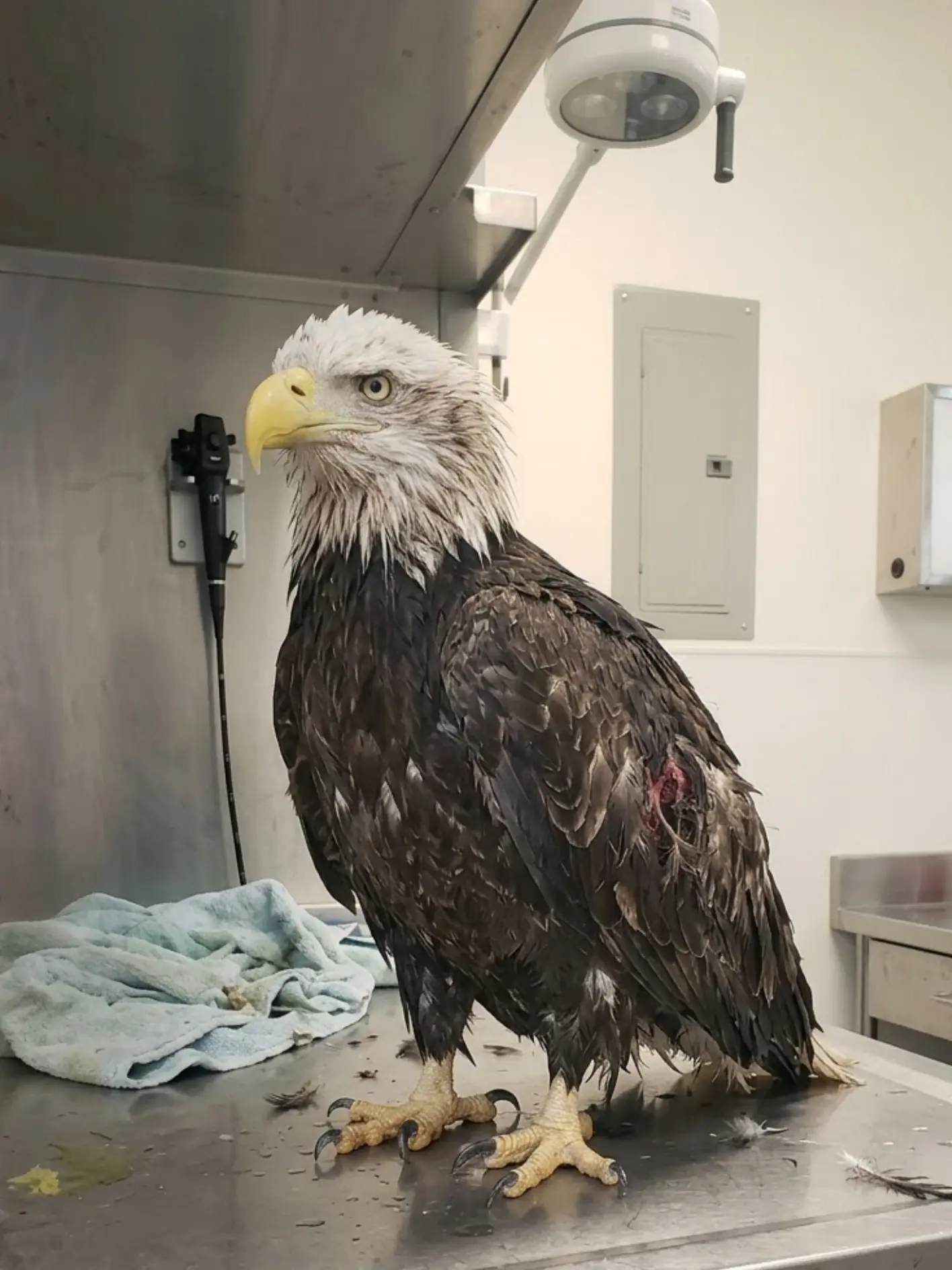
At first, the movement was difficult to understand.
Only the head and part of the upper back of an adult bald eagle were visible above the water.
The bird would lift itself against the wall, spread its feet, and search for something — anything — that its talons could grip. But the concrete surface was nearly smooth. There were no exposed roots, no loose rocks, no branches, and no vegetation strong enough to support the weight of a large raptor.
Each attempt ended the same way.
The eagle climbed only a short distance before its feet slipped.
Its body dropped back into the water.
Then, after several moments of rest, it tried again.
And again.
By the time wildlife personnel were contacted, the bird’s movements had become noticeably weaker.
Based on the witness’s observations and the eagle’s condition at the time of rescue, responders estimated that it may have been trapped in the canal for more than three hours.
That length of time raised concerns that went far beyond the obvious problem of being unable to escape.
The eagle’s feathers were saturated.
Its energy reserves were being consumed by repeated climbing attempts.
Its body temperature was beginning to fall.
And with every unsuccessful effort against the concrete wall, the bird was moving closer to a point where exhaustion itself could become life-threatening.
The eagle was eventually removed from the channel and transported directly to a licensed wildlife rehabilitation hospital in eastern Washington.
There, veterinary staff began emergency stabilization.
The first priorities were controlled rewarming, fluid support, treatment of dehydration, careful drying of the plumage, and evaluation for injuries that might have occurred during the hours the bird spent striking and scraping against the concrete.
The examination revealed multiple abrasions along the right side of the body, including an exposed wound near the wing and flank.
Radiographs, however, brought encouraging news.
No major fracture was identified.
The initial examination also did not reveal evidence of a catastrophic internal injury.
For an eagle that had spent hours fighting cold water and smooth concrete, those findings were better than the rehabilitation team had expected.
But the case was far from over.
The bird still needed time to recover from profound exertion, restore normal body temperature, repair its skin injuries, and — perhaps most importantly — regain the feather condition and muscle strength necessary for flight.
A Stormwater Canal Can Become a Trap
Stormwater channels are designed for one primary purpose: to move water efficiently.
In developed areas, they help direct runoff away from roads, neighborhoods, parking lots, and other infrastructure.
Their surfaces are often engineered to reduce obstruction.
That may mean steep concrete walls.
Smooth slopes.
Minimal vegetation.
Few irregular surfaces.
For water management, those features can be useful.
For wildlife, they can create an unintended trap.
A natural riverbank is structurally complex.
An animal attempting to climb out of a river or stream may encounter rocks, exposed roots, branches, mud, reeds, grasses, or uneven soil.
Even if one point fails, another may offer purchase.
Concrete canals can be very different.
A large bird that drops into one may have only a slick wall between itself and escape.
If the canal is narrow enough, normal takeoff may also be difficult.
A bald eagle requires space to extend its wings and generate lift.
A wet bird requires even more effort.
In this case, the eagle appeared to have neither a usable climbing surface nor enough functional flight capacity to escape directly from the water.
Every Failed Climb Cost More Energy
Witnesses reported that the eagle repeatedly tried to climb the embankment.
Its talons scratched against the concrete but could not establish a secure hold.
That repeated effort likely contributed significantly to the bird’s declining condition.
A bald eagle is a powerful animal.
Its legs and feet are built for gripping prey and perches.
Its pectoral muscles are capable of generating tremendous force during flight.
But those systems are not designed for prolonged climbing on smooth vertical surfaces.
Each attempt required the eagle to push upward with its legs while using its wings and body for balance.
When the feet slipped, the bird fell back into the water and had to recover before trying again.
The cycle repeated.
Attempt.
Slip.
Immersion.
Rest.
Attempt again.
Over time, the bird had less energy available for each new effort.
By the later stages of the rescue, the movements were reportedly slower and less forceful.
That change was one of the strongest indications that the bird was approaching dangerous exhaustion.
Saturated Feathers Changed the Situation Quickly
An eagle’s plumage is not simply decorative covering.
Feathers provide insulation.
They help repel water.
They maintain the aerodynamic surfaces that make flight possible.
Under normal conditions, the feather structure and preening behavior help keep much of the plumage functional even in wet weather.
Prolonged immersion is different.
When feathers become thoroughly saturated, the air normally trapped within the plumage is displaced.
Insulation becomes less effective.
The bird loses heat more rapidly.
The feathers also become heavier and less aerodynamically efficient.
For an eagle already struggling to escape a canal, that creates a worsening cycle.
The wetter the bird becomes, the harder flight becomes.
The harder escape becomes, the longer the bird remains in the water.
The longer it remains in the water, the greater the risk of hypothermia and exhaustion.
By the time responders arrived, the eagle’s plumage was visibly waterlogged.
The feathers around the head and neck were clumped.
Body feathers were flattened and disorganized.
The bird still responded to activity around it, but its physical reserve appeared greatly reduced.
More Than Three Hours in Cold Water
Based on the reported timeline, wildlife staff estimated the eagle may have been trapped for more than three hours.
The exact duration could not be confirmed.
What could be confirmed was that the bird had been exposed long enough for prolonged cold stress to become a serious concern.
Hypothermia does not always begin dramatically.
At first, an animal may simply become less active.
As body temperature falls, muscle function becomes less efficient.
Coordination declines.
The animal may appear increasingly weak.
Eventually, the ability to generate heat through activity also decreases.
That is especially dangerous for a bird trapped in water.
Movement creates heat, but movement also consumes energy.
A bird that is already exhausted may reach a point where it can no longer produce enough muscular activity to maintain body temperature.
Without intervention, the combination of cold exposure and exhaustion can become fatal.
Rescuers Had to Remove the Eagle Without Forcing More Struggle
When the wildlife response team reached the canal, the goal was to end the cycle of repeated escape attempts as quickly and safely as possible.
Approaching a bald eagle in water still requires caution.
A weak eagle can strike with its talons.
A frightened bird may make one final explosive attempt to escape.
The responder had to protect both the eagle and the people involved.
A net and protective equipment were used to contain the bird.
Once the eagle was secured, the feet were controlled first.
The wings were supported close to the body.
The bird was then lifted from the canal.
At that point, the rescue team avoided unnecessary examination in the field.
A cold, exhausted animal can deteriorate further if kept outside while people repeatedly handle it.
The eagle was wrapped, placed into a secure ventilated transport carrier, and taken directly for medical care.
The Immediate Problem Was Not the Visible Wound
When the eagle arrived at the rehabilitation hospital, staff could see several areas of disrupted plumage and a visible abrasion along the right side.
But the veterinary team did not initially treat the skin wound as the most urgent issue.
The entire patient had to be stabilized first.
The bird had experienced prolonged exertion.
Its feathers were saturated.
Its body temperature was lower than desired.
Dehydration was possible.
Its muscles had been repeatedly strained during unsuccessful climbing attempts.
The first question was not whether the abrasion needed medication.
The first question was whether the eagle could safely recover from the physiological stress of the preceding several hours.
Rewarming Had to Be Controlled
The eagle was moved into a warm, quiet treatment environment.
Rewarming was performed gradually.
This is important in hypothermic wildlife patients.
The goal is not to expose the animal to extreme heat and raise body temperature as rapidly as possible.
Controlled warming allows circulation and metabolism to recover in a more stable way.
Warm towels were used.
The ambient temperature was managed.
The bird’s response was monitored closely.
Staff watched respiration, alertness, posture, and body temperature.
Because the eagle was still responsive and able to stand with support, the team had reason for cautious optimism.
But the bird was profoundly fatigued.
Warmed Fluids Supported Circulation and Hydration
Intravenous access was established and warmed fluids were administered according to the bird’s clinical needs.
Fluid therapy served several purposes.
It supported circulation.
It helped address dehydration.
And in combination with external warming, it supported the controlled return toward normal body temperature.
The fluids were not a direct treatment for the abrasions or the underlying cause of the entrapment.
They were part of systemic stabilization.
A wildlife patient that has spent hours struggling in cold water needs treatment aimed at the whole body, not just the most visible injury.
Drying the Feathers Required Care
The rehabilitation team also had to dry the plumage.
That sounds simple.
It was not.
Feathers are complex structures.
Aggressive rubbing can damage the fine interlocking components that help maintain aerodynamic shape and water resistance.
The bird was therefore dried carefully.
Excess water was removed.
Warm conditions allowed further drying.
Handling was minimized as much as possible.
The eagle would later need to preen on its own to realign feather structure more completely.
The rehabilitation team understood that even if the bird’s muscles recovered, damaged plumage could still delay release.
A bald eagle cannot return safely to the wild if its feathers no longer support normal flight and insulation.
The Examination Found Multiple Abrasions
Once the bird was sufficiently stable for a more complete physical examination, the veterinary team began working through the feathers.
Several abrasions were identified along the right side of the body.
The most obvious area involved the flank and region near the wing base.
The skin was raw in places.
Feathers around the injury were disordered.
The pattern was considered compatible with repeated contact against a rough or abrasive surface.
Given the witness report, the concrete embankment was the most likely source.
Each time the eagle attempted to climb, the side of the body may have struck or scraped the wall.
But the team still used cautious language.
No one had documented every movement during the hours the bird was trapped.
The injuries were described as likely associated with repeated efforts to escape.
The Image Shows the Bird After Stabilization Began
Photographs taken during the early examination show the adult bald eagle standing on a stainless-steel veterinary table.
The bird is alert.
Its head is upright.
Its eyes are open and responsive.
The plumage remains wet and clumped, particularly around the head and neck.
An exposed reddish abrasion is visible along the right side beneath disturbed feathers.
The photograph captures an important point in the timeline.
This is not the bird in the canal.
This is the bird after rescue — alive, standing, but still visibly affected by water exposure and trauma.
The ability to stand was encouraging.
The condition of the plumage and wound showed how much recovery still remained.
Radiographs Ruled Out the Injury Everyone Feared
Because the eagle had been trapped, falling repeatedly into water and striking concrete, veterinarians were concerned about fractures.
The wings were a particular priority.
A broken humerus, radius, ulna, or shoulder structure could prevent release even if the bird survived the immediate cold exposure.
The legs were also evaluated.
Radiographs were obtained.
No major fracture was identified.
That result substantially improved the outlook.
The eagle had escaped hours of struggling without suffering a catastrophic skeletal injury.
The initial examination also did not reveal evidence of severe internal trauma.
That did not mean the bird was uninjured.
The abrasions were real.
Soft-tissue bruising was possible.
Muscle fatigue was severe.
But the structural findings were encouraging.
No Broken Bones Did Not Mean the Eagle Was Ready to Fly
The rehabilitation team deliberately avoided testing flight immediately.
A wet bird that has been exhausted for hours may not fly normally even when the wings are structurally intact.
The flight muscles may be fatigued.
The shoulder structures may be sore.
The feathers may be too saturated or disorganized to produce efficient lift.
The bird may also be metabolically depleted.
Forcing a flight test in that condition would provide little useful information and could create additional injury.
The eagle needed rest first.
The First Night Was About Stabilization
The bird was moved into a quiet medical enclosure.
The environment was warm.
The floor was padded.
Handling was minimized.
Staff monitored:
- body temperature,
- breathing,
- alertness,
- hydration,
- appetite,
- wound condition,
- and posture.
No high perch was offered initially.
A fatigued bird that is still regaining strength can fall from a perch and injure itself.
The goal was to allow the eagle to recover at floor level while the medical team reassessed it periodically.