An adult female bald eagle transferred from Maryland’s Eastern Shore has given wildlife veterinarians several encouraging answers since arriving at a licensed raptor rehabilitation center near Annapolis.
There are no fractures.
No major structural injuries have been identified.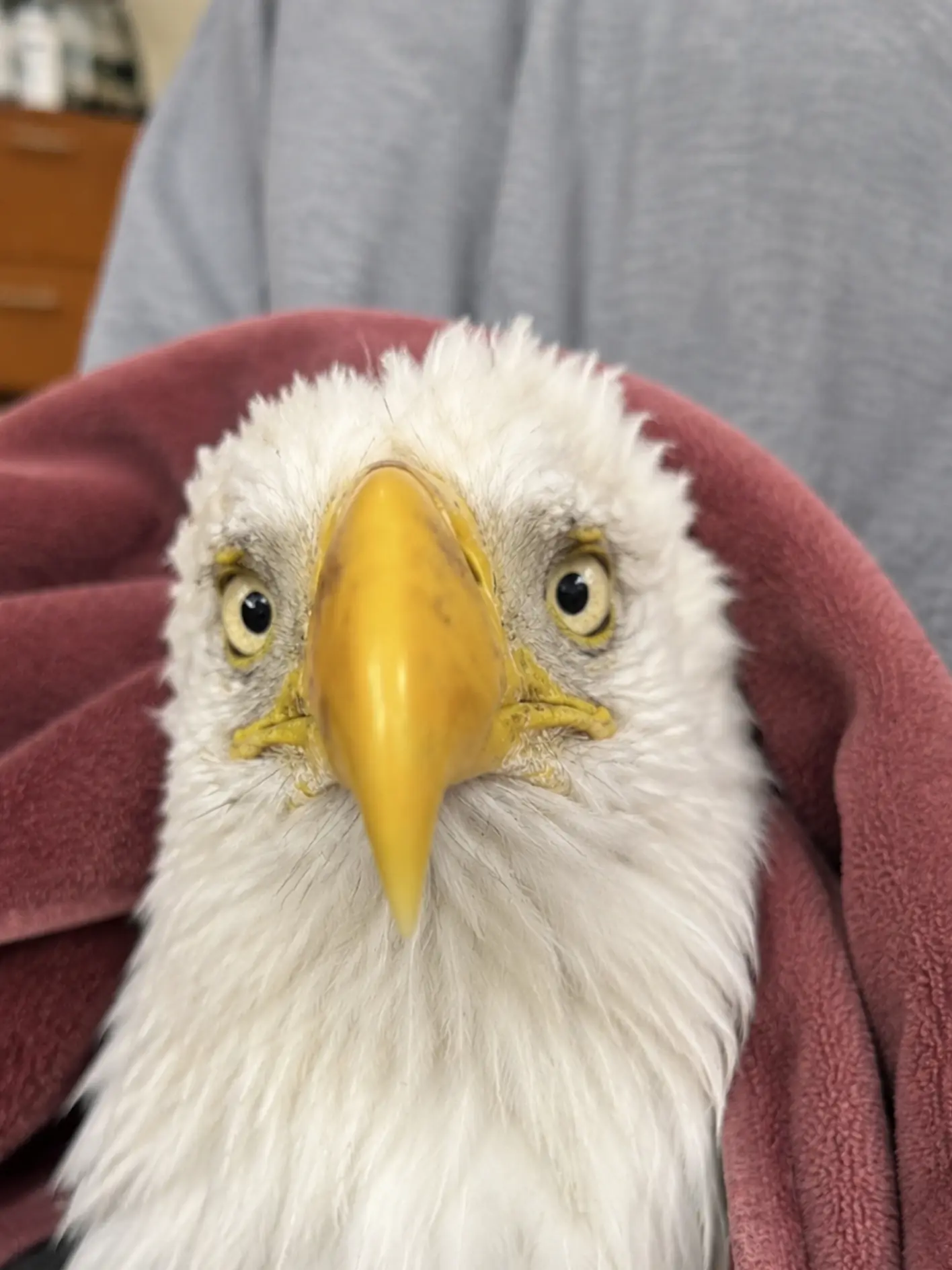
Both wings remain intact, the major joints appear stable, the bird’s feet are functional, and the initial neurological examination has not revealed an obvious deficit that would permanently prevent her from returning to the wild.
Yet one important problem remains.
She is still not flying well enough to be released.
The eagle was originally taken into care by a permitted wildlife rescue organization in Queen Anne’s County after responders determined that her flight performance was abnormal. She remained alert, could stand on her own, and was able to use both wings, but she did not demonstrate the power or endurance expected from a healthy adult bald eagle.
After initial stabilization, the organization arranged for her transfer to a larger rehabilitation center equipped with diagnostic imaging, veterinary support, and an outdoor flight enclosure designed for large raptors.
The first round of testing was largely reassuring.
Radiographs showed no fractures or major skeletal abnormalities. No obvious joint instability was found during physical examination. Her eyes responded appropriately, the feet and talons appeared functional, and there was no major external injury that could immediately explain why she was flying below normal capacity.
That left the rehabilitation team with a different question.
If the eagle’s bones and major structures are intact, why is she still unable to fly with normal strength?
For now, the answer remains uncertain.
Bloodwork is still being evaluated to rule out anemia, inflammation, metabolic abnormalities, or toxic exposure. In the meantime, the eagle has begun conditioning in the center’s large flight enclosure, where staff can closely monitor takeoff strength, wing symmetry, altitude gain, endurance, turning, and landing.
One thing has not been a problem.
Her appetite.
“She is eating exceptionally well,” a rehabilitator involved in the case said. “Structurally, she looks very good. What we need to see now is whether her endurance continues to improve and whether the blood results give us any reason to delay that process.”
If the remaining medical findings are reassuring and her flight performance reaches normal release standards, staff hope to return the eagle to the same general area of Maryland’s Eastern Shore where she was originally found.
The Transfer Was About Function, Not Emergency Surgery
When the adult female first came into wildlife care in Queen Anne’s County, she did not present with the type of obvious orthopedic emergency that immediately explains why a raptor is grounded.
There was no clearly dangling wing.
No major open fracture.
No obviously broken leg.
She was conscious and responsive.
She could move around.
And importantly, she could fly.
The problem was that her flight was not normal.
Wildlife rehabilitators often distinguish between a bird that is completely unable to fly and one that can become airborne but cannot perform at a level considered adequate for survival in the wild.
This eagle fell into the second category.
She could use both wings, but her flights appeared shorter and less powerful than expected.
She did not consistently gain altitude with the efficiency typical of a healthy adult bald eagle.
She also tired sooner than staff wanted to see.
Because the first organization did not have the same long-distance flight enclosure or diagnostic capacity available at the receiving facility, the decision was made to transfer her for a more extensive evaluation.
The transfer itself did not mean her condition had suddenly worsened.
It meant the rehabilitation question had become more specific.
Could she regain enough physical capacity to return safely to the wild?
Initial Examination Found No Major Structural Problem
After arrival, veterinary staff performed a complete physical examination.
The head and eyes were assessed first.
Both pupils responded appropriately.
There was no obvious severe ocular injury.
The beak appeared normally aligned.
The neck moved without a dramatic restriction.
Both wings were extended carefully while clinicians compared range of motion, muscle tone, swelling, joint stability, and response to palpation.
The shoulders received particular attention because subtle injury in the shoulder girdle can severely affect flight even when the distal wing appears normal.
No gross instability was detected.
The major bones of both wings did not show an obvious painful deformity on examination.
The legs and feet were also checked.
Both feet demonstrated useful grip, and the talons were intact.
No severe foot injury was found that would interfere with normal perching or landing.
Neurologically, the bird remained bright and responsive.
There was no obvious head tilt, loss of balance, or severe postural abnormality.
Those findings were all encouraging.
They also made the reduced flight performance more difficult to explain.
The Examination Image Shows a Controlled Medical Assessment
Images from the early veterinary workup show the eagle being restrained with towels while staff complete the physical examination.
The bird’s eyes are open and attentive.
Its head feathers appear slightly disordered from handling, but there is no obvious catastrophic injury visible in the image.
Towel restraint is commonly used during raptor examinations because it limits sudden wing movement while reducing unnecessary struggling.
A bald eagle may appear relatively calm in a photograph even while several trained people are carefully controlling its movement.
The image should therefore not be interpreted as evidence that the bird was tame, sedated, or critically weak.
It documents one stage of the assessment.
The more important findings came from the examination and diagnostic imaging.
Radiographs Brought the Best News So Far
Because the eagle’s flight remained weaker than expected, radiographs were obtained to look for injuries hidden beneath the feathers and muscle.
The veterinary team examined the humeri, radii, ulnae, shoulders, and other skeletal structures important to flight.
They also reviewed the chest and other areas that might reveal evidence of older trauma or abnormalities that could influence movement.
No fracture was identified.
There was no major skeletal lesion that immediately explained the reduced endurance.
For the rehabilitation team, that significantly improved the outlook.
A severe wing fracture can permanently alter alignment, joint movement, or the mechanics required for sustained flight.
Some fractures heal completely.
Others heal structurally but leave a bird unable to produce normal flight.
This eagle did not appear to be dealing with that type of injury.
But normal radiographs do not mean a raptor is ready to go home.
Flight Is More Than Bone
The skeleton provides the framework for flight.
It does not provide the entire system.
Muscles generate the force.
Tendons and ligaments transfer and stabilize that force.
The cardiovascular system delivers oxygen.
The nervous system coordinates the movement.
Vision guides takeoff, maneuvering, and landing.
A bird can therefore have completely intact bones and still be unable to fly normally.
Possible explanations for reduced performance include soft-tissue strain, generalized deconditioning, anemia, exhaustion, systemic illness, metabolic disease, or the lingering effects of a problem that has already begun resolving.
That is why the eagle remained in care after the X-rays came back reassuring.
“Normal imaging is good news,” the rehabilitator said. “It tells us what we are probably not dealing with. It does not automatically tell us why her endurance is still low.”
The First Controlled Flights Confirmed the Problem
Once staff determined that exercise could be performed safely, the eagle was given access to a large flight enclosure.
The enclosure provides enough distance to evaluate more than a short hop between nearby perches.
The bird demonstrated that she could fly.
She launched successfully.
Both wings participated in the wingbeat.
She could reach a perch.
But the flights lacked the sustained strength expected from an adult eagle considered ready for release.
Altitude gain was less efficient than staff wanted to see.
She required more wingbeats to maintain height.
Longer flights resulted in earlier fatigue.
In some sessions, she chose to land sooner than a fully conditioned eagle likely would.
None of these findings by itself indicated permanent disability.
Together, they confirmed that the bird was not yet ready to return to an environment where every flight would have consequences.
“She can fly,” staff explained. “She just cannot yet fly at the level we would consider safe for release.”
The Goal Is Not to Teach Her How to Fly
An adult eagle does not forget how to fly because it spends time in rehabilitation.
The motor patterns are already established.
The challenge is rebuilding physical capacity.
“We are not teaching her to fly again,” the rehabilitator said. “She knows how to fly. We are giving her the opportunity to regain the strength and endurance needed to do it normally.”
That means the flight enclosure serves two purposes.
It is a conditioning space.
And it is a diagnostic tool.
Every flight tells the rehabilitation team something.
Takeoff Is the First Major Test
Takeoff requires a sudden burst of power.
The eagle must push with the legs, extend the wings, and rapidly generate enough lift to accelerate the body upward.
For a large adult female, that requires substantial muscular strength.
A deconditioned bird may still leave a perch successfully but struggle to gain altitude.
Staff therefore watch the first several wingbeats carefully.
Does the bird launch cleanly?
Do both wings extend fully?
Is the downstroke symmetrical?
Does the eagle climb quickly, or remain low?
Does it hesitate before initiating flight?
These small details help distinguish simple lack of conditioning from a more specific mechanical problem.
So far, no consistent one-sided weakness has been identified that would immediately suggest a major hidden injury.
The broader issue appears to be overall conditioning and endurance.
The Pectoral Muscles Matter Enormously
The large muscles of the chest provide much of the power for avian flight.
When a wild eagle spends time grounded, confined, ill, or inactive, those muscles can lose condition.
Even a relatively short period of reduced activity can become noticeable in a large bird whose normal lifestyle requires repeated powerful flights.
Rehabilitation staff therefore monitor muscle condition along the keel in addition to body weight.
A heavier eagle is not automatically a fitter eagle.
The goal is appropriate muscle development, not simply weight gain.
This becomes especially important because the bird is eating so well.
Her Appetite Has Been One of the Most Positive Signs
According to staff, feeding has not been a challenge.
The eagle has shown strong interest in food and is consuming an appropriate carnivorous diet readily.
That is important for several reasons.
Adequate food provides the protein and calories required to rebuild muscle.
A healthy appetite also suggests that the bird is not dealing with severe ongoing nausea or profound systemic weakness.
It helps maintain body condition while exercise increases.
But rehabilitation staff are also careful not to overfeed.
A large raptor carrying unnecessary extra weight has to work harder during takeoff.
The ideal rehabilitation diet therefore supports muscle recovery without creating excessive body mass.
The eagle’s weight is monitored alongside food intake and flight performance.
Bloodwork Is Still Needed Before the Case Can Be Called Simple
Although the examination and X-rays have been encouraging, veterinary staff are waiting for laboratory information before concluding that the bird simply needs conditioning.
Bloodwork can reveal problems that are invisible during a physical examination.
A complete blood count can help identify anemia or inflammatory changes.
Chemistry testing can provide information about organ function, hydration, and metabolism.
Depending on clinical judgment, additional testing may be considered for conditions known to affect bald eagles.
Lead exposure is one example.
Because bald eagles frequently scavenge, some individuals ingest fragments of lead associated with animal remains.
Lead can contribute to weakness and neurological dysfunction even when there is no obvious external injury.
There is no evidence at this stage that this eagle has clinically significant lead poisoning.
The screening is intended to rule out an important possibility, not to establish a diagnosis before results are available.
Why Anemia Could Affect an Otherwise Normal-Looking Eagle
Anemia is one example of a problem that could produce the pattern staff are seeing.
A mildly or moderately anemic eagle may stand normally.
It may remain alert.
It may eat.
Its bones can look completely normal.
But during flight, the reduced ability of the blood to carry oxygen may become more apparent.
Flight muscles have high oxygen demands.
A bird with inadequate red blood cell capacity can fatigue sooner than expected even when the wings themselves are structurally normal.
That is one reason staff want laboratory results before considering release.
If the blood values are normal, anemia becomes less likely.
If they are abnormal, the conditioning program may need to pause while the underlying problem is addressed.
Inflammation or Systemic Illness Could Produce a Similar Pattern
A recovering bird may also be weaker because its body is still dealing with inflammation or illness.
The eagle might appear externally healthy while internal recovery remains incomplete.
Energy that would normally support flight may be redirected toward healing.
Cardiovascular endurance may decline.
Muscle condition may have deteriorated during the earlier illness.
These possibilities cannot be excluded simply because the eagle is now eating and behaving relatively normally.
The bloodwork is one way to look beneath that surface improvement.
Every Flight Session Provides a Trend
One weak flight would not define the eagle’s prognosis.
Staff are interested in patterns.
Does she fly farther this week than last week?
Does she gain altitude more quickly?
Does she reach higher perches?
Can she perform several flights without prolonged recovery?
Does she maintain wing symmetry as fatigue increases?
A bird that is simply deconditioned should generally show progressive improvement with appropriate exercise and nutrition.
A bird with an unresolved medical or soft-tissue problem may plateau or worsen.
That distinction becomes clearer over time.
Wing Symmetry Is Watched Closely
One of the most important observations is whether the left and right wings continue working in the same way as exercise becomes more demanding.
Subtle injury may not appear during one short flight.
After repeated exercise, staff may notice one wing beginning to droop or shorten its downstroke.
The eagle may begin turning preferentially in one direction.
One side may fatigue more quickly.
If that happens consistently, further examination or imaging may be necessary.
At present, the team has not identified an obvious structural explanation for the reduced flight strength.
That allows conditioning to remain the primary focus while laboratory testing is completed.
Endurance Is More Important Than a Dramatic First Flight
A rehabilitation video showing an eagle crossing an enclosure can look impressive.
For release decisions, it means very little by itself.
Wild eagles have to perform repeatedly.
An adult may cross open water, travel between feeding sites, respond to competitors, and fly in variable weather.
It may need to take off from the ground after feeding.
It must sometimes gain altitude rapidly.
A bird that can complete one short flight but becomes exhausted afterward is not prepared for those demands.
The rehabilitation team therefore looks for sustained performance across multiple flights and multiple days.
Landing Is Just as Important as Flight
Takeoff gets the attention.
Landing reveals a great deal about function.
An eagle approaching a perch must coordinate vision, wings, tail, legs, and feet.
It has to judge distance.
Reduce speed.
Extend the legs.
Grip.
Balance.
All of that happens within seconds.
A bird with subtle weakness, visual impairment, or neurological dysfunction may fly in a straight line adequately and still land poorly.
The adult female is therefore evaluated not only for how far she flies, but how well she completes each flight.
Controlled landings with immediate secure grip are part of the release standard.
Feet and Talons Remain Part of the Assessment
Both feet appeared functional during the veterinary examination.