Bruno Chose the Narrow Strip of Concrete Every Night
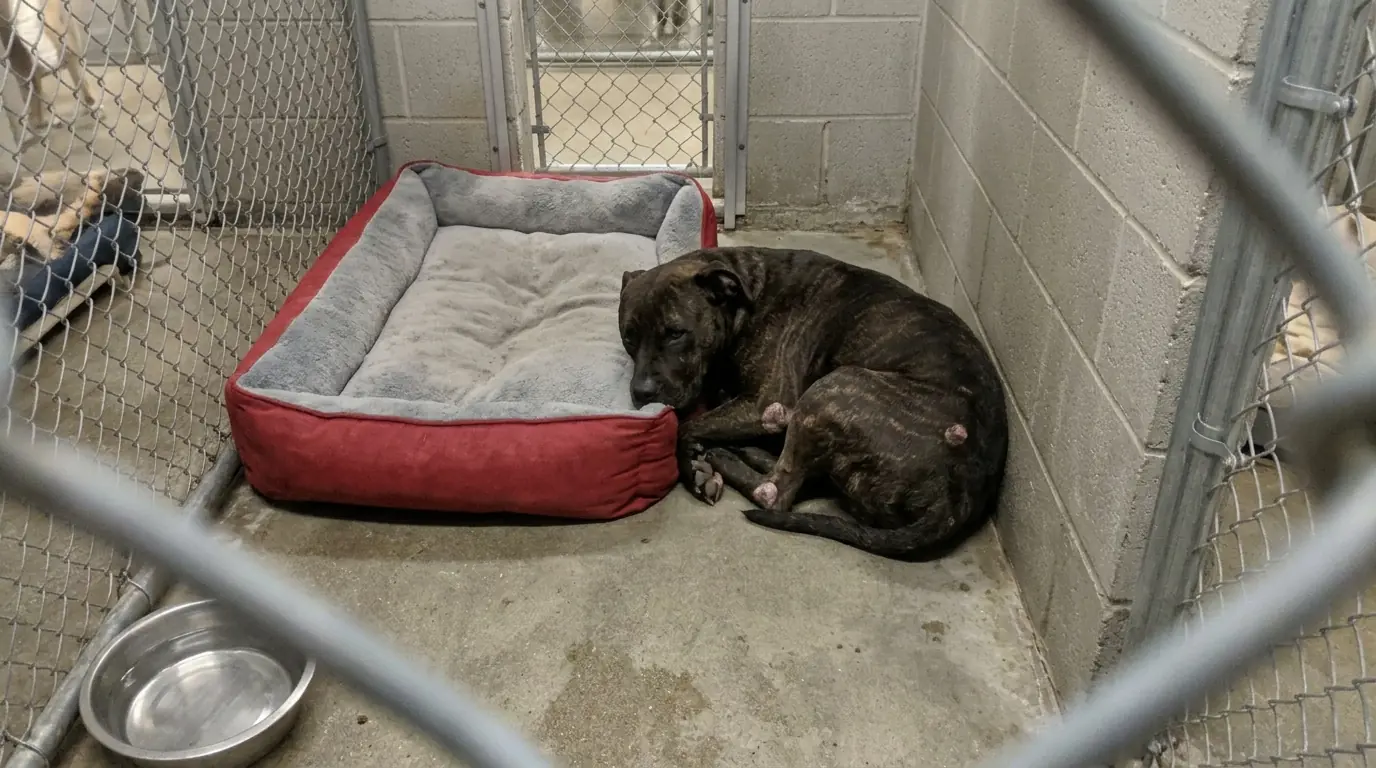
Bruno had a bed.
It was large enough for him.
It was padded.
It was dry.
It sat against one side of his kennel, leaving a narrow strip of bare concrete between the edge of the bed and the wall.
That strip was where Bruno slept.
He was an adult Pit Bull mix who came into the shelter after spending years primarily outdoors with very limited protection from the elements. His body showed the physical consequences of that kind of life.
The most obvious were the thickened areas over his elbows and hips.
They were not fresh wounds.
They were calluses.
The skin was darker and tougher there, with less hair covering it than the surrounding areas. The pattern was consistent with a dog who had spent a great deal of time resting on hard surfaces.
That was what made his kennel behavior so difficult to miss.
Bruno finally had a soft place to sleep.
He would not use it.
Every evening, after the kennel row became quieter, he walked past the bed, turned into the small space beside it, and folded himself onto the concrete.
He made his body as compact as possible.
His hind legs tucked tightly underneath him.
His front legs folded toward his chest.
His back curved toward the wall.
Sometimes his nose nearly touched his own tail.
There was barely any empty floor around him.
The bed was only inches away.
Bruno slept as though that narrow patch of concrete was the only place that made sense.
His Body Already Told Us What Hard Surfaces Had Done
Calluses over pressure points are common in larger dogs that repeatedly lie on hard surfaces.
The elbows are especially vulnerable.
So are the hips and hocks, depending on how a dog rests.
In Bruno’s case, the thickened skin gave us useful information without allowing us to invent details we could not verify.
We knew he had spent years living primarily outside.
We knew shelter had been limited.
We knew he had chronic pressure calluses.
What we did not know was exactly what surface he slept on every night, how often bedding had been available, or what his day-to-day routine had looked like.
We did not need to exaggerate it.
The physical evidence was already there.
His elbows had adapted to repeated contact with something unforgiving.
His behavior now seemed to have adapted too.
A Soft Bed Was Not Automatically Comfortable to Him
People often assume that an animal will immediately choose the softest option available.
That is not always how behavior works.
Dogs learn through repetition.
They develop preferences based on what has been familiar, predictable, and safe.
For Bruno, softness may simply not have been part of his sleeping routine.
The bed also changed the geometry of the kennel.
It created an open surface that shifted under his weight.
The concrete did not move.
The wall gave him a solid boundary along one side.
The narrow gap kept his body contained.
Those details can matter to a dog adjusting to an unfamiliar environment.
A large open bed may feel inviting to us.
To a dog who has spent years curling tightly against hard edges, it may feel exposed.
So Bruno was not lifted onto the mattress.
He was not blocked from the concrete.
He was not corrected for choosing the floor.
The bed stayed there.
The decision remained his.
His Intake Exam Focused on More Than the Calluses
Bruno received a full physical examination after arrival.
His weight and body condition were documented.
His skin was checked carefully, including the thickened areas over the elbows and hips.
Calluses can remain uncomplicated.
They can also crack, become irritated, develop pressure sores, or become infected if the skin barrier breaks down.
Bruno’s were chronic and thick but did not appear to be acutely infected.
That distinction mattered.
They needed protection and monitoring.
They did not need to be treated like open wounds.
His paws were examined.
His joints were assessed.
His gait was observed.
Because he had been living outdoors and was now an adult dog entering care without a complete medical history, routine screening was appropriate based on shelter protocols and veterinary judgment.
But the most immediate issue visible in the kennel was not a hidden diagnosis.
It was the fact that Bruno continued placing those same pressure points back onto hard concrete every night.
We Started by Changing the Space, Not the Dog
Instead of trying to make Bruno sleep differently, staff began making his preferred place less punishing.
A thin nonslip mat was placed along the strip where he always curled.
It was not thick.
It did not change the size of the space dramatically.
It simply added a small amount of cushioning between Bruno and the floor.
The larger bed remained beside it.
That first night, Bruno approached the usual corner.
He sniffed the mat.
He stepped on it.
Then he backed off and curled on the small section of exposed concrete that remained.
The next evening, he did the same.
So the mat was adjusted again.
This time, it covered the entire strip.
Bruno stood over it for a long moment.
Then he lowered himself.
He slept on the mat.
Not the bed.
That was still progress.
His Sleeping Position Was Extremely Tight
Bruno rarely stretched out during the first days.
Even when he was deeply asleep, his body stayed compressed.
His spine remained curved.
His legs remained tucked close.
His chin usually rested near his forelegs.
This posture was not necessarily evidence of one specific emotional state.
Dogs curl for warmth, security, habit, or simple preference.
But in Bruno’s case, the persistence of the behavior across multiple quiet nights made it significant.
He had enough room to extend his legs.
He chose not to.
He had a padded bed.
He chose the smallest sleeping footprint available.
That became one of the clearest markers of how unfamiliar this new environment still was.
The Bed Was Modified Again
The original bed was large and comfortable but relatively open.
Staff tried a different setup.
Part of the bedding was positioned closer to the wall.
A rolled blanket created a low boundary along one edge.
The idea was not to trap Bruno.
It was to make the bed feel more defined.
The kennel still offered a clear exit path.
Nothing prevented him from leaving.
Bruno investigated the change.
He sniffed the blanket.
He put one front paw onto the bed.
Then the other.
He stepped off.
That was all he did that day.
Nobody tried to turn two paws into a full-body milestone.
Shelter Noise Made His Corner Preference Stronger
Bruno was not the most visibly fearful dog in the kennel row.
He did not panic when other dogs barked.
He did not throw himself against the gate.
But louder periods changed his body language.
He became more contained.
His movements shortened.
He stayed closer to the wall.
When the shelter was active, he was less likely to investigate the bed.
During quieter parts of the day, he sometimes stood beside it longer.
That pattern suggested that environmental stress played at least some role in his choices.
So staff reduced pressure wherever possible.
Interactions were calm.
The kennel was not constantly entered for unnecessary contact.
Bruno was given time to observe people before they approached.
Treats could be tossed onto the bed without requiring him to climb onto it.
The bed became associated with neutral and positive experiences rather than insistence.
His Relationship With People Developed Slowly
Bruno was not immediately affectionate with everyone.
He was curious.
He often watched people from the side of the kennel.
If someone entered too directly, he tended to shift backward.
A sideways posture worked better.
So did allowing him to sniff first.
He accepted food sooner than touch.
Once he became familiar with a caregiver, brief contact around the shoulders and chest became easier.
He did not immediately seek prolonged petting.
That was fine.
Behavioral progress did not need to look like dramatic physical affection.
For Bruno, staying in place while a familiar person changed his water was progress.
Eating while someone remained nearby was progress.
Walking voluntarily toward the kennel door when his leash appeared was progress.
Outdoor Time Revealed That He Was More Comfortable on Hard Ground
Bruno moved confidently across concrete and packed dirt.
Soft surfaces produced more hesitation.
Deep grass slowed him.
Plush bedding made him test each step.
That pattern supported the idea that certain textures were simply unfamiliar.
It also gave staff a practical way to help.
Instead of asking Bruno to move directly from hard floor onto a thick mattress, transitional surfaces were introduced.
Thin mats.
Folded blankets.
Firm pads.
The progression was gradual.
Hard to slightly padded.
Slightly padded to firmer bedding.
Then eventually a softer bed.
The process respected what Bruno already understood.
His Calluses Needed Time Too
Even with better sleeping surfaces, chronic calluses do not disappear immediately.
The thickened skin had developed over a long period.
Reducing pressure could help prevent worsening and allow irritated areas to improve, but the skin would not become normal overnight.
The calluses were kept clean and monitored.
Any cracking, bleeding, swelling, heat, or discharge would require reassessment.
Moisturizing or protective strategies could be considered when appropriate, but the most important treatment was mechanical.
Less time on hard surfaces.
More cushioning.
Better distribution of pressure.
That sounded simple.
For Bruno, it depended entirely on whether he would actually use the softer options.
The First Time He Put His Chest on the Bed, He Left His Hindquarters on the Floor
It happened during a quiet afternoon.
Bruno had been resting near the wall.
He got up, circled once, and stepped toward the bed.
His front paws went onto the mattress.
Then his chest lowered.
His hind legs remained on the mat beside it.
He stayed like that for several minutes.
Half on.
Half off.
The position looked awkward, but no one moved him.
This was Bruno experimenting.
The bed shifted slightly under his chest.
He froze for a moment.
Then relaxed.
After several minutes, he stood and returned to the corner.
That night, he still slept beside the bed.
The next afternoon, he used the half-on position again.
Progress Often Looked Temporary
There were days when Bruno appeared ready to abandon the corner entirely.
Then one loud evening could send him right back.
A maintenance cart rattled through the hallway.
Dogs began barking.
Bruno left the bed and tucked himself tightly against the wall.
That did not mean the previous progress had disappeared.
Behavioral change rarely follows a straight line.
Stress lowers tolerance.
Familiar habits become more attractive when the environment feels uncertain.
The important question was not whether Bruno ever returned to the concrete.
It was whether he was building more choices.
Slowly, he was.
He Began Taking Treats Onto the Bed
Food helped create those choices.
A treat tossed onto the edge was easy.
Bruno could stretch his neck and take it without stepping up.
Later, treats were placed slightly farther back.
He put both front paws on the mattress.
Then all four.
At first, he ate and stepped off immediately.
Later, he stayed long enough to sniff.
Then long enough to sit.
The first sit was brief.
Bruno lowered his hindquarters onto the mattress, ate the treat, and stood again.
That was a major movement change for a dog who had treated the bed like unstable territory.
He Still Slept in the Corner
Despite all of those daytime experiments, nights remained different.
When the lights dimmed and activity decreased, Bruno returned to the narrow space.
He curled tightly.
His body touched the wall.
His elbows rested on the mat.
The large bed beside him remained empty.
This distinction was important.
A dog may be willing to explore a surface while awake and still not trust it enough for deep sleep.
Sleep removes control.
A dog cannot monitor the environment as effectively.
For Bruno, choosing where to sleep was likely a much bigger decision than stepping onto a mattress for food.
We did not rush that part.
Foster Care Offered the Environment He Needed
Once Bruno was medically stable and his behavior was better understood, a quiet foster home became available.
The home was prepared carefully.
He was not given access to the whole house immediately.
One room was set up with several sleeping options.
A firm orthopedic-style bed.
A thinner mat.
A folded blanket along the wall.
An open crate with bedding inside.
Hard flooring remained available too, but not as the only choice.
The room was calm.
Traffic through it was limited.
Bruno could observe household life without being surrounded by constant movement.
He Chose the Floor Beside the Bed Again
The first night in foster care looked almost exactly like the shelter.
Bruno ignored the large bed.
He found the narrow strip between it and the wall.
He turned twice.
Then he curled into the smallest shape his body could make.
The foster family had been prepared for this.
They did not move him after he fell asleep.
They did not wake him and guide him onto the mattress.
A thin mat was already beneath that area.
Bruno slept there.
The second night, the same thing happened.
Then the third.
Household Quiet Changed His Daytime Behavior First
Without the constant kennel noise, Bruno began relaxing in other ways.
He slept longer during the day.
He stopped lifting his head every time someone walked through the room.
He began following his foster caregiver into the kitchen.
He explored a second room.
He accepted longer periods of gentle petting.
His appetite remained reliable.
He started showing interest in toys.
A rubber food toy held his attention.
A soft plush toy did not at first.
He seemed more interested in objects he could investigate with his mouth than in carrying or cuddling them.
All of this suggested that the home was becoming predictable.
His sleep location, however, remained stubbornly familiar.
We Made the Bed Smaller
This turned out to be one of the most useful changes.
The original bed was large enough for Bruno to stretch completely.
That was good physically.
Behaviorally, it may have felt too open.
So a second smaller bed was placed in the corner.
It was still large enough for him to lie comfortably.
But the edges were more defined.
One side touched the wall.
Another side was bordered by a low piece of furniture.
The entrance remained completely open.
That night, Bruno approached it.
He sniffed.
He stepped on.
Then he circled.
He left.
A few minutes later, he came back.
This time he sat.
Then he stood again.
Finally, much later, he lowered his chest.
He stayed there for less than ten minutes.
Then he moved back to the mat.
But for the first time, Bruno had tried to sleep on an actual bed.
His Body Needed to Learn a New Position
Using the bed changed more than surface texture.
It changed posture.
The cushioning allowed Bruno’s hips to sink slightly.
His elbows were no longer braced against a rigid surface.
He could extend his legs without immediately contacting a wall.
Those differences can feel strange to a dog accustomed to sleeping tightly.
At first, Bruno remained curled even on the bed.
His body still formed the same compact circle.
The only difference was what was underneath him.
That was enough.
Changing the sleeping surface did not require changing every other habit at the same time.
He Began Spending Entire Naps There
The first full nap happened in the afternoon.
Bruno climbed onto the smaller bed.
He circled.
He lowered himself.
His back stayed against the wall.
His legs tucked close.
He slept for nearly an hour.
Nobody entered the room unnecessarily.
When he woke, he stood, stretched briefly, and walked away.
That evening, he returned to the floor.
The next day, he napped on the bed again.
Gradually, the balance changed.
More naps on the bed.
Fewer on the floor.
Then one night, Bruno remained on the bed after the household became quiet.
The First Full Night Did Not Change Everything
The next morning, Bruno was still there.
Curled tightly against the wall side of the mattress.
His nose tucked close to his front paws.
The bed had supported him through an entire night.
That was a major milestone.
The following night, he slept on the floor again.
That was not a failure.
The important part was that the bed had become a real option.
It no longer represented something unfamiliar enough to avoid completely.
His Calluses Began Looking Less Irritated
As Bruno spent more time on padded surfaces, the pressure on his elbows and hips decreased.
The calluses did not disappear.
They remained visible reminders of years of repeated pressure.
But the skin looked less dry.
Areas that had appeared irritated became calmer.
There were no new pressure sores.
That was exactly the kind of improvement we wanted.
Not cosmetic perfection.
Better comfort.
Less ongoing damage.
His Foster Family Learned That He Preferred Boundaries
Bruno continued sleeping best when a bed touched a wall.
A mattress placed in the middle of a room was less attractive.
A bed tucked into a corner was used regularly.
That preference did not need to be trained away.
There was nothing unhealthy about wanting a protected side.
The goal was not to make Bruno sleep in the open.
It was to give him a comfortable version of the enclosed resting style he already preferred.
That distinction became part of his adoption planning.
He Started Stretching One Leg Out
The next important change was almost comically small.
Bruno was asleep on his bed one afternoon.
His body was curled as usual.
Then one hind leg slid outward.
It remained stretched behind him.
His front half stayed tucked.
Several days later, he extended both front legs while resting.
Eventually, he began lying partly on his side.
The posture looked less compressed.
He was using more of the bed.
Again, we did not claim to know exactly what he felt.
We could simply observe that he was no longer keeping his entire body folded into the smallest possible area.
He Had Setbacks During Storms
Thunderstorms brought the old sleeping behavior back.
Bruno did not panic dramatically, but loud thunder made him seek tighter spaces.
During one storm, he left the bed and squeezed between it and the wall.
The gap was now narrower than before because the smaller bed occupied more space.
He still found it.
So the foster setup was adjusted.
An open crate was positioned nearby and partly covered.
It gave him a secure enclosed option with padded flooring.
During the next storm, Bruno chose the crate.
That was a better outcome than asking him not to seek shelter at all.
His World Expanded Without Taking Away the Corner
As Bruno became more comfortable, he gained access to more of the house.
He developed favorite places.
A rug near the kitchen.
A bed beside the couch.
The open crate during storms.
A sunny area near a window.
The corner bed remained his most reliable sleeping spot.
That was fine.
Security does not have to look like complete behavioral transformation.
Bruno could keep the preference while losing the physical consequences.
Adoption Planning Focused on Realistic Expectations
Bruno was not difficult because he preferred corners.
He needed a home willing to respect that preference.
A large soft bed in the center of a room might remain unused.
A bed positioned against a wall would likely work better.
He needed continued monitoring of his elbows and hips.
Maintaining a healthy body weight would reduce pressure on joints and skin.
Comfortable flooring and regular veterinary care would remain important.
He also needed people who would not interpret slow adjustment as rejection.
Bruno had already shown that he could develop trust.
He simply did it gradually.
His Past Did Not Need to Be Recreated to Make Him Feel Safe
One of the most important lessons from Bruno was that familiarity and comfort are not always the same thing.
Hard concrete was familiar.
That did not make it good for him.
A tight corner was familiar.
That did not mean he needed to lose every sense of enclosure.
The solution was not to force him onto something completely different.
It was to preserve the parts of his routine that gave him security while changing the parts that hurt his body.
Wall at his back.
Fine.
Small sleeping footprint.
Fine.
Protected corner.
Fine.
Bare concrete under thickened elbows and hips.
That was the part we could change.
The Old Sleeping Position Never Completely Disappeared
Even after Bruno became comfortable in foster care, he still occasionally curled himself into a remarkably small circle.
Sometimes his entire body occupied only half the bed.
His nose tucked inward.
His legs disappeared beneath him.
The shape was almost identical to the dog who had slept between the shelter bed and the concrete wall.
But there was one major difference.
Now the surface underneath him gave.
His elbows sank into padding.
His hip did not press directly against concrete.
He could shift without scraping over a hard floor.
The habit remained.
The damage did not have to.
One Morning, Bruno Was Using the Entire Bed
It happened months after his arrival.
His foster caregiver walked into the room expecting to find the familiar tight curl.
Instead, Bruno was asleep on his side.
His back legs were stretched behind him.
One front leg extended toward the edge.
His head rested flat on the mattress.
His body occupied almost the entire bed.
The wall was still behind him.
He had not abandoned the corner.
He had simply stopped making himself fit into the smallest part of it.
There was no reason to wake him.
Bruno Still Likes Corners
That is unlikely to change completely.
He still chooses beds positioned against walls.
During loud weather, he prefers more enclosed spaces.
If given several sleeping options, he often selects the one with the clearest boundaries.
Those are preferences his future home can easily accommodate.
What he no longer needs is the hard surface that once came with them.
The Concrete Is Still There, but Bruno Rarely Chooses It
When Bruno first entered the shelter, the soft bed beside him seemed almost irrelevant.
Night after night, he folded himself into the narrow strip of concrete between that bed and the wall.
His thickened elbows rested on the same kind of unforgiving surface his body had already spent years adapting to.
We could not teach him a new sleeping habit in one night.
We could not explain to him that the mattress was better.
So we stopped trying to make the bed win.
We made his preferred space safer.
Then we gave him slightly softer choices.
Then smaller beds.
Then protected beds.
Then time.
Bruno did the rest.
His calluses are still visible.
The history written into that skin does not vanish because his environment improved.
And there are still nights when he curls his body tightly enough to look much smaller than he is.
But now he does it on padding.
More often, he stretches.
Sometimes he sleeps on his side.
Sometimes one leg hangs over the edge.
The adult dog who once had a full bed available and still chose bare concrete has not forgotten how to sleep in a corner.
He has simply learned that the corner can be soft.