For most of his thirteen years with Sarah Mitchell, Allen had made being alone almost impossible.
He followed her into the kitchen even when he knew there was nothing for him there. He waited outside the bathroom door, slept close enough to the couch that Sarah had to step over him when she stood up, and appeared on the porch within seconds whenever he heard the screen door open. If Sarah walked from one room to another simply to retrieve a pair of glasses she had forgotten, Allen often followed as though the trip required supervision.
That was why the change unsettled her long before she understood what it meant.
Allen began choosing distance.
At first, the differences were small enough to explain away. He was thirteen, his muzzle had turned almost completely white, arthritis had slowed his back legs, and he slept more than he once did. Sarah assumed that when he remained in the living room instead of following her into the kitchen, he was simply tired.
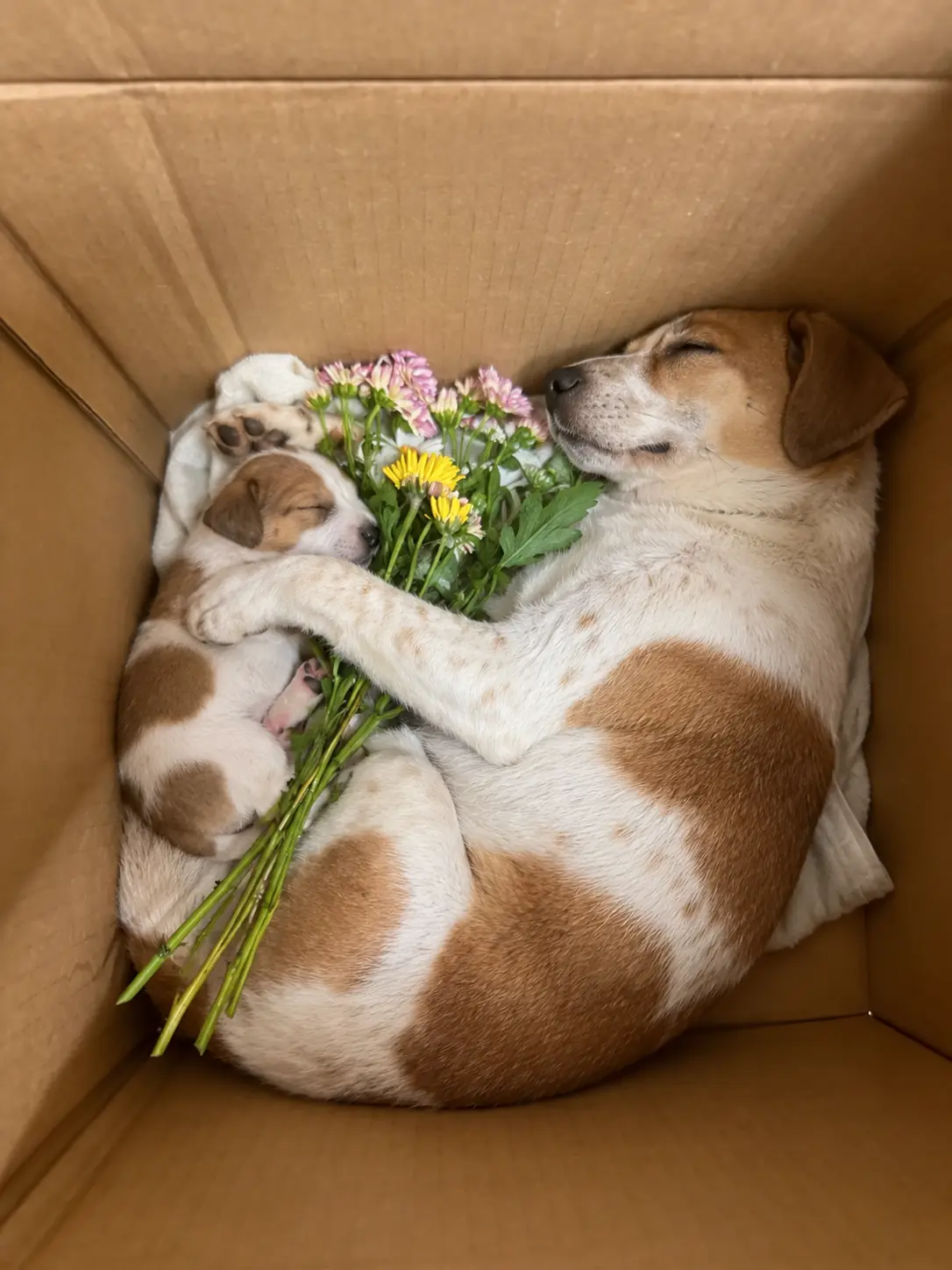
Then he started leaving the living room too.
He would walk onto the covered porch by himself and stay there after Sarah went back inside. On mild evenings, she sometimes found him lying at the far end near the steps, facing the yard instead of the house. When she called his name, Allen still lifted his head and wagged his tail, but there were moments when he seemed reluctant to come back in.
“You turning into an outdoor dog now?” Sarah asked him one evening.
Allen stood slowly, stretched, and followed her inside.
She smiled and forgot about it.
A week later, she found him behind the garden shed.
That bothered her more.
Allen had never been especially interested in that part of the property. The shed sat beyond the vegetable garden beneath an old maple tree, close enough to the woods that fallen leaves accumulated around it every autumn. Sarah’s late husband, Michael, had used it for tools, paint cans, and the assortment of things he insisted might become useful someday.
After Michael died, Sarah rarely opened it.
Allen remembered it differently.
Years earlier, the shed had briefly become one of the most important places in his life.
Sarah had almost forgotten that until she found him lying there again.
Allen came to the Mitchell house when he was barely a year old. Michael had found him outside a hardware store on a July afternoon, sitting beneath a pickup truck where the concrete offered a few inches of shade. Allen wore a faded collar but had no tag, and after several weeks of calls, flyers, and shelter checks produced no owner, the temporary arrangement became permanent.
Sarah had wanted to name him something cheerful.
Michael chose Allen because, in his words, “he looks like an Allen.”
Nobody ever understood what that meant.
The name stayed.
Allen grew into a large brown-and-white mixed breed with a patient face and the habit of leaning his entire weight against whoever was petting him. He loved Michael, but Sarah was his person. She was the one he followed while laundry moved from washer to dryer, the one he waited for beside the kitchen every morning, and the one whose side of the bed he chose when thunderstorms shook the windows.
Then Michael died.
It happened much faster than anyone expected.
He was sixty-six, still mowing his own lawn and still insisting that his blood pressure medication was “mostly a suggestion,” when a heart attack took him on an ordinary Tuesday morning.
Sarah spent that week surrounded by people.
Her children came home. Neighbors brought casseroles. Friends called. Flowers arrived until every flat surface in the living room seemed to hold a vase.
Then the funeral ended.
Her children returned to their own homes.
The dishes were washed.
The flowers wilted.
And suddenly the house became quieter than Sarah had ever heard it.
Allen changed during that period too.
For the first few nights, he walked from the bedroom to Michael’s empty recliner and back again. He smelled the jacket hanging by the door. He waited beside the garage when he heard vehicles in the driveway.
Eventually, he stopped searching.
What he did not stop doing was staying close to Sarah.
Years later, she would say that Allen never “saved” her in the dramatic way people sometimes described animals after loss. He did something more ordinary and perhaps more important.
He made her get up.
A dog still needed breakfast.
A dog still needed the back door opened.
A dog still wanted to walk even when Sarah would have preferred to sit in Michael’s chair and let the afternoon disappear.
Allen made the house inconveniently alive.
Sarah came to depend on that.
When her oldest daughter moved to Arizona, Allen was there.
When her son remarried and became busy raising his own children, Allen remained part of every morning and every night. Birthdays changed. Holidays became smaller. Friends aged, moved, or became ill.
Allen simply grew older beside her.
By the time he was thirteen, Sarah sometimes joked that they were “two retirees keeping tabs on each other.”
His hearing was not what it used to be.
He needed medication for arthritis.
He occasionally stood at the wrong side of a door waiting for Sarah to open it.
But he still knew where she was.
That was why distance felt wrong.
At first Sarah wondered whether Allen was becoming confused.
Older dogs sometimes change sleeping patterns, become restless, or seek unfamiliar places as their senses and bodies change. She mentioned it during a veterinary appointment after Allen began losing interest in breakfast.
The veterinarian examined him carefully.
Bloodwork revealed changes consistent with age and chronic disease, and additional testing brought the news Sarah had quietly feared.
Allen’s body was failing.
There was no single catastrophic problem to fix.
His kidneys were declining, his heart sounded weaker than it had months earlier, and the weight he had lost was not simply from becoming picky with food. Treatment could keep him comfortable, perhaps give him more good days, but nobody could promise how many.
Sarah listened to every instruction.
Medication.
Hydration.
Watch his appetite.
Watch his breathing.
Watch whether he could still stand comfortably.
She asked practical questions because practical questions were easier than the one she really wanted answered.
“How long?”
The veterinarian did not pretend to know.
Sarah drove home with Allen lying in the back seat.
At a red light, she looked at him in the mirror.
He was watching her.
“Don’t start,” she whispered.
His tail moved once against the blanket.
Over the next several weeks, Sarah reorganized her life around making Allen comfortable.
She moved one of his beds closer to the back door so he would not have to walk far when he needed to go outside. She warmed his food and sat beside him while he ate. She placed rugs across slippery sections of hardwood so his legs would not slide.
Allen accepted all of it.
He also kept retreating.
Some dogs who are sick, exhausted, or uncomfortable become more withdrawn and look for quiet, protected places. Sarah learned that after searching late at night for explanations that would make Allen’s new behavior less frightening.
What she refused to believe was the romantic version people sometimes repeated—that dogs knowingly leave because they do not want their humans to watch them die.
Nobody could know that.
Allen could not explain his intentions.
Sarah did not want to put human reasoning into a dog’s mind simply because the story hurt less that way.
Still, she could not ignore what she was seeing.
The dog who had spent thirteen years trying to occupy the same room was slowly choosing rooms without her.
One afternoon, Sarah found him beside the old storage shed again.