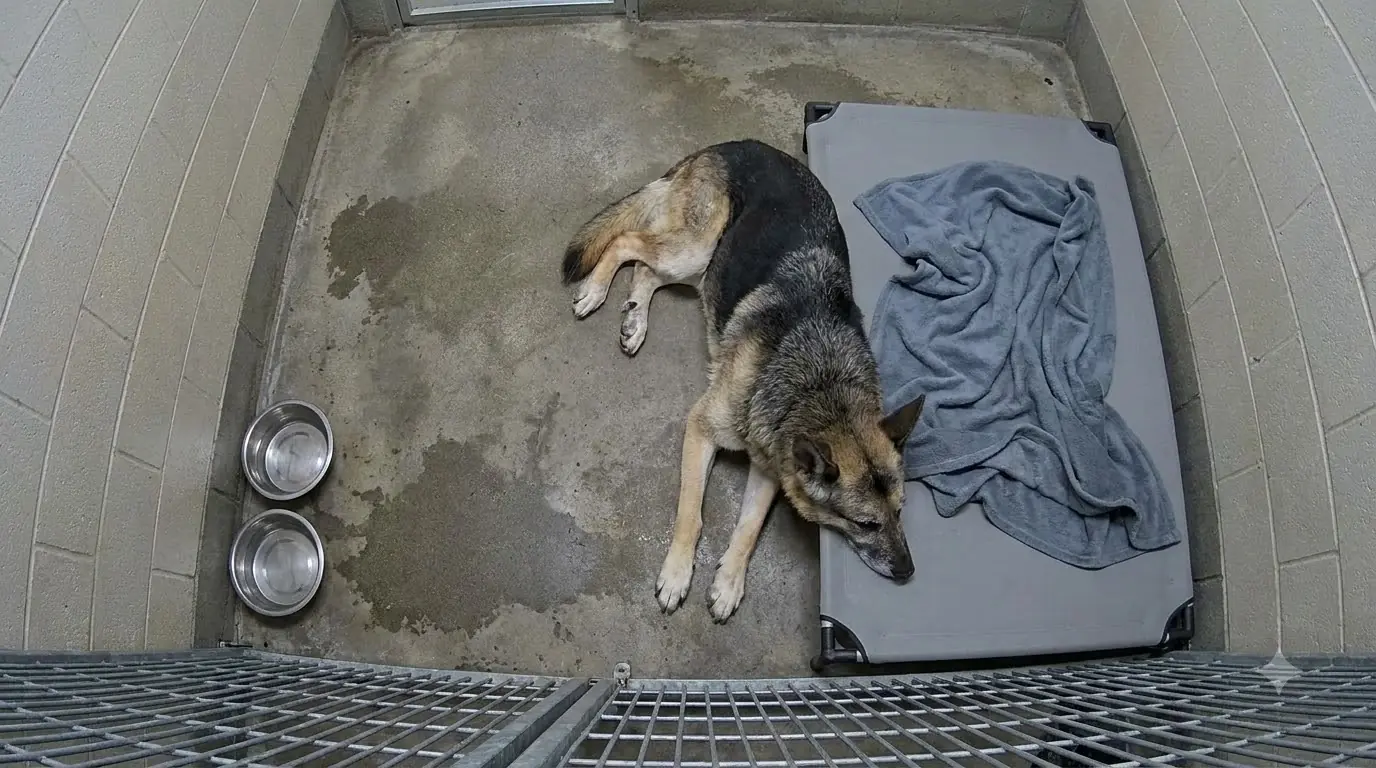
Archie doesn't fall off his bed all at once.
It happens slowly.
The 11-year-old German Shepherd lies on an orthopedic mattress with his hind legs stretched behind him. When he becomes uncomfortable and tries to change position, his front paws press into the bedding.
His shoulders shift.
His chest moves.
But the back half of his body barely follows.
Then gravity begins doing what Archie's weakened muscles no longer reliably prevent.
His hips slide toward the edge.
One hind leg slips off first.
Then the other.
Within moments, part of Archie's body is on the floor while his chest remains against the mattress.
He does not try to stand.
Instead, Archie plants his front paws against the floor and pulls.
Once.
Then again.
He drags himself back toward the edge of the bed until his chest is close enough to rest against it.
Then he stops.
His breathing becomes heavier from the effort.
And that is often where staff find him: lying beside the orthopedic bed that his body can no longer reliably keep itself on.
This Isn't Simply an Old Dog Having Trouble Getting Up
Archie is a senior dog, but age alone does not explain what staff are seeing.
He is living with a progressive neurological disease that has severely affected the back half of his body.
His hind legs have lost most of their useful strength.
They frequently remain extended behind him while Archie relies on his front legs to reposition himself.
His body has also become noticeably thinner.
The muscular support he once had through his hindquarters has diminished, making ordinary movements increasingly difficult.
Standing is no longer something Archie can simply decide to do.
Even changing position in bed has become a physical task.
And because his neurological condition is degenerative, the medical team has to approach his care differently from that of a dog recovering from a temporary injury.
The goal is not to promise that Archie will eventually walk normally again.
The question is how to keep him comfortable as his abilities continue to change.
Staff Began Paying Attention to Every Time He Slid
At first, the orthopedic bed seemed like the obvious solution.
It provided cushioning for a thin senior body and reduced the amount of time Archie's hips and joints spent directly against the hard kennel floor.
But the bed created another challenge.
Archie could no longer reliably control the movement of his hindquarters.
When he shifted his shoulders, the rest of his body did not always move with them.
That made it surprisingly easy for him to gradually slide over the edge.
Once on the floor, Archie still had considerable strength in his front half.
So he used it.
He would hook his front paws against the surface and pull himself back toward the mattress.
The behavior showed that Archie could still move himself in certain ways.
It also showed staff how much work those movements required.
The Pull Back to the Bed Was Exhausting Him
After dragging himself even a short distance, Archie often needed to stop.
His breathing became heavier.
His head lowered.
Sometimes he simply rested with his chest touching the mattress instead of trying to climb completely back onto it.
That detail mattered.
Archie's determination to reposition himself could not be mistaken for physical capacity.
Just because he could pull did not mean he should repeatedly have to.
His front legs were compensating for a back half that could contribute very little.
Over time, that placed more demand on the parts of his body that still worked well.
Staff realized that simply giving Archie a soft bed was no longer enough.
His entire resting setup had to change around the body he had now.
They Stopped Expecting Archie to Get Himself Back Onto the Bed
Caregivers began checking his position more frequently.
The bedding could be arranged to reduce unnecessary sliding.
Supportive padding could be placed where appropriate so that slipping partly off the mattress did not immediately leave Archie's thin body against a hard surface.
His food and water also needed to remain accessible without requiring him to cross the kennel.
Most importantly, staff helped him reposition before he exhausted himself trying to do it alone.
For a dog losing mobility, independence can still matter.
But there is a point where insisting on independence simply makes an ordinary task harder.
Archie did not need to prove that he could drag himself back.
If he needed help, staff gave it.
His Immobility Created Another Concern
Archie's inability to reposition normally was not only a mobility problem.
A dog who spends long periods lying down can place repeated pressure on the same parts of the body.
For a thin senior dog, there may be less natural cushioning protecting those areas.
That meant staff had to watch his skin and comfort closely.
Was he lying on one hip too long?
Could he shift enough to relieve pressure?
Was bedding staying clean and dry?
Was he becoming uncomfortable before he could move himself?
Archie's neurological disease had changed the simplest parts of daily care.
Resting was no longer passive.
His position mattered.
The surface underneath him mattered.
How often he was checked mattered.
And staff had to keep adapting as his mobility changed.
Then They Saw a Small Difference
One day Archie began shifting on the mattress.
His front legs moved first.
Staff nearby watched closely, ready to help before his hips reached the edge.
But this time, Archie managed a slightly different movement.
He planted one front paw.
Adjusted the other.
Then moved his chest without sliding as far as usual.
His hind legs still barely participated.
He did not stand.
But he managed to settle into a new position while keeping most of his body on the mattress.
It was a tiny success.
For Archie, it meant he had changed positions without immediately ending up on the floor.
Nobody treated it as evidence that his neurological disease was reversing.
It wasn't.
It was simply one movement that worked better that day.
There Are Still Times When His Body Slides Away From Him
Archie's condition has not disappeared.
Sometimes staff see the familiar sequence begin again.
His shoulders move.
His hips drift.
The hind legs slide over the mattress edge.
Archie reaches forward with his front paws.
If nobody is immediately beside him, he may start pulling himself toward the bed again.
But now caregivers try to intervene before the effort becomes exhausting.
They support his hindquarters.
Help reposition his body.
Straighten the bedding.
Then let him rest.
The change is not that Archie suddenly learned how to stay on his bed.
The change is that he no longer has to solve the problem alone every time it happens.
His Strong Front Legs Can Hide How Disabled He Has Become
When Archie pulls himself forward, the movement can look surprisingly powerful.
His shoulders still work.
His front paws still grip.
His chest can move across the floor.
But behind that movement are two hind legs providing very little assistance.
That distinction is important.
A dog who can crawl is not necessarily a dog who can walk.
A dog who can pull himself several feet is not necessarily comfortable doing it repeatedly.
And a dog who still responds to people and his surroundings can simultaneously have profound physical limitations.
Staff evaluate Archie based on the whole picture.
His comfort.
His breathing after exertion.
His ability to rest.
His appetite and hydration.
His skin.
His hygiene.
His interest in his surroundings.
And whether his current level of mobility can be supported without causing unnecessary distress.
There Is No Miracle Rehabilitation Planned for Archie
His disease is progressive.
That reality shapes every decision.
Supportive care may help Archie use the abilities he still has and make daily life easier, but staff are not expecting his weakened hind legs to suddenly return to normal.
Instead, his care is increasingly about mobility assistance and quality of life.
He may need help repositioning.
He may need assistance with toileting and hygiene.
He needs surfaces that protect his body.
He needs unnecessary movement minimized.
And as his condition changes, his care plan has to change with it.
Some days Archie has more energy.
Other days even pulling himself a short distance leaves him tired.
Neither kind of day changes the underlying diagnosis.
Staff Have Learned That Progress Looks Different for Archie
With a temporary injury, progress might mean eventually standing independently.
Then walking.
Then returning to normal activity.
For Archie, success has a different definition.
A comfortable night.
A clean, supported resting position.
Being able to reach water without exhausting himself.
Changing position with less struggle.
Remaining interested when a familiar caregiver enters.
Using his front legs without being forced to drag his entire body unnecessarily.
The objective is not to push Archie toward an ability his disease is taking away.
It is to make the abilities he still has useful without allowing them to become another source of exhaustion.
Archie Still Slides Sometimes
Even with the adjustments, his body can gradually move toward the edge of the mattress.
His hindquarters no longer reliably tell him where they are or support the movement needed to correct his position.
So a leg slips down.
His hips follow.
Then Archie realizes he is no longer where he started.
His front paws reach forward.
Those paws still know what to do.
They grip.
His shoulders pull.
His chest moves back toward the bed.
But now, someone is usually watching.
A caregiver reaches down and supports the part of Archie that can no longer follow on its own.
They help bring his hips back into position.
Then Archie settles.
His Orthopedic Bed Is Still Where He Wants to Rest
That is why staff keep helping him return to it.
Not because getting back onto the mattress represents recovery.
It doesn't.
Archie remains an 11-year-old German Shepherd with a progressive neurological condition and profound weakness through his hindquarters.
His medical future has to be approached realistically.
Comfort and quality of life remain central.
But there is still something very specific Archie shows his caregivers whenever his body slides away from the mattress.
He pulls toward it.
So they make sure he does not have to pull far.
The first time staff watched Archie slip off the bed, he used his front legs to drag himself back until he was too tired to continue.
Now those same paws may begin the movement.
But they don't have to finish it alone.
Archie still reaches for the edge of his bed.
Staff simply meet him there.