“When the eagle came in, the first thing we noticed was the way it was sitting,” a wildlife rehabilitator said.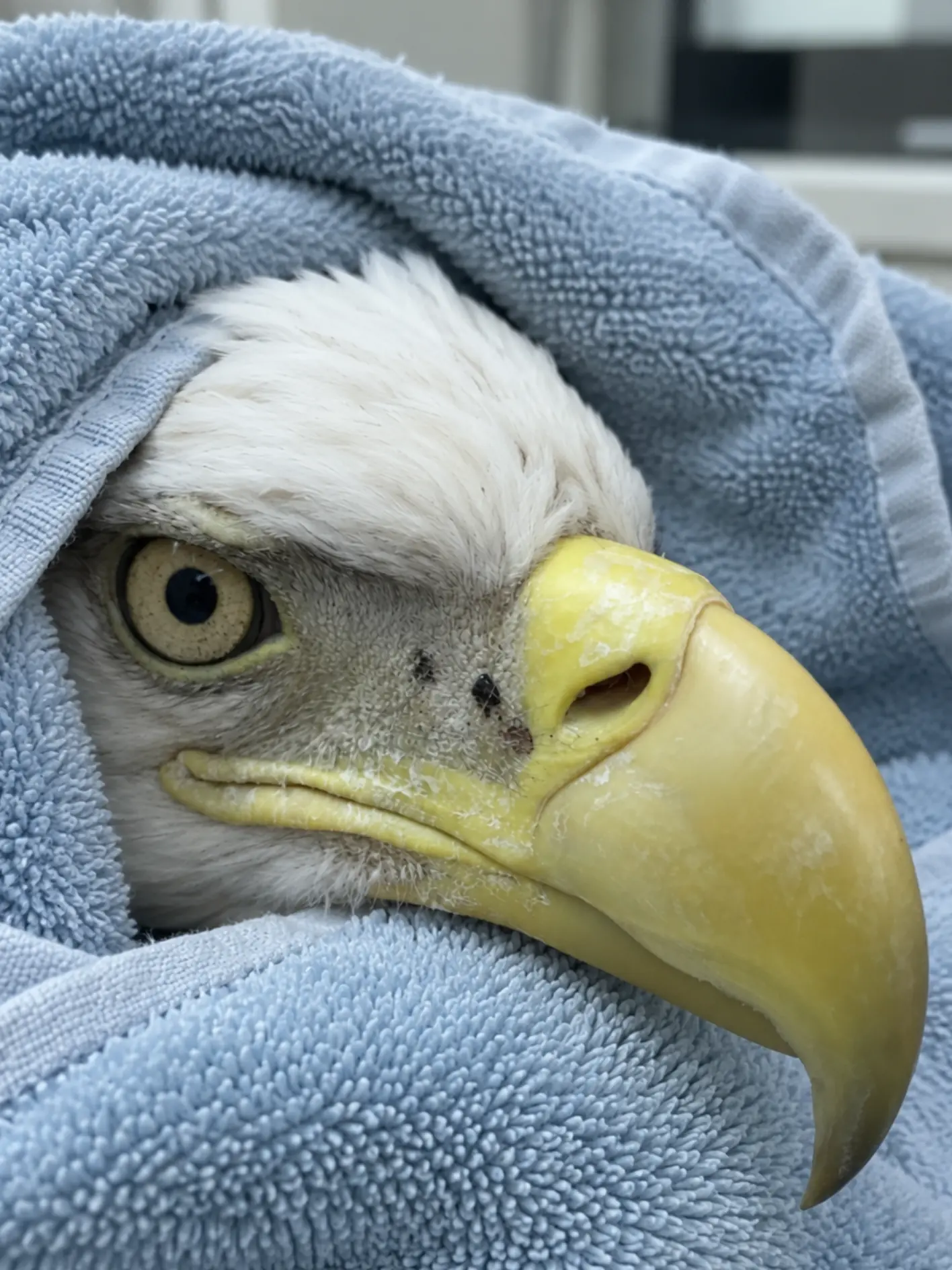
A healthy Bald Eagle normally carries itself upright. Its legs are positioned beneath the body, its powerful feet support its weight, and its talons either rest flat against the ground or close securely around a perch.
This bird could do none of those things.
Instead, the adult Bald Eagle leaned backward with both legs stretched awkwardly in front of its body. Its feet showed very little grip strength. Both wings were held partially away from the body, almost as if the bird were using them as supports to keep from falling over.
There was no obvious broken wing.
There was no large external wound.
Nothing about the bird’s skeleton immediately explained why an animal built for powerful flight could barely hold itself upright.
But something was clearly very wrong.
The eagle had been found grounded in the Upper Midwest and was transferred to a licensed wildlife rehabilitation center after rescuers realized it could not fly normally. By the time it reached the medical team, the bird was weak, dehydrated and showing neurological abnormalities severe enough that staff immediately began looking beyond trauma.
Blood testing eventually provided the answer.
The eagle had a markedly elevated concentration of lead in its bloodstream.
The abnormal sitting posture, the weakness in its legs, the reduced grip strength and the inability to maintain normal balance were all consistent with severe lead toxicosis.
The bird was moved into intensive supportive care and began treatment under veterinary supervision.
Its prognosis was guarded.
And although the exact source of the lead may never be known, the case reflects a problem wildlife rehabilitators across North America continue to encounter in scavenging raptors.
The Way the Eagle Was Sitting Was the First Clue
The bird’s posture immediately caught the rehabilitation team’s attention because it was so different from what they expect from a healthy Bald Eagle.
Even a temporarily grounded eagle normally tries to remain upright.
The legs stay beneath the body.
The feet engage the floor.
The toes flex.
The wings remain folded closely against the sides.
This bird was almost doing the opposite.
Its body weight had shifted backward.
The legs projected forward rather than supporting the torso.
The toes were not gripping normally.
The wings were opened enough to create additional points of support.
In effect, the bird was using parts of its wings to compensate for a loss of strength and coordination in its legs.
“That posture was immediately abnormal,” the rehabilitator said. “It wasn’t simply resting. It looked like the bird could not organize its body well enough to sit or stand normally.”
That kind of presentation can point veterinarians toward neurological or neuromuscular dysfunction.
It does not reveal a diagnosis by itself.
But it tells the medical team that the problem may involve more than a single injured limb.
The Eagle Had Been Found Grounded and Unable to Fly
The initial call came after someone noticed the eagle remaining on the ground for an extended period.
Bald Eagles do spend time on the ground.
They may descend to feed on fish, carrion or other prey.
They may rest after a large meal.
But this bird did not behave like a healthy eagle simply taking a break.
It did not fly away when given space.
Its movements were slow.
It appeared unable to maintain normal posture.
The feet were not working as expected.
Wildlife responders approached cautiously.
A Bald Eagle can still use its talons defensively even when severely compromised, so the bird was handled with protective equipment and transferred to a secure carrier.
No attempt was made to force it to fly.
The unusual posture alone was enough to justify immediate medical evaluation.
Trauma Was Considered First
Grounded eagles are often evaluated for traumatic injury.
Vehicle collisions are common concerns.
So are power-line accidents, territorial encounters, falls and other impact events.
The veterinary team therefore examined the entire bird.
Both wings were checked.
The shoulders were palpated.
The legs and feet were examined.
The pelvis and spine were assessed.
The head and eyes were evaluated.
No major fracture was found that could explain the degree of weakness.
The bird’s wings were structurally present.
The legs were not obviously broken.
Yet the eagle still could not use its body normally.
That discrepancy became important.
If the wings were not broken, why could the eagle not fly?
If the legs were not fractured, why could it not stand?
The answer increasingly appeared to lie in function rather than structure.
Severe Weakness Can Be Neurological
A bird does not stand simply because its bones are intact.
Standing requires the nervous system to coordinate muscles throughout the legs, feet and body.
Signals must travel from the brain and spinal cord to the muscles.
Those muscles must contract with enough force and precision to maintain balance.
The feet must respond.
The toes must flex.
The bird must continuously adjust its posture.
When that system is disrupted, the animal may appear almost mechanically intact but still be unable to perform basic movements.
The eagle’s backward-leaning posture was therefore a major concern.
Its wings were not necessarily failing first.
Its entire neuromuscular system appeared compromised.
Bloodwork Became Essential
The rehabilitation team collected blood to evaluate the eagle’s internal condition.
They wanted to know whether the bird was dehydrated.
Whether it was anemic.
Whether organ function was abnormal.
Whether inflammatory changes were present.
And because unexplained weakness in scavenging raptors raises particular concern, lead testing was included.
The result was markedly elevated.
That finding changed the direction of the case.
The eagle was not simply exhausted.
It was not merely recovering from an unseen collision.
Lead toxicosis became the primary explanation for the combination of neurological weakness, abnormal posture and impaired grip.
Lead Can Affect Multiple Systems at Once
Lead is toxic to wildlife because it can interfere with several physiological systems.
The nervous system is among the most important.
Affected birds may become:
weak,
poorly coordinated,
unable to grip normally,
unable to stand,
lethargic,
or neurologically abnormal.
Some develop gastrointestinal dysfunction.
Some stop eating.
Some experience vision problems or generalized muscle weakness.
In severe cases, a raptor may have completely intact wings yet remain unable to fly because the body no longer has the coordination or muscular strength required for takeoff and controlled movement.
That helps explain the eagle’s strange posture.
The bird’s wings were partly extended not necessarily because the wings themselves were damaged, but because the bird needed them to stabilize a body that its legs could no longer support properly.
Grip Strength Was Severely Reduced
For a Bald Eagle, the feet are essential equipment.
They are used to:
capture prey,
hold food,
grip perches,
maintain balance,
and absorb the forces of landing.
The rehabilitation team immediately noticed that this eagle’s grip was weak.
The toes did not close around objects with the expected force.
The feet were slow to reposition.
That loss of grip was consistent with the broader neurological picture.
A Bald Eagle with weak feet cannot survive normally in the wild even if its wings remain capable of movement.
The bird would be unable to perch securely.
It could not hold food effectively.
It might not be able to land safely.
That is why grip strength became one of the most important functional measurements during treatment.
The Exact Source of the Lead May Never Be Known
The blood test could establish that the eagle had been exposed to lead.
It could not identify exactly where the exposure occurred.
That distinction matters.
Bald Eagles are opportunistic feeders.
They hunt live prey, but they also scavenge extensively.
Animal carcasses can provide an efficient source of calories, especially during periods when other food is less predictable.
One well-recognized pathway of lead exposure involves carcasses or discarded animal remains that contain fragments of lead ammunition.
A projectile can fragment after entering an animal.
Some pieces may remain within tissue.
A scavenger feeding later may swallow those fragments unknowingly.
The eagle does not need to ingest an entire bullet.
Very small fragments within edible tissue can provide a route of exposure.
Deer Carcasses and Discarded Remains Can Become Feeding Sites
During and after hunting seasons, scavengers may gather around carcasses, unrecovered animals or field-dressed remains.
For an eagle, this is simply a food opportunity.
The bird has no way to distinguish between uncontaminated tissue and tissue containing tiny fragments of metal.
It feeds.
The material enters the digestive system.
From there, absorbed lead can begin affecting the body.
Not every eagle feeding on a carcass will become clinically poisoned.
Not every carcass contains lead fragments.
But the pathway is well recognized enough that wildlife hospitals routinely consider lead testing in eagles presenting with unexplained weakness or neurological signs.
Fishing Tackle Represents Another Source of Environmental Lead
Lead associated with fishing equipment can also enter aquatic environments.
Lost sinkers, jigs and other tackle may remain in lakes, rivers and wetlands.
Waterbirds can sometimes ingest small pieces directly while feeding.
Other animals may interact with contaminated prey or carcasses.
For a Bald Eagle that spends substantial time around waterways and feeds opportunistically, aquatic sources of environmental lead are also relevant to the broader conservation picture.
Again, that does not mean this individual eagle definitely encountered lead through fishing tackle.
The exact source remains unknown.
The important point is that multiple environmental pathways can bring lead into contact with wildlife.
Treatment Began Immediately
Once blood testing confirmed significant lead exposure and the clinical signs supported lead toxicosis, the medical team began targeted treatment.
The first priority was stabilization.
The eagle was dehydrated and weak.
It could not perch normally.
It was housed on a padded surface where it could rest without falling.
Fluids were administered according to its condition.
Nutritional support was provided carefully.
The enclosure was kept quiet and low-stress.
When clinically appropriate, chelation therapy was initiated under veterinary supervision.
Chelating medications bind circulating lead and help the body eliminate it.
But chelation is not an instant antidote.
Removing Lead Does Not Immediately Reverse the Damage
This is one of the most important realities in lead-poisoning cases.
Lowering the amount of circulating lead is only one part of treatment.
The nervous system may already have been affected.
Muscle control may already be impaired.
The gastrointestinal system may already be functioning poorly.
The bird may have lost body condition.
Kidneys and other organs may also have experienced stress.
That means visible recovery can lag behind laboratory improvement.
A blood lead concentration may begin falling before an eagle can stand normally again.
Or a bird may appear brighter while still carrying enough impairment to make release unsafe.
For that reason, veterinarians monitor both laboratory values and physical function.
The First Days Were Critical
During the earliest phase of treatment, the eagle remained profoundly weak.
Its posture was still abnormal.
The legs often remained extended forward.
The wings continued to assist with balance.
The bird spent significant time resting.
It showed limited strength when handled.
Its appetite was not yet normal.
The rehabilitation team watched for even small changes.
Could the bird hold its head higher?
Could it pull one leg beneath the body?
Did the toes begin flexing?
Would the wings fold more naturally?
Could the eagle sit without leaning backward?
These basic movements became important milestones.
The First Improvement Was More Normal Body Position
Gradually, staff began noticing that the bird’s posture was changing.
The eagle did not lean backward as dramatically.
One foot came farther beneath the body.
Then the other.
The wings no longer needed to remain spread as widely for support.
The bird began holding itself closer to the upright posture expected of a healthy raptor.
That was a significant development.
A person watching from outside might see only a bird sitting differently.
The rehabilitation team saw neurological function beginning to return.
Toe Movement Became Stronger
The toes also began responding more normally.
At first, the improvement was subtle.
The eagle flexed them more often.
Then the toes began closing with greater force.
Grip strength increased.
This was one of the best functional signs the team could observe.
A powerful grip requires coordination between the nervous system and muscles.
As the eagle regained that ability, it suggested that the lead-associated weakness was beginning to improve.
Appetite Returned Gradually
The bird also started showing more interest in food.
Initially, nutrition required close monitoring because severe weakness can make feeding difficult.
As treatment progressed, the eagle became more willing to eat voluntarily.
That helped the recovery process significantly.
An animal rebuilding muscle and recovering from systemic illness needs energy.
Voluntary feeding also reduces the stress associated with assisted nutritional support.
The team continued monitoring body weight and condition.
The goal was not simply to make the bird heavier.
It needed to rebuild functional muscle.
The Eagle Became More Alert During Examinations
Recent photographs show the adult eagle awake and visually attentive while wrapped securely in a towel during medical handling.
Its eye is open.
It follows the activity around it.
The beak is closed.
The bird remains physically restrained for safety and stress reduction during examination.
That level of awareness is encouraging compared with the profound weakness described at intake.
But the image alone does not demonstrate complete recovery.
The team still needs objective evidence that the bird can stand, grip and eventually fly normally.
Repeat Lead Testing Matters
As treatment continues, blood lead concentration can be checked again.
Veterinarians want to see a downward trend.
If levels remain elevated, additional treatment may be required.
But laboratory values are interpreted alongside the bird’s behavior.
A lower number is good.
A normal posture is better.
Strong grip is better still.
Ultimately, release depends on the bird as a whole, not a single laboratory result.
Kidney Function May Also Need Monitoring
Lead exposure and chelation treatment can place additional demands on the body.
Veterinarians may therefore monitor organ function as rehabilitation progresses.
Hydration remains important.
So does adequate nutrition.
The eagle must tolerate treatment without developing new complications.
This is why severe lead poisoning is managed as a whole-body problem.
The goal is not merely to remove metal from the bloodstream.
The goal is to return the animal to normal physiological function.
The First Perch Will Be an Important Test
Once the eagle can stand reliably on the floor, staff can introduce a low perch.
The perch is deliberately kept close to the padded surface at first.
If the bird slips, the risk of injury is limited.
The team will watch how the eagle positions its feet.
Do the toes wrap completely around the perch?
Can it support body weight with both legs?
Does it lean backward?
Does it use its wings to maintain balance?
Can it remain perched without fatigue?
A successful transition to a perch would represent another major neurological milestone.
Perching Is More Demanding Than Standing
Standing on a flat surface allows weight to spread across the feet.
A perch requires active grip.
The toes must close around a narrower structure and remain engaged continuously.
Balance adjustments must happen constantly.
For a bird recovering from neurological weakness, perching can reveal deficits that are not obvious on the floor.
That is why rehabilitators pay close attention to it.
A bird that cannot perch securely cannot return to the wild.
Feeding Independently Will Also Be Evaluated
Bald Eagles use their feet during feeding.
They pin food with their talons while tearing pieces with the beak.
This requires strength and coordination.
As the bird improves, staff can observe whether both feet participate normally.
An eagle that eats from a bowl but cannot secure food with its talons may still have an important deficit.
The rehabilitation process therefore gradually becomes more demanding as basic health returns.
Flight Comes Much Later
The bird will not be released simply because it can stand and perch.
Lead poisoning can produce subtle neurological effects.
A bird may appear almost normal while stationary but reveal problems during complex movement.
Flight requires coordination between:
vision,
balance,
muscles,
wings,
tail,
legs,
and feet.
The eagle must perform all of those functions simultaneously.
That makes flight testing one of the most important final assessments after lead toxicosis.
Takeoff Will Show Whether Strength Has Truly Returned
A Bald Eagle must generate tremendous force during takeoff.
The legs push from the ground or perch.
The wings begin powerful strokes.
The body must immediately stabilize.
A bird with lingering weakness may hesitate, fail to gain altitude or become unbalanced.
Those signs would indicate that rehabilitation needs to continue.
The goal is not simply to become airborne.
The goal is a strong, controlled launch.
Turning and Landing Will Test Coordination
Once airborne, the eagle must control direction.
Turning requires asymmetrical adjustments between both wings.
Landing is even more complex.
The bird must judge distance.
Slow itself.
Extend the feet.
Orient the talons.
And absorb impact on a perch.
A mild neurological problem may not be visible until that moment.
That is why rehabilitation staff watch landing behavior carefully in birds recovering from toxins.
One Good Flight Will Not Be Enough
Wild survival demands repeated performance.
An eagle may need to fly long distances.
Respond to strong winds.
Escape another eagle.
Carry food.
Make rapid changes in direction.
Land on narrow branches.
A single successful flight inside an enclosure cannot prove that the bird is ready.
The eagle will need to demonstrate consistency.
Endurance.
Accuracy.
And normal behavior across repeated sessions.
The Prognosis Remains Cautious
The eagle’s improving posture and grip are encouraging.
Its greater alertness is encouraging.
The return of appetite is encouraging.
But severe lead toxicosis can have lasting effects.
The rehabilitation team therefore remains cautious.
The bird must continue improving.
Lead levels must decline.
Neurological function must normalize.
Grip must become strong.
Standing and perching must remain stable.
And flight must ultimately meet the standards required for release.
Until then, the prognosis remains guarded but improving.
The Case Highlights a Preventable Exposure Pathway
The exact source of this eagle’s lead may never be established.
But cases like this draw attention to known pathways by which lead enters scavenging wildlife.
One of the most direct opportunities for prevention is reducing the amount of lead left in edible animal tissue.
Non-lead ammunition can reduce that particular source.
Proper management of carcass remains can also limit scavenger access to contaminated material.
Reducing lost lead fishing tackle can help decrease another source entering aquatic ecosystems.
These measures do not eliminate every environmental exposure.
But they address routes that wildlife cannot avoid on its own.
The Concern Is the Material, Not Scavenging Behavior
Bald Eagles are not behaving abnormally when they feed on carrion.
Scavenging is a natural and useful feeding strategy.
A carcass represents concentrated energy.
The problem arises when toxic material is present inside that food.
An eagle cannot visually detect tiny lead fragments hidden in tissue.
It cannot choose to eat around them.
Preventing exposure therefore has to happen before the bird reaches the carcass.
Hunters Can Be Part of the Solution
The issue does not need to be framed as a conflict between wildlife rehabilitation and hunting.
Hunters contribute substantially to wildlife conservation and habitat management in the United States.
The practical question is narrower:
What material remains in tissue that scavengers may later consume?
Using effective non-lead ammunition where possible can reduce that pathway.
That approach allows hunting to continue while decreasing a specific toxic risk to scavengers.
Wildlife Hospitals See the Consequences Individually
Population studies describe lead exposure with percentages and trends.
Rehabilitation centers encounter it as individual animals.
A bird arrives unable to stand.
Another loses grip strength.
Another can no longer fly.
Another is found beside a road and initially assumed to have been struck by a vehicle.
The clinical presentation may vary.
But blood testing can reveal a common underlying factor.
For staff, that makes lead toxicosis both a medical and a conservation issue.
The Eagle’s Posture Told the Story Before the Blood Test Did
When this bird first entered the facility, the medical team did not yet know the laboratory result.
But its body was already showing that something fundamental had gone wrong.
A Bald Eagle that should have been upright instead leaned backward.
Legs that should have supported the body stretched forward.
Talons built to lock around a perch barely gripped.
Wings designed for flight were being used simply to keep the bird from falling.
That posture was not a diagnosis.
But it was an unmistakable sign of dysfunction.
The blood test explained why.
Recovery Is Being Measured in Small Movements
Now the team watches for the opposite progression.
Legs moving beneath the body.
Toes curling.
Feet gripping.
Wings folding normally at the sides.
The eagle holding itself upright without support.
Eating voluntarily.
Standing longer.
Eventually perching.
Then flying.
Each movement is a small return toward what a healthy Bald Eagle does automatically.
A Lower Lead Level Will Not Be the Finish Line
The medical team may eventually reach a point where blood testing shows that the toxic burden has fallen substantially.
That will be important.
But release requires more.
Wildlife rehabilitation does not release laboratory results.
It releases animals.
The eagle itself must demonstrate that the nervous system has recovered enough to support life outside human care.
That means function.
The Final Goal Is a Bird That No Longer Needs the Center
If rehabilitation succeeds, the eagle will eventually move into increasingly natural housing.
Human contact will remain limited.
It will build strength.
Use perches.
Feed independently.
Fly repeatedly.
Avoid people.
The best outcome is not a bird that becomes comfortable with its caregivers.
It is a bird that becomes difficult to approach, difficult to handle and entirely capable of leaving them behind.
That is what a successful release requires.
For Now, the Eagle Is Still in Treatment
The bird remains under veterinary supervision.
Its lead concentration is being monitored.
Its posture is improving.
Its feet are beginning to work more normally.
Its awareness has increased.
The team is encouraged, but not complacent.
The initial neurological signs were severe enough that nobody is assuming a complete recovery until the eagle proves it.
The days ahead will reveal whether the nervous system continues to regain function.
The First Sign of Illness May Become the Best Measure of Recovery
The eagle arrived sitting in a position no healthy raptor should need.
Leaning backward.
Legs out in front.
Wings opened for support.
If treatment continues working, that same posture provides a simple way to understand how far the bird has come.
The day the eagle no longer needs its wings to hold itself upright matters.
The day its feet remain beneath its body matters.
The first strong grip matters.
The first confident perch matters.
And eventually, the first controlled flight matters.
For an eagle recovering from lead poisoning, these ordinary movements are not ordinary at all.
They are evidence that a nervous system disrupted by a toxic metal is beginning to function again.
The exact meal that exposed this Bald Eagle to lead may never be identified.
What is known is what happened afterward.
A powerful adult raptor reached the point where it could no longer sit, stand or grip normally.
Its blood revealed the toxic burden its body had been carrying.
Now veterinarians and rehabilitators are working to reverse as much of that damage as possible.
The bird is not ready for the wild yet.
But every time its feet move back beneath its body, every time its talons close more strongly and every time its wings remain folded instead of being used as crutches, the eagle moves a little closer to the function it will eventually need most.
Flight begins with the wings.
But in this case, recovery begins with something much simpler:
being able to stand again.