An adult Bald Eagle was brought into emergency wildlife care after being found grounded near the James River in Virginia, with injuries considered consistent with a recent confrontation involving another eagle.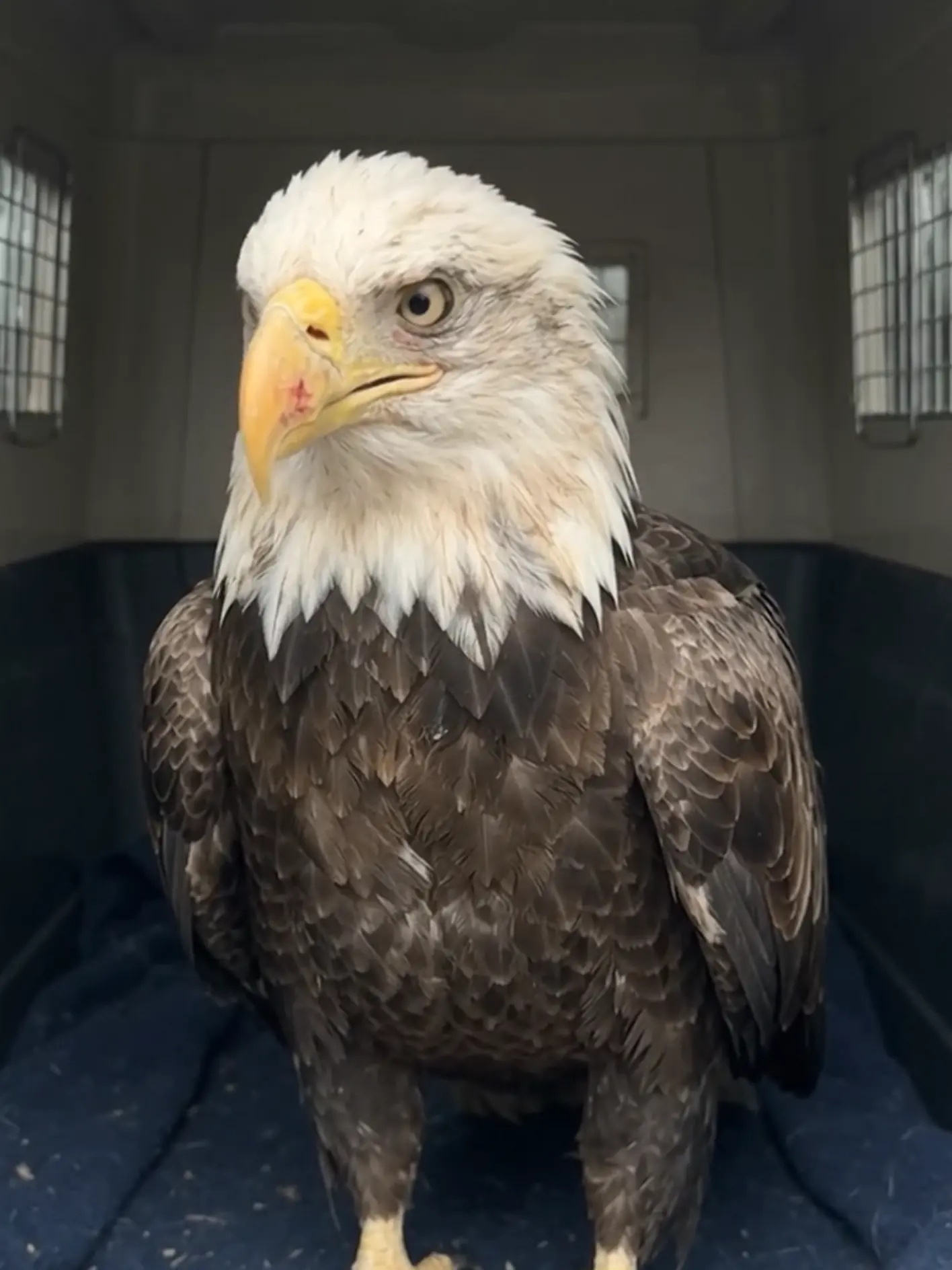
When rescuers first approached, the bird was conscious but unusually quiet.
It did not display the strong defensive behavior normally expected from a healthy adult Bald Eagle. Its posture was low, its responses were slow, and it appeared reluctant to move even when people came within a distance that should ordinarily have prompted an immediate attempt to escape.
Several small wounds were visible around the face and upper body, and feathers along the neck and chest were disordered. The eagle could move both wings and both legs, but it lacked the alertness, strength and coordination expected from an adult bird capable of surviving independently in the wild.
Because of the location of the wounds and the circumstances in which the eagle was found, the rehabilitation team considered a territorial confrontation with another Bald Eagle one of the leading possibilities.
No one witnessed what happened.
There was no video of the encounter and no second injured eagle was found nearby.
For that reason, the exact cause may never be known.
But the distribution of the injuries was considered compatible with talon trauma, and staff suspected that the eagle may have been knocked to the ground during an aggressive encounter, leaving it temporarily stunned, exhausted or disoriented.
At admission, the prognosis was guarded.
The bird was awake, but far too subdued.
Several days later, however, the picture looks very different.
The eagle is now standing normally.
Its grip has strengthened.
Its eyes remain open and attentive.
It watches staff closely.
And perhaps most encouraging of all, the bird that initially tolerated human presence with very little resistance is once again behaving much more like a wild Bald Eagle.
“The change in its level of awareness has been one of the most encouraging things to see,” the attending wildlife veterinarian said. “When this eagle arrived, it was conscious but unusually quiet and slow to respond. Now it is alert, standing normally and paying very close attention to everything happening around it.”
The bird is not ready for release yet.
Its wounds still need time to heal, and it will eventually have to prove that it can fly, turn and land normally.
But the neurological and behavioral improvement so far has given the rehabilitation team reason for cautious optimism.
The Eagle Was Found Grounded Near the James River
The first report came from someone who noticed an adult Bald Eagle remaining on the ground near a stretch of habitat along the James River.
A Bald Eagle on the ground is not automatically injured.
These birds frequently descend to feed on fish, carrion or other prey. They may remain low for extended periods while eating.
What concerned the observer was that this eagle did not leave.
It remained in roughly the same area.
Its posture appeared abnormal.
And when approached from a responsible distance, it did not respond with the immediate alertness expected from a healthy adult bird.
A normal Bald Eagle generally watches people carefully and maintains a significant safety buffer.
If that distance is reduced, the bird will usually move away or take flight.
An eagle that allows people to come unusually close may be injured, sick, exhausted or neurologically compromised.
That behavior alone was enough to justify contacting wildlife professionals.
The Rescue Had to Be Done Carefully
The fact that the eagle was weak did not make it safe to handle.
Bald Eagle talons can cause severe injuries.
Even a bird that appears barely responsive can suddenly strike if it feels threatened.
Wildlife responders therefore approached with appropriate protective equipment and controlled the feet before fully restraining the bird.
The wings were supported close to the body.
Handling was kept brief.
The eagle was then placed into a secure, ventilated carrier lined with towels and padding.
During transport, the environment was kept relatively dark and quiet.
Reducing stimulation helps lower stress in injured wild birds, particularly when there may be head trauma or neurological impairment.
The eagle remained conscious throughout transport but continued to appear unusually subdued.
The First Examination Raised More Questions Than Answers
At the rehabilitation center, the medical team began with a systematic physical examination.
The bird’s wings were palpated.
Both shoulders were evaluated.
The humerus, radius, ulna and distal wing structures were checked for obvious instability.
The legs, feet and pelvis were also examined.
No catastrophic deformity was immediately apparent.
Several small traumatic wounds were found around the face, neck and upper body.
There was mild bruising and disturbed plumage in several areas.
Some puncture-type wounds were considered compatible with talon contact.
Yet none of the visible injuries seemed severe enough to fully explain why the eagle was so quiet and poorly coordinated.
That discrepancy became one of the central concerns of the case.
The Bird Was Awake — But Too Calm
Healthy Bald Eagles generally resist human handling.
They watch intensely.
They may vocalize.
They may strike with their feet.
They often attempt to move away as soon as an opportunity appears.
This bird did very little of that during its first examination.
It was not unconscious.
It was aware of the medical team.
But its reactions were reduced.
“The fact that the bird was conscious was encouraging,” the veterinarian said. “But it was much too quiet for a healthy adult eagle. In wildlife medicine, an animal that suddenly becomes easy to handle can actually be telling you that something is very wrong.”
The team began considering temporary neurological impairment from blunt trauma.
A collision or fall during an aerial confrontation could potentially produce concussion-like signs even without a visible skull fracture.
Why a Territorial Fight Was Suspected
The small puncture wounds around the head and upper body were one reason the team considered another eagle.
Bald Eagles can be intensely territorial.
Conflicts may occur over nesting areas, mates, favored feeding sites, perches or access to food.
Most disputes end without serious injury.
One bird may simply chase another away.
But close interactions can become physical.
Bald Eagles use their feet and talons during aggressive encounters.
They may strike at each other in flight.
They may briefly lock feet.
They may lose altitude.
If two large birds become entangled or distracted during a confrontation, one or both may hit the ground, a branch or another object.
A bird can therefore suffer two different types of injury in a single event:
direct punctures from talons,
and blunt trauma from the subsequent fall or collision.
That combination fit what veterinarians were considering in this eagle.
But because no one saw the event, the conclusion remains tentative.
Radiographs Were Used to Rule Out Hidden Fractures
The medical team obtained radiographs to look for injuries that could not be confirmed through palpation alone.
Particular attention was given to:
the wings,
shoulders,
pelvis,
and other areas potentially affected by a fall or collision.
No major skeletal fracture or dislocation was identified.
That was the first significant piece of good news.
A severe wing fracture could have dramatically changed the prognosis.
For an eagle to return to the wild, both wings need enough structural integrity to generate powerful and symmetrical flight.
The absence of a catastrophic orthopedic injury meant the team could focus more heavily on the bird’s neurological condition and soft-tissue wounds.
A Temporary Neurological Injury Became More Plausible
Because the skeleton appeared relatively intact, veterinarians evaluated the eagle’s neurological function more closely.
They watched:
pupil responses,
head position,
balance,
foot placement,
grip strength,
coordination,
and the bird’s ability to right and stabilize itself.
The bird appeared somewhat slow and weak during the early examination.
Its balance was not as confident as expected.
Its defensive responses were reduced.
Those findings were considered compatible with temporary neurologic depression following blunt trauma.
The team was careful not to label the condition definitively as a concussion.
In wildlife patients, advanced neurological imaging is not always available or justified, and concussion-like injuries may be diagnosed largely through history, examination and improvement over time.
What mattered most was whether the abnormalities progressed or began to resolve.
Supportive Care Became the First Treatment
Because there was no major fracture requiring immediate orthopedic surgery, treatment focused on stabilization.
The eagle was placed in a quiet enclosure with padded flooring.
No high perch was provided initially.
A bird with impaired balance should not be placed in a position where it can fall and create a new injury.
The medical plan included:
fluid support as needed,
pain management,
cleaning of superficial and puncture wounds,
careful monitoring for infection,
and minimal unnecessary handling.
If a puncture wound was considered contaminated or sufficiently deep, antimicrobial therapy could be used according to veterinary judgment.
The bird was kept warm and allowed to rest.
Sometimes the most important treatment after suspected blunt trauma is simply creating conditions in which the nervous system can recover without further stress.
The First Night Remained Uncertain
During the first several hours, staff watched for deterioration.
Head injuries can change over time.
A bird that appears stable initially may later develop worsening neurological signs.
The team monitored:
respiratory effort,
head control,
posture,
pupil response,
grip strength,
and overall alertness.
The eagle continued to rest heavily.
It did not show the level of defensive behavior staff wanted to see.
The prognosis remained guarded.
There was no reason to assume the bird would deteriorate, but there was also no responsible way to promise recovery.
The First Improvement Was in the Way the Eagle Held Its Head
By the following period of observation, staff began noticing subtle changes.
The eagle held its head upright for longer periods.
Its eyes stayed open more consistently.
It tracked movement around the enclosure with greater attention.
Those changes might seem small, but they were clinically meaningful.
A bird recovering from neurologic impairment often improves in stages.
Alertness returns before endurance.
Posture improves before flight.
Normal defensive behavior may return before the bird is physically ready for release.
The rehabilitation team documented each step.
Grip Strength Began to Return
The feet became another important indicator.
At intake, grip strength had been reduced.
As the eagle recovered, the toes began flexing more forcefully.
Both feet appeared more symmetrical.
The bird began placing them more confidently beneath its body.
For an eagle, this is critical.
The feet are used not only to capture prey but also to maintain balance during perching and landing.
A bird that cannot grip strongly cannot safely return to the wild.
The improvement suggested that both strength and neurological coordination were returning.
Then the Eagle Began Standing Normally
One of the clearest milestones came when the bird started remaining upright without assistance for increasingly long periods.
Its legs were positioned normally beneath the body.
It no longer seemed to collapse into the low, subdued posture seen at admission.
Balance improved.
The body remained more centered.
The eagle could shift its weight without obvious loss of coordination.
Recent images from the recovery enclosure show a very different patient from the one first brought in.
The bird is upright.
Both feet are planted normally.
The eyes are open.
Its posture is attentive.
The eagle looks less like a compromised patient and more like a wild raptor actively monitoring its surroundings.
That visual change matches what the rehabilitation team has been seeing clinically.
Alertness Has Now Returned Close to Normal
The most encouraging change may be behavioral.
The eagle now watches staff closely.
It reacts when someone enters the enclosure.
Its head follows movement.
It is less tolerant of people approaching.
Those behaviors are exactly what wildlife rehabilitators want to see.
A successful rehabilitation program is not trying to make a wild eagle comfortable around humans.
The opposite is true.
Normal wariness is important.
An eagle that regains the instinct to avoid people is demonstrating that both its physical strength and natural behavior are returning.
“The bird that barely reacted during intake is now watching every move we make,” the veterinarian said. “That is a very positive change.”