I do not usually share the final moments of a wildlife patient, especially when there is no recovery video, no release day, and no second chance waiting at the end of the story. Most people who follow wildlife rescue understandably prefer to see the cases that end well. They want to watch an injured eagle stand again, move to a flight enclosure, regain strength, and eventually disappear into the sky after weeks of treatment.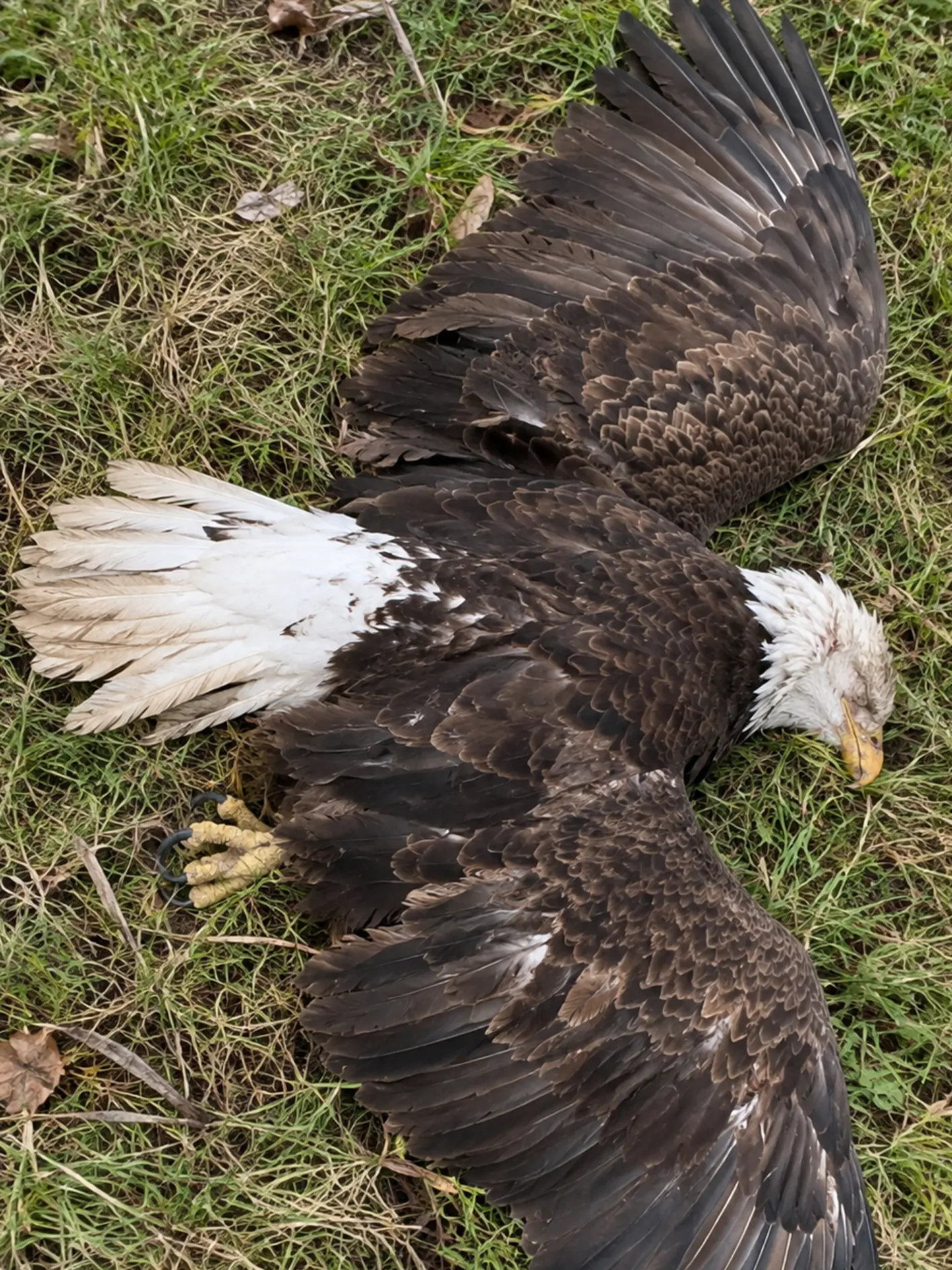
Those moments matter, and they are part of why we do this work.
However, they are not the whole reality of wildlife rehabilitation.
Sometimes we arrive in time to save an animal. Sometimes we arrive only in time to stop it from being struck again. Sometimes the injuries hidden beneath feathers are already too severe for medicine to reverse. In those cases, all that remains is to document what happened, learn from it, and hope that sharing the circumstances might prevent the same thing from happening to another animal.
That is why I decided to share the story of this Bald Eagle.
The adult eagle was struck by a vehicle while feeding on a dead animal beside a rural road. According to the driver, he had seen the eagle before reaching it. He expected the bird to move. He expected it to take off before the vehicle got close.
He did not substantially reduce his speed.
The eagle did attempt to leave.
It simply did not gain altitude fast enough.
When I reached the scene, the bird was still alive. Its wings were largely intact, there was no catastrophic open fracture, and from several feet away the injuries did not initially look severe enough to explain how close the eagle already was to death.
I placed it in a transport carrier and began driving toward emergency veterinary care.
During the drive, its breathing changed.
I could hear it from the front seat.
The breaths became heavier, wetter, and increasingly irregular.
I pulled over as soon as I could do so safely.
When I opened the carrier to check the bird, blood began coming from its mouth.
The eagle died before we reached the hospital.
A postmortem examination later identified severe internal blunt-force trauma and extensive internal hemorrhage consistent with a high-energy vehicle impact.
The outside of the bird had never shown us the full extent of what had happened inside.
I am not sharing this case to create anger toward one driver. I am not sharing it because graphic loss attracts attention. I am sharing it because one sentence from that scene has stayed with me.
“I thought it would fly.”
That assumption is exactly why people need to understand how large birds take off from the ground and why a Bald Eagle feeding beside a road may not be capable of clearing traffic as quickly as a driver expects.
Please slow down.
The Call Came in as an Injured Eagle Beside the Road
The report came from a rural two-lane road bordered by open grass, scattered woodland, and stretches of low brush.
A Bald Eagle had been hit by a vehicle.
The bird was still alive.
It was no longer in the active traffic lane when I arrived, but it was lying in the grass just beyond the pavement. One wing was partially extended, the head remained low, and the bird made only limited movements when I approached.
A healthy adult Bald Eagle does not normally allow a person to walk close enough to pick it up.
Even many severely injured raptors react aggressively when they realize a human is approaching. They may roll onto their backs, strike with their feet, spread their wings, or attempt to move away despite broken bones.
This eagle did almost none of that.
Its eye was open.
It was conscious.
It could see me.
It simply did not have much strength left.
The lack of resistance was not reassuring. It was one of the first signs that the impact had caused far more damage than I could see.
I approached carefully because a weak eagle can still inflict serious injuries with its talons. I controlled the feet first, supported the wings against the body, and assessed the bird as quickly as possible without unnecessarily manipulating it.
There was some superficial damage to the plumage. Several areas showed disturbed feathers and minor abrasions. However, I did not immediately see a major open fracture or a large external wound.
Both wings were present and appeared relatively well aligned.
The legs were intact.
There was no massive external blood loss.
For a moment, that gave me hope.
Then I felt how weak the eagle was.
The Driver Told Me He Had Seen the Bird Before the Impact
The driver remained long enough to explain what had happened.
According to his account, the eagle had been feeding on a dead animal near the roadside.
He saw it.
He expected it to move.
He believed the bird would fly away before his vehicle reached that point.
He did not substantially slow down because he assumed the eagle would clear the roadway on its own.
It did not.
I want to be precise about this because the purpose of sharing the case is not to transform one person into a villain.
There was no indication that the driver had deliberately tried to hit the eagle.
The important issue is the assumption he made.
He saw a large wild animal beside the roadway and assumed that the animal would respond to the approaching vehicle quickly enough to avoid being struck.
That assumption is common.
It is also dangerous.
Wild animals do not calculate vehicle speed the way people do.
They do not always move in the direction we expect.
They may freeze.
They may attempt to protect food.
They may already be compromised.
They may be facing away from traffic.
They may need several seconds to reposition their bodies before they can escape.
For a large bird such as a Bald Eagle, those seconds can determine whether it clears the roadway or enters directly into the path of the vehicle.
Bald Eagles Commonly Scavenge
Bald Eagles are highly capable predators, particularly around aquatic habitats, but they are also opportunistic scavengers.
Carrion is food.
A deer killed by a vehicle, a rabbit on the shoulder, a waterfowl carcass, a fish, or another dead animal may attract an eagle.
This behavior is not abnormal.
The eagle is not “making a bad decision” by feeding on carrion.
It is taking advantage of an available energy source, just as scavenging birds have done long before paved highways existed.
The problem is that modern roads place those food sources directly beside fast-moving vehicles.
A carcass that has already resulted from one collision can become a secondary hazard for every scavenger that arrives afterward.
Eagles are not the only animals affected.
Vultures, hawks, owls, ravens, crows, foxes, coyotes, and many other scavengers may be drawn toward roadkill.
The carcass itself may remain on the roadside for hours or days, creating repeated opportunities for additional collisions.
A Large Wingspan Does Not Mean an Eagle Can Instantly Lift Straight Up
One of the most persistent misunderstandings about large raptors is that their enormous wings somehow allow them to rise immediately into the air.
That is not how takeoff works.
A Bald Eagle cannot simply jump vertically several feet like a helicopter.
Its wings generate lift, but the bird needs motion and repeated powerful wingbeats to create enough airflow over those wings.
When an eagle is taking off from the ground, the first part of the flight may remain relatively low.
It may need to run or push forcefully with the legs.
It needs room to open its wings completely.
It needs enough horizontal distance to accelerate.
Only then can it gain meaningful altitude.
Several factors can make this process slower.
A large meal may increase the bird’s effective weight.
A full crop can affect the initial takeoff effort.
Tall roadside vegetation may limit the direction in which the eagle can launch.
A ditch may force the bird to climb over an embankment.
Trees, utility poles, fences, or traffic may influence its escape route.
If the bird is facing away from open space, it may first need to turn.
Every one of those movements takes time.
A driver traveling toward the bird may cover the same distance much faster than the eagle can gain height.
That is how an animal with a wingspan of six or seven feet can still end up directly in front of a vehicle.
The Driver Saw the Eagle Move, but the Bird Was Still Too Low
From what I was told, the eagle did attempt to get away.
It opened its wings and started to leave the feeding site.
However, it remained low during the first stage of takeoff.
The approaching vehicle reached it before the bird had gained enough altitude.
No independent video documented the exact moment of impact, so I cannot reconstruct every detail with certainty.
What I can say is that the circumstances described by the driver and the injuries later documented by the veterinary team were consistent with a vehicle strike.
The eagle had been feeding beside the road.
The driver saw the bird.
The bird attempted to leave.
The vehicle reached it before it cleared the travel path.
That sequence is preventable more often than people realize.
A few seconds of reduced speed can create substantially more time for a large animal to react.