An adult Bald Eagle found lying almost motionless near the Rappahannock River in Stafford County, Virginia, was rushed into emergency wildlife care after rescuers realized the bird was too weak to stand normally or attempt flight.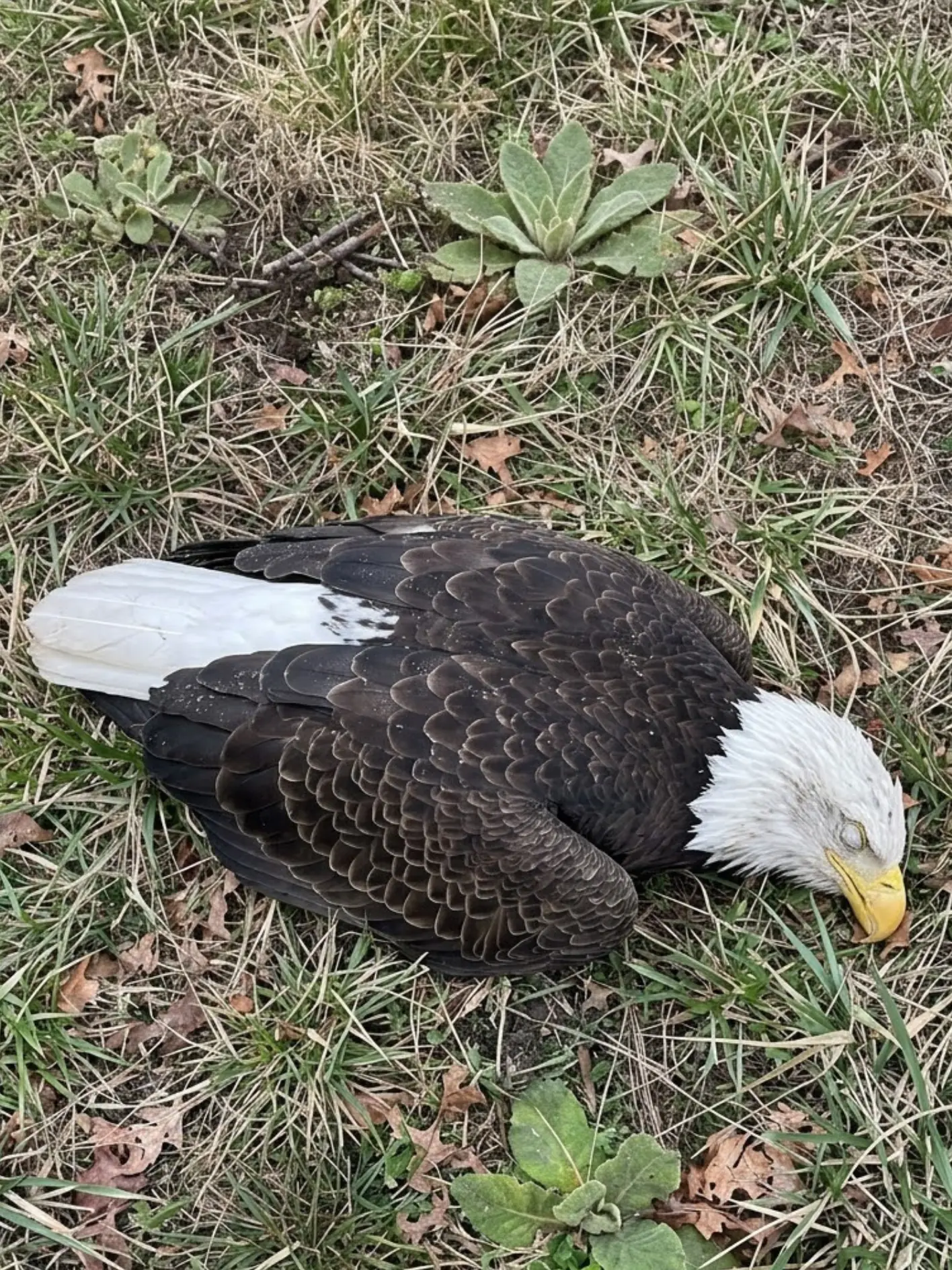
From a distance, the eagle looked almost as though it were sleeping.
Its body rested unusually low against the ground. Its eyes remained closed for long periods. When wildlife responders moved closer, the bird showed only limited defensive behavior — a striking departure from what would normally be expected from a healthy adult Bald Eagle.
There was no obvious open fracture.
No major external bleeding.
No visible injury severe enough to immediately explain why such a powerful raptor had become nearly incapacitated.
That absence of obvious trauma quickly shifted the veterinary team’s attention toward another possibility.
Based on the bird’s clinical condition, the circumstances in which it had been found, and previous cases involving similarly debilitated raptors, veterinarians became concerned that the eagle may have been exposed to an anticoagulant rodenticide.
The suspected route was secondary poisoning.
In other words, the eagle may never have touched rodent poison directly.
It may simply have eaten an animal that had.
“The clinical picture immediately raised concern for toxic exposure,” the attending wildlife veterinarian said. “This bird was profoundly weak, dehydrated and unable to function normally, but we were not seeing the kind of major orthopedic trauma that would explain that degree of collapse.”
Because some anticoagulant rodenticides interfere with the body’s ability to form normal blood clots, a poisoned animal can begin bleeding internally with few obvious external signs.
For a Bald Eagle already showing severe weakness, waiting for every diagnostic result before beginning supportive care could carry its own risks.
The treatment team began stabilization immediately.
The bird’s condition was considered critical.
The Eagle Was Found Almost Flat Against the Ground
The initial report came from a member of the public who noticed the Bald Eagle remaining in the same area near the river for an unusually long period.
Bald Eagles may spend time on the ground while feeding or resting.
That alone is not necessarily abnormal.
But healthy adults typically remain alert and maintain the ability to move away when approached.
This eagle did not.
Its head was low.
Its eyes repeatedly closed.
Its body seemed heavy against the ground.
Most concerning, it showed little interest in escaping even as responders moved within a distance that would normally cause a wild eagle to take flight.
That behavior was enough to justify intervention.
A wild Bald Eagle that permits close human approach is often not tame.
It is often sick or injured.
Rescuers Had to Assume the Bird Could Still Defend Itself
The eagle’s weak appearance did not make the rescue simple.
Even severely compromised raptors may retain enough strength in their feet to inflict serious injuries.
The talons remain the primary hazard.
Wildlife responders therefore approached using proper protective equipment and controlled the feet before fully securing the bird.
The wings were supported close to the body.
Handling time was kept as short as possible.
The eagle was placed into a ventilated transport carrier lined with towels and padding, then moved directly to a licensed wildlife rehabilitation center in Northern Virginia.
Low light and minimal stimulation helped reduce stress during transport.
The bird spent much of the trip resting with its head supported against the padding.
The First Examination Did Not Reveal a Major Traumatic Injury
At intake, the veterinary team performed a rapid but systematic examination.
The wings were palpated.
The legs and feet were checked.
The shoulders were compared.
The keel, spine and pelvis were assessed as carefully as the bird’s condition allowed.
There was no obvious catastrophic fracture.
No major wing deformity.
No large open wound.
No single injury that could adequately explain why the eagle was so weak.
That finding did not make the case less serious.
It made the diagnosis more complicated.
A bird can be critically ill even when the problem is invisible from the outside.
The Eagle Was Profoundly Debilitated
Several abnormalities stood out immediately.
The bird was dehydrated.
Its overall strength was poor.
Its posture was abnormal.
Grip strength was reduced.
It appeared lethargic and required substantial support during examination.
The eagle could respond to movement, but its reactions were slower and less forceful than expected.
The clinical team also remained alert for evidence of blood loss or abnormal bleeding.
With suspected anticoagulant rodenticide exposure, bruising or internal hemorrhage can occur even when very little blood is visible externally.
Veterinarians therefore needed laboratory information.
Bloodwork Became a Priority
The medical team collected blood to evaluate several aspects of the bird’s condition.
One important measurement was packed cell volume, or PCV.
PCV reflects the proportion of the blood made up of red blood cells.
If an eagle has been bleeding internally, the value may fall.
The team also considered clotting function, hydration status and other indicators of systemic illness.
In a severely compromised wildlife patient, these numbers are not interpreted in isolation.
They are combined with:
- posture,
- respiratory effort,
- mucous membrane appearance,
- strength,
- neurological function,
- and the bird’s response to treatment.
The concern was not simply whether the eagle had been exposed to a toxicant.
The more urgent question was whether that exposure had already caused clinically significant bleeding or circulatory compromise.
Why Rodenticide Became a Leading Concern
Anticoagulant rodenticides work by disrupting the body’s normal clotting process.
They interfere with vitamin K-dependent clotting factors.
The result is delayed bleeding.
That delay is important.
A rodent may ingest bait and continue moving through the environment for some time before becoming critically ill.
During that period, the animal may become lethargic or slow.
That can make it easier prey for predators.
If an eagle, owl, hawk, fox, or other predator consumes the poisoned animal, the toxicant can potentially move into the predator as well.
The predator was never the intended target.
But the poison does not necessarily stop with the rodent.
The Eagle Did Not Need to Eat the Bait
This is one of the most important points in secondary poisoning.
A Bald Eagle does not have to enter a building, find a bait station or directly ingest rodenticide to be exposed.
The pathway may be indirect.
A rat eats poison.
The rat becomes weak.
The rat is captured or scavenged.
The eagle eats the rat.
The toxicant moves one step higher in the food web.
The eagle has no way to recognize that the prey contains a chemical.
To the bird, it is simply food.
Not Every Rodenticide Causes the Same Type of Poisoning
Veterinarians also emphasized an important distinction.
The term “rodenticide” describes a broad category of products.
Different active ingredients affect the body in different ways.
The concern in this case specifically involved the possibility of an anticoagulant rodenticide, because those compounds can cause bleeding by disrupting normal clot formation.
The rehabilitation team was careful not to claim that every type of rat or mouse poison produces the same clinical signs.
Accurate terminology matters, particularly when discussing wildlife toxicology.
Treatment Began Before Every Question Was Answered
The eagle was too compromised for the team to simply place it in an enclosure and wait.
Supportive treatment began immediately.
The bird was placed on padded flooring rather than a high perch.
That reduced the risk of falling.
Fluids were administered according to clinical need to address dehydration and support circulation.
The environment was kept warm, quiet and dimly lit.
Pain was managed as appropriate.
Veterinarians continued monitoring the bird for respiratory changes and evidence of worsening blood loss.
When the clinical suspicion for anticoagulant exposure was considered sufficiently strong, treatment directed at clotting dysfunction could be initiated under veterinary supervision.
Vitamin K1 is commonly used in cases involving anticoagulant rodenticides because the body needs vitamin K to produce several essential clotting factors.
The goal is not to “flush out” the poison instantly.
The goal is to help restore the body’s ability to clot while the toxicant is being metabolized and eliminated.
Why Vitamin K Can Be So Important
Anticoagulant rodenticides do not usually cause immediate collapse the moment they are swallowed.
Their effects develop as functional clotting factors are depleted.
That means an exposed bird may initially look relatively normal.
Then bleeding begins.
It may occur internally.
In the chest.
Abdomen.
Muscles.
Or beneath the skin.
By the time an eagle is discovered unable to fly, the physiological effects may already be advanced.
Vitamin K1 therapy can help the body resume production of functional clotting factors, but the process takes time.
Treatment may need to continue for an extended period depending on the suspected compound and clinical response.
Some second-generation anticoagulants can persist in tissues longer than older compounds.
That is one reason repeat testing is important.
The First Night Was Critical
The eagle remained under close observation throughout the first night.
Staff watched its breathing.
Its head position.
Its ability to move.
Its level of alertness.
Its response to sound and motion.
Any sign of sudden deterioration could indicate new bleeding, circulatory compromise or another complication.
The bird was not placed on a high perch.
It was simply too weak.
Instead, the padded floor allowed the eagle to rest without risking another injury.
The prognosis remained guarded.
At that stage, no one was willing to say whether the bird would recover.
There Were No Dramatic Signs of Improvement at First
Wildlife recovery often progresses slowly.
The eagle did not suddenly stand up and behave normally.
The first changes were much smaller.
It began opening its eyes for longer periods.
The head stayed upright more consistently.
Its grip seemed slightly stronger.
The bird reacted more readily when staff entered the enclosure.
Those changes were encouraging because they suggested that neurological function and overall strength were improving.
But the eagle remained seriously ill.
The Team Watched Closely for Anemia
If internal bleeding had occurred, the packed cell volume could decline over time.
That made repeat blood assessment important.
A bird can appear slightly more alert while still carrying significant anemia.
And anemia itself can create profound weakness because less oxygen is being transported to the tissues.
For a Bald Eagle, that can eventually affect:
- standing,
- grip strength,
- endurance,
- and flight capacity.
The rehabilitation team therefore needed to see more than improved behavior.
The blood values also had to stabilize.
Internal Bleeding Can Be Difficult to Detect From the Outside
One of the most dangerous aspects of anticoagulant poisoning is that the injury can remain hidden.
A bird may have no obvious external wound.
No pool of blood.
No dramatic laceration.
Yet blood may be accumulating internally.
Possible clinical clues include:
- increasing weakness,
- pale tissues,
- rapid or difficult breathing,
- bruising,
- declining PCV,
- or progressive collapse.
That is why the initial lack of visible trauma did not reassure the medical team.
In some ways, it increased the importance of investigating toxic exposure.
Food Had to Be Introduced Carefully
The eagle was not forced immediately into normal feeding.
Critically ill wildlife patients may have poor gastrointestinal function or reduced swallowing strength.
Stress can also suppress appetite.
The veterinary team first focused on stabilization.
As the bird became more responsive, small amounts of appropriate food could be offered.
Voluntary eating would be an important milestone.
A Bald Eagle that begins showing interest in food is often demonstrating improvement in several systems at once:
alertness,
coordination,
strength,
and gastrointestinal function.
The Poison Can Persist Beyond the First Improvement
Another important point is that an eagle may begin looking better before the toxicant has fully cleared from the body.
With some anticoagulant rodenticides, prolonged effects are possible.
That means treatment cannot simply stop because the bird stands up once.
The team may need to continue vitamin K therapy for an appropriate clinical period and reassess clotting function before considering the bird stable.
Stopping treatment too early could allow the clotting abnormality to return.
Standing Became the First Major Functional Goal
Flight was not discussed seriously during the acute phase.
The first major goal was simpler.
Stand.
A Bald Eagle has to be able to position both feet beneath the body and support its own weight reliably.
The toes must flex.
The legs must respond symmetrically.
The bird must maintain balance.
Only after those abilities return can the team begin thinking about a perch.
For this eagle, even a short period of stable standing would represent meaningful progress.
Grip Strength Matters More Than It May Seem
A healthy Bald Eagle has extraordinary foot strength.
The feet are essential not only for catching prey but also for perching and landing.
If the eagle remains too weak to grip a perch, it cannot safely return to the wild.
That is why rehabilitators repeatedly assess the feet.
A stronger grip is often one of the first clear signs that systemic weakness is improving.
The goal is not merely movement.
It is controlled, sustained function.
Perching Comes Later
Once the bird is strong enough to stand reliably, a low perch can be introduced.
The low height reduces injury risk if the bird slips.
Perching tests coordination in a way that standing on a flat surface does not.
The eagle must continuously adjust:
foot pressure,
leg position,
body balance,
and head orientation.
If the bird cannot remain securely perched, rehabilitation must continue.
Flight Is the Final Test — Not the First
One of the most common mistakes in evaluating injured wildlife is assuming that flight should be tested early.
For a critically ill eagle, that can be dangerous.
A weak bird may crash.
It may worsen internal bleeding.
It may fall and sustain orthopedic injuries on top of the original illness.
The team will not ask the eagle to fly until:
blood values are stable,
strength has returned,
grip is normal,
hydration is restored,
and the bird can perch safely.
Only then does flight become useful diagnostically.
A Releasable Bald Eagle Must Do More Than Leave the Ground
Eventually, if the eagle continues improving, it may be moved into a large flight enclosure.
Staff will evaluate:
takeoff strength,
wing symmetry,
turning,
altitude,
endurance,
visual navigation,
and landing.
One short flight is not enough.
A wild eagle must repeat those tasks reliably.
It must be able to survive without assistance.
That standard is intentionally demanding.
The Case Highlights a Larger Problem
Whether this individual eagle’s exposure can ultimately be confirmed through toxicology or remains a strong clinical suspicion, the case illustrates a recognized pathway by which rodent-control products can affect animals far beyond the intended target.
Anticoagulant rodenticides are designed to kill rodents.
But the poisoned rodent remains part of the food web.
A hawk may catch it.
An owl may take it at night.
A fox may scavenge it.
An eagle may consume it.
The chemical can continue moving.
Predators May Be Especially Vulnerable Because Poisoned Rodents Are Easier to Catch
A healthy rat or mouse is fast and cautious.
A poisoned animal may become sluggish.
It may move in the open.
It may lose coordination.
Those behavioral changes can make it especially attractive to predators.
The very effects that indicate the rodent is dying can increase the likelihood that another animal consumes it.
This creates an unintended pathway of exposure.
Bald Eagles Are Opportunistic Feeders
Although many people associate Bald Eagles primarily with fish, they are highly flexible feeders.
They hunt.
They scavenge.
They consume carrion.
They may take small mammals when opportunities arise.
That adaptability is usually an ecological advantage.
But it also means they can encounter toxins moving through several different prey pathways.
The eagle does not need to live beside a bait station.
It only needs to eat contaminated prey.
The Problem Extends Beyond Eagles
Rodenticide exposure can threaten many predators and scavengers.
Depending on the environment, potentially affected animals may include:
- owls,
- hawks,
- falcons,
- foxes,
- coyotes,
- and other carnivorous wildlife.
The risk is particularly concerning when toxicants persist in prey tissues after the prey has become sick.
The Center Encourages Prevention Before Poison
The rehabilitation center encourages homeowners and property managers to consider non-chemical rodent-control measures whenever they can be used effectively and safely.
Those strategies may include:
- sealing holes and access points,
- removing outdoor food sources,
- securing garbage,
- eliminating spilled seed,
- reducing shelter around buildings,
- and using appropriately protected mechanical traps.
These measures address why rodents are present rather than introducing a toxicant into the food chain.
The best approach depends on the property and severity of the infestation.
But from a wildlife perspective, preventing predator exposure begins by reducing the availability of toxic prey.
“The Poison Does Not Necessarily Stop With the Rodent”
“The biggest misconception is that the product only affects the animal that eats the bait,” the rehabilitation director said. “The poison does not necessarily stop with the rodent it was intended to kill. That rodent can become prey, and the toxicant can move directly into the predator or scavenger that consumes it.”
That is the message staff hope people remember from this case.
Not that every rodent-control product is identical.
Not that every grounded eagle has been poisoned.
And not that every rodenticide exposure ends the same way.
The message is that secondary exposure is biologically possible and preventable risk should be taken seriously.
The Eagle Is Beginning to Show Encouraging Changes
After arriving profoundly weak, the bird has begun showing small but measurable improvements.
Its eyes remain open more often.
It is holding its head upright more consistently.
Grip strength has improved.
The eagle is showing greater awareness of staff entering the enclosure.
Those are all encouraging developments.
But the bird remains under close observation.
It has not been declared out of danger.
The Prognosis Remains Guarded
Veterinarians are continuing to monitor:
blood values,
clotting function,
hydration,
strength,
appetite,
and neurological behavior.
The next several days will help determine whether the improvement is sustained.
A bird that looks better one morning can still deteriorate if internal bleeding resumes or anemia progresses.
That is why cautious language matters.
The eagle is improving.
That is not the same as being recovered.
The Goal Is Still Release
If the eagle continues to stabilize, the rehabilitation process will advance gradually.
From padded floor.
To standing.
To a low perch.
To normal feeding.
To a larger enclosure.
Eventually, if all clinical and functional criteria are met, to flight conditioning.
And only then to release.
There are many steps between a critically ill bird lying on the ground and a Bald Eagle returning to open sky.
For now, the team is concentrating on the next step rather than the last one.
One Sick Eagle Can Reveal an Invisible Path Through the Food Web
When this eagle was first found near the Rappahannock River, there was no obvious explanation for its condition.
No broken wing.
No catastrophic external injury.
Just a powerful adult raptor lying almost flat against the ground, eyes closing, too weak to behave like a wild eagle.
The possibility of anticoagulant rodenticide exposure offered one explanation for how an apparently uninjured bird could become so severely compromised.
If that suspicion proves correct, the eagle was not necessarily poisoned because it encountered bait.
It may have been poisoned because it did exactly what a predator is supposed to do.
It ate prey.
That is what makes secondary poisoning so difficult.
The wildlife behavior is normal.
The danger is hidden inside the food.
For Now, the Bird Has a Chance
The eagle remains under veterinary care.
Its condition was critical when it arrived.
The prognosis is still guarded.
But the direction of change is encouraging.
It is more alert.
It is stronger.
It is beginning to respond more normally to its surroundings.
The treatment team will continue monitoring blood values and clotting function while providing the supportive care needed for recovery.
Whether the bird ultimately returns to the Rappahannock River will depend on what happens over the coming days and weeks.
What is already clear is that the eagle reached care in time to receive a chance.
And the case carries a message that extends beyond one patient.
A toxicant placed for one species does not always remain with that species.
A poisoned mouse or rat can become prey.
That prey can become an eagle’s meal.
And an invisible chemical pathway can end with a federally protected raptor lying helpless on the ground.
The rehabilitation center hopes fewer wildlife patients will reach that point.
Reducing unnecessary anticoagulant rodenticide use, limiting rodents’ access to food and shelter, and choosing safer control strategies where practical can interrupt that pathway before it begins.
For this eagle, treatment is already underway.
For the next one, prevention may be the most important medicine of all.