“At first, we thought it had been hit by a car,” the responding wildlife officer said. “But when I got there, I couldn’t find any obvious injury. The bird just looked terrible.”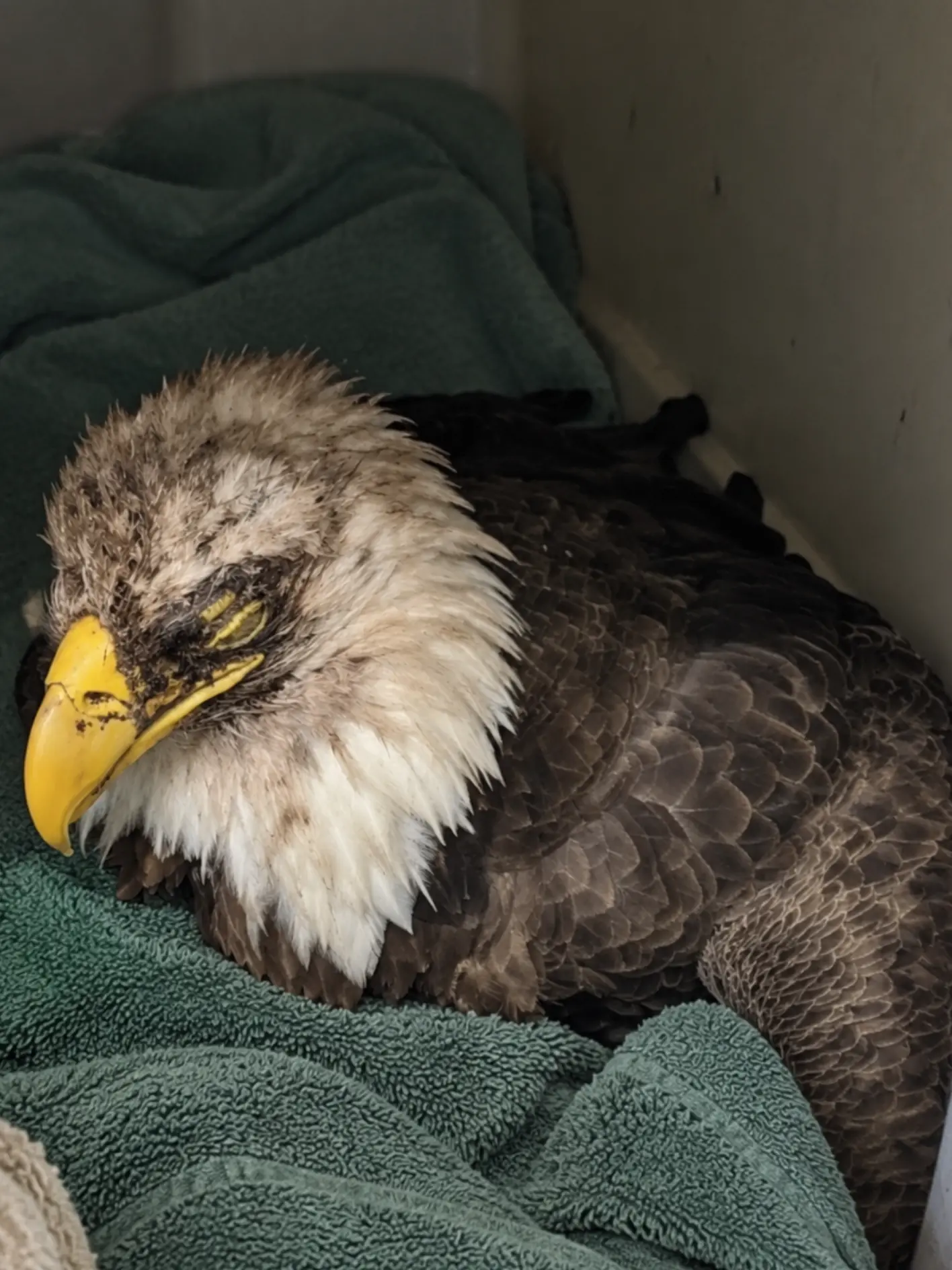
That first observation changed the direction of the entire case.
The adult Bald Eagle had been found sitting low beside a rural road in western Wisconsin, not far from the Upper Mississippi River corridor. From a distance, its location suggested one of the most common emergencies wildlife responders encounter with large scavenging raptors: a collision with a vehicle.
But once responders reached the bird, the expected signs of a major impact were missing.
There was no wing hanging at an obviously abnormal angle.
No open fracture.
No large bleeding wound.
No clear deformity of either leg.
Yet the eagle was in extremely poor condition.
Its body remained close to the ground. Its white head feathers were dirty and disheveled, one eye was almost completely closed, and the bird reacted only weakly when people moved nearby. Rather than attempting to fly or defend itself, the eagle remained almost motionless.
“There wasn’t an injury that explained what we were seeing,” the officer said. “It just looked profoundly sick.”
The eagle was safely captured and taken to a nearby veterinarian for an initial examination.
After ruling out the most obvious traumatic injuries, the veterinarian made another decision quickly.
The bird needed more specialized care.
“We took it to the veterinarian, and they transferred it to our team,” a rehabilitation specialist said. “By the time it arrived here, our concern was no longer simply, ‘Where is the fracture?’ We were asking, ‘What is making this bird this sick?’”
That question would require bloodwork, imaging, toxicology testing, infectious-disease screening and several days of careful observation to begin answering.
For now, the eagle remains under intensive care.
Its condition has improved.
But the case is a reminder that a grounded Bald Eagle found beside a road is not always a vehicle-strike patient — and that sometimes the most serious problems are the ones that cannot be seen from the outside.
The Eagle Had Been Sitting Beside the Road for Too Long
The first person to notice the bird did not immediately know that something was wrong.
Bald Eagles regularly spend time on the ground.
They may descend to feed on fish, waterfowl, carrion or other food. In agricultural areas and river corridors, they can also be seen resting in open fields or near roads where animal carcasses provide an easy food source.
But this eagle stayed in the same place.
It did not move away from nearby activity.
It did not launch into flight when given plenty of distance.
Its head repeatedly lowered toward its body.
Eventually, the observer became concerned enough to contact wildlife authorities.
That call may have made the difference between the bird reaching professional care and continuing to deteriorate unnoticed.
By the time the wildlife officer arrived, the eagle was still conscious, but there was little about its behavior that resembled a healthy adult raptor.
A Healthy Bald Eagle Usually Does Not Allow This Kind of Approach
Adult Bald Eagles are powerful, highly alert birds.
Even an injured eagle often remains difficult to capture.
Its feet can strike rapidly.
The talons are capable of causing severe injury.
The bird may attempt to run, flap, climb or defend itself when a person gets too close.
This eagle barely resisted.
That did not make the rescue easier in a reassuring way.
It made the situation more alarming.
A wild bird that suddenly appears “calm” around humans is often not calm at all.
It may simply be too weak to react.
The responding officer approached with appropriate protective equipment and secured the eagle’s feet before supporting the body.
The bird did not need to be chased.
It did not have enough strength to go far.
No one attempted to make the eagle fly.
Forcing a compromised bird into the air can worsen an injury, consume limited energy or expose neurological deficits that leave it unable to land safely.
The goal was transport.
The Roadside Location Made a Vehicle Collision Seem Likely
The initial assumption was reasonable.
Bald Eagles are frequently drawn to roadside carrion.
A deer, raccoon or other animal killed by traffic may attract scavengers from a considerable distance.
Once an eagle is feeding on the ground, it needs space to become airborne.
Large raptors do not always accelerate vertically.
They often require a forward launch before gaining altitude.
That can put them directly in the path of vehicles.
For this reason, an eagle found beside a road with an inability to fly raises immediate concern for collision trauma.
But assumptions in wildlife medicine have to be tested.
And in this case, the first examination did not support a straightforward orthopedic explanation.
No Major Fracture Could Be Found
At the local veterinary clinic, the eagle received a careful physical examination.
Both wings were checked for abnormal movement or swelling.
The shoulders were palpated.
The legs and feet were examined.
The pelvis and spine were evaluated as safely as possible.
The chest and head were checked for impact injuries.
There were no major open wounds.
There was no gross instability of the wings.
There was no obvious fracture that could explain why the bird had become almost unable to function.
That result was not necessarily good news.
It simply changed the medical problem.
If no major broken bone was preventing the bird from flying, something else had to explain the profound weakness.
The Eagle Was Dehydrated and Severely Debilitated
The veterinary team also noted that the bird’s overall condition was poor.
It appeared dehydrated.
Its responses were slow.
Grip strength was reduced.
The eagle tired easily during the examination.
One eye remained mostly closed and appeared inflamed.
The bird did not maintain the strong upright posture expected from a healthy adult.
These findings suggested a systemic illness — a problem affecting more than one body part.
The local veterinarian determined that the case required specialized avian diagnostics, toxicology testing and prolonged wildlife care.
The eagle was transferred to a licensed raptor rehabilitation center.
The Photograph From Intake Shows the Severity of Its Condition
Images taken during the early phase of hospitalization show the Bald Eagle resting low on padded towels inside a medical enclosure.
The bird’s head is down.
The white feathers around the face and crown are heavily soiled.
One eye is almost closed.
The eagle is not standing tall.
Its body appears heavy against the bedding.
To a rehabilitation team, posture like this matters.
A critically ill raptor often conserves energy by remaining low.
The bird may close its eyes frequently.
It may stop maintaining its feathers.
It may become unable to perch safely.
These findings do not identify a diagnosis by themselves, but they provide important information about severity.
This was not an eagle that simply needed a few hours of rest.
Full-Body Radiographs Were Performed
Once the eagle was stable enough, the rehabilitation team obtained radiographs to look for injuries that might have been missed during the initial examination.
The images allowed veterinarians to evaluate the wings, shoulders, chest, pelvis, spine and other skeletal structures.
No acute major fracture was identified.
There was no obvious catastrophic skeletal trauma.
That further weakened the original vehicle-strike hypothesis as a complete explanation for the bird’s condition.
Soft-tissue injury or concussion could not be completely excluded.
But neither would automatically explain every clinical sign.
The diagnostic search continued.
Bloodwork Became More Important Than the X-Ray
When trauma fails to explain a grounded eagle, blood testing can reveal problems hidden beneath an apparently intact body.
The veterinary team collected samples to evaluate several areas.
They wanted to understand the bird’s hydration status.
They assessed red blood cells for evidence of anemia.
White-cell changes could suggest inflammation or infection.
Blood chemistry could provide information about organ function.
The results confirmed that the eagle was significantly dehydrated and showed abnormalities consistent with systemic illness.
But that still did not identify a single cause.
More testing was needed.
Lead Exposure Had to Be Considered
Lead toxicosis is an important differential diagnosis in Bald Eagles with unexplained weakness or neurological abnormalities.
Eagles are opportunistic scavengers.
They may consume animal carcasses or remains containing fragments of lead ammunition.
A poisoned bird can become lethargic, poorly coordinated and unable to stand or fly normally despite having no broken bones.
Grip strength may decline.
The gastrointestinal system can be affected.
Neurological abnormalities can develop.
Because several of those signs overlapped with what the veterinary team was seeing, a blood lead test was included in the diagnostic workup.
The team did not assume the result would be positive.
Lead was one possibility among several.
Infectious Disease Was Another Concern
The eagle’s profound weakness and eye abnormality also made infectious disease an important consideration.
Wild birds can be affected by pathogens capable of producing neurological signs, ocular changes or severe systemic illness.
Depending on the clinical picture and regional disease activity, wildlife veterinarians may submit samples for conditions such as highly pathogenic avian influenza or West Nile virus, among other possibilities.
Testing is important not only for the individual patient.
Some wildlife diseases have implications for other birds in rehabilitation facilities.
Biosecurity therefore matters.
Until infectious causes could be better evaluated, handling and housing decisions had to be made carefully.
The Eye Could Not Be Ignored
One of the most visible abnormalities involved the eye.
The eyelids remained partially closed.
The surrounding tissues appeared irritated.
The bird did not use the eye as consistently as expected during the earliest examinations.
An ophthalmic evaluation was therefore included in the workup.
Veterinarians needed to determine whether there was direct trauma to the eye, inflammation inside the eye, infection or another process.
The eye problem could potentially be a primary injury.
It could also be secondary to a broader disease.
At this stage, the team resisted the temptation to make the most visible abnormality explain everything else.
The entire patient had to be considered.
Treatment Could Not Wait for Every Laboratory Result
Diagnostic tests can take time.
The eagle did not have the luxury of waiting untreated while every possibility was investigated.
Supportive care began immediately.
Fluids were provided to address dehydration and support circulation.
The bird was placed in a quiet intensive-care enclosure.
Because it was too weak to perch reliably, the floor was padded with towels and soft material.
High perches were removed.
A weak eagle that falls can create a second injury on top of the original medical problem.
Food intake was monitored.
Nutritional support was provided according to the bird’s condition.
Eye treatment and pain management were used when indicated by the veterinary examination.
The first objective was stability.
The First Night Was Difficult
During the initial hours, the eagle remained extremely quiet.
It spent much of the time resting.
One eye stayed mostly closed.
The head often remained low.
The bird showed little interest in food.
Its posture remained weak.
The rehabilitation team minimized unnecessary handling.
Every time a wild bird is restrained, heart rate and stress increase.
For a debilitated patient, repeated examinations can consume energy that would be better spent maintaining body temperature and supporting basic physiological functions.
Staff therefore relied heavily on observation between required medical procedures.
The prognosis was guarded.
There Was No Guarantee the Bird Would Improve
Severely ill wildlife patients can deteriorate quickly.
A bird may survive transport and still decline during the first night.
Dehydration may have already compromised circulation.
An infection may be progressing.
A toxin may continue affecting the nervous system.
Organ damage may only become evident after further testing.
For that reason, no one at the center described the eagle as stable simply because it had reached a treatment room alive.
The first 24 to 48 hours would provide crucial information.
The First Improvement Was Small
The earliest positive change was easy to miss.
The eagle began holding its head slightly higher.
It opened its eyes more frequently.
When staff entered the room, the bird noticed them sooner.
Its response remained weak, but it was more consistent.
For wildlife rehabilitators, changes like these matter.
Recovery rarely begins with a dramatic transformation.
Often it begins with an animal doing something for thirty seconds that it could not do the day before.
Grip Strength Began to Improve
The team also noticed gradual changes in the feet.