An adult Bald Eagle found grounded near the Mississippi River in western Wisconsin is undergoing treatment for lead poisoning after wildlife responders discovered the bird too weak to fly normally despite having no major fracture or obvious traumatic injury.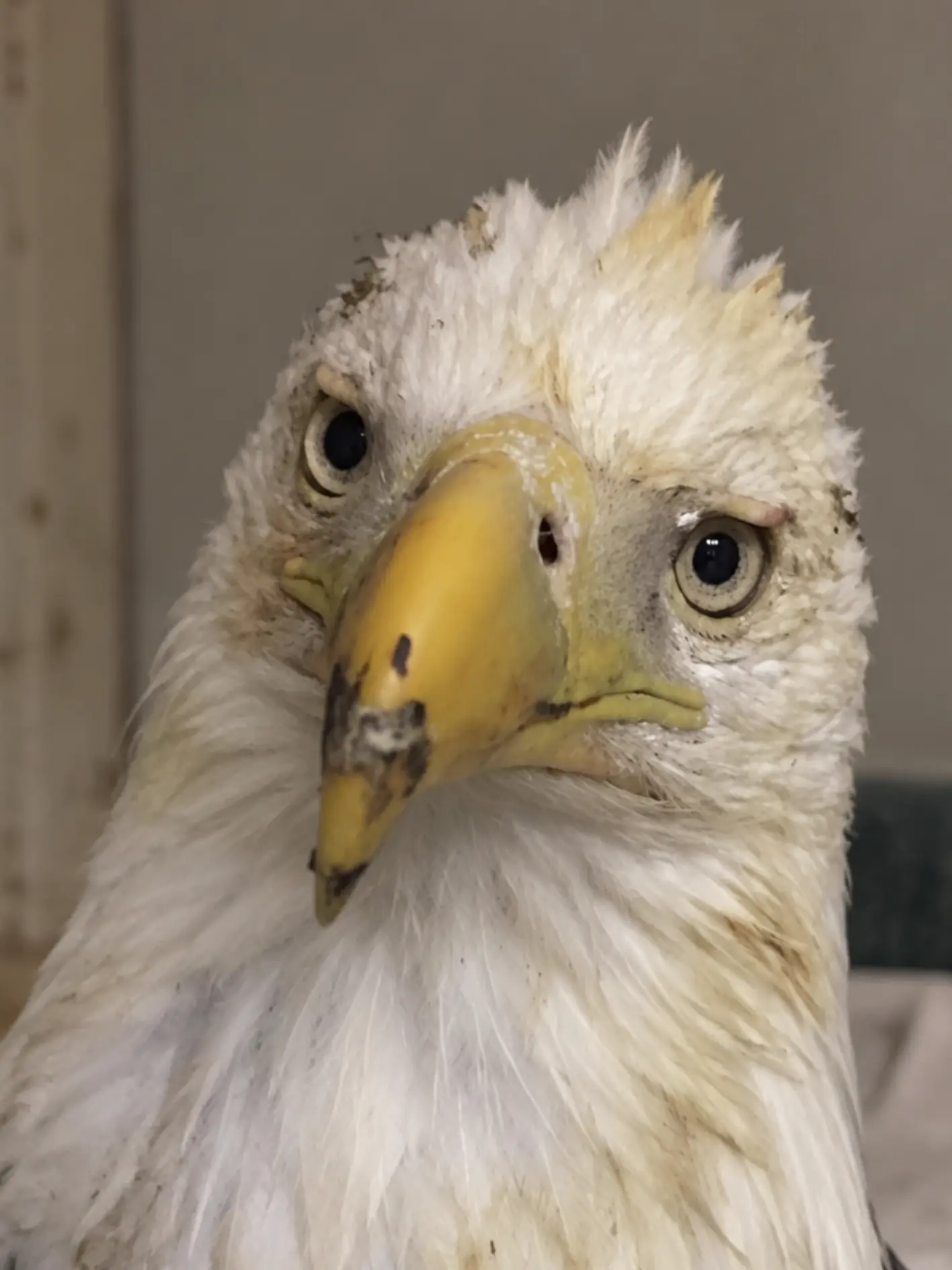
The eagle was first noticed on the ground near a wooded river corridor, where it remained for an unusually long period and made little effort to move away as people approached from a safe distance.
That behavior immediately raised concern.
A healthy adult Bald Eagle is typically wary of people. Even when resting or feeding on the ground, it will usually move away or take flight if someone comes too close.
This bird did neither.
Its movements were slow. Its posture was weak. Its grip appeared reduced, and the eagle struggled to maintain the upright position normally expected from a large raptor.
Wildlife responders safely captured the bird and transported it to a licensed rehabilitation center for evaluation.
At first, the medical team looked for trauma.
Both wings were examined.
The legs and feet were checked.
The pelvis, spine, head and chest were evaluated.
No major fracture or external injury was found that could explain why an otherwise structurally intact eagle had become so debilitated.
Blood testing eventually provided the answer.
The eagle had a markedly elevated blood lead concentration.
For the rehabilitation team, the result was familiar.
Lead exposure remains an important cause of illness in Bald Eagles and other scavenging wildlife, and the exact source of an individual bird’s exposure is often impossible to determine.
But one well-documented pathway is clear: eagles can ingest small fragments of lead ammunition while feeding on animal carcasses, unrecovered game or discarded remains left in the field.
Cases like this have prompted wildlife advocates and rehabilitation organizations to renew calls for hunters to consider non-lead ammunition where practical.
The message, they say, is not about opposing hunting.
It is about reducing the amount of a toxic metal entering food that scavenging wildlife may later consume.
“The exact meal that exposed this eagle to lead may never be known,” a rehabilitation representative said. “But when a bird arrives this weak with no major traumatic injury, and the blood lead level comes back significantly elevated, we have to take that exposure seriously.”
The Eagle Was Found Grounded Near the River
The rescue began when a member of the public noticed the eagle sitting low near the edge of a rural area not far from the Mississippi River.
Bald Eagles are common throughout parts of the Upper Midwest, particularly near large rivers, lakes and reservoirs where fish and other food sources are abundant.
Seeing one on the ground is not automatically unusual.
The problem was how long this bird remained there.
It did not fly when given space.
It did not reposition itself normally.
Its body appeared heavy.
The head frequently dropped lower than expected.
When the eagle attempted to stand, it seemed weak and unstable.
That was enough for the observer to contact wildlife authorities.
A Grounded Bald Eagle Can Have Many Different Problems
Wildlife responders do not assume every grounded eagle is suffering from the same condition.
Some are injured by vehicles.
Others collide with power lines, windows or other structures.
Some become entangled.
Some suffer fractures during territorial fights.
Others may be affected by infectious disease, starvation, dehydration or toxic exposure.
That is why the bird’s location alone could not provide a diagnosis.
The responders approached carefully.
Heavy protective gloves were used because even a weakened Bald Eagle can defend itself with powerful talons.
The feet were controlled first.
The wings were supported against the body.
The eagle was then placed in a secure transport carrier and taken for professional care.
There Was No Major Injury to Explain the Weakness
At the rehabilitation center, the veterinary team conducted a complete physical examination.
The wings were palpated.
The shoulders were assessed.
The legs and feet were compared.
The pelvis and spine were examined.
The head and eyes were checked for signs of impact.
No catastrophic orthopedic injury was identified.
The bird did not have the kind of severe wing fracture that would normally explain its inability to fly.
It did not have a broken leg that would account for the abnormal posture.
There was no large external wound.
Yet the eagle was profoundly weak.
Its grip strength was reduced.
Its posture was abnormal.
Its overall condition suggested a systemic problem rather than a single mechanical injury.
That pushed the medical team toward bloodwork and toxicology testing.
Lead Testing Became a Critical Part of the Workup
Lead exposure is routinely considered in Bald Eagles presenting with unexplained weakness, poor coordination or neurological abnormalities.
Bald Eagles are highly opportunistic feeders.
They hunt live prey, but they also scavenge frequently.
Carrion can provide a valuable food source, especially in winter or in areas where animal remains are readily available.
Unfortunately, scavenging behavior can expose them to material that was never intended for them.
When lead ammunition fragments inside an animal, tiny pieces can remain in tissue.
If that tissue is later consumed by an eagle, the bird may ingest lead without any visible warning.
The blood test in this case showed a markedly elevated concentration.
That result offered a plausible explanation for the bird’s condition.
Lead Can Affect the Nervous System
Lead is not simply a contaminant that remains passively inside the body.
It can interfere with multiple physiological systems.
In raptors, severe exposure may cause:
weakness,
poor coordination,
reduced grip strength,
abnormal posture,
gastrointestinal dysfunction,
lethargy,
visual abnormalities,
and impaired neurological function.
A severely affected Bald Eagle may have wings that are anatomically intact and still be unable to fly.
The problem may be that the bird no longer has the muscular strength and neurological coordination required for takeoff, balance and controlled movement.
That distinction is important.
An eagle can look uninjured externally and still be critically ill.
The Bird’s Grip Was One of the Most Concerning Signs
For Bald Eagles, the feet are essential to survival.
They use their talons to capture prey.
They hold food while tearing pieces with the beak.
They grip branches and other perches.
They absorb the force of landing.
When grip strength disappears, many basic survival behaviors become impossible.
At admission, the eagle’s feet were far weaker than expected.
The toes did not close with normal force.
The bird had difficulty maintaining stable posture.
Those findings were consistent with the broader neurological effects associated with lead toxicosis.
The Exact Source of Exposure May Never Be Identified
Testing can show that lead is present in the bloodstream.
It cannot usually show which specific carcass or meal caused the problem.
That is why wildlife professionals remain cautious when discussing individual cases.
No one can say with certainty that this bird consumed lead from a specific deer carcass, gut pile or other animal remains.
What can be said is that scavenging on remains containing lead ammunition fragments is a well-recognized exposure route for eagles.
The bird does not need to swallow an entire bullet.
Fragments can be extremely small.
A piece of meat may look completely normal while containing lead particles embedded inside.
The eagle simply eats the food available to it.
Why Carcass Remains Matter
After a game animal is harvested, some material may remain in the field.
That can include gut piles, portions of carcasses or animals that were shot but not recovered.
Scavengers often find those remains quickly.
Ravens, crows, vultures, coyotes, foxes and eagles may all feed from the same source.
If lead ammunition fragmented within the animal, some of those scavengers may ingest it.
The issue is not that eagles are behaving improperly.
Scavenging is natural.
The concern is that a human-introduced toxic material may be present inside otherwise natural food.
Wildlife Advocates Are Asking Hunters to Consider Non-Lead Ammunition
Cases like this have led wildlife organizations to encourage voluntary changes that reduce the amount of lead entering carcasses.
One option is the use of non-lead ammunition, including copper-based alternatives.
The reasoning is straightforward.
If less lead enters animal tissue during the shot, less lead remains available to scavengers afterward.
“This is not a conversation about ending hunting,” a rehabilitation representative said. “Hunters are an important part of wildlife management and conservation. The question is whether we can reduce one preventable toxic exposure pathway by changing the material used in ammunition.”
That framing matters.
Wildlife advocates increasingly describe hunters as potential partners in reducing lead exposure rather than as the target of the discussion.
Hunters Already Play a Major Role in Conservation
Across the United States, hunters contribute substantially to wildlife conservation through license fees, excise taxes, habitat programs and direct participation in management efforts.
Many also work closely with state wildlife agencies.
For rehabilitation organizations, that makes outreach particularly valuable.
The goal is not to create conflict between hunters and wildlife professionals.
It is to provide information about how ammunition choice can affect scavengers after the hunt is over.
A hunter may never see the eagle that later feeds on a carcass.
That does not mean the ecological connection is absent.
Carcass Management Can Reduce Exposure Too
Ammunition choice is not the only possible intervention.
How animal remains are handled can also affect scavenger access.
Where practical and appropriate, reducing access to tissue that may contain lead fragments can decrease the chance that eagles and other scavengers consume it.
The exact methods vary by location, regulations and circumstances.
The broader principle is simple:
if potentially contaminated tissue does not remain freely available to scavenging wildlife, one exposure route is reduced.
Lead Fishing Tackle Is Another Environmental Concern
Ammunition is not the only source of environmental lead relevant to wildlife.
Lost fishing sinkers, jigs and other tackle can remain in lakes, rivers and wetlands.
Some waterbirds may ingest small pieces directly.
Other wildlife may encounter lead through food-web interactions or through scavenging.
For Bald Eagles that depend heavily on aquatic ecosystems, environmental lead associated with fishing activity is also part of the broader conservation discussion.
Again, that does not prove this individual eagle was exposed through fishing tackle.
The source in this case remains unknown.
Treatment Focused First on Stabilization
Once significant lead exposure was confirmed, the eagle’s treatment focused on both the toxic burden and the effects the poisoning had already caused.
The bird was dehydrated and weak.
It was housed on padded flooring because normal perching was not yet safe.
Fluids were administered according to its clinical needs.
Nutritional support was introduced carefully.
The enclosure was kept quiet to reduce stress.
When indicated, chelation therapy was initiated under veterinary supervision.
Chelating medications bind lead and help the body remove it.
But chelation does not instantly restore a damaged nervous system.
Recovery From Lead Poisoning Can Take Time
A bird may begin clearing lead from the bloodstream before its neurological function has fully returned.
That is why veterinarians monitor much more than laboratory numbers.
They watch posture.
Grip strength.
Balance.
Appetite.
Alertness.
Vision.
And eventually flight.
A lower lead concentration is encouraging.
It does not automatically mean the eagle is ready to return to the wild.
The First Days Were Guarded
During the initial phase of treatment, the eagle remained weak.
It spent long periods resting.
Its feet did not grip normally.
The bird tired easily.
Its appetite was inconsistent.
The rehabilitation team watched closely for evidence of improvement or deterioration.
Severe lead toxicosis can progress quickly if exposure has already caused substantial neurological or organ damage.
Some birds recover.
Others reach care too late.