When an adult Bald Eagle was brought into a wildlife rehabilitation center after being found grounded and unable to fly, the first thing the medical team noticed was a large wound involving the bird’s left wing.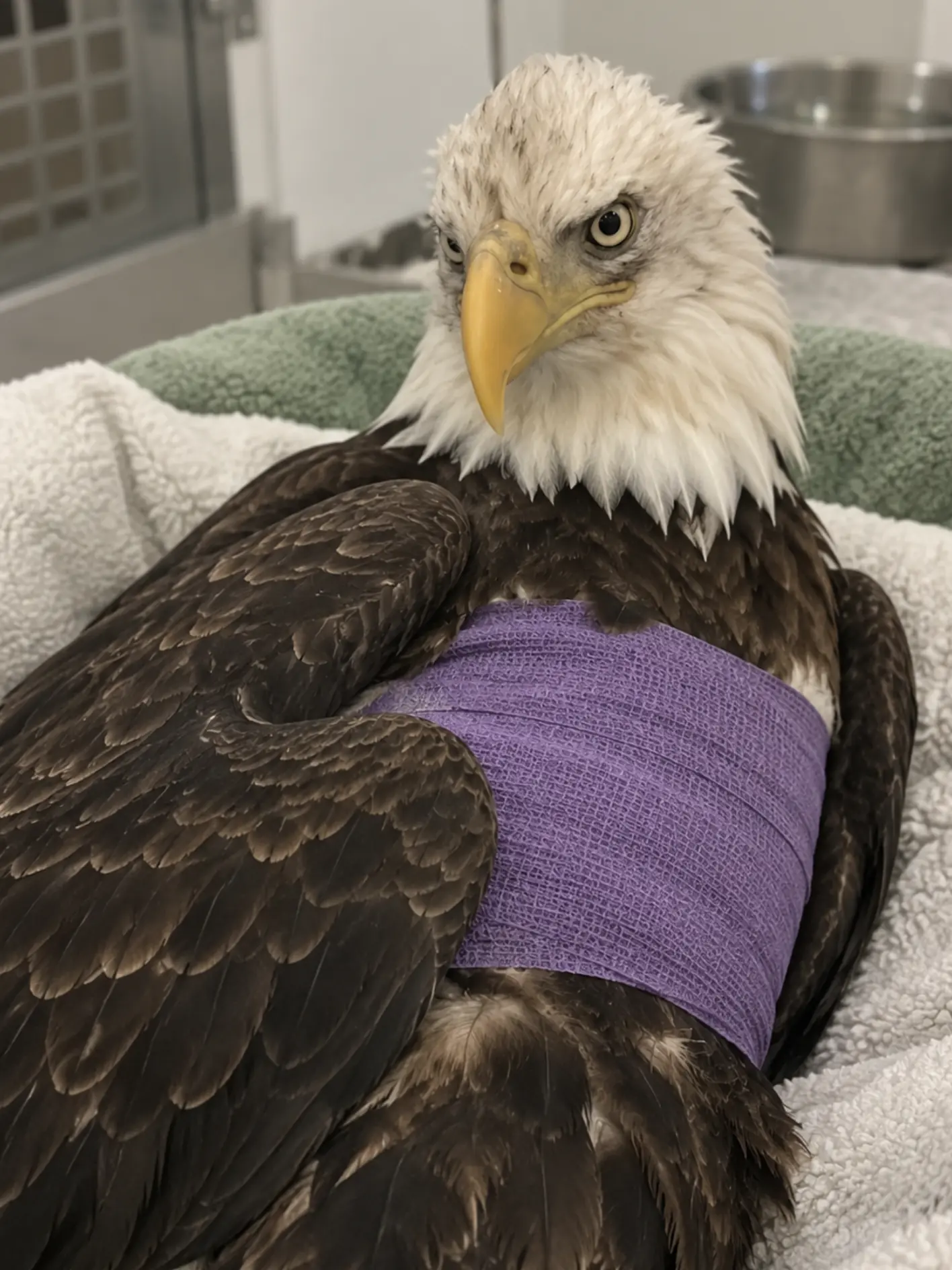
The injury was severe enough to be concerning on its own. Feathers around the damaged area were disrupted, the surrounding tissues were swollen, and the eagle carried the wing abnormally. But the full extent of the trauma could not be determined simply by looking at the outside of the bird.
The rehabilitation team therefore took full-body radiographs.
Those images changed the entire case.
The damage was centered around the eagle’s left elbow — the joint where the humerus of the upper wing meets the radius and ulna of the lower wing. The joint was catastrophically disrupted. Part of the distal ulna was no longer intact, and multiple small radiopaque fragments were visible around the injured region.
The appearance of those fragments, combined with the pattern of tissue and bone destruction, was considered strongly suspicious for projectile trauma.
In other words, veterinarians believed the eagle may have been shot.
Even more concerning, the injury was not fresh.
The open wound was already severely inflamed and infected by the time the bird reached professional care. The tissue surrounding the fracture had been exposed to the environment, and the loss of normal bone structure around the elbow meant this was not a fracture that could simply be aligned, immobilized and allowed to heal.
“The radiographs immediately told us that we were dealing with much more than a broken wing,” the attending veterinarian said. “The elbow joint had suffered extensive structural damage, part of the ulna was missing, and the wound itself was already heavily compromised.”
The eagle was awake.
Its eyes were alert.
Its feet remained strong.
But the wing injury presented a far more difficult question.
Could the bird ever regain a functional, pain-free wing capable of flight?
The answer, after a complete medical assessment, was devastating.
The Eagle Was Found Grounded and Unable to Fly
The rescue began when the adult Bald Eagle was discovered on the ground in an area where healthy eagles would normally have been capable of leaving without difficulty.
The bird remained alert but did not fly when approached from a distance.
One wing was held lower than the other.
Its posture suggested discomfort.
When wildlife responders moved closer, they could see obvious damage involving the left wing.
A large wound was present beneath the feathers.
The bird was safely restrained using appropriate raptor-handling equipment, with particular attention given to controlling the talons first.
Even a severely injured Bald Eagle remains capable of defending itself.
The damaged wing was supported but not manipulated unnecessarily.
Responders did not attempt to straighten the fracture or reposition the wing in the field.
The eagle was placed into a secure transport carrier and taken for emergency veterinary evaluation.
The External Wound Was Only Part of the Problem
During the initial examination, the medical team carefully separated feathers around the injured area to determine how far the wound extended.
The injury was substantial.
There was significant soft-tissue disruption around the left wing.
The wound was open.
Inflammation was already present.
And the abnormal position of the wing suggested that major underlying structures had been damaged.
But thick feathers can hide the true extent of raptor trauma.
A wound that appears localized from the outside may involve broken bone, damaged muscle, tendons, nerves or a joint beneath the surface.
That is why imaging was necessary before the team could make a meaningful prognosis.
The eagle underwent full-body radiographs rather than imaging only the injured wing.
This allowed veterinarians to evaluate not only the obvious trauma but also the remainder of the skeleton for additional injuries that might have occurred during the same event.
The X-Rays Revealed Catastrophic Damage at the Elbow
The most serious findings were concentrated around the left elbow.
A bird’s wing is structurally comparable in some ways to a human arm.
The humerus forms the upper portion.
The radius and ulna extend through the lower portion.
The elbow connects those structures and allows the wing to fold and extend.
For a flying bird, that joint is not optional.
It must move through a precise range of motion while transferring enormous forces between the body and the outer wing.
In this eagle, that normal architecture had been severely disrupted.
The fracture involved the elbow region.
Part of the distal ulna had been destroyed or was no longer present as an intact functional structure.
The normal relationship between the bones around the joint had been lost.
This meant the team was not looking at a simple fracture line.
There was actual bone loss.
“This was not something we could just line up and wait for it to heal,” the veterinarian said. “Part of the structure that gives the elbow its normal mechanics was no longer there.”
That distinction would ultimately determine the eagle’s prognosis.
Metallic Fragments Raised Strong Concern for Gunshot Trauma
The radiographs also revealed several small dense fragments within and around the damaged tissues.
Their radiographic appearance was consistent with metallic material.
Taken together with the pattern of injury, the findings raised serious concern that a projectile had passed through or struck the wing.
The rehabilitation center documented the images carefully.
Because the exact incident was not witnessed by the medical team, the case was described using appropriately cautious terminology.
The findings were considered strongly consistent with gunshot trauma.
That phrasing matters.
Veterinarians can document wound patterns, metallic fragments and bone destruction.
Determining the legal circumstances surrounding an apparent shooting belongs to wildlife law-enforcement investigators.
The medical team’s role was to establish what had happened anatomically and what it meant for the bird.
The Wound Appeared to Have Been Present for Some Time
Another major concern was the condition of the open wound itself.
The injury did not look like one that had occurred immediately before rescue.
There was already substantial inflammation.
The wound was contaminated.
The surrounding tissues showed evidence of infection.
Some areas appeared unhealthy enough to raise concern about tissue viability.
An open fracture becomes increasingly dangerous the longer it remains exposed.
Every hour outdoors can introduce more bacteria and environmental debris.
Feathers, dirt and organic material can contaminate damaged tissue.
Once bacteria reach deeper structures, infection can involve not only skin and muscle but also the bone.
That creates the possibility of osteomyelitis — infection within bone itself.
In a complex joint such as the avian elbow, infection can be particularly destructive.
The Infection Made an Already Severe Injury Worse
If the eagle had suffered only an uncomplicated fracture, orthopedic stabilization might have offered a realistic path toward recovery.
If it had suffered only a superficial wound, aggressive cleaning and medical management might have been sufficient.
But this bird had several major problems occurring at once:
a large open wound,
significant soft-tissue destruction,
major bone loss,
damage involving a critical joint,
and established infection.
Each problem reduced the probability of restoring normal flight.
Together, they created a very poor functional prognosis.
The medical team began stabilization while continuing to assess whether any reconstructive option could realistically return the wing to useful function.
The Eagle Was Still Alert Despite the Severity of the Injury
One of the hardest parts of cases like this is the contrast between the bird’s mental condition and the extent of its orthopedic damage.
The eagle was not unconscious.
It was not neurologically unresponsive.
Its eyes remained alert.
It watched the people around it.
Its feet could still grip.
Its right wing appeared functional.
The bird was very much alive.
That can make the reality of an irreversible wing injury particularly difficult to accept.
But wildlife rehabilitation cannot be judged by alertness alone.
A Bald Eagle must be able to perform the behaviors necessary for independent survival.
Flight is among the most fundamental.
The Wing Was Stabilized to Reduce Pain and Further Damage
While the team evaluated the injury, the damaged wing was supported beneath a broad padded body wrap.
Recent photographs show the eagle standing alert while the wing remains secured against the body.
The wrap serves several purposes.
It reduces movement at the damaged joint.
It prevents additional tearing of already compromised tissue.
It limits pain caused by uncontrolled motion.
It also protects the wound while the veterinary team performs repeated examinations and treatment.
The bandage is not evidence that the wing has been successfully repaired.
It is supportive stabilization.
For an injury this severe, stabilization helps keep the bird comfortable while the team determines what is medically and ethically possible.
The Wound Was Cleaned and Debrided
Under appropriate sedation or anesthesia, the damaged area was carefully cleaned.
The team removed debris and flushed contaminated tissue.
Clearly nonviable tissue was addressed conservatively.
This process is known as debridement.
The goal is to reduce the amount of dead or heavily contaminated material that can support bacterial growth while preserving healthy tissue wherever possible.
Antibiotic therapy was used when clinically indicated.
Pain management was also essential.
Open fractures are painful injuries, and the medical team’s responsibility included maintaining the bird’s comfort while the prognosis was being assessed.
Why the Eagle’s Elbow Matters So Much for Flight
A Bald Eagle does not simply flap its wing up and down.
Flight depends on coordinated movement through multiple joints.
The shoulder controls the large sweep of the wing.
The elbow contributes to extension, folding and changes in wing geometry.
The wrist positions the outer wing.
The feathers then respond to those structural changes to produce lift, thrust and control.
Damage to the elbow affects the entire system.
If the elbow cannot extend properly, the bird cannot achieve normal wingspan.
If the joint is unstable, the wing cannot transmit force efficiently.
If bone loss changes the geometry of the joint, muscle contractions can no longer produce normal movement.
Scar tissue can restrict motion even further.
In this eagle, the structural loss was so substantial that healing alone could not recreate normal anatomy.
Bone Can Heal, but Missing Architecture Cannot Simply Grow Back
This is an important distinction.
Fractured bone can often repair itself.
The body produces new tissue around the fracture, eventually creating a callus that bridges the break.
Over time, that bone remodels.
But healing depends on there being enough viable structure to reconnect.
Here, part of the ulna was absent or catastrophically damaged.
The elbow joint itself had been severely disrupted.
The medical team would have needed not only to control infection and stabilize the fracture, but somehow restore the precise alignment and mechanics of a joint that had lost part of its normal architecture.
For a wild eagle expected to return to full flight, that threshold is extremely demanding.
Infection Also Threatened the Remaining Bone
The open wound added another obstacle.
Even if reconstruction were mechanically possible, the infected environment made healing less predictable.
Bacteria can delay bone union.
They can destroy healthy tissue.
They can create draining tracts.
They can spread through bone.
They can potentially enter the bloodstream and cause systemic illness.
Managing infection can require prolonged treatment.
But controlling infection does not restore missing bone or a destroyed joint.
That was the difficult reality in this case.
A Bird With One Nonfunctional Wing Cannot Be Released
Bald Eagles depend on flight for nearly every part of their life.
They use flight to locate food.
Reach roosting sites.
Escape danger.
Travel between feeding areas.
Defend territory.
Approach and leave nests.
Avoid people and vehicles.
An eagle that cannot fly normally cannot simply adapt by walking through the landscape.
Wild release therefore requires much more than the ability to remain alive.
The bird must be capable of sustained, controlled flight.
A permanently disabled wing makes that impossible.
“Almost Functional” Is Not Enough
A large bird may sometimes manage short hops or limited flights with a compromised wing.
That does not qualify it for release.
A wild Bald Eagle must be able to:
launch powerfully from the ground,
gain altitude,
soar efficiently,
turn sharply,
land precisely,
and repeat those actions without significant fatigue.
A bird that can cross a rehabilitation enclosure once but cannot sustain normal flight would be at severe risk outside human care.