An adult Bald Eagle found severely injured in an agricultural field near Plattsmouth, Nebraska, is making steady progress after wildlife officials discovered the bird unable to fly with an open fracture and a large wound involving one of its wings.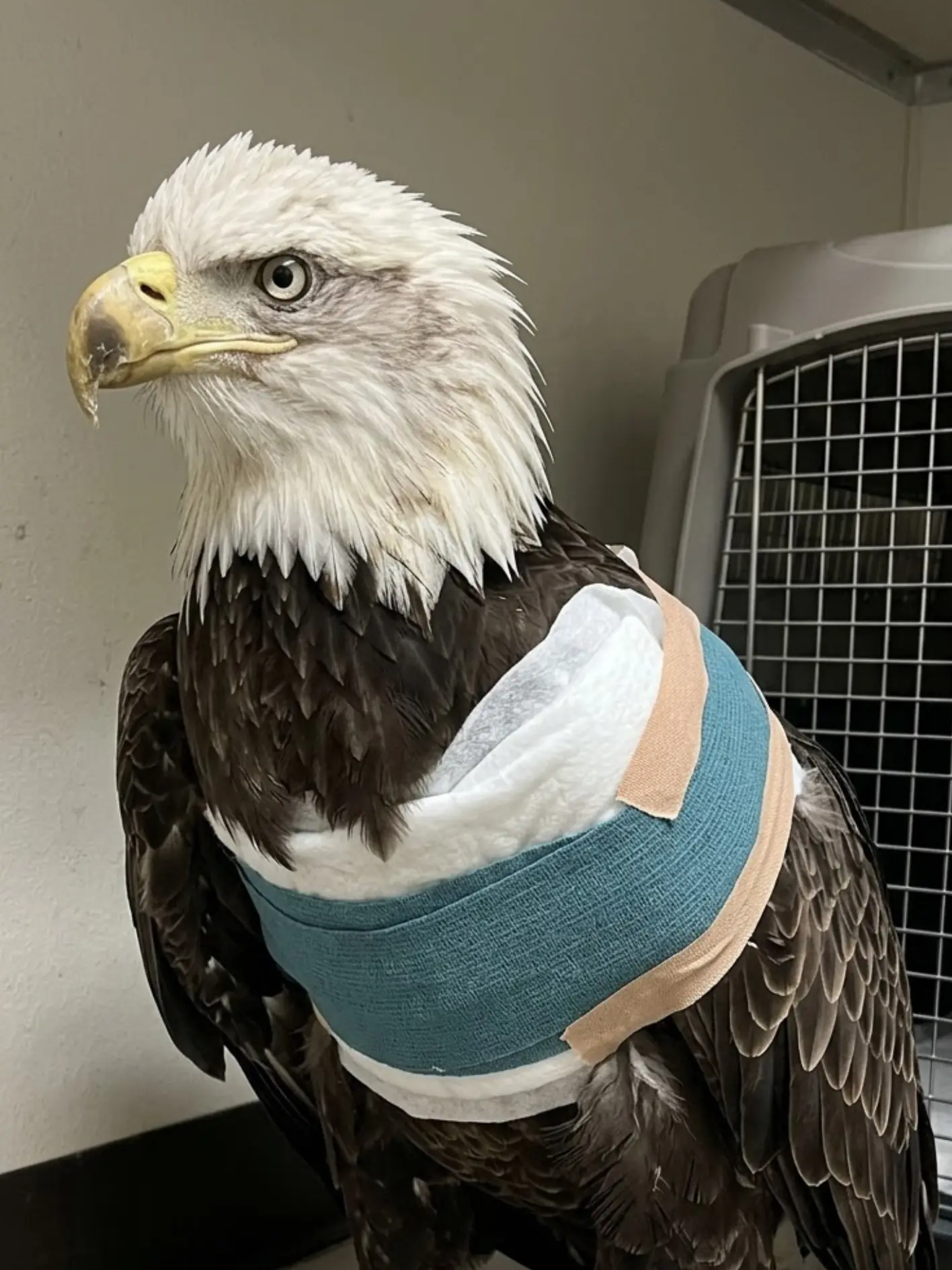
The eagle was first reported by a member of the public who noticed it remaining on the ground in an exposed section of farmland near the Missouri River corridor. From a distance, the bird was still conscious and watching its surroundings, but something about the position of one wing immediately appeared abnormal.
When a state conservation officer reached the property, the extent of the injury became clearer.
The affected wing was badly damaged. A large open wound was present near the fracture site, and the injury appeared to communicate directly with the broken bone — a condition veterinarians classify as an open fracture.
That distinction made the case an emergency.
With an open fracture, the problem is no longer limited to whether the bone can heal. Once the protective barrier of the skin has been broken, bacteria, soil, plant material, feathers and other environmental contaminants may reach the damaged tissues and bone.
Every additional hour outside can increase the risk of infection, tissue deterioration and permanent loss of function.
The conservation officer safely contained the eagle, stabilized the injured wing as much as possible without manipulating the fracture and began an approximately two-hour drive to the Great Plains Raptor Rehabilitation Center, where veterinary staff had been notified that a critically injured Bald Eagle was on the way.
“That transport was incredibly important,” the center’s rehabilitation director said. “An open fracture is not the kind of injury where you want to wait until the next morning and see how the bird looks. The sooner we can clean the wound, assess blood supply and stabilize the fracture, the better chance we have of protecting the remaining tissue.”
The bird arrived tired, painful and dehydrated, but still responsive.
Several weeks later, recent images show a very different patient.
The eagle is standing upright.
Its eyes are bright and attentive.
Both feet are supporting its weight normally.
And the injured wing remains secured beneath a carefully padded support wrap while the rehabilitation team continues daily bandage changes and wound evaluations.
The bird is not yet ready for flight.
But after an injury that initially carried a guarded prognosis, the direction of recovery is encouraging.
The Eagle Was Found in an Open Field Unable to Leave
A Bald Eagle on the ground is not automatically injured.
These birds may descend to feed on carrion or other prey, and agricultural areas near rivers can provide abundant feeding opportunities.
What drew attention to this eagle was its persistence in the same location.
It did not fly away.
It did not move to a nearby tree.
Its posture suggested that one side of the body was not functioning normally.
The person who first noticed the bird kept a safe distance and contacted wildlife officials rather than attempting to capture it.
That decision was important.
An injured eagle remains capable of defending itself with powerful talons, and an improperly handled wing fracture can become significantly worse if the bird struggles or the limb is manipulated.
When the conservation officer arrived, the bird was assessed from a distance before capture.
The eagle was alert enough to watch the responder but appeared unable to generate normal flight.
The injured wing was held abnormally.
A large traumatic wound was visible.
Professional intervention was clearly necessary.
The Capture Focused on Preventing Further Damage
Wildlife responders often have to balance two competing risks.
The bird must be captured.
But capture itself can worsen an unstable fracture.
The officer approached with protective equipment and controlled the eagle’s feet first.
The wings were then supported against the body with particular care given to the injured side.
No attempt was made to straighten the fracture in the field.
That is an important principle in wildlife rescue.
A badly broken wing should not be manipulated simply because the alignment looks abnormal.
Without radiographs, a rescuer cannot know exactly where the fracture is located, how many fragments are present or whether important blood vessels, nerves or tendons are involved.
The goal in the field is stabilization and transport.
Definitive orthopedic treatment belongs in a veterinary setting.
The Two-Hour Transport Became Part of the Emergency Response
The eagle was placed inside a secure carrier with padding that limited unnecessary movement.
The transport environment was kept quiet and relatively dark.
This reduces stress in wild raptors and can help prevent repeated attempts to flap inside the carrier.
The conservation officer then drove approximately two hours to the rehabilitation center.
During that time, the injured wing remained supported as carefully as possible.
A two-hour drive can feel long during an emergency, but for a rural wildlife rescue, distance is often unavoidable.
Specialized raptor rehabilitation centers are not located in every county.
What mattered was that the eagle was moving toward definitive care rather than remaining exposed in the field.
An Open Fracture Is More Than a Broken Bone
When the veterinary team examined the eagle, the distinction between a closed fracture and an open fracture became central to the treatment plan.
In a closed fracture, the bone is broken but the skin remains intact.
That intact skin provides a valuable barrier against contamination.
In an open fracture, the injury communicates with the external environment.
Bone or deep tissue may be exposed.
Even if the bone itself is eventually stabilized, infection can develop inside the damaged tissue or directly within the bone.
That condition — osteomyelitis — can be extremely difficult to treat and can destroy any realistic chance of returning a raptor to normal flight.
“With an open fracture, the bone is only part of the problem,” the attending wildlife veterinarian said. “We are also trying to preserve soft tissue, maintain blood supply and prevent infection from establishing itself around the fracture.”
That is why cleaning the wound became just as important as aligning the wing.
The First Examination Had to Be Thorough but Efficient
The eagle was evaluated for more than the obvious wing injury.
Trauma severe enough to fracture a wing can also cause injuries elsewhere in the body.
The medical team examined:
the head and eyes,
the beak,
the neck,
the chest and keel,
the opposite wing,
the pelvis,
the legs and feet,
and the neurological responses of the bird.
The eagle was dehydrated and understandably subdued, but it remained conscious.
There was no immediate indication of catastrophic neurological injury.
Both feet remained functional.
The unaffected wing appeared intact.
Those findings were encouraging, but the injured wing remained the major concern.
Radiographs Defined the Fracture
Diagnostic X-rays were obtained to determine exactly what had happened beneath the feathers and open wound.
Radiographs help veterinarians answer several important questions.
Which bone is fractured?
How far are the fragments displaced?
Does the fracture involve a joint?
Is the bone shattered into multiple pieces?
Is there evidence of older injury or infection?
Are other areas of the wing damaged?
In this case, imaging confirmed a serious fracture involving a major bone of the wing.
The injury was severe, but there appeared to be enough viable tissue and enough potential for stabilization that the team considered treatment medically reasonable.
That did not guarantee a return to flight.
But it justified proceeding.
The Wound Had to Be Cleaned Before the Team Could Think About Healing
The eagle was sedated or anesthetized as necessary so the wound could be addressed thoroughly without causing additional pain or movement at the fracture site.
The area was carefully exposed.
Contaminated material was removed.
The wound was flushed repeatedly.
Damaged tissue was evaluated for viability.
The team looked closely at the surrounding muscle and soft tissue to determine whether enough healthy structure remained to support healing.
Any tissue that was clearly nonviable could become a source of infection if left in place.
That is why debridement — the removal of dead or severely damaged tissue — may be necessary in major open wounds.
The objective is not to make the wound look cosmetically clean.
The objective is to create an environment in which healthy tissue can survive.
The Fracture Was Immobilized
Once the wound had been treated and the fracture position assessed, the injured wing was immobilized.
A padded support wrap was placed around the wing and body to limit movement.
The wrapping technique had to accomplish several things at once.
It needed to stabilize the fracture.
It needed to protect the open wound.
It needed to prevent excessive wing movement.
And it had to avoid becoming so tight that circulation or breathing was compromised.
Birds have very different respiratory mechanics from mammals, and wraps around the body must therefore be applied carefully.
The eagle’s current appearance reflects this stage of treatment.
Recent photographs show the bird standing with a substantial padded wrap securing the injured wing against the body.
The wrap may look restrictive, but its purpose is temporary protection while the fracture and wound begin healing.
Daily Bandage Changes Became One of the Most Important Parts of Care
An open wound cannot simply be wrapped and ignored for a week.
The rehabilitation team has been changing the bandage frequently — often daily during the most active stage of wound management — so that the underlying tissue can be examined directly.
Each bandage change provides information.
Staff evaluate:
swelling,
wound drainage,
odor,
tissue color,
skin condition,
temperature,
bleeding,
and whether the fracture remains stable.
They also check for pressure areas created by the wrap itself.
A bandage that is beneficial on the first day can become harmful if swelling changes and pressure increases.
That is why repeated adjustment is essential.
The Team Was Watching Closely for Infection
The greatest concern during the early period was infection.
The eagle had been lying outside in a field with an open traumatic wound.
No outdoor environment is sterile.
An agricultural field contains bacteria, dirt, vegetation and organic debris.
Feathers themselves can also carry contamination into a wound.
If bacteria reached the fracture and established infection inside the bone, the prognosis would become much worse.
The eagle therefore received antimicrobial therapy as clinically indicated, along with careful wound management.
Veterinarians also monitored for systemic evidence that infection might be spreading.
The team watched appetite, body temperature, behavior and bloodwork in addition to the wound itself.
Pain Control Was Essential
Pain management is a central part of wildlife medicine.
A wild bird may not show pain in the same way a domestic animal does.
Raptors frequently remain still and quiet rather than vocalizing.
That does not mean the injury is painless.
A fractured wing with a large open wound is expected to cause substantial discomfort.
Appropriate analgesic and anti-inflammatory medications were used based on the eagle’s clinical condition.
Controlling pain serves several purposes.
It reduces suffering.
It lowers physiological stress.
And it can improve appetite and normal posture, both of which support recovery.
Fluids and Nutrition Helped Support Healing
The eagle also needed systemic support.
Dehydration can compromise circulation and tissue healing.
Fluid therapy was provided according to veterinary assessment.
Once the bird was stable enough to eat safely, appropriate food was offered.
A large raptor recovering from trauma requires significant nutritional resources.
Healing bone demands protein, minerals and energy.
Repairing muscle and skin requires the same.
An eagle that stops eating for prolonged periods can lose condition quickly.
Fortunately, the patient gradually began eating more normally.
That was one of the first encouraging signs that its overall condition was improving.
The Wound Began Looking Healthier
During the early bandage changes, the rehabilitation team paid particular attention to whether the injury was progressing in the right direction.
The ideal signs were not dramatic.
Less swelling.
Cleaner tissue.
No spreading areas of necrosis.
No increase in discharge.
No evidence that infection was moving deeper.
Gradually, healthier tissue began developing at the wound margins.
That gave the team cautious reason for optimism.
A clean, vascular wound has a much better chance of healing than one surrounded by deteriorating tissue.
The Eagle Became More Alert as Its Condition Stabilized
Another positive change was behavioral.
The bird that arrived exhausted and painful became increasingly attentive to staff.
Its posture improved.
It began standing normally for longer periods.
Its eyes remained open and focused.
Its grip became stronger.
The bird also became less cooperative with handling.
For a wildlife rehabilitator, that can be good news.
A healthy Bald Eagle should not enjoy being handled.
As the patient becomes stronger, it should become more defensive and more interested in avoiding people.
“The eagle is watching us much more closely now,” the rehabilitation director said. “That is exactly what we want. A wild bird becoming harder to work with can be one of the clearest signs that it is feeling better.”
Standing Normally Is an Important Milestone
The current images show the eagle bearing weight on both feet.
That may seem unrelated to a wing fracture, but it is an important measure of overall recovery.
A severely ill or painful bird may remain crouched or spend long periods lying down.
An eagle that chooses to stand upright is demonstrating:
improved strength,
better comfort,
normal leg function,
and greater environmental awareness.
The bird’s posture now appears substantially improved from its condition at admission.
Still, standing does not tell veterinarians whether the wing will ultimately function well enough for flight.
That question remains much harder.
Bone Healing Takes Time
Even when a fracture begins healing normally, bone does not regain full strength immediately.
The early stages involve formation of stabilizing tissue around the fracture.
That tissue gradually matures and remodels.
During this period, premature movement can disrupt healing.
That is why the wing remains immobilized despite the bird looking stronger.
The eagle may feel ready to move before the bone is mechanically ready to tolerate the forces generated by flight.
Veterinary staff therefore rely on repeat imaging rather than behavior alone.
Repeat X-Rays Will Guide the Next Stage
Follow-up radiographs are an important part of the treatment plan.
They allow the team to evaluate:
whether alignment remains acceptable,
whether healing bone is developing,
whether the fracture is becoming more stable,
and whether there are radiographic signs concerning for infection.
The images also help determine when the amount of external support can begin to decrease.
Removing the wrap too early could undo weeks of progress.
Leaving the wing immobilized unnecessarily long can create different problems, including stiffness and muscle loss.
The timing has to be individualized.
Immobilization Creates Its Own Rehabilitation Challenge
A wing that remains wrapped for weeks will not emerge with normal strength automatically.
Muscles begin losing condition when they are not used.
Joints can become stiff.
Soft tissues may lose flexibility.
For a Bald Eagle, those changes matter enormously.
Flight is not a simple up-and-down wing movement.
A bird needs precise range of motion through the shoulder, elbow, wrist and distal wing.
If healing leaves the wing permanently restricted, the eagle may not be capable of sustained flight even if the bone itself unites.
That is why orthopedic healing is only the first part of rehabilitation.
Physical Therapy May Eventually Become Necessary
Once the fracture is sufficiently stable, the veterinary team can begin carefully assessing range of motion.
Any physical rehabilitation must occur under professional supervision.
Movements that are safe during one stage of bone healing could be damaging during an earlier stage.
Gentle range-of-motion work may eventually help reduce stiffness and restore flexibility.
But the team will not rush that process.
Protecting the fracture remains the immediate priority.
Removing the Bandage Will Be a Major Milestone
Eventually, if the wound closes appropriately and imaging confirms sufficient fracture stability, the external support can be reduced.
That day will answer several new questions.
How does the eagle hold the injured wing without the wrap?
Is the position symmetrical with the opposite side?
Can the bird fold the wing normally?
Does extension cause pain?
Is there significant muscle loss?
Does the joint move through an appropriate range?
The answers will help determine whether the eagle has a realistic path toward flight rehabilitation.
A Healed Bone Does Not Automatically Mean a Releasable Eagle
This is one of the most important realities in raptor medicine.
An X-ray can show a healed fracture while the bird remains incapable of surviving in the wild.
The fracture can heal with:
abnormal alignment,
restricted motion,
reduced strength,
or altered wing mechanics.
Any of those problems may compromise flight.
Bald Eagles are large, heavy-bodied raptors.
They require powerful symmetrical wingbeats to generate lift.
They also need exceptional control for turns and landings.
A relatively small functional deficit can become a major survival problem outside captivity.
The First Flight Test Is Still Well in the Future
The eagle will not be asked to fly simply because it looks bright and alert.
Flight testing must wait until:
the wound is closed,
the fracture is stable,
the wrap has been removed,
normal range of motion is returning,
and the bird has rebuilt enough strength.
When those conditions are met, the eagle may transition into a larger rehabilitation enclosure.
The first flights will be closely observed.
Veterinary and rehabilitation staff will assess:
takeoff,
wing extension,
symmetry,
altitude,
turning,
endurance,
and landing.
Landing May Reveal Problems That Straight Flight Does Not
A bird can sometimes cross an enclosure despite a mild wing deficit.
Landing requires much finer control.
The eagle must reduce speed, adjust both wings, extend the feet and judge the perch simultaneously.
If the injured wing cannot alter angle or produce lift precisely, the deficit may become obvious during landing.
That is why one successful flight will never be enough.
Repeated controlled flights are necessary before release.
The Prognosis Has Improved, but It Remains Cautious
When the eagle first arrived with an open fracture and large traumatic wound, the prognosis was guarded.
There were too many possible complications.
Infection.
Loss of tissue.
Poor fracture alignment.
Damage to muscles or tendons.
Failure of the bone to heal.
The bird has now passed several important early milestones.
The wound is being monitored closely.
Daily bandage changes have allowed the team to identify problems early.
The eagle is standing.
Its alertness has improved.
Its appetite has strengthened.
And there is no current indication that the wound is deteriorating in the way the team initially feared.
Those changes justify cautious optimism.
They do not yet guarantee release.
The Conservation Officer’s Fast Response May Have Changed the Outcome
Wildlife staff repeatedly emphasize that timing matters in open fractures.
Had the eagle remained in the field another day, contamination could have worsened.
The bird could have damaged the wing further.
Weather exposure could have increased physiological stress.
It might have become unable to find food.
Predators or other eagles could have approached.
Instead, the bird reached professional care the same day.
The rehabilitation director credited the conservation officer who made the long drive.
“The officer understood that this was not a bird we could leave overnight,” the director said. “He secured the eagle, protected the injured wing and spent nearly two hours getting it to us. That gave our medical team the opportunity to start wound treatment before the situation became even more complicated.”
The Person Who Made the First Call Also Matters
Wildlife rescues often begin with an ordinary person recognizing that something is wrong.
That first observer did not need to diagnose the fracture.
They only needed to recognize that an eagle on the ground with an abnormal wing required professional help.
People who encounter injured raptors should generally keep their distance and contact the appropriate wildlife authority or licensed rehabilitator.
They should not attempt to splint a wing.
They should not force the bird to fly.
They should not offer medications or attempt treatment themselves.
The combination of sharp talons and fragile injured bones makes improper handling dangerous for both bird and person.
The Current Patient Is Stronger Than the Bird That Arrived
The difference is now visible.
The eagle stands upright beneath its supportive wrap.
Its eyes are bright.
Its feet are planted securely.
It watches staff.
It looks far more like a powerful adult Bald Eagle than the exhausted trauma patient carried through the hospital doors after a two-hour emergency transport.
But the bandage around its body is also a reminder that the injury is not finished healing.
Underneath that wrap, bone is still repairing.
Soft tissue is still rebuilding.
The medical team is still watching for infection.
There are many steps between this stage and open sky.
For Now, Each Clean Bandage Change Is Progress
Wildlife rehabilitation does not always advance through dramatic milestones.
Sometimes progress is quieter.
A wound looks cleaner today than yesterday.
Swelling decreases.
The eagle eats a full meal.
It stands longer.
The fracture remains aligned on a repeat X-ray.
Healthy tissue replaces damaged tissue.
The bandage comes off for inspection and goes back on without revealing a new complication.
Those small developments accumulate.
For this eagle, that is where recovery stands now.
Steady.
Careful.
Still uncertain, but moving in the right direction.
The long-term question remains the one that matters most for every injured raptor:
Will the wing heal well enough not simply to move, but to fly?
That answer will take weeks.
Until then, the rehabilitation team will continue doing what it has done since the eagle arrived — protecting the fracture, treating the wound, changing the bandages, watching for infection and allowing the bird’s own healing process the time it needs.
“The eagle has made encouraging progress,” the veterinarian said. “But with an injury like this, we have to respect every stage of healing. We’re pleased with what we’re seeing. We’re just not going to ask the wing to do more than it is ready to do.”
For now, the Bald Eagle is stable, alert and getting stronger.
And after being found stranded in a field with an exposed fracture and a badly damaged wing, that alone represents a significant step forward.