The adult Bald Eagle arrived at the fictional Ozark Wildlife Medical Center in central Missouri looking far sicker than its visible injuries seemed to justify.
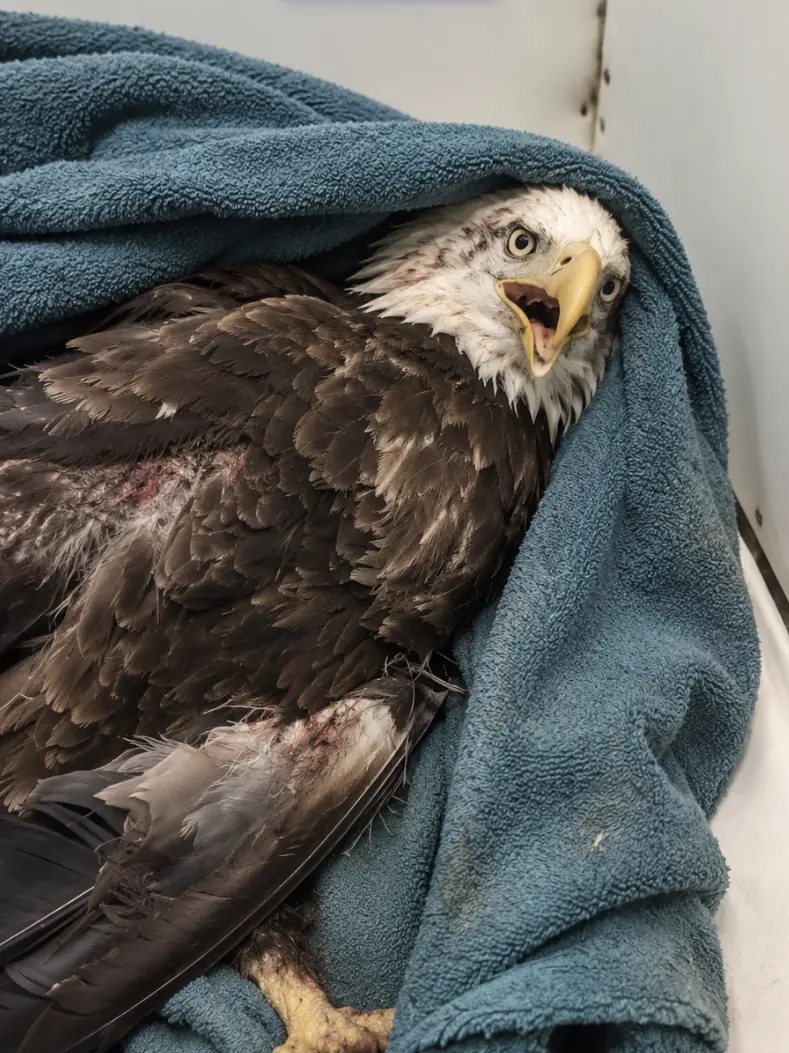
A conservation officer had picked the bird up late in the afternoon after a landowner found it sitting on the ground near the edge of a flooded field. The eagle had apparently been in the same place for several hours. It could stand, but it made no serious attempt to fly when approached, and one wing hung slightly lower than the other. There was a small area of missing feathers and dried blood near the upper wing, along with several superficial abrasions across the body, but nothing about the scene immediately explained why an adult Bald Eagle that should have been capable of crossing miles of open country was instead allowing people to come close enough to capture it. By the time the transport crate reached the wildlife hospital, the bird had become even quieter. It remained conscious and alert enough to watch the staff through the carrier door, but it sat low rather than standing normally and opened its beak defensively whenever a person moved too close. The eagle looked frightened, exhausted and painful, but the most troubling part of the case was not what the veterinary team could see. It was what they could not.
Dr. Claire Morgan, the center’s attending wildlife veterinarian, had treated enough injured raptors to know that dramatic external wounds are not always necessary to produce serious disability. A small puncture near the shoulder can damage muscle, a tendon or a joint. A collision can cause deep bruising without breaking a bone. A bird may also become dehydrated and weak after spending several days unable to hunt. Even so, the difference between the eagle’s overall condition and the relatively modest visible trauma raised another question that could not be ignored: Was the bird suffering from something other than injury?
That possibility had become increasingly important for wildlife hospitals dealing with sick birds. Avian influenza virus, commonly abbreviated AIV, had changed the way many facilities approached unexplained weakness, neurologic abnormalities and unusual behavior in wild raptors. A bird with a clearly fractured wing after a witnessed vehicle collision presents one type of problem. A bird that is profoundly weak, unable to fly and showing only limited trauma presents another. The second patient may still be injured, but infectious disease has to remain part of the differential diagnosis until testing provides more information.
Morgan examined the eagle with that concern in mind. The bird’s eyes responded normally to light. There was no obvious head tilt, persistent tremor or severe loss of coordination. Its feet retained sensation, and both talons could still close around a padded surface, although the overall grip was weaker than expected from a healthy adult. The wing wound was painful, but the long bones did not feel grossly unstable. The bird was moderately dehydrated and underweight enough to suggest that it had probably not been feeding normally. Its breathing was somewhat elevated, although that could have reflected stress, pain or recent transport.
None of those findings alone pointed directly to avian influenza.
None allowed the team to dismiss it either.
Morgan explained the concern to the staff before the eagle was moved into treatment. “I want everyone to understand why we are going to be more cautious with this bird than the wound alone might suggest,” she said. “Avian influenza has changed the way wildlife hospitals have to think about a sick raptor when the examination does not immediately give us a complete explanation. We cannot look at a small injury and assume that everything else we are seeing is caused by that injury.”
The consequences extended beyond the patient in front of them. Ozark Wildlife Medical Center routinely worked with the fictional Riverbend Zoological Park, which maintained a large collection of native and exotic birds. Under normal circumstances, certain wildlife patients could be transferred to specialized spaces there for imaging, long-term care or rehabilitation support. That option was not available while AIV remained a possibility.
“We cannot take a bird with unknown avian influenza status into a facility that houses other susceptible birds,” Morgan said. “A positive patient could create a biosecurity problem far larger than the individual case. Until we know more, this eagle has to stay completely separate.”
The treatment plan for the day was therefore built around two priorities at once. The staff needed to support an injured, debilitated eagle while also treating it as a potential infectious-disease patient until testing came back. The wing would be cleaned and supported with a temporary bandage. Fluids would be administered to address dehydration. Pain medication would be started. Blood would be collected for routine testing, and swabs would be submitted for AIV testing according to the center’s current protocol. Most importantly, the eagle would remain in strict isolation.
Isolation did not simply mean putting the bird in a different cage.
The eagle was moved into a dedicated room away from the center’s other avian patients. Staff entering that space used designated protective clothing and equipment. Gloves were changed according to protocol, footwear was managed carefully, and items used inside the room stayed there rather than moving between patients. The number of people handling the bird was kept as small as practical. Food dishes, towels, cleaning equipment and medical supplies were separated from those used elsewhere in the hospital.
This kind of procedure can look excessive to someone seeing only a single eagle with a small wound.
From a veterinary and population-health perspective, it was routine caution.
A wildlife hospital is responsible for more than the patient currently on the examination table. A facility caring for multiple birds has to consider what happens if one infectious animal introduces a virus into the environment. The risk is especially serious when an outside institution such as a zoo maintains birds that cannot simply be moved elsewhere if an exposure occurs.
“People sometimes hear the word isolation and imagine we are saying the eagle definitely has avian influenza,” Morgan said. “That is not what isolation means. It means we do not know yet, and while we do not know, we manage the risk.”
The first diagnostic step was radiography. If the wing contained a major fracture, the visible injury could explain much of the bird’s condition and provide a clearer path forward. The imaging team worked efficiently to minimize handling time. The eagle was weak, but it remained capable of defending itself, and even a debilitated Bald Eagle can cause serious injury with its feet. One handler controlled the legs while another supported the body and the injured wing.
The X-rays produced a result that was both reassuring and, in another sense, frustrating.
There was no fracture of the humerus.
The radius and ulna were intact.
The shoulder joint remained aligned.
There was no obvious spinal injury.
No major skeletal trauma appeared that could easily explain the degree of weakness the staff had seen on admission.
“Sometimes finding very little on an X-ray is good news,” Morgan told the team. “Sometimes it makes us more cautious because we still have to explain the patient.”
The blood work added pieces but did not immediately solve the puzzle. The eagle was dehydrated. There were changes compatible with physiologic stress and inflammation, but no dramatic anemia, no laboratory abnormality that clearly explained collapse and no single number that allowed the team to say, “This is why the bird cannot fly.”
That left the small wing wound under greater scrutiny.
When the feathers around the area were carefully separated and the skin examined under better lighting, the injury proved deeper than it had looked from the outside. The opening through the skin was relatively narrow, but beneath it the surrounding tissue was swollen and bruised. The eagle reacted strongly when the upper wing was moved through certain angles. The wound appeared to extend into soft tissue around the shoulder, and there was evidence of inflammation that could interfere significantly with normal motion.
The opening in the skin was small.
The problem beneath it was not.
Morgan began to think the injury might explain more of the eagle’s weakness than the first glance had suggested. Pain alone can change the way a large bird moves. If the shoulder could not generate normal force, the eagle may have become grounded. Once grounded, an adult raptor that cannot hunt or move normally can deteriorate quickly. Dehydration, lack of food, stress and prolonged exposure can transform what began as a localized injury into whole-body weakness.
Still, that interpretation remained a working hypothesis.
The AIV test had not returned.
The center would not shorten isolation merely because the wound now looked more important.
The eagle’s first night reflected that cautious approach. The wing was cleaned and supported. Fluids were administered carefully. Pain medication was continued. The bird was placed on thick towels rather than a high perch because it did not have enough strength to balance safely above the floor. The room remained dim, and staff observed through the small window whenever possible instead of entering repeatedly.
The eagle spent much of the evening lying low against the bedding.
Its white head rested partly beneath the edge of a towel, and the beak occasionally opened when someone entered the room. One eye remained fixed on the person working nearby. The bird’s posture could easily have been interpreted as panic because the eyes were wide and the defensive response appeared disproportionate to how little the eagle moved.
Morgan described it differently.
“This bird is stressed, painful and unable to escape,” she said. “It is not confused about whether we are friends. It is a wild predator in a situation where people are controlling everything around it. We should expect a strong stress response whenever it still has enough energy to show one.”
The staff did not try to comfort the eagle through additional handling.
Quiet was part of treatment.
By midnight, the fluids had begun improving hydration, and the bird’s breathing was more regular. It still refused to use a perch. The injured wing remained tucked more carefully against the body, supported by the temporary wrap. The eagle had eaten very little.
The team did not force a large meal.
A severely stressed bird that has just undergone examination, imaging and transport does not necessarily benefit from aggressive feeding on the first night, particularly when there are unanswered questions about its condition. Small amounts of appropriate nutritional support could be provided as needed, but the staff wanted the eagle stable enough to swallow normally and tolerate care.
Early the next morning, one of the technicians looked through the observation window and noticed the first meaningful change.
The eagle was sitting upright.
It was still on the floor, but the chest was no longer resting heavily against the towels. The head remained elevated. When the technician entered wearing isolation equipment, the eagle turned away and raised the beak defensively.
The reaction was stronger than it had been the day before.
That was good news.
During the morning treatment, grip strength had also improved slightly. The eagle attempted to pull one foot away from the handler and opened the uninjured wing briefly before settling again. The injured side remained guarded.
There was still no neurologic deterioration.
There were no new respiratory abnormalities.
The lack of progression toward neurologic disease did not rule out AIV, but it was reassuring.
Morgan rechecked the shoulder wound and found the swelling still present but not rapidly increasing. The tissue had responded well to cleaning, and there was no obvious expanding infection. Pain remained significant when the wing was manipulated, strengthening the argument that the small wound had a substantial functional effect.
The bird also accepted food later that day.