At first, there was nothing about the Bald Eagle that looked dramatically wrong.
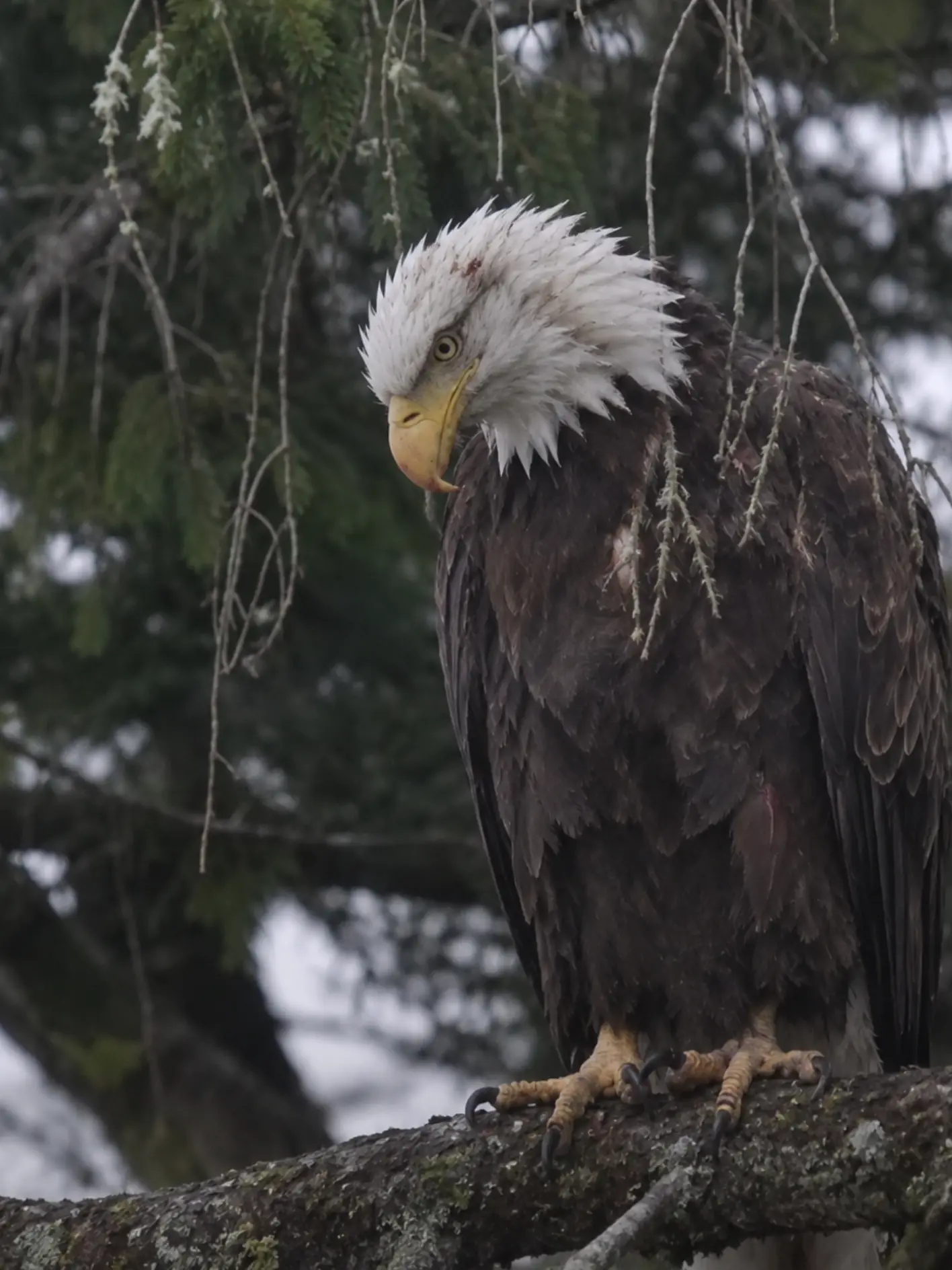
The adult bird was standing on a large branch overlooking a quiet stretch of river in northern Wisconsin. Its wings were folded normally against its body, both feet were wrapped around the branch, and there was no visible fracture, major wound, or obvious sign that the eagle had recently collided with anything.
A nearby resident first noticed the eagle early in the morning while walking along the edge of the property. Seeing a Bald Eagle perched near the river was not unusual in the area, so the person continued with the day and did not give the sighting much thought.
Several hours later, however, the eagle was still there.
By early afternoon, it remained on the same part of the tree.
As evening approached, the bird had shifted its feet only a few times and had not made the kind of strong, purposeful flight that observers normally expected from an adult Bald Eagle.
Its posture had also begun to look different.
The eagle frequently lowered its head toward its chest. Its feathers appeared slightly fluffed, and although it remained conscious and visually aware of activity below, its responses seemed unusually slow. At times, the bird appeared to need considerable effort simply to maintain its position on the branch.
The resident continued watching from a distance.
Eventually, the eagle opened its wings as though preparing to leave.
Instead of launching into a normal flight, it dropped awkwardly to a lower branch and struggled to regain its balance.
That was the moment the observer realized the problem was more serious than fatigue.
A wildlife rescue team was contacted.
Several hours later, the eagle would be undergoing emergency examination at the fictional Great Lakes Wildlife Rehabilitation Center, where veterinarians would discover that the bird’s wings were not broken at all.
The problem was inside its body.
Blood testing showed a markedly elevated concentration of lead, high enough for the veterinary team to consider clinical lead toxicosis a likely explanation for the profound weakness, poor coordination, and inability to sustain normal flight.
What had looked from the ground like a tired eagle resting on a branch was actually a wild raptor whose nervous and muscular systems were beginning to fail.
The First Warning Was Not an Injury but a Change in Behavior
Wildlife rescuers often receive calls about animals with injuries that can be recognized immediately.
A wing may hang at an abnormal angle.
A bird may have visible bleeding.
Fishing line may be wrapped around a leg.
A vehicle collision may be witnessed.
This Bald Eagle presented differently.
The first sign that something was wrong was simply that the bird stopped behaving like a healthy eagle.
Bald Eagles may remain perched for long periods, particularly when resting, watching a feeding area, conserving energy during poor weather, or monitoring territory. Remaining on one branch by itself is therefore not evidence of illness.
What concerned the observer in this case was the combination of behaviors.
The eagle remained in essentially the same location for most of the day.
It appeared increasingly subdued.
It made little effort to leave despite normal human activity occurring at a safe distance below.
When it finally attempted to move, the result looked weak and poorly coordinated.
Those details were enough to justify a call to professionals.
The resident did not attempt to climb toward the bird, shake the tree, or force it to fly. Instead, the person photographed the eagle from a distance and provided the rescue team with its location and a description of the behavior.
That choice was important.
Forcing a sick raptor to fly can consume the limited energy it has left and may cause it to fall into an unsafe area. Approaching an eagle directly can also place the rescuer at risk because even a profoundly weakened Bald Eagle can inflict serious injuries with its talons.
The safest immediate action was observation followed by a call for help.
Wildlife Responders Initially Considered Trauma
When the fictional Northwoods Wildlife Response Team reached the site, trauma was still one of the first possibilities considered.
Bald Eagles commonly encounter vehicles, power lines, territorial conflicts, windows, and other hazards. An eagle that cannot fly normally may have a fractured wing, a shoulder injury, soft-tissue trauma, or neurologic damage resulting from a collision.
The responders watched the bird before approaching.
Both wings appeared to be held symmetrically against the body.
There was no obvious droop on either side.
The eagle was still gripping the branch, although the grip looked less secure than expected.
The bird followed movement with its eyes but did not show the alert, defensive posture typically associated with a healthy adult eagle.
The team decided that capture was justified.
The eagle eventually moved from the tree to a lower position, where trained responders were able to contain it safely. Once secured, the feet were controlled and the wings were supported close to the body.
What happened next made the rescuers even more concerned.
The eagle barely resisted.
A healthy adult Bald Eagle usually does not accept close human handling quietly. Even birds with orthopedic injuries often defend themselves vigorously with their feet.
This bird reacted, but the response was weak.
Its grip strength was reduced.
The head remained low.
The eagle appeared exhausted.
The lack of resistance was not interpreted as calmness.
It was interpreted as illness.
The Photograph Shows a Weak Bird, but It Does Not Reveal the Diagnosis
A photograph taken before rescue shows the eagle still perched in the tree with its head lowered and body held in a subdued posture.
There is no catastrophic injury visible in the image.
The wings appear present and normally positioned.
The bird is still standing.
Nothing about the photograph alone proves lead poisoning.
That distinction is important because environmental toxicology cannot usually be diagnosed from appearance.
The image documents abnormal behavior.
The diagnosis came later through clinical examination and blood testing.
That progression reflects a common challenge in wildlife medicine. The first clue is often behavioral, while the underlying disease is hidden.
The Initial Examination Did Not Find a Major Fracture
After arrival at the Great Lakes Wildlife Rehabilitation Center, the eagle was placed in a quiet, padded enclosure while the veterinary team performed an initial assessment.
The bird was weak but conscious.
Its body condition was below ideal.
The breast muscles were less developed than expected for a healthy adult Bald Eagle, suggesting that the problem may not have begun that morning.
Both feet remained functional, but grip strength was reduced.
The eagle could stand for short periods but frequently lowered itself back onto the padded floor.
The wings were carefully examined.
There was no major open wound.
No bone was exposed.
Palpation did not reveal the kind of instability expected with a severe long-bone fracture.
The shoulders appeared reasonably symmetrical.
The legs were also evaluated.
Nothing in the musculoskeletal examination adequately explained why the eagle had been unable to leave the tree.
Radiographs were therefore obtained once the bird was stable enough for imaging.
The images showed no major fracture that could account for the profound weakness.
That result changed the direction of the case.
If the wings were structurally intact, the team needed to ask a different question.
Why could the bird not use them normally?
The Problem Appeared to Be Systemic Rather Than Mechanical
An eagle can be incapable of flight for reasons that have nothing to do with a broken wing.
Flight requires much more than intact bones.
The nervous system must coordinate movement.
The muscles must generate sufficient force.
The cardiovascular system must supply oxygen.
The bird must be alert enough to judge distance and maintain balance.
The feet must release and reposition correctly.
The eyes and brain must process the environment.
A systemic disease can disrupt several of these functions at once.
That possibility became increasingly important as the physical examination continued.
The eagle’s responses were slow.
Its grip was weak.
It tired rapidly.
The bird could open and move both wings, but there was not enough coordinated strength for normal flight.
Veterinarian Dr. Rebecca Collins, a fictional wildlife specialist at the center, ordered blood testing to look for metabolic disease, infection, anemia, and toxic exposure.
Lead was among the substances the team wanted to assess because Bald Eagles are highly susceptible to exposure through scavenging.
The Blood Lead Result Changed the Case
The result came back elevated well above the center’s threshold for concern.
At that point, the clinical picture began to make sense.
The bird did not have a broken wing.
The bird had a toxic metal circulating through its body.
“The initial appearance could easily have made someone think this was simply an exhausted eagle,” Collins said. “Once the lead result returned, the weakness, reduced grip and inability to sustain flight became much easier to explain.”
The team considered the combination of elevated blood lead and compatible neurologic signs consistent with lead toxicosis.
The precise clinical significance of any blood lead measurement depends on concentration, timing, individual condition, and the laboratory methods used, so the clinicians did not rely on a number alone.
They looked at the whole bird.
The eagle had measurable lead exposure.