Six weeks before this adult Bald Eagle rose above the tree line and disappeared toward the Upper Mississippi River, the bird arrived at a wildlife rehabilitation center with one side of its face covered in blood and one eye swollen almost completely shut.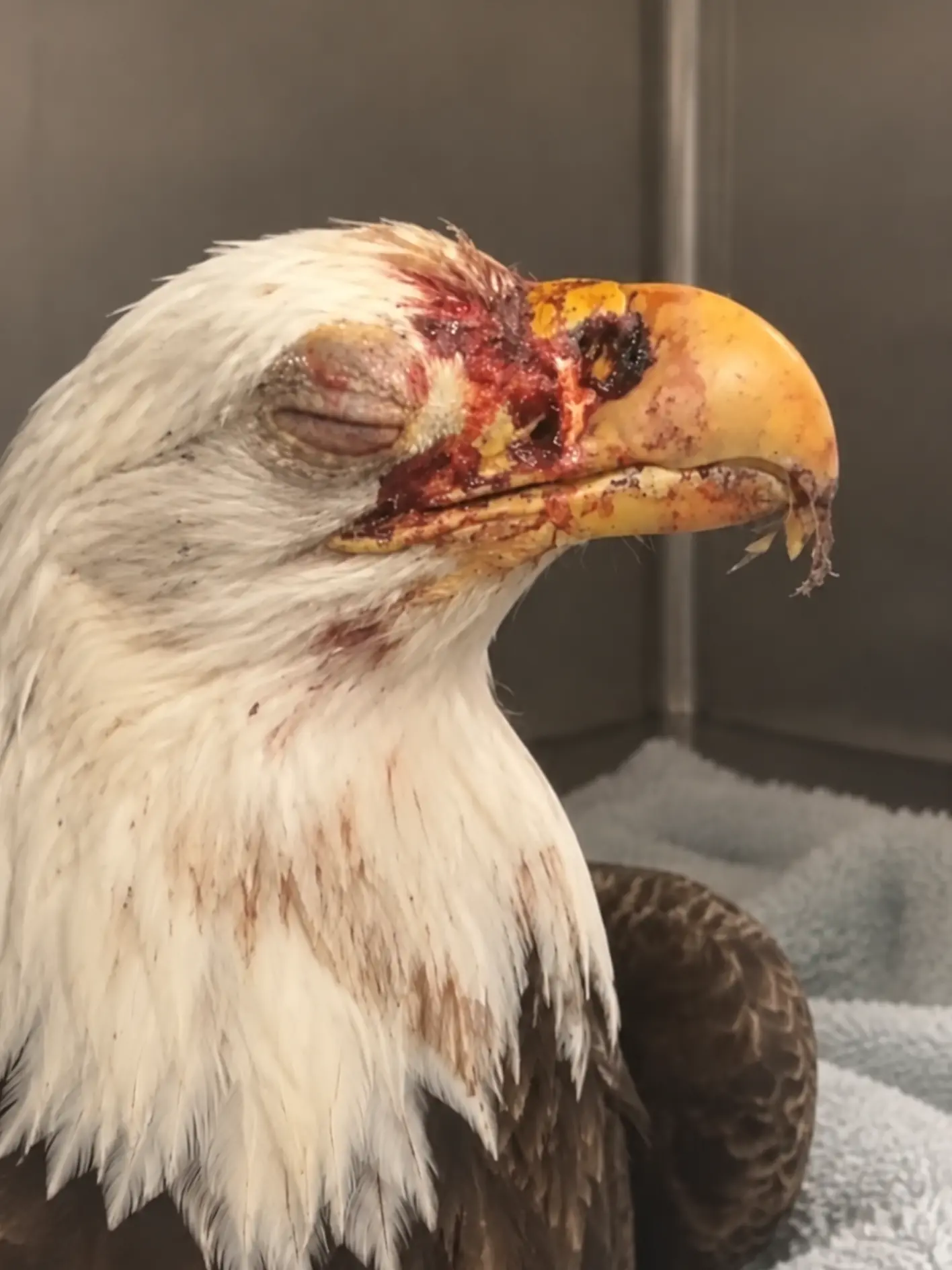
The injuries were immediately alarming.
Blood had dried across the feathers around the eye, forehead, and base of the beak. Several small but deep wounds were visible around the head and neck. The tissue surrounding one eye was severely swollen, making it impossible during the first examination to know how much damage had occurred beneath the surface.
Yet the eagle was still conscious.
It could hold its head upright.
It responded to movement around the treatment room.
And despite everything visible on its face, it remained neurologically alert.
Wildlife responders believed the injuries were consistent with a violent encounter involving another Bald Eagle — the kind of close aerial territorial confrontation in which powerful talons can turn a dispute lasting only seconds into a potentially life-threatening emergency.
The exact fight was not witnessed from beginning to end, so veterinarians remained careful about assigning a definitive cause. But the location where the bird was found, the pattern of puncture injuries, and the absence of evidence for several other major causes made an aggressive encounter with another eagle a leading possibility.
For the rehabilitation team, however, determining exactly how the injuries occurred was not the first priority.
The immediate question was much simpler.
Could the eagle keep its injured eye?
And if it survived, would it still be able to see well enough to return to the wild?
The Eagle Was Found Grounded After a Suspected Aerial Confrontation
The bird was discovered near a wooded river corridor in southeastern Minnesota, an area used regularly by Bald Eagles for feeding, roosting, and nesting.
The person who reported the eagle initially noticed that it remained on the ground despite nearby activity.
That alone was unusual.
Healthy adult Bald Eagles are typically wary of people and usually move away or fly when approached too closely.
This bird did not.
As rescuers came nearer, the reason became obvious.
One side of the eagle's face was badly injured.
Blood was visible around the eye and beak.
The head feathers were matted.
The affected eye was swollen to the point that normal vision on that side could not be confirmed.
The eagle was capable of moving but did not appear able to leave the area normally.
Wildlife personnel were contacted, and the bird was safely restrained and transferred into a padded transport carrier.
Even severely injured eagles can defend themselves with their feet, so responders controlled the talons first and minimized handling of the head.
The bird was then transported directly to a licensed raptor rehabilitation center.
Territorial Conflicts Between Bald Eagles Can Become Physical
Bald Eagles are often seen soaring together peacefully, particularly around abundant food resources or communal roosts.
But they are also territorial birds.
During breeding periods, around nests, or when access to food is contested, interactions can escalate.
Eagles may chase one another through the air.
They can dive toward rivals.
They may attempt to strike with their feet.
In the most intense encounters, two birds can make direct contact.
Because the talons are designed to seize and hold prey, they can also produce penetrating injuries during fights with other eagles.
Wounds around the head, neck, chest, and back can occur.
That does not mean every injured eagle with puncture wounds has been in a territorial fight. Vehicle strikes, collisions, entanglement, and other forms of trauma can produce overlapping injuries.
In this case, the veterinary team treated the fight as a suspected explanation rather than an established fact.
The bird's injuries would have to speak for themselves.
The Initial Examination Revealed Significant Head Trauma
At admission, the eagle was quiet but responsive.
Staff began with a complete examination rather than concentrating only on the visibly injured eye.
Both wings were checked.
The legs and feet were assessed.
The keel, shoulders, and spine were palpated.
The beak was examined for instability.
The neck was evaluated carefully.
The most serious abnormalities were concentrated around the head.
There were several puncture and laceration wounds.
The tissues around one eye were markedly swollen.
Blood and debris covered parts of the face.
There was bruising near the base of the beak.
The injured eyelids could not open normally.
For a bird that depends on exceptional visual precision, this was a major concern.
Vision Is Essential to a Bald Eagle's Survival
A Bald Eagle does not merely need enough vision to recognize large shapes.
It must judge distance accurately.
It must track moving prey.
It must navigate through branches.
It must coordinate its approach to a perch while traveling at speed.
It must recognize threats.
And during landing, the bird has only moments to estimate distance, extend its feet, adjust the wings, and close its talons around a branch.
Even if the eagle's wings and legs healed perfectly, a severe visual deficit could still prevent release.
That is why the eye became one of the central issues in the case.
The rehabilitation team's goal was not simply to preserve the appearance of the eye.
They needed useful function.
X-Rays Provided the First Encouraging News
Diagnostic radiographs were obtained after the eagle was stabilized.
The veterinary team wanted to rule out injuries that could not be seen externally.
A direct blow to the head can fracture the skull.
Trauma around the beak can affect the jaw or facial bones.
Neck injuries can compromise neurological function.
Radiographs did not reveal a catastrophic skull fracture or major skeletal damage.
That was important.
The wounds were severe, but the bird's fundamental skeletal structure remained intact.
The next question was whether the injured eye itself could recover.
The Eye Was Swollen, but Not Necessarily Lost
Once the eagle was stable enough for a more detailed ophthalmic examination, veterinarians assessed the eye beneath the swollen tissues.
The globe remained intact.
That did not guarantee normal vision.
There was substantial inflammation, and the surrounding tissues had sustained significant trauma.
But the eye had not been destroyed.
For the first time since admission, the team had a reason for cautious optimism.
The injury would require close monitoring.
Swelling could worsen.
Infection could develop.
Damage inside the eye might become clearer only after inflammation decreased.
But preserving useful vision remained possible.
"At first, the swelling made it difficult to know what we were dealing with," the attending veterinarian said. "Once we were able to evaluate the eye more completely, we became more hopeful that there might still be useful vision."
The Facial Wounds Required Immediate Treatment
The puncture and laceration wounds around the head were carefully cleaned.
Dried blood and debris were removed so the veterinary team could evaluate the tissue directly.
Deeper wounds were flushed thoroughly.
Any damaged tissue that could not recover was assessed.
Where necessary, wounds were closed or managed to allow healthy healing while maintaining drainage and reducing infection risk.
Because puncture wounds can carry bacteria deep beneath the surface, monitoring for infection was especially important.
Medication was provided as clinically appropriate for pain, inflammation, and infection risk.
No treatment could guarantee a perfect outcome.
The goal was to give healthy tissue the best possible environment in which to repair itself.
The First Several Days Were Quiet
The eagle was housed in a padded intensive-care enclosure with minimal human activity.
Lighting was controlled.
Handling occurred only when medically necessary.
Stress matters in wildlife patients.
A bird recovering from severe trauma uses energy simply remaining alert and defensive around people.
Reducing unnecessary stimulation allows more of that energy to be directed toward healing.
During the first days, staff watched for changes in:
swelling,
bleeding,
appetite,
head position,
neurological responsiveness,
and visual behavior.
The prognosis remained guarded.
The First Major Improvement Was Reduced Swelling
Gradually, the tissues around the eye began to change.
The swelling decreased.
The eyelids could open farther.
The surface of the eye became easier to assess.
The eagle began tracking movement from the injured side.
That did not immediately prove normal vision, but it was encouraging.
A completely nonfunctional eye would have created a much more complicated rehabilitation decision.
Instead, the bird appeared increasingly aware of activity approaching from both sides.
The Eagle Also Became More Difficult to Handle
At admission, the eagle was relatively subdued.
That began to change.
It watched staff more closely.
It reacted earlier when someone approached.
Its grip became stronger.
It began attempting to move away during examinations.
Wildlife rehabilitators welcome those behaviors.
The goal is never to make a Bald Eagle comfortable with human contact.
A healthy wild bird should resist restraint and maintain appropriate fear of people.
The return of defensive behavior was another sign that the eagle's overall condition was improving.
Appetite Returned
Head and facial trauma can interfere with feeding.
Pain around the beak may discourage eating.
Visual impairment can make food difficult to locate or manipulate.
Initially, the bird's intake was closely monitored.
As the facial wounds improved, the eagle began showing stronger interest in food.
Soon it was eating independently.
That was an important milestone.
The bird could locate food.
It could use the beak normally enough to tear and swallow.
Its appetite was consistent with improving systemic health.
Adequate nutrition also provided the protein and energy needed for tissue repair.
The Wounds Looked Dramatically Better After the First Two Weeks
The change in appearance was striking.
Areas that had initially been covered in blood and swelling became cleaner.
The skin began closing.
Inflammation around the eye decreased substantially.
Feathers around the face began settling back toward their normal position.
But rehabilitators did not use appearance alone to judge recovery.
A wound can look much better while deeper functional problems remain.
The eye needed continued assessment.
The eagle's responses had to demonstrate that vision was useful, not simply that the tissue looked healthier.
Visual Testing Became More Important as the Bird Improved
Once the eagle was stronger, staff could evaluate visual function more meaningfully.
They watched how the bird responded to movement from different directions.
They observed head positioning.
They looked for evidence that the eagle was consistently using information from the injured side.
Eventually, the bird would face much more demanding visual tests in a larger enclosure.
Perching and landing would provide some of the most useful functional information.
The Eagle Was Moved Out of Intensive Care
As the wounds stabilized and the bird's strength returned, it no longer needed the same level of medical confinement.
It was moved into a larger rehabilitation enclosure.
This was an important transition.
The eagle could now move more naturally.
It could choose different positions.
It could use progressively higher perches.
The team could observe behavior without the constant constraints of a small medical enclosure.
The bird remained alert and strongly wary of people.
Those were exactly the behaviors staff wanted.
Perching Offered the First Real Test of Distance Judgment
Perching seems simple when watching a bird sitting quietly on a branch.
The process of reaching that branch is not simple at all.
An eagle must judge its distance from the perch.
It must coordinate the wings and tail.
It must determine when to extend the legs.
And it must close the talons at exactly the right moment.
A bird with inadequate vision can hesitate, overshoot, undershoot, or repeatedly make inaccurate approaches.
This eagle began moving between perches with increasing confidence.
There was no obvious pattern of repeated misses associated with the previously injured side.
That was encouraging.
Flight Conditioning Came Next
Once the eagle was medically stable and the facial injuries had healed sufficiently, it was transferred to a large flight enclosure.
This was the stage where weeks of clinical treatment would finally be tested under conditions that more closely approximated life in the wild.
Staff evaluated:
takeoff,
wing symmetry,
speed,
turning,
altitude,
endurance,