An adult Bald Eagle is undergoing rehabilitation after police found the bird injured along Interstate 84 near Waterbury, Connecticut, unable to fly following an apparent collision with a motor vehicle.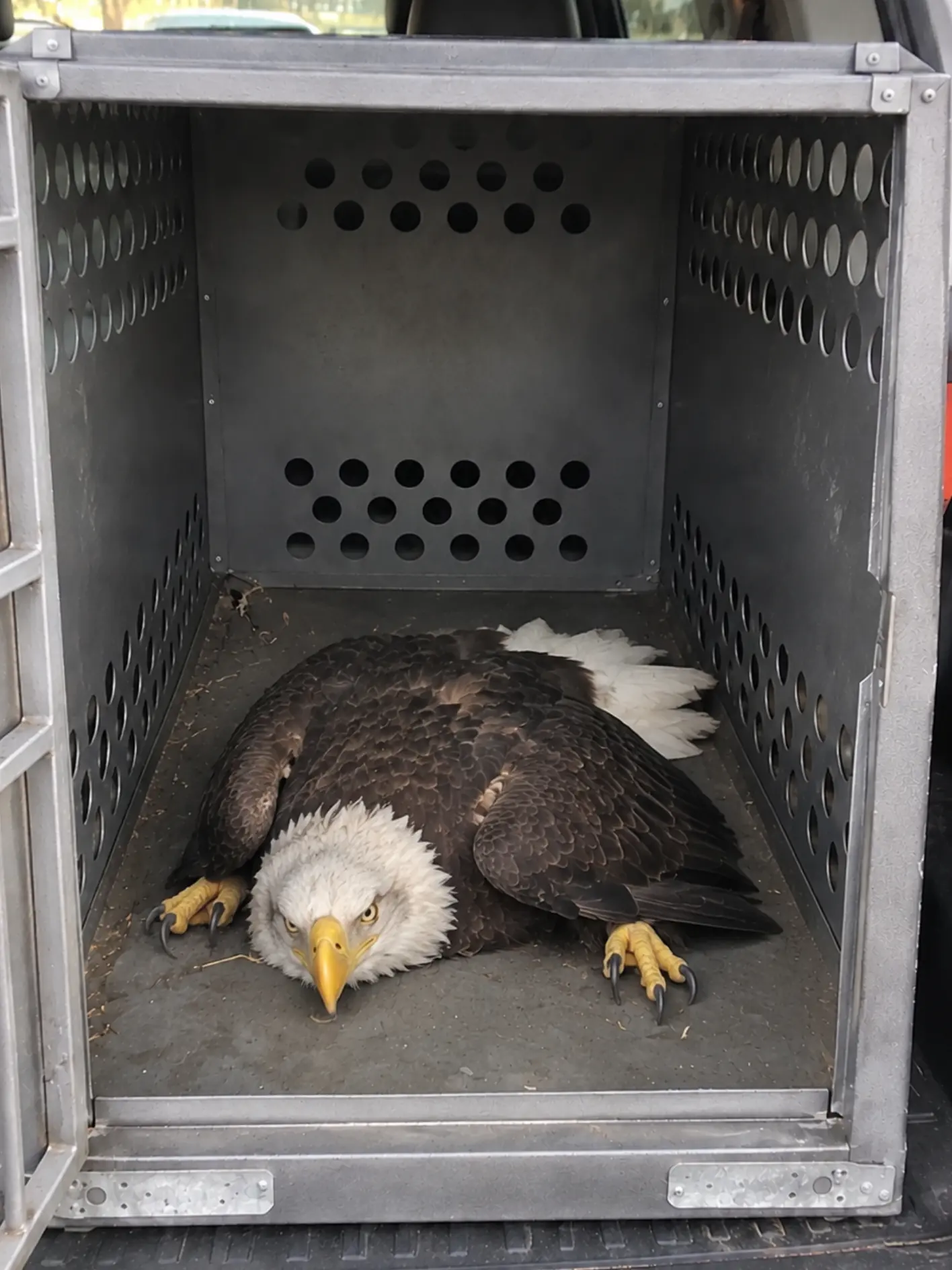
According to responding officers, the eagle was first noticed on the ground near the highway after apparently being struck while flying low across or alongside the roadway. The bird was conscious when officers approached, but one wing was being held abnormally and it made no attempt to take off.
With traffic moving nearby, the situation presented an immediate danger.
Even if the eagle had survived the initial impact, remaining beside an active highway left it vulnerable to being struck again.
Police secured the area as best they could and contacted Waterbury Animal Control for assistance.
Animal-control personnel arrived with appropriate protective equipment, safely restrained the eagle and provided initial stabilization before transporting the bird for transfer to wildlife personnel with the Connecticut Department of Energy and Environmental Protection, or DEEP.
From there, arrangements were made for specialized veterinary evaluation and rehabilitation.
The first examination confirmed what rescuers had feared.
The eagle had suffered significant trauma to one wing.
Radiographs later revealed a fracture severe enough to explain why the bird could no longer fly.
Although the injury was serious, the eagle remained alert and responsive, and no other catastrophic skeletal injury was immediately identified.
For the rehabilitation team, those findings offered cautious reason for hope.
The road back to the sky, however, would be measured in weeks rather than days.
Police First Noticed the Eagle Beside the Highway
The rescue began when officers noticed what initially appeared to be a large dark shape near the edge of the highway.
As they approached, the white head and tail became unmistakable.
It was an adult Bald Eagle.
The bird was sitting low rather than standing in the upright posture typically seen in a healthy eagle.
Its wings were not positioned symmetrically.
One remained close to the body while the injured side appeared lower and less controlled.
When officers stopped at a safe distance, the eagle watched them but did not fly.
That immediately suggested that something was wrong.
Bald Eagles may occasionally remain on the ground while feeding, but a healthy adult usually maintains significant distance from people.
This bird was clearly unable to do so.
Responders also had to contend with the location.
A highway shoulder is dangerous enough for people.
For a large bird unable to fly, it can become fatal very quickly.
The Suspected Vehicle Strike May Have Happened in Seconds
Police believed the eagle had been struck by a motor vehicle while flying through the roadway corridor.
Bald Eagles frequently travel low when moving between feeding areas, waterways and nearby trees.
They may also approach roadsides to feed on animal carcasses.
When a large raptor launches from the ground, particularly after feeding, it may require more distance to gain altitude than a smaller bird.
Exactly what happened in this case may never be reconstructed with certainty.
No one had a complete view of the collision from beginning to end.
But the location, the bird’s inability to fly and the nature of the wing trauma were consistent with a significant impact.
Regardless of the exact sequence, the priority was clear.
The eagle needed to be removed from the highway and evaluated as quickly as possible.
Waterbury Animal Control Was Called to Assist
Capturing an injured Bald Eagle requires training.
A bird that appears weak can still defend itself with tremendous force.
The talons are the primary danger.
An adult eagle’s feet are designed to seize struggling prey, and a frightened bird may strike reflexively even when badly injured.
Waterbury Animal Control personnel approached with heavy protective gloves and equipment suitable for containing a large raptor.
The eagle’s feet were controlled first.
Its body was then supported carefully.
Particular attention was given to the injured wing so that the fracture would not be displaced further during handling.
No attempt was made to pull the wing straight or manipulate it into a normal-looking position.
That is an important part of appropriate wildlife rescue.
Without radiographs, responders cannot know precisely where a fracture lies or what structures surround it.
Unnecessary manipulation can worsen damage to muscles, nerves, blood vessels or bone.
The goal in the field is stabilization.
Definitive treatment comes later.
The Eagle Was Placed in a Secure Transport Crate
Once captured, the bird was transferred into a ventilated wildlife carrier.
Photographs taken during this phase show the adult eagle lying low inside the crate, eyes open and focused on the people nearby.
The bird was clearly alert.
But its posture was not normal.
Instead of standing tall, the eagle remained low, conserving energy and protecting the injured side.
The carrier provided several benefits.
It limited unnecessary wing movement.
It separated the bird from additional traffic hazards.
And the relatively enclosed environment reduced visual stimulation, helping minimize stress during transport.
Injured raptors should not be repeatedly handled unless medically necessary.
For a bird that has just experienced significant trauma, quiet itself becomes part of treatment.
Initial Stabilization Came Before the Full Diagnosis
Waterbury Animal Control provided initial care and coordinated the eagle’s transfer to DEEP wildlife personnel.
At this point, the complete extent of the trauma was still unknown.
A visibly injured wing was only one possibility.
Vehicle collisions can also cause:
head trauma,
internal bruising,
pelvic injuries,
spinal trauma,
lung or air-sac injury,
and internal bleeding.
Some of those injuries may not be obvious during the first few minutes after rescue.
The eagle therefore needed a comprehensive veterinary assessment.
DEEP personnel coordinated the next stage of transport to a facility experienced in treating large raptors.
The First Examination Focused on More Than the Wing
At the rehabilitation facility, staff began with a complete physical examination.
The eagle was tired but responsive.
Its eyes remained open.
The feet still had grip strength.
Breathing was monitored carefully.
Veterinarians examined the head and neck for evidence of impact.
Both legs and feet were checked.
The pelvis and spine were palpated.
The chest was evaluated for signs of trauma.
Then attention returned to the injured wing.
The bird showed a clear pain response.
The wing was not being held normally.
Swelling and soft-tissue trauma were evident around the injured region.
A fracture was strongly suspected.
Radiographs were the next step.
X-Rays Confirmed the Wing Fracture
Diagnostic imaging confirmed that the eagle had sustained a significant fracture in the injured wing.
For veterinarians, this information was essential.
An external examination can tell them that a wing is painful or unstable.
An X-ray shows how the bone itself has been damaged.
The team evaluated:
the location of the fracture,
the degree of displacement,
whether multiple bone fragments were present,
whether nearby joints were involved,
and whether acceptable alignment could be maintained during healing.
The fracture was serious enough to explain the eagle’s inability to fly.
But the imaging did not show a combination of injuries that made treatment immediately impossible.
That distinction mattered.
The prognosis remained guarded, but rehabilitation was considered worthwhile.
Why a Broken Wing Is Such a Serious Injury for an Eagle
A wing fracture in any wild bird is significant.
For a Bald Eagle, the demands placed on the repaired wing are particularly high.
An adult eagle is a large, powerful bird.
During takeoff, both wings must generate enough lift to raise several kilograms of body weight into the air.
During soaring, the wings must maintain precise aerodynamic alignment.
During turning, each wing must alter force independently.
During landing, the bird must slow itself while maintaining balance and accuracy.
Even a small loss of normal range of motion can become a major survival problem.
A healed bone is therefore not automatically a successful outcome.
The wing must heal functionally.
The Injured Wing Was Stabilized
Once the fracture had been evaluated, the veterinary team positioned the wing carefully and applied a padded support wrap.
The purpose of immobilization was to reduce movement at the fracture site.
Every uncontrolled flap creates force across the damaged bone.
Too much movement can interfere with early healing or worsen displacement.
The eagle was placed in a quiet medical enclosure with padded flooring.
High perches were avoided during the initial stage.
A bird with a fresh fracture does not need opportunities to jump, climb or attempt short flights.
The safest place was close to the floor.
Pain Management Became an Important Part of Treatment
Wild birds do not always display pain in obvious ways.
They may simply become quiet.
Stop eating.
Hold an injured wing unusually.
Or reduce movement.
That does not mean the pain is minor.
The eagle received analgesic treatment appropriate to its clinical condition.
Anti-inflammatory therapy could also be considered as indicated by the attending veterinarian.
Managing pain supports welfare, but it also helps rehabilitation.
A bird in severe pain may struggle unpredictably or refuse nutrition.
A more comfortable patient can rest.
And rest is exactly what a fresh fracture needs.
Fluids Helped Address the Stress of Trauma
Vehicle-strike patients may arrive dehydrated or physiologically stressed even if the accident occurred only hours earlier.
The eagle’s hydration and circulation were assessed.
Fluid therapy was provided based on its clinical needs.
The bird was also monitored for changes that could indicate delayed complications.
Trauma is not always static.
Bruising can worsen.
Swelling may increase.
A bird that initially appears stable can deteriorate later.
That is why the first 24 to 48 hours remained important even after the fracture had been identified.
Staff Watched Closely for Evidence of Head Trauma
Because the eagle had reportedly been struck by a vehicle, the rehabilitation team could not assume the wing was the only affected structure.
Head injuries are especially concerning in birds.
Possible signs can include:
abnormal pupil responses,
poor balance,
head tilt,
reduced awareness,
seizure activity,
or difficulty maintaining normal posture.
Fortunately, the eagle remained neurologically responsive.
Its eyes followed movement.
There was no immediate evidence of a catastrophic neurological injury.
That was encouraging.
But monitoring continued.
The First Day Was Mostly About Keeping the Bird Quiet
The eagle spent much of its first day resting.
Handling was minimized.
The bird had already experienced the original trauma, roadside capture, transport, transfer and veterinary examination.
Each additional interaction carries stress.
Wildlife rehabilitation teams therefore try to accomplish necessary treatment efficiently while allowing long periods of uninterrupted rest.
The injured wing remained stabilized.
Food and hydration were monitored.
The eagle’s breathing, posture and mental status were checked regularly.
The initial prognosis was still guarded.
No one was predicting release yet.
The First Improvements Appeared in the Eagle’s Behavior
Over the following days, the bird became more alert.
Its posture grew stronger.
Instead of remaining low for long periods, the eagle began standing more consistently.
Its eyes followed staff immediately when they entered the room.
Grip strength improved.
Eventually, the bird began reacting more defensively during examinations.
That was viewed positively.
A healthy wild Bald Eagle should not be comfortable with people.
The return of strong defensive behavior often indicates that a previously debilitated raptor is regaining energy.
The bird was beginning to act less like a trauma patient and more like a wild eagle.
Appetite Became Another Important Indicator
The eagle also began eating more reliably.
Trauma frequently suppresses appetite.
Pain and stress can make an injured raptor refuse food even when nutritional support is desperately needed.
As the eagle stabilized, voluntary feeding increased.
That mattered because bone repair requires substantial metabolic resources.
New tissue must be produced.
Muscle condition must be preserved.
The bird needs adequate protein and calories throughout recovery.
An eagle that eats independently is easier to rehabilitate than one requiring prolonged assisted feeding.
Swelling Around the Fracture Had to Be Monitored
The fracture itself was only part of the injury.
Vehicle impact can cause substantial soft-tissue bruising.
Muscles may be damaged.
Blood vessels can rupture.
Inflammation can develop around the fractured area.