When residents began assessing storm damage after a powerful tornado tore through a rural community in Oklahoma, they found more than broken branches, twisted fencing, and scattered debris. Beneath a stand of damaged trees, lying low in the grass and unable to escape, was an adult bald eagle.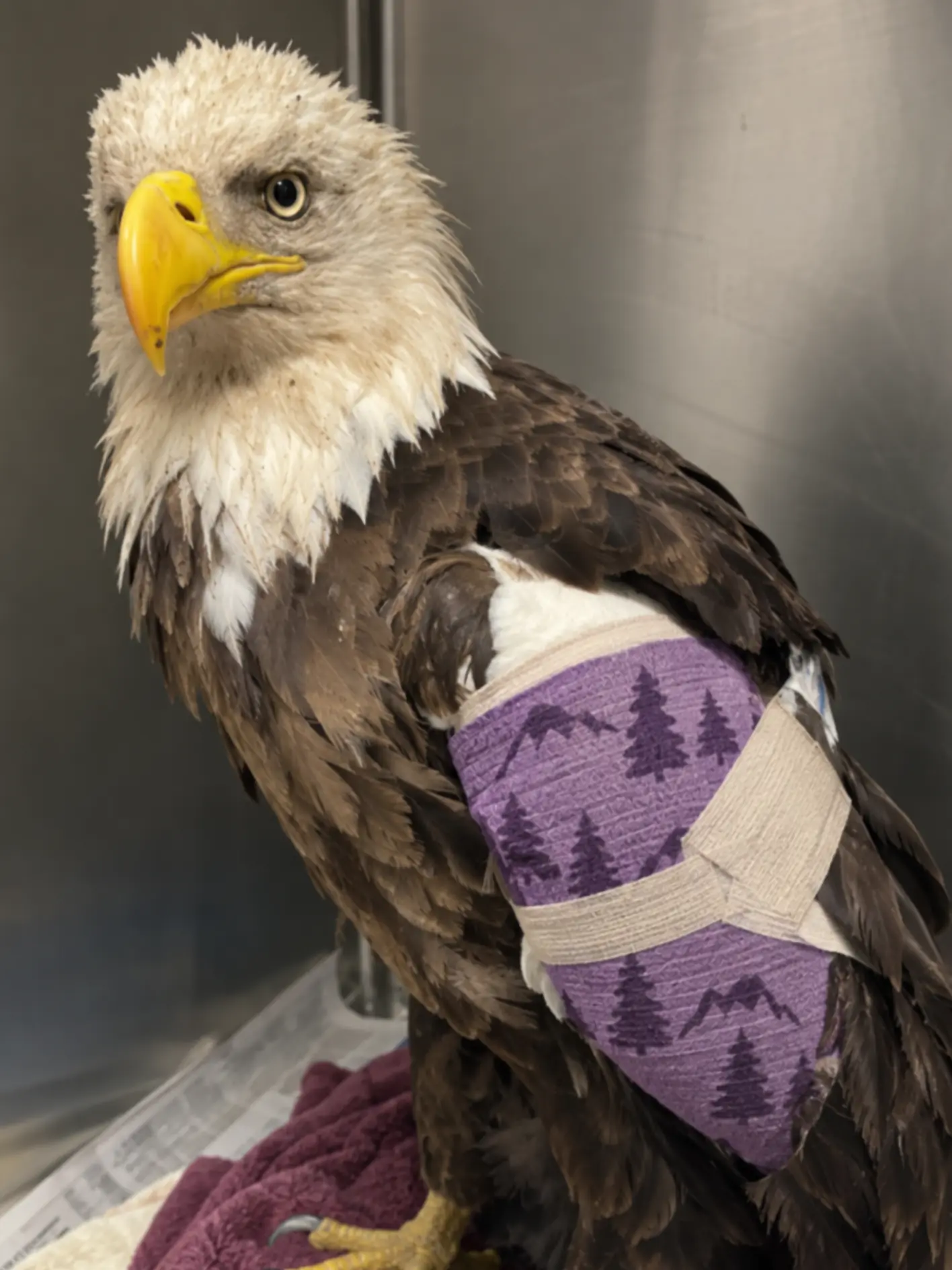
The bird was alive, alert, and breathing on its own. But something was clearly wrong.
Wildlife responders who arrived at the scene quickly saw that the eagle could not fly. One wing was held abnormally close to the body, and the bird’s posture suggested significant pain. Although the exact cause of the injuries could not be confirmed, the circumstances of the discovery and the nature of the trauma were considered consistent with injuries that may have been sustained during the storm or in its immediate aftermath.
Within hours, the eagle was transported to a licensed wildlife rehabilitation hospital, where veterinarians began what would become a race not only to save the bird’s wing, but to preserve its future as a free-ranging raptor.
By the end of the day, the bald eagle had undergone a complex operation that lasted nearly two hours.
And against difficult odds, it survived.
Found alive after the storm
According to wildlife staff, the eagle was discovered shortly after the tornado passed through the area. Neighbors searching for damaged livestock fencing and downed limbs noticed the bird on the ground and recognized immediately that it was in distress. A healthy adult bald eagle will typically flush or attempt to launch if a person gets too close. This one remained grounded.
Responders used heavy gloves, a protective blanket, and a transport crate to secure the bird safely. Even in a weakened condition, bald eagles remain powerful animals, and minimizing stress during capture is a critical part of emergency handling.
The eagle was then taken to a wildlife care facility for urgent examination.
“From the beginning, it was clear this bird had significant trauma,” one member of the rehabilitation team said. “It was bright enough to track people with its eyes, but it could not use the injured wing normally, and we were concerned that the damage might be severe enough to end its chances for release.”
That concern would soon prove justified.
Emergency intake reveals serious trauma
Once the eagle arrived at the hospital, veterinary staff performed a full triage evaluation. As with any raptor admitted after suspected blunt-force trauma, the team assessed the bird’s hydration status, body condition, mentation, and basic stability before moving on to more detailed orthopedic work.
The bird’s weight and body condition suggested that, prior to the incident, it had been maintaining itself adequately in the wild. That was an encouraging finding. In many wildlife cases, chronic starvation, heavy parasite burden, or prolonged debilitation can complicate recovery from trauma. In this case, the most urgent issue appeared to be the injury itself.
On physical examination, the veterinary team documented swelling and instability in one wing, along with bruising and soft-tissue trauma. The eagle also had superficial abrasions consistent with recent environmental injury. Because fractures in birds can be difficult to characterize without imaging, the team proceeded with full-body radiographs.
Those images confirmed the problem: the bald eagle had sustained a serious wing fracture.
The break was significant enough that conservative management alone was unlikely to provide a functional outcome. For a bird whose survival depends on strength, symmetry, lift, and precision in flight, even a fracture that technically heals can still be career-ending if the bones heal out of alignment.
In other words, saving the eagle’s life was only one part of the challenge.
Saving the wing was the harder part.
Why surgery was necessary
In many injured wild birds, veterinarians must make a careful distinction between survival and release potential. A bird may recover enough to remain alive in captivity but never regain the ability to fly, hunt, evade danger, or migrate as needed. For a bald eagle, permanent loss of wing function is often incompatible with return to the wild.
That is why the treatment decision in this case was so important.
The fracture pattern, while severe, was considered potentially repairable. The team determined that the wing still had a reasonable chance of functional recovery if the bones could be realigned and stabilized promptly. Without surgery, the likelihood of poor healing, chronic pain, or permanent flight impairment would have been substantially higher.
After discussing the prognosis and reviewing the imaging, the veterinary staff elected to proceed with surgical repair.
The procedure required anesthesia, fracture reduction, wound assessment, stabilization of the damaged area, and careful protection of surrounding soft tissues. Because avian bones are lightweight and specialized for flight, orthopedic repair in birds demands both technical precision and an understanding of how even subtle changes in anatomy can affect biomechanics later.
This would not be a quick operation.
A two-hour operation
The eagle was anesthetized and taken into surgery later that day.
For nearly two hours, the veterinary team worked to stabilize the injured wing. Staff focused on restoring the alignment of the fractured bones while minimizing further tissue damage. Damaged and contaminated soft tissue was evaluated and cleaned as needed, and the fracture was secured in a way that offered the best chance of healing while protecting the structures required for flight.
The procedure also required close monitoring of temperature, respiration, and cardiovascular stability throughout anesthesia. Large raptors are resilient, but trauma patients always carry risk under anesthesia, particularly when they are stressed, painful, and recently admitted from the wild.
“The surgery went as well as we could have hoped,” a veterinarian involved in the case said afterward. “But in a patient like this, the end of surgery is not the end of the danger. It is really the beginning of a much longer period of careful monitoring.”
The eagle recovered from anesthesia and was transferred to a quiet hospital enclosure, where padded support and bandaging helped restrict movement of the injured wing during the early healing period.
Post-operative photographs showed the bird standing in its enclosure with the wing secured beneath a snug purple body wrap — an external support designed to stabilize the area, reduce painful motion, and protect the repair while tissues began to recover.
To many observers, that image looked hopeful.
To the veterinary team, it was only the first small step.
The first 48 hours were critical
The immediate period after surgery was considered guarded.
Birds recovering from major orthopedic trauma must contend with pain, physiologic stress, reduced appetite, and the risk of complications including poor bandage tolerance, additional soft-tissue swelling, delayed healing, or infection. In eagles, stress management is especially important; excessive struggling can compromise a fresh repair.
During the first two days, the rehabilitation team monitored the eagle closely. Staff assessed posture, foot grip, mentation, respiratory effort, food intake, fecal output, and willingness to bear weight normally. The bird received supportive care that included analgesia, fluid support as indicated, and strict rest.
One encouraging sign emerged early: the eagle remained alert.
Another came soon after: it began standing more consistently.
For a large raptor, posture can tell caregivers a great deal. A bird in severe systemic distress may sit low, fail to grip properly, or appear dull and disengaged. This eagle, though clearly uncomfortable, began to show the kind of attention and defensive awareness that rehabilitators like to see.
“The first time it really let us know it was unhappy during a recheck, we took that as a positive sign,” one staff member said. “A bald eagle that still has some fight in it is often a bird that may have a path forward.”
Daily care and bandage management
As the days passed, the focus shifted from surgical recovery to structured rehabilitation.
The eagle’s body wrap and wing support had to be checked and adjusted regularly. Daily monitoring ensured that the bandage remained secure, that circulation was not compromised, and that there were no signs of skin irritation, pressure injury, or increased swelling. Any external wound associated with the original trauma also required ongoing observation.
This stage of care is often less dramatic than the rescue or the operation, but it is one of the most important parts of the process. A technically successful surgery can still fail if post-operative care is inadequate. Birds may shift, struggle, soil bandaging, or reopen wounds through movement.
The rehabilitation staff therefore maintained a careful routine of observation, cleaning, recheck examinations, and supportive husbandry. The eagle was kept in a controlled environment with reduced visual stress, soft footing, and enough room to stand and reposition, but not enough to attempt vigorous movement too early.
Nutrition was equally important. Bald eagles recovering from trauma need sufficient calories and protein to support tissue repair, immune function, and eventual muscle rebuilding. As the bird’s appetite returned, that marked another positive milestone.
Within days, the team noted that the eagle was not only more responsive, but also eating more reliably.
The bigger question: will the wing work again?
In wildlife medicine, the question is never simply whether a bone will heal. It is whether it will heal well enough to restore the function that life in the wild demands.
For a bald eagle, that means much more than short-distance gliding.
A releasable eagle must be able to launch strongly, gain altitude, maneuver, land accurately, and sustain flight without asymmetry or exhaustion. It must also be able to hunt or scavenge effectively, defend itself, and navigate weather and terrain.
That is why the team remained cautious, even as the bird stabilized.