The people gathered at the edge of the release site fell quiet the moment the carrier door opened.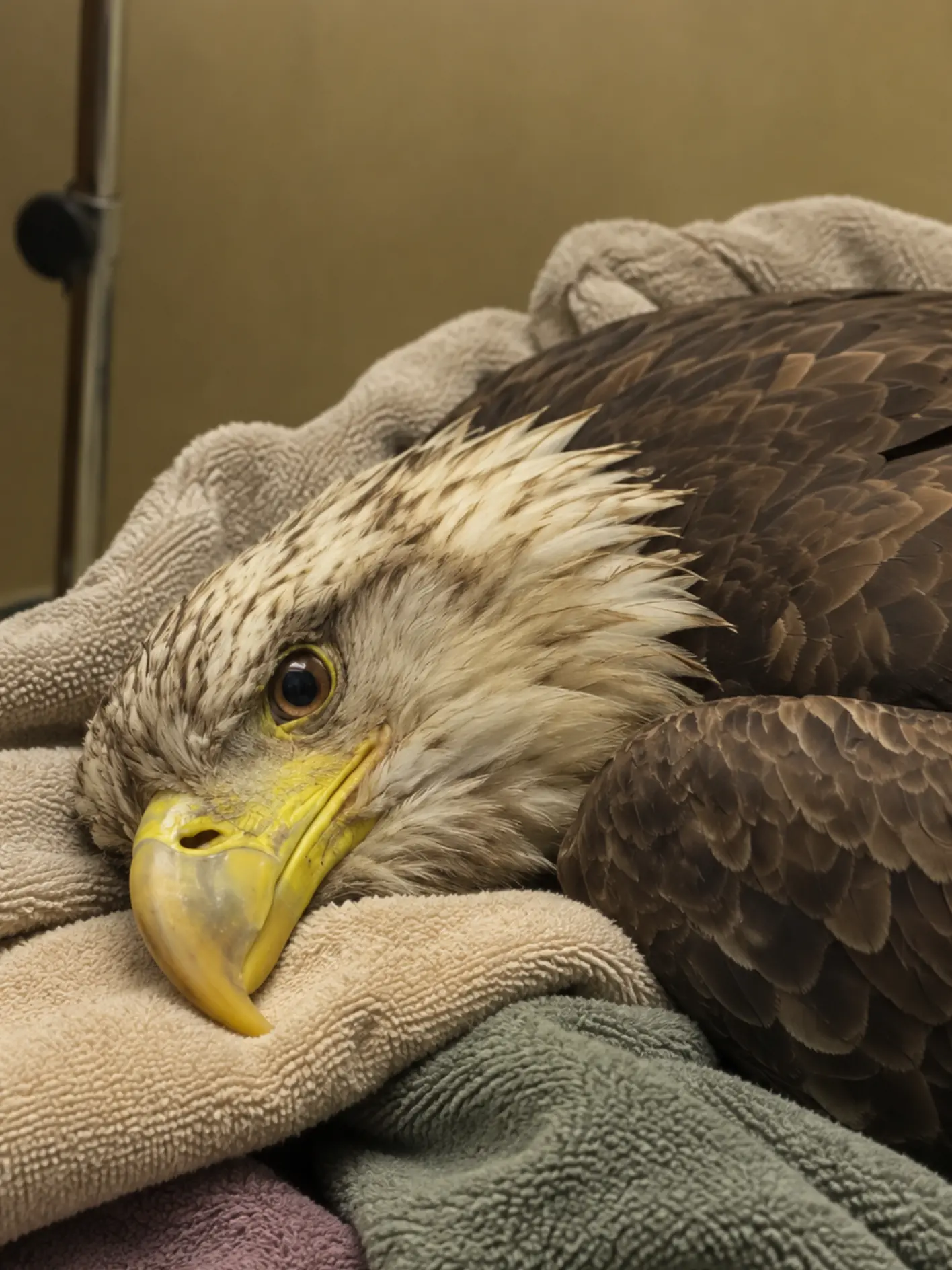
For a few seconds, the Bald Eagle did not move. It stayed low, alert, reading the wind and the space in front of it. Then it leaned forward, spread both wings, and launched. One powerful downstroke became two, then three. In an instant, the bird lifted above the grass, rose toward the treeline, and disappeared into the open country where it belonged.
For the small group watching, it was more than a release. It was the end of a long and uncertain recovery that had begun weeks earlier with a very different sight: the same eagle grounded, injured, unable to fly, and facing a future that was anything but certain.
When the bird first came in, nobody could promise this moment would ever happen.
The adult Bald Eagle had been found in a rural area of northern Idaho, not far from public land where hunting activity was common that time of year. A passerby noticed the eagle on the ground near the edge of a field and stopped because something was clearly wrong. Even from a distance, the bird’s posture looked abnormal. It was alert and still trying to defend itself, but one wing was hanging lower than the other, and every attempt to move ended in an awkward, painful struggle. The eagle could not gain lift. It could not escape. It could barely reposition itself.
Wildlife officials were contacted, and the bird was carefully contained and transported to a local veterinarian for emergency evaluation. That veterinarian was Dr. Emily Carter, a clinician known in the region for taking difficult wildlife cases that required both patience and realism. By the time the eagle arrived, it was exhausted. It remained bright enough to watch the room closely, but it was clearly stressed, weak, and in pain.
“The bird still had fight in it,” Carter later said. “That’s often one of the first things you notice with a raptor. Even when they’re hurt badly, they’re still watching, still assessing, still trying to stay in control of the situation.”
Initial stabilization came first. The team minimized handling, protected the injured wing, and focused on the basics that can determine whether a wild bird makes it through the first critical hours: hydration, pain control, warmth, and stress reduction. The eagle was placed on soft towels in a quiet enclosure where it could rest without further damaging the injured limb. Only after it had settled and its condition was stable enough did the veterinary team proceed with diagnostic imaging.
Those radiographs changed the case immediately.
What responders had first hoped might be a blunt-force injury turned out to be something more serious. X-rays showed a fracture involving one of the major bones of the wing, along with metallic fragments embedded in the injured area. The pattern was strongly consistent with gunshot trauma. In addition to the fracture itself, the surrounding tissue had sustained soft-tissue damage that raised concern for swelling, contamination, and delayed healing.
“It was one of those moments where the whole room understands the stakes right away,” Carter said. “A fractured wing is always serious in a Bald Eagle because flight is everything. But when a fracture is accompanied by projectile fragments and tissue trauma, you also have to worry about infection, tissue viability, and whether the wing will ever function normally again.”
The eagle was then transferred into a coordinated rehabilitation plan involving veterinary treatment and wildlife recovery support. The first question was not whether the bird could be saved in the abstract. The first question was whether the injury was survivable and whether there was a legitimate path back to full function. A Bald Eagle that cannot fly, turn, land, and hunt with precision cannot be released simply because it looks brighter or stands more comfortably. For a wild raptor, recovery must mean more than survival. It must mean restored function.
Fortunately, the fracture, though serious, was not beyond repair.
Under anesthesia, the medical team addressed the wound, evaluated the degree of tissue damage, and stabilized the wing. Devitalized tissue was cleaned, the fracture was aligned as well as possible, and the limb was supported to protect the healing process. Some metallic debris could be addressed safely; deeper fragments that posed greater risk than benefit if aggressively removed were managed conservatively. As with many wildlife injuries, the team had to balance ideal orthopedic goals with the realities of stress, tissue trauma, and what the patient would tolerate over time.
For the next several days, the eagle’s condition remained guarded.
There were encouraging signs, but no guarantees. The bird rested for long stretches, often lying low on layered towels with its head supported against the bedding. It was awake, but tired. It watched staff enter and leave. It shifted only when necessary. Its appetite was initially inconsistent, and every small milestone mattered: accepting food, maintaining hydration, tolerating treatment, and avoiding further complications.
Photographs from that early stage showed an eagle that looked nothing like the powerful national symbol most people recognize in flight. Instead, it looked what it truly was in that moment: a patient. A wild animal recovering from trauma, conserving every ounce of energy, and depending entirely on human care until it could stand on its own again.
Carter said the emotional challenge in cases like this is learning to work without promises.
“We never tell ourselves too early that a bird will make it,” she said. “That can be emotionally dangerous, and medically it can lead you to overlook how much still needs to go right. But we also never assume the worst if there’s still a defensible chance. This eagle had enough structural integrity left in the wing that we believed it deserved that chance.”
As the first week passed, the eagle began to stabilize. Swelling around the injured area started to come down. The bird became more responsive during treatment sessions and more assertive in the enclosure. It was holding itself more normally. Its appetite improved. The posture that had at first reflected exhaustion and discomfort gradually gave way to something stronger: attention, irritation, resistance. In a rehabilitation setting, those are often welcome signs in a wild patient.
Repeat imaging provided the next reason for cautious optimism.
Follow-up X-rays showed that the fracture alignment remained acceptable and that early healing changes were beginning. There was no evidence that the wing had catastrophically destabilized after the initial repair. Equally important, the wound itself was progressing in the right direction. The team continued antibiotics when indicated, monitored for signs of infection, and maintained supportive care while reducing handling whenever safely possible.
Still, bone healing was only part of the challenge.
A raptor wing is not just a structure that must mend. It is an extraordinary instrument of lift, control, braking, balance, and precision. An eagle can appear stronger long before it is truly capable of surviving in the wild. Prolonged restriction also leads to muscle loss, and even once a fracture begins to heal, the bird must gradually rebuild the strength and coordination needed for real flight.
That phase demanded patience.
The eagle remained in a protected enclosure while the team monitored weight, stance, feather condition, and overall behavior. As healing progressed, support around the wing was adjusted to reflect the bird’s improving condition. Eventually, the eagle began testing the wing on its own, making subtle movements that told the staff more than any single exam could. At first there were small shifts of balance, guarded repositioning, and limited extension. Later came fuller stretches, stronger posture, and the ability to perch more normally.
Each step forward was hard-won.
Weeks earlier, the eagle had been grounded and vulnerable, unable to take off at all. Now it was standing taller, watching more intently, and reacting more like a healthy wild bird. Staff who had first seen it exhausted and flattened against the bedding began to see flashes of the bird it had been before the injury. The eyes were sharper. The body carriage was stronger. The indignation—the unmistakable personality of a Bald Eagle that does not appreciate captivity—was returning.
That was exactly what the team wanted.
“When a bird starts reminding you that it absolutely does not want to be there, that can be a very good sign,” Carter said. “You want the patient to recover physically, of course. But you also want to see the wildness fully intact.”
After the fracture had enough time to consolidate and the wound was sufficiently improved, the eagle advanced to the next phase of rehabilitation: controlled exercise and flight assessment. This is the stage where hope must be tested against reality. It is not enough for a bird to flap. It is not enough to hop or glide. A releasable Bald Eagle must be able to launch cleanly, sustain flight, maneuver, gain height, and land without obvious weakness or asymmetry.
The bird was moved into a larger flight enclosure where these abilities could be evaluated progressively.
The first attempts were short. A few wingbeats. A modest push from one end of the enclosure to the other. Controlled, but tentative. The staff watched everything: whether the injured wing opened fully, whether both wings moved in balance, whether the eagle could bank, whether it favored one side, and how it landed.
Then came the moment that shifted the case.
One day, after several shorter efforts, the eagle lifted more decisively. It flew the full distance of the enclosure, landed with control, and held its position. There was no dramatic celebration in the building, no cheering, no clapping—wildlife professionals are usually too cautious for that—but everyone understood what they had just seen. The bird had crossed an invisible line from recovery into possibility.
“It was the first time we could truly imagine release,” Carter said. “Not because it had technically flown, but because it had flown in a way that looked functional.”
From there, the focus turned to repetition and endurance. One good flight is not enough. The eagle had to do it again, and again, and again. It needed to demonstrate that it could climb, turn, and land consistently. It needed to show that the wing could tolerate exertion and that the earlier trauma would not limit its survival once human support disappeared.
During that period, the eagle continued to gain strength. It perched confidently. It ate well. It maintained weight. Its landings improved. Its launches became more forceful. By the end of the conditioning period, the difference between the bird that had arrived and the bird now moving through the enclosure was extraordinary.
Final assessments supported what staff had begun to believe. The fracture had healed sufficiently. The eagle’s flight performance was strong. Its behavior remained appropriately wild and wary. Nothing in its posture, movement, or handling response suggested that it had become dependent on care or incapable of resuming life in the wild.
Plans for release began.
For everyone involved, release day carried a particular meaning because this case had once seemed so uncertain. A bird that survives gunshot trauma to the wing is not automatically a release candidate. Many never regain the full mechanical function required for wild flight. Some survive but remain permanently impaired. Others deteriorate from complications long before reaching the final stage of rehabilitation. This eagle had cleared every barrier one by one.
When the day came, the bird was transported back to suitable habitat in the region. The carrier was positioned toward open space with enough room for a clean departure. Those present stepped back. The latch was opened.
At first, the eagle remained still inside the crate, looking out.
Then it stepped forward.
Then it was airborne.
The launch was strong and direct. There was no stumble, no falter, no obvious hesitation in the injured wing. The bird rose above the release area, caught the air, and continued away from the people who had carried, examined, treated, monitored, and waited for it. That is how a successful wildlife rescue is supposed to end: not with gratitude, not with attachment, but with absence. The patient leaves, and the humans are left behind.
For Carter, that is the best possible outcome.
“The goal was never to keep this bird alive in a hospital,” she said. “The goal was always to restore its chance to live as a Bald Eagle in the wild. Watching it fly off and no longer need us—that’s the success.”
Cases like this also carry a broader message. Bald Eagles have made one of the most remarkable recoveries in American conservation history since the era when DDT devastated their populations. But their recovery does not mean they are free from harm. They still face collisions, electrocution, poisoning, habitat pressures, and in some cases intentional or accidental shooting. For a species so deeply woven into the American imagination, the injuries seen in rehabilitation centers are often a blunt reminder that survival depends not only on biology, but on human choices.
This eagle was fortunate. Someone noticed it. Someone made the call. Wildlife responders acted quickly. A veterinarian chose to take on a difficult case. A rehabilitation team had the skill and patience to see it through. And the bird itself did the rest, enduring pain, confinement, healing, and retraining until it could finally reclaim the air.
By the time it vanished beyond the trees, the scars of its ordeal had not disappeared. The story, however, had changed completely.
What began as a grounded bird with a shattered future ended as what it had been meant to be all along: a wild Bald Eagle, flying home.