The Bald Eagle that arrived at the Atlantic Veterinary College in Charlottetown could not stand.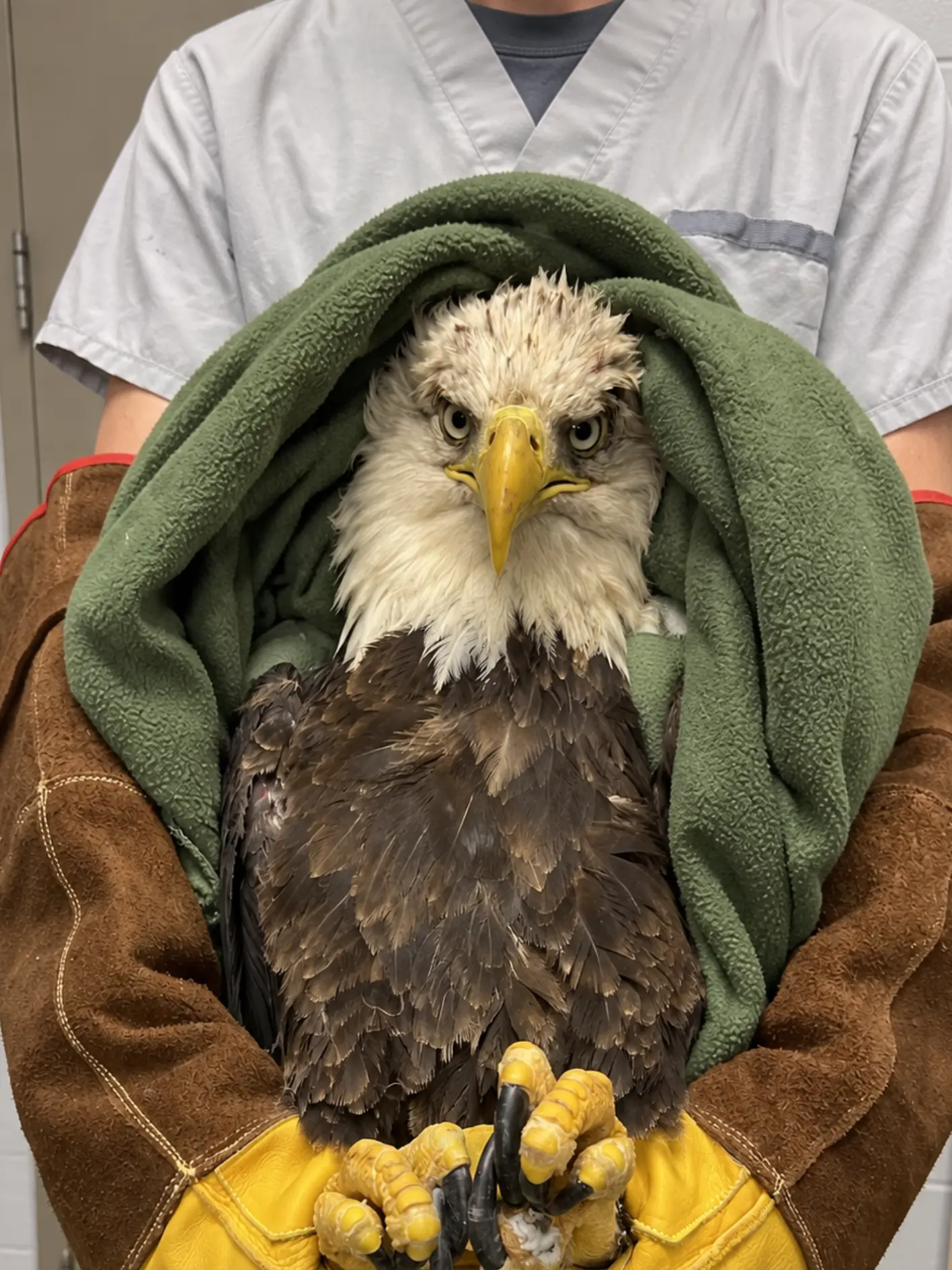
Its wings were still capable of movement. Its eyes remained alert, and the bird could follow people around the treatment room. The powerful yellow feet that normally allow an adult Bald Eagle to seize prey, absorb the force of a landing, and hold tightly to a tree branch were present beneath its body, but they could not reliably support its weight.
The initial neurologic findings were serious enough that the veterinary team feared permanent damage to the spinal cord.
Diagnostic imaging later confirmed a severe injury affecting the eagle’s vertebral column. The damage was located in a region of the spine considered vulnerable in large birds, and the abnormal alignment raised concern that the spinal cord was being compressed or otherwise compromised.
The prognosis was uncertain from the beginning.
Without meaningful neurologic recovery, the eagle would never be able to return to the wild. Even if its wings remained physically intact, a Bald Eagle must be able to stand, grip, balance, launch, maneuver, and land with precision. Flight is not an isolated function of the wings. It depends on coordination of the entire body.
Faced with limited options, specialists at the Atlantic Veterinary College, part of the University of Prince Edward Island, attempted an unusual spinal stabilization procedure that may represent one of the rarest surgical interventions undertaken in a Bald Eagle.
The operation could not repair the spinal cord itself.
Instead, the surgeons attempted to restore and stabilize the damaged vertebral structures around it, giving whatever surviving nervous tissue remained the best possible opportunity to recover.
The procedure worked well enough to change the eagle’s future.
Over the weeks that followed, sensation remained in the feet. Small toe movements became stronger. The bird gradually began supporting some of its own weight. Eventually, it could stand. Later, it could grip a perch and move around without the profound instability seen when it first arrived.
What the eagle never fully regained was reliable flight.
After extensive rehabilitation and repeated functional assessments, veterinarians determined that the bird could not meet the physical standards required for release. It might manage limited movement and short controlled flights, but it could not consistently generate the altitude, endurance, coordination, and landing precision necessary for independent survival.
That conclusion ended one part of the rehabilitation effort.
It did not end the eagle’s life.
Instead of being released, the bird was transferred to a licensed wildlife facility in Nova Scotia, where its new enclosure was adapted around the abilities it had recovered rather than the ones it had permanently lost.
The eagle would never return to the open sky in the way the veterinary team had originally hoped.
However, it could stand.
It could perch.
It could feed independently.
It could groom its feathers.
It could move through a carefully designed environment without requiring constant physical assistance.
For a bird that had once arrived unable even to support its own body, those changes represented an extraordinary recovery, even if the final outcome looked very different from a conventional wildlife release.
The Case Began With a Vehicle Collision
The eagle had been brought into care after being struck by a vehicle.
The full mechanics of the collision were not known, but the force was sufficient to cause major trauma. When rescuers reached the bird, it remained conscious but was unable to rise normally.
That inability to stand immediately separated the case from many routine trauma admissions.
Vehicle-strike patients may arrive with fractured wings, broken legs, eye injuries, internal bleeding, or head trauma. Some have several of those problems simultaneously.
This eagle showed neurologic deficits involving both legs.
The wings could still move.
The head remained functional.
The bird was responsive.
But the lower body was profoundly compromised.
That pattern raised concern that the injury might involve the spinal cord or the vertebral structures protecting it.
The eagle was transported carefully, with its body supported and unnecessary movement minimized.
When a spinal injury is possible, rescuers do not benefit from repeatedly asking an animal to stand or walk. Every unnecessary attempt can increase pain or potentially worsen instability.
The bird was placed on padded material and transferred to the veterinary hospital for diagnostic evaluation.
The First Question Was Whether the Eagle Could Feel Its Feet
At the hospital, the medical team evaluated the eagle’s basic stability before focusing more closely on neurologic function.
The bird was breathing on its own.
Its cardiovascular condition was assessed.
The eyes were responsive.
The wings were examined for major fractures.
The legs were then evaluated individually.
The eagle could not stand.
The feet showed little useful motor function.
However, the bird still reacted to appropriate sensory testing.
That finding was important.
The eagle appeared able to feel both feet even though it could not use them normally.
Preserved sensation did not mean recovery was guaranteed. A severely injured spinal cord can retain partial function, and the amount of motor recovery possible cannot be predicted from sensation alone.
Still, the finding meant the neurologic injury did not appear completely functionless.
That was enough to justify a more detailed investigation.
Imaging Confirmed a Serious Spinal Injury
Diagnostic imaging revealed abnormality in the spinal column consistent with substantial trauma.
The vertebral alignment had been disrupted in a region that can be vulnerable in large birds. The finding supported what the neurologic examination had already suggested: the lower-body weakness was not simply the result of pain, exhaustion, or shock.
There was a mechanical problem involving the spine.
The concern extended beyond the bone itself.
The spinal cord passes through the vertebral column, and displacement, swelling, or instability around an injured vertebra can interfere with neurologic function even if the cord has not been completely severed.
That distinction became central to the decision-making process.
If the spinal cord had already sustained irreversible damage, stabilizing the bones would not restore normal movement.
If the nervous tissue remained partially functional but was being affected by unstable or abnormal vertebral alignment, correcting the mechanical problem might prevent further injury and allow some recovery.
No diagnostic test could promise which outcome would occur.
The medical team had to make a decision under uncertainty.
Spinal Surgery in a Free-Ranging Bald Eagle Is Far From Routine
Veterinary teams regularly repair fractures in wildlife.
Broken wings may be surgically stabilized.
Leg injuries can sometimes be reconstructed.
Soft-tissue wounds are treated every day at rehabilitation hospitals.
The spine is different.
The vertebrae are small, anatomically specialized, and positioned immediately around delicate nervous tissue.
Bird anatomy introduces additional complexity.
The avian skeleton is highly adapted for flight. Some bones are lightweight, and regions of the spine have different patterns of rigidity and mobility compared with mammals. Surgical access must also account for the bird’s respiratory system, body positioning, and the need to minimize anesthetic time in a trauma patient.
There was also another problem.
There was very little precedent for exactly what the team was considering.
The procedure was unusual enough that the clinicians could not rely on a large body of published wildlife cases showing predictable outcomes.
They could apply established principles of orthopedic and neurologic surgery.
They could study the anatomy.
They could plan fixation.
What they could not do was promise that a Bald Eagle with this injury would eventually stand, much less fly.
The Goal Was to Stabilize the Spine, Not to “Repair” the Spinal Cord
It is important to describe the procedure accurately.
The surgeons were not reconnecting the spinal cord or replacing damaged neural tissue.
The operation was directed at the vertebral injury surrounding the spinal cord.
The goal was to improve alignment, reduce instability, and protect the neurologic structures from further mechanical damage.
That distinction matters because bone and nervous tissue heal differently.
A fractured bone can often repair itself if the pieces are appropriately aligned and stabilized.
The spinal cord is far less forgiving.
If neural tissue is severely destroyed, surgery cannot simply reconstruct it.
The most the team could offer was a better environment for the surviving nervous system.
The rest would depend on biology.
The Decision to Operate Was Based on What the Eagle Still Had
The eagle still had several things working in its favor.
It was alert.
The wings were not catastrophically damaged.
The feet retained sensation.
The rest of the body was considered stable enough to tolerate the procedure.
The spinal lesion also appeared to have a mechanical component that might benefit from stabilization.
Without recovery of the legs, however, the bird’s prospects were poor.
A permanently nonambulatory Bald Eagle cannot simply be released because its wings still move.
Landing alone requires precise extension of both legs, rapid opening and closing of the feet, and the ability to grip a perch at the exact moment the body reaches it.
An eagle must also stand for long periods, balance in wind, hold food, capture prey, and defend itself.
The legs are not secondary equipment.
They are essential.
The surgical team therefore proceeded with the understanding that the operation was not merely intended to keep the eagle alive.
It was intended to preserve a realistic possibility of useful function.
The Procedure Was Only the Beginning
The eagle was anesthetized and carefully positioned.
Throughout the operation, the team monitored physiologic parameters while maintaining body temperature and supporting respiration.
The injured region was approached with the goal of exposing only what was necessary.
The surgeons identified the vertebral abnormality seen on imaging and worked to improve the alignment and provide stabilization around the damaged portion of the spine.
When the operation ended, the repair was considered technically successful.
The spinal region was more stable.