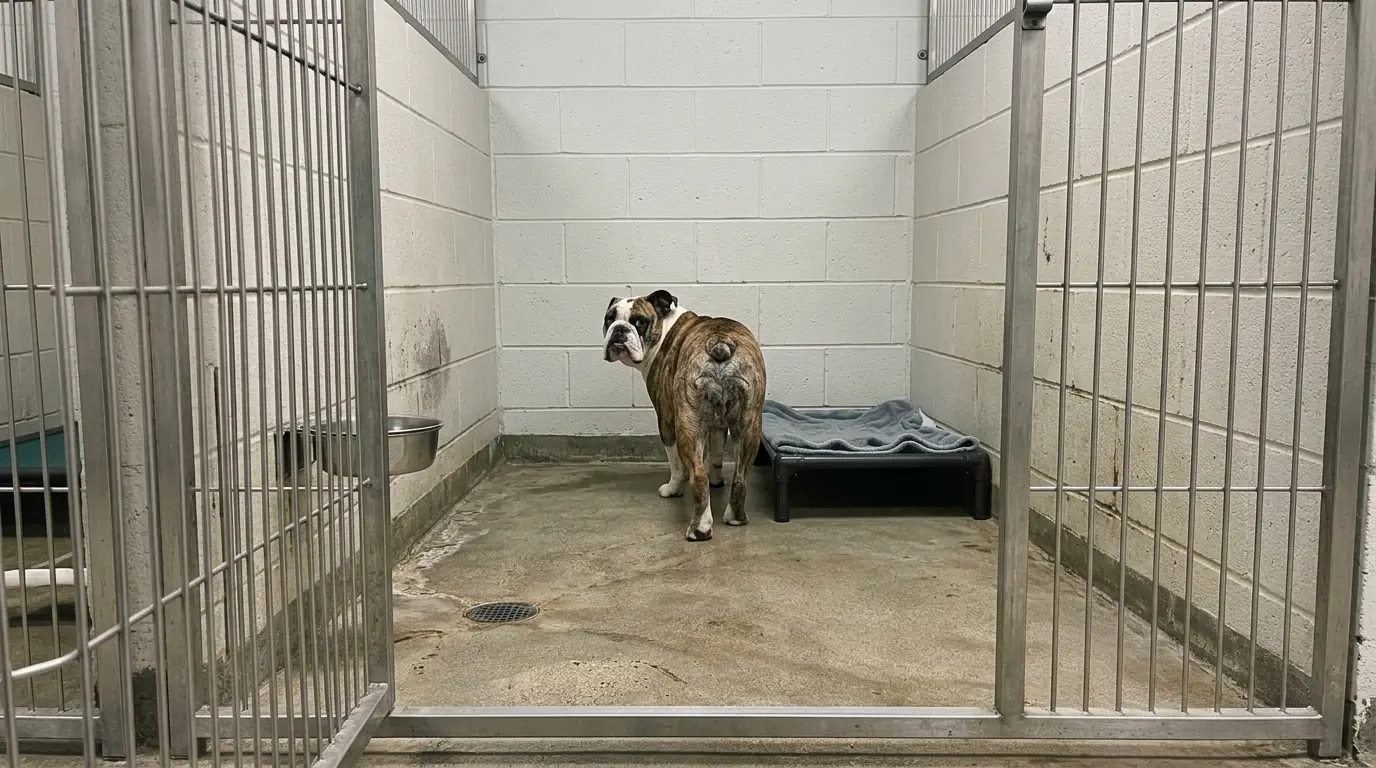
Walking forward is not Baxter's problem.
The seven-year-old English Bulldog can leave his bed and cross the kennel without much hesitation.
His steps are short but steady.
He reaches his water.
Walks toward the gate.
Follows the wall.
Nothing about those straight lines immediately looks alarming.
The problem begins when Baxter runs out of room.
He reaches the end of the kennel.
Stops.
And suddenly seems unable—or unwilling—to do the simplest thing.
Turn around.
His body becomes rigid.
His breathing grows faster.
He looks over one shoulder but does not pivot.
Then Baxter begins backing up.
One step.
Another.
Another.
He will sometimes reverse almost the entire length of the kennel rather than rotate his body and walk forward again.
And nobody yet knows whether Baxter is afraid to turn—or whether turning hurts in a way walking straight does not.
At First, Baxter Looks Like a Dog Who Can Move Normally
That is what makes the behavior easy to misunderstand.
Baxter is not obviously unable to walk.
Put something interesting several feet ahead of him and he can move toward it.
He does not consistently drag a leg.
He does not collapse after every few steps.
His body works reasonably well as long as the route remains straight.
Then he reaches a dead end.
Everything changes.
He Stops Before His Nose Reaches the Wall
Baxter seems to know what is coming.
His pace slows.
His front paws stop.
His hind legs remain planted behind him.
For several seconds, he simply stands.
A normal turn would require only a few steps.
But Baxter does not take them.
Instead, his mouth opens.
His breathing becomes louder.
His body stiffens.
Then he looks backward.
His First Solution Is Always the Same
Baxter lifts one front paw.
Places it behind him.
Then moves the other.
His hind legs follow awkwardly.
He begins reversing.
Sometimes he backs up only until there is enough space around him.
But instead of using that extra space to turn, Baxter continues.
Five feet.
Eight feet.
Sometimes nearly the entire kennel.
All while facing the direction he was originally walking.
It Doesn't Look Like a Trick
There is no playful quality to the movement.
Baxter does not wag and repeat it for attention.
He is not simply showing off an unusual learned behavior.
The panting matters.
The rigidity matters.
The hesitation before the first backward step matters.
Something about rotating his body appears much more difficult than traveling in a straight line.
Baxter Arrived With Clues on His Body, But No Clear History
Thick callused areas are visible along both sides of his hips.
He also has several old scars.
Those findings cannot reconstruct his past.
Calluses can develop when pressure repeatedly affects the same areas, particularly in heavier dogs resting on firm surfaces.
Scars tell even less about exactly how they occurred.
It would be easy to create a dramatic explanation.