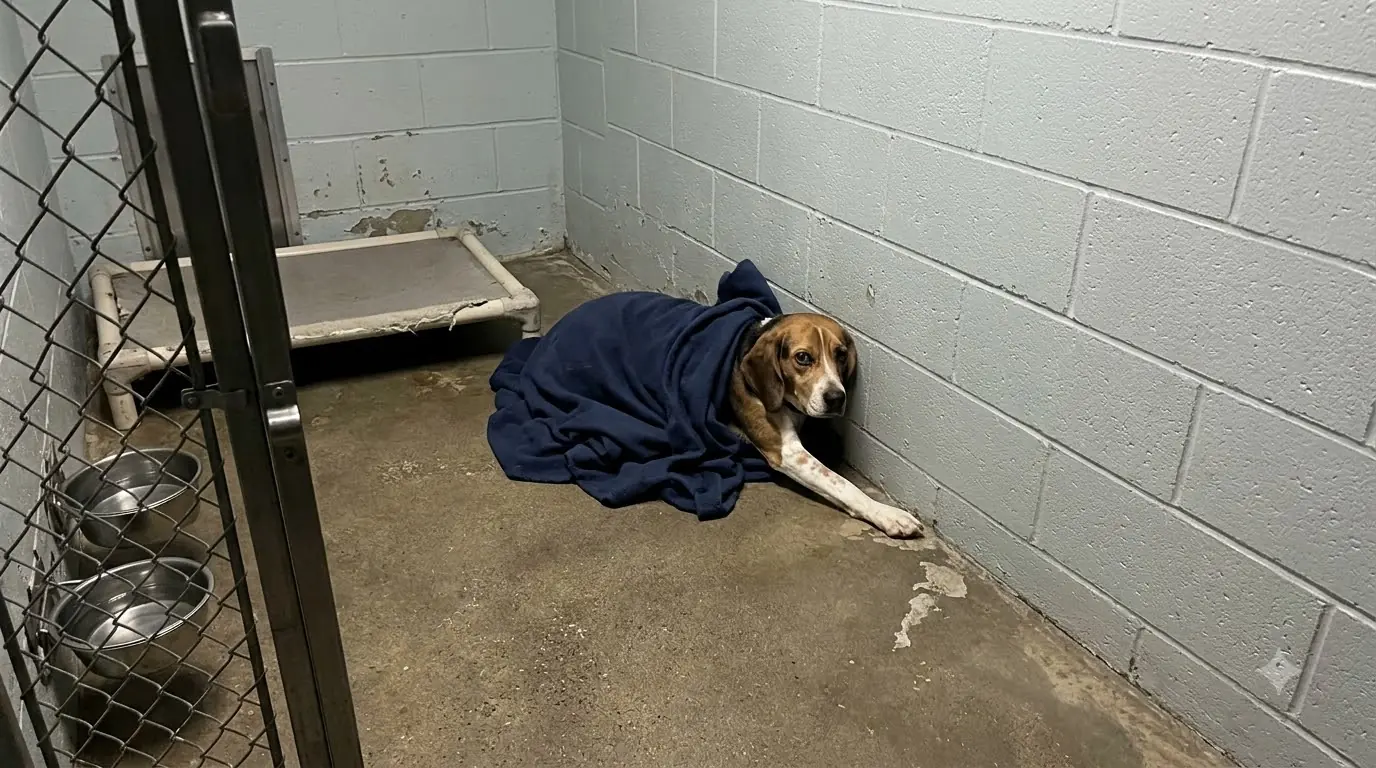
During the day, there is very little about Benny's behavior that immediately tells visitors something is wrong.
The 7-year-old Beagle hears footsteps and walks toward the kennel gate.
A familiar staff member approaches with a treat, and Benny takes it.
He watches activity in the hallway.
Sometimes he sniffs through the bars.
He may be quieter than some of the dogs around him, but he remains responsive.
Then evening comes.
The shelter begins shutting down for the night.
Some of the lights are turned off.
Footsteps become less frequent.
Doors stop opening.
Voices disappear from the hallway.
And Benny changes.
He leaves the kennel gate.
Takes his blanket.
Pulls it into the corner.
Then presses his back tightly against the wall and begins to shake.
Not a small tremble.
Some nights, Benny shakes hard enough that the bedding beneath him visibly moves.
But there is one detail staff cannot explain.
Even while Benny curls beneath the blanket, he leaves one front leg stretched outward toward the kennel door.
And when footsteps finally return to the hallway, the shaking sometimes begins to ease.
At First, Staff Only Saw Benny in the Daytime
That made the behavior easy to miss.
Morning staff often found Benny awake and responsive.
During cleaning and feeding, there was activity everywhere.
Kennel doors opened.
Bowls moved.
People spoke to the dogs.
Benny participated in those routines.
He approached for treats.
He watched people.
He could look almost ordinary.
If staff had judged him only by those moments, they might never have realized what happened after the building became quiet.
The Evening Pattern Changed That
One night, someone remained in the medical area later than usual.
The shelter had already settled.
Most of the overhead lights were dimmed.
Benny was no longer at the front of his kennel.
His blanket had been pulled away from the bed.
It was bunched into the back corner.
Benny had pushed himself against the wall and partially curled into it.
His muscles were visibly trembling.
The blanket beneath him moved with every shake.
The worker stopped.
Benny did not come forward.
Then Someone Walked Down the Hall
Benny heard the footsteps before the person reached his kennel.
His ears shifted.
His head lifted slightly.
The trembling did not disappear instantly.
But his body began to loosen.
The closer the footsteps came, the more his posture changed.
Then the person stopped outside the kennel.
Benny remained in the corner.
But the shaking was less intense.
That was the first clue that the quiet itself—or something associated with the nighttime transition—might be part of the pattern.
The Next Evening, Staff Watched More Carefully
They did not deliberately frighten Benny.
There was no reason to repeatedly switch lights off and on simply to produce a reaction.
Instead, they observed the normal evening routine.
During the active part of the day, Benny behaved much as usual.
Then activity decreased.
The hallway quieted.
Benny took hold of his blanket.
He dragged it toward the wall.
Then he turned around and pressed his back against the corner.
Minutes later, the trembling began.
But One Paw Stayed Outside
That became the detail staff kept noticing.
Benny could pull much of his body close to the blanket.
He could tuck himself against the wall.
But one front leg often remained extended.
It pointed toward the kennel gate.
Sometimes the paw rested completely outside the blanket.