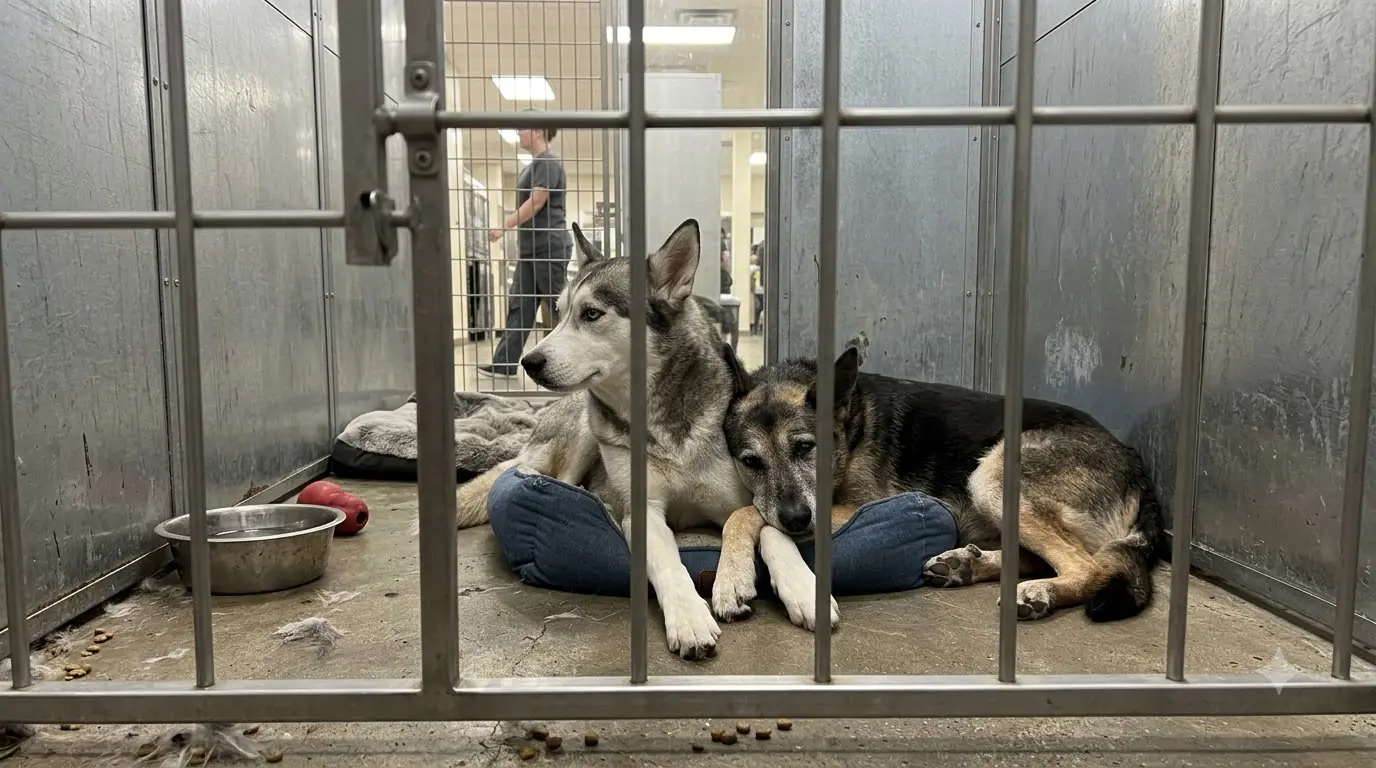
Charlie can move much faster than June.
That is obvious the moment the two dogs enter the shelter exercise yard.
Charlie is a 4-year-old Husky mix with more speed, more stamina, and the kind of energy that could carry him from one end of the yard to the other in seconds.
June is a 10-year-old senior Shepherd mix.
She walks with a noticeable limp.
Her pace is slower.
Every turn takes a little longer.
Every stretch of ground takes more time.
Charlie has every opportunity to leave her behind.
He rarely does.
He will move several steps ahead, then stop.
Turn.
Look back.
Wait.
June continues toward him at her own pace.
Only when she catches up does Charlie begin moving again.
Staff noticed the pattern early because it repeated so consistently.
Charlie did not need a leash connecting him to June.
He did not need to be called back.
He simply kept checking.
A few steps.
A look over his shoulder.
A pause.
Then June beside him again.
It was one of the clearest signs that whatever life they had shared before entering the shelter, they were still moving through this new one together.
Then one morning, for practical shelter reasons, Charlie had to be moved temporarily to another kennel.
June stayed behind.
For most of the day, she barely moved from one place.
The empty bed Charlie had been using.
They Entered the Shelter Together
Charlie and June were surrendered together.
That fact matters because they did not meet after arriving.
They already had a shared routine.
They already knew each other's sounds, movements, habits, and pace.
Shelter staff did not have to create a relationship between them.
They simply had to notice the one that was already there.
June, at 10, is the older dog.
Her limp means she cannot match Charlie physically.
Charlie, at four, could easily live at a much faster tempo.
On paper, they do not appear like an obvious pair.
One is younger.
One is senior.
One can move quickly.
One cannot.
One could fill a yard with motion.
The other needs more time.
But their behavior repeatedly closes that gap.
Charlie adjusts.
June keeps going.
And somewhere between the two, they meet.
The Exercise Yard Shows Their Relationship Best
The exercise yard gives Charlie freedom.
That is what makes his choices there so meaningful.
Inside a kennel, space limits movement.
In the yard, Charlie has room.
He can run.
He can explore.
He can follow scents.
He can move far enough away that June would never keep up.
Sometimes he starts to.
He trots ahead.
His pace lengthens.
Then he turns his head.
June is behind him.
Charlie stops.
He waits.
Sometimes he stands completely still.
Sometimes he circles a little in place.
But he does not simply disappear to the far end of the yard.
June keeps walking.
Her limp remains visible.
She does not hurry.
Charlie watches.
When she reaches him, he moves again.
That sequence may happen several times during one outing.
The emotional weight does not come from Charlie sacrificing all activity.
He still gets to move.
It comes from the way he repeatedly reconnects.
June Never Has to Be Fast Enough
One of the easiest mistakes to make with dogs of different ages is to let the younger dog's pace become the standard.
Charlie could set that pace.
He does not.
June is allowed to be slow.
That matters.
She does not have to chase him.
She does not have to strain to keep him in sight.
Charlie keeps making himself available.
In practical terms, that means their shared walks and yard time look different from what Charlie might choose alone.
He starts.
Stops.
Checks.
Waits.
June arrives.
Then they continue.
Staff are careful not to overinterpret.
Nobody can know exactly what Charlie is thinking when he looks back.
But the behavior is consistent.
He tracks June's position.
And he changes his own movement when she falls behind.
June Gives Charlie a Rhythm Too
Because Charlie is the one doing the visible waiting, it can seem as though he is the only dog giving something to the relationship.
That is not true.
June gives Charlie a rhythm.
Without her, Charlie could turn every yard session into continuous motion.
With her, he pauses.
He checks.
He returns.
He spends more time close to another dog than his physical energy would require.
June's slower pace becomes part of his routine.
When they settle indoors, Charlie often positions himself near her.
When she lies down, he eventually comes close.
When she stands, he notices.
Their differences do not separate them.
They shape the way they move together.
June's Limp Is Part of the Story, Not the Whole Story
June's mobility matters.
It changes what a future home would need to provide.
It affects how quickly she can walk.
It may require ongoing veterinary attention depending on the cause and progression.
But her limp is not the emotional center of the story.
Charlie is.
Or, more accurately, the relationship is.
A senior dog with a limp can still be active, curious, affectionate, and engaged.
June is not simply waiting passively while Charlie takes care of her.
She participates.
She walks.
She follows.
She settles.
She makes her own choices.
Charlie simply refuses to make her speed the price of staying beside him.
The Day Charlie Was Moved
One morning, Charlie was moved temporarily to another kennel.
It was not an adoption.
It was not a permanent separation.
Shelters sometimes have to adjust housing arrangements for cleaning, medical, behavioral, logistical, or space-related reasons.
For Charlie and June, it meant something unfamiliar.
The kennel suddenly contained only June.
Charlie was elsewhere.
Staff immediately noticed a difference in her.
Normally, June would at least show some interest in activity outside.
She might look toward people.
She might move toward the gate.
That day, she did not.
Instead, she went to the empty bed Charlie had been using.
Then she curled beside it.
June Did Not Make a Scene
June did not bark for hours.
She did not pace frantically.
She did not scratch at the kennel gate.
She did not create a dramatic display.
Her response was quieter.
She stayed near Charlie's empty bed.
People passed.
June did not approach.
Dogs moved through the area.
June did not get up to watch.
She remained curled close to the place Charlie had been sleeping.
That kind of behavior can easily be missed in a busy shelter.
A loud reaction demands attention.
Stillness does not.
But staff had already learned June's routine.
They knew what she usually did.
The difference was clear.
Charlie was gone.
June's world became smaller.
Separation Can Look Like Withdrawal
Not every bonded animal responds to separation with obvious anxiety.
Some become quieter.
Some reduce activity.
Some spend more time in familiar locations.
June appeared to do exactly that.
She was safe.
She had food.
She had water.
She had people nearby.
But she did not engage with the environment in the same way.
Instead, she remained close to Charlie's bed.
Again, responsible storytelling matters.
Staff cannot claim that one day apart proved June would never adapt to life without Charlie.
No responsible shelter should make that leap.
But one day's behavior does provide information.
June had choices.
She chose the empty bed.
She had opportunities to approach the gate.
She did not.
That mattered.
Charlie's Day Was Different Too
Charlie was housed elsewhere temporarily.
In another kennel, he had more physical freedom than June.
He could stand.
Move.
Watch the hallway.
Respond to activity.
But staff also noticed that his normal rhythm had changed.
There was no June to check.
No slow dog behind him.
No reason to pause and look back.
He could move at full speed.
Yet the part of his day that usually involved June was missing.
That absence became most obvious when he returned.
The Moment Charlie Came Back
That evening, Charlie was brought back to June.
He did not spend long inspecting the kennel.
He did not choose his old bed.
He did not pause at the gate.
He went directly to June.
Then he did something that made several staff members stop and look.
June had a small bed.
It fit her.
It did not fit Charlie very well.
Charlie climbed into it anyway.
His body crowded the edges.
There was barely enough room.
June did not move away.
Instead, she rested her head across Charlie's front legs.
Charlie stayed still.
Completely still.
He Could Have Chosen the Bigger Bed
This detail matters because Charlie had another option.
The bed he had used before was still there.
It fit him better.
It offered more room.
He ignored it.
He chose June's smaller bed.
This was not a case of limited space forcing the dogs together.
Charlie made the space smaller on purpose.
Or, more precisely, he chose the place June was already occupying.
Then June placed her head on him.
For the rest of the night, neither dog moved away.
The Empty Bed Said More Than Words Could
By late evening, the kennel contained two sleeping areas.
One suited Charlie better.
One was meant for June.
Charlie and June were both in June's.
That image became one of the clearest examples of their relationship.
Not because they had to share.
Because they chose to.
There is something powerful about that difference.
Bonded pairs are often described with emotional language.
Shelter staff try to rely on behavior instead.
Charlie has room to run.
He waits.
June has a gate she could approach.
She stays beside his empty bed.
Charlie has a larger place to sleep.
He squeezes into hers.
June has room to shift away.
She puts her head across his legs.
Those are the details that matter.
Their Relationship Is Not Perfectly Equal
Charlie and June do not depend on each other in exactly the same way.
Charlie appears more physically independent.
He can move farther.
He can interact with the environment more quickly.
He has more energy.
June, meanwhile, appears more affected by his absence.
The day he was moved, her behavior changed significantly.
That does not mean Charlie cares less.
It means their roles are different.
Charlie seems to manage his relationship with June through movement.
He checks.
Waits.
Returns.
June seems to manage hers through proximity.
She stays near him.
Rests beside him.
Becomes quieter when he is gone.
Those differences make the pair more believable.
A Shared Home Has to Respect Both Dogs
The shelter's goal is not simply to preserve one touching image.
A home for Charlie and June has to work in practical terms.
Charlie is four.
He needs meaningful exercise.
A Husky mix may require regular physical and mental activity.
June is 10.
Her limp means her exercise should likely be more measured.
That creates an obvious challenge.
One home has to support two different activity levels.
Charlie may need longer outings.
June may need shorter ones.
They may begin together.
Then Charlie may continue.
That kind of routine could work.
What would not work is forcing June to match Charlie's energy or limiting Charlie entirely to June's slower pace.
Charlie Needs More Than Waiting
Charlie should not spend his whole life holding himself back.
His patience with June is meaningful.
His own needs still matter.
He needs opportunities to run or move appropriately.
He needs enrichment.
He needs individual attention.
He needs training and interaction.
A future adopter has to understand that bonded does not mean identical.
Charlie can love being near June and still need experiences that are his alone.
In fact, healthy independence can help both dogs adjust to a home.
June Needs More Than Charlie
The reverse is equally important.
June should not be treated as though Charlie is her only source of comfort.
She needs her own relationship with people.
She needs veterinary care appropriate to her age and mobility.
She needs comfortable resting areas.
She needs predictable routines.
She needs opportunities to engage without always using Charlie as a reference point.
Charlie can help.
He cannot replace human care.
Why Adopting Them Together Is Harder
If Charlie were being adopted alone, he might attract people looking for a younger adult dog.
If June were alone, she might attract someone specifically interested in seniors.
Together, their adopter pool becomes smaller.
A household needs room for two.
A lease has to permit two.
Finances have to support two.
There may be resident animals.
There may be size restrictions.
Charlie may need more exercise than some households can provide.
June may need more accessibility than others can manage.
Finding one person who fits both sets of needs is harder than finding someone who fits just one.
That is the central challenge.
A Person Could Love Charlie and Still Say No
Someone may meet Charlie and immediately connect with him.
His age.
His energy.
His appearance.
His personality.
Then they learn about June.
They may genuinely care about her too.
But perhaps their home has stairs.
Perhaps their landlord allows only one dog.
Perhaps they already have a resident pet.
Perhaps they cannot manage the long-term costs of two animals, one of whom is entering senior years.
Saying no in that situation does not make someone cruel.
It may make them responsible.
The shelter's job is to find the person who can honestly say yes.
Someone Could Want June but Not Charlie
The opposite is possible too.
Some adopters specifically seek older dogs.
June's slower pace may suit them perfectly.
But Charlie may require more exercise than they can provide.
A household that would be wonderful for June alone may not be enough for Charlie.
Again, the right answer must fit both.
Not just emotionally.
Practically.
Meet-and-Greets Reveal the Difference
A proper meet-and-greet with Charlie and June should allow potential adopters to see their full dynamic.
Charlie may engage quickly.
June may approach more slowly.
In a yard, Charlie may want to move ahead.
Then he may look back.
That behavior is worth seeing.
An adopter can watch how long June needs.
How Charlie responds.
How both dogs interact with people.
What happens when the pair briefly separates.
The goal is not to stage emotional moments.
It is to let normal behavior emerge.
The Home Needs to Work for June's Mobility
June's limp means physical layout matters.
Too many stairs could be difficult.
Slippery floors may need rugs or traction.
Easy access to an outdoor area could help.
Comfortable beds should be available.
Veterinary follow-up may be necessary depending on the cause of the limp.
A future adopter should be prepared for mobility needs to change with age.
Charlie can wait for June.
A home has to do more than wait.
It has to accommodate her.
The Home Needs to Work for Charlie's Energy Too
Charlie will likely need more physical and mental stimulation.
That could mean longer walks.
Controlled running where appropriate.
Training.
Food puzzles.
Scent work.
Other enrichment.
June may join some activities.
She may not join all.
That is fine.
A good home gives them shared time and individual time.
Charlie does not lose his younger years simply because June moves slowly.
June does not lose comfort simply because Charlie has energy.
Their Daily Routine Already Shows How That Balance Could Work
Morning begins.
June gets up carefully.
Charlie notices.
They go out together.
Charlie moves ahead.
Looks back.
Waits.
Later, June rests.
Charlie receives enrichment.
Eventually, he returns.
They settle.
Visitors arrive.
Charlie may approach first.
June may remain close behind.
Evening comes.
Their activity levels decrease.
They rest near each other.
This rhythm already contains the blueprint for a future home.
Together when it helps.
Separate when each dog needs something different.
Back together afterward.
The Shelter Is Showing Them as a Pair
Their adoption photos and profiles should reflect that.
Not just Charlie alone looking energetic.
Not just June alone looking senior.
Together.
Charlie turning back in the yard.
June near him.
The difference in size and pace.
The shared sleeping space.
The way they reconnect.
Potential adopters need to see what one dog's life looks like beside the other.
That context matters.
Serious Interest Starts With Questions
The most promising adopter will ask practical things.
How much exercise does Charlie need?
How far can June comfortably walk?
What veterinary follow-up does her limp require?
Can they be left alone safely?
How do they behave separately?
What are their feeding routines?
Do they need separate sleeping spaces even if they choose one?
How should walks be structured?
Those questions show preparation.
Preparation is what a bonded pair needs.
Their Current Status
Charlie and June remain together while the shelter continues looking for one home prepared to take both.
The temporary kennel move has ended.
They are back in their shared routine.
Charlie still has more energy.
June still moves slowly.
He still checks back.
She still stays close.
The small bed incident has also become part of what staff explain to serious adopters.
Not as proof that separation would be impossible.
As evidence of a relationship that deserves to be considered.
June Still Takes Her Time
Some mornings, June is slower than others.
Charlie gets ready first.
He stands.
Looks toward the gate.
Then toward her.
June takes another moment.
Charlie waits.
This is not a one-time behavior.
That repetition is what gives it meaning.
A younger dog with room to move keeps choosing to match an older dog's pace.
Charlie Still Fits Poorly in June's Bed
The small bed remains.
So does the bigger one.
Sometimes Charlie uses more appropriate space.
Sometimes he does not.
On nights when he chooses June's bed, he still looks oversized.
His legs may extend awkwardly.
His body crowds the edge.
June does not seem concerned.
She finds a place against him.
The scene remains almost comical in its proportions.
It is also revealing.
The Day Apart Made the Pattern Clearer
Before the temporary move, staff already knew Charlie checked on June.
They knew the dogs rested together.
Afterward, they understood the separation side too.
June's quiet withdrawal.
The empty bed.
The lack of interest in the gate.
Then Charlie's return.
The tiny bed.
June's head across his legs.
No need for dramatic language.
The behavior did the work.
What the Right Adopter Needs to Understand
Taking Charlie and June home means accepting both a younger dog's energy and a senior dog's limitations.
It means budgeting for two.
Planning for different veterinary needs.
Giving Charlie enough activity.
Giving June enough rest.
Managing mobility.
Allowing independence.
Preserving companionship.
It also means understanding that their relationship may change over time.
June may slow further.
Charlie may become more independent.
Their routines may evolve.
The goal is not to freeze them in the behavior they show today.
It is to give them enough stability to continue choosing each other in whatever way feels natural.
One Bed Still Stays Empty Sometimes
Late at night, the kennel row quiets.
Charlie has room.
June has room.
Two beds remain available.
Some nights they use them separately.
Other nights, one stays empty.
Charlie moves toward June.
June settles.
Charlie adjusts his body into whatever space is left.
Sometimes he ends up in the tiny bed again.
June lays her head across his legs.
Charlie stays still.
Morning will bring movement again.
Charlie will be ready first.
June will take longer.
He may step ahead.
Then turn.
Look back.
Wait.
And somewhere beyond the exercise yard, the shelter will continue looking for a home that understands what Charlie already does:
Going faster does not mean you have to leave someone behind.