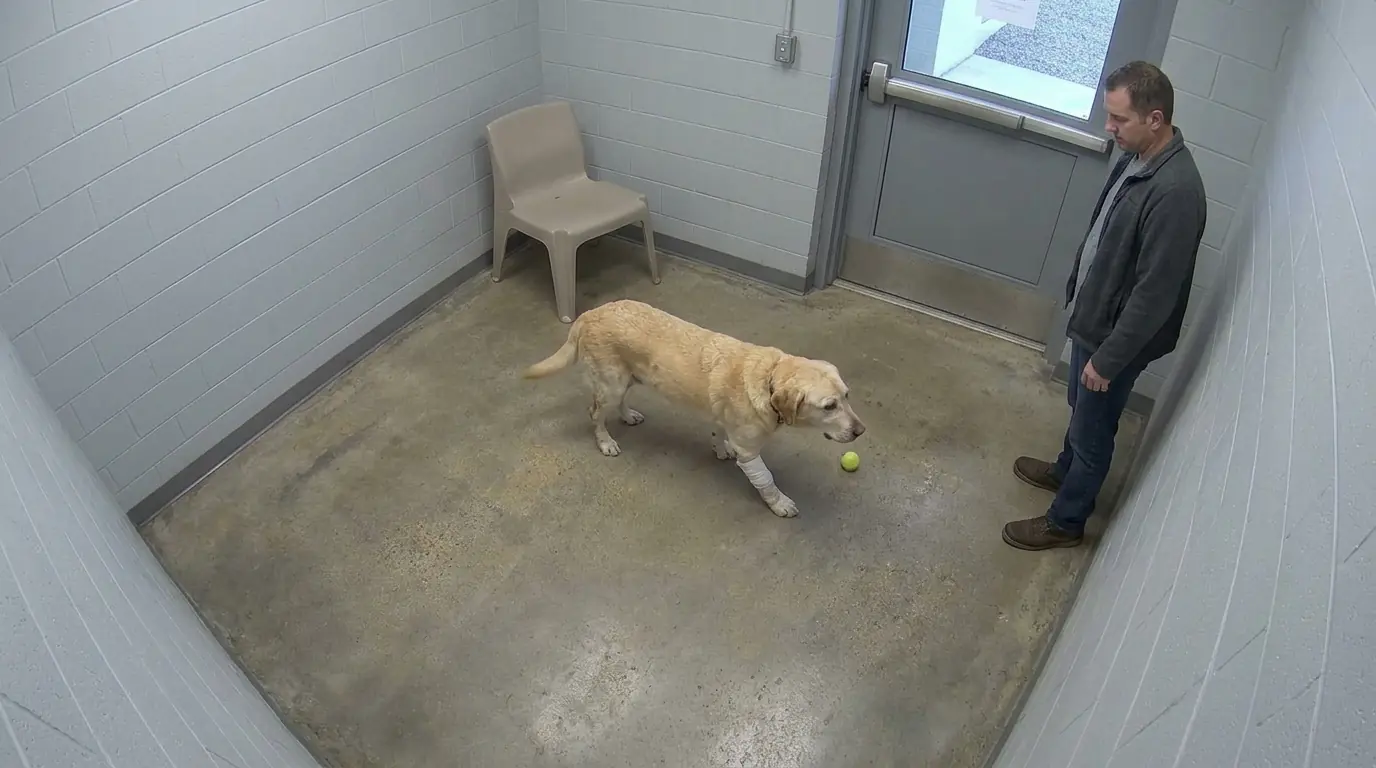
The tennis ball is old.
Its bright surface has faded, and years of teeth marks have roughened the felt.
It is also the only ball Cooper keeps in his shelter space.
The 9-year-old Labrador Retriever arrived thin and physically worn, with gray already spreading around his muzzle and one front leg still supported by a splint after an injury.
Walking is not effortless for him.
Every step places more work on the other three legs.
That is why staff noticed immediately when Cooper began using some of those difficult steps for something that had nothing to do with food or water.
During visitor time, Cooper would see someone sit down.
Then he would turn around.
Limp toward his bed.
Find the tennis ball.
Pick it up.
And carry it back.
He did not drop it several feet away for someone to throw.
He did not bounce around waiting for a game.
Cooper walked directly to the person and placed his only tennis ball against their feet.
Then he backed away.
Sat down.
And waited.
But the part staff found hardest to understand happened when the visitor tried to leave.
Cooper would pick the ball up again.
Limp toward the door behind them.
And place it at their feet one more time.
At First, Everyone Assumed Cooper Wanted to Play
He was a Labrador Retriever holding a tennis ball.
There was an obvious explanation.
Throw it.
But Cooper's injured front leg made ordinary games inappropriate while he was recovering.
Staff were not going to encourage running, sudden turns, or repeated chasing simply because he brought over a familiar toy.
So instead of throwing it, the first visitor left the ball where Cooper had placed it.
Cooper sat several feet away.
He looked at the person.
Then at the ball.
But he did not pick it up and demand a throw.
He simply stayed there.
The Ball Seemed to Be Part of the Interaction, Not Necessarily a Game
Another visitor sat with Cooper later.
The same thing happened.
Cooper retrieved the ball.
Limped over.
Dropped it at the person's feet.
Then stepped backward and sat.
The visitor picked it up briefly and placed it down again.
Cooper remained calm.
No frantic barking.
No repeated play bow.
No attempt to chase something that had not been thrown.
He appeared content simply to have the ball there between them.
Then the Person Stood Up
Cooper's head rose immediately.
The visitor moved toward the door.
Cooper looked down.
Picked up the tennis ball.
Then stood.
His gait was uneven.
The splinted front leg limited how normally he could move, and his weakened body did not have much extra energy.
Still, Cooper followed.
One step.
Then another.
He reached the doorway.
The person stopped.
Cooper lowered his head.
And dropped the ball directly in front of their shoes again.
That Changed the Question
Maybe Cooper did want to play.
But why repeat the offering specifically when someone was leaving?
Why spend additional physical effort following a person to the door?
And why leave the ball there instead of carrying it away himself?
Staff did not have an answer.
They only had a pattern.