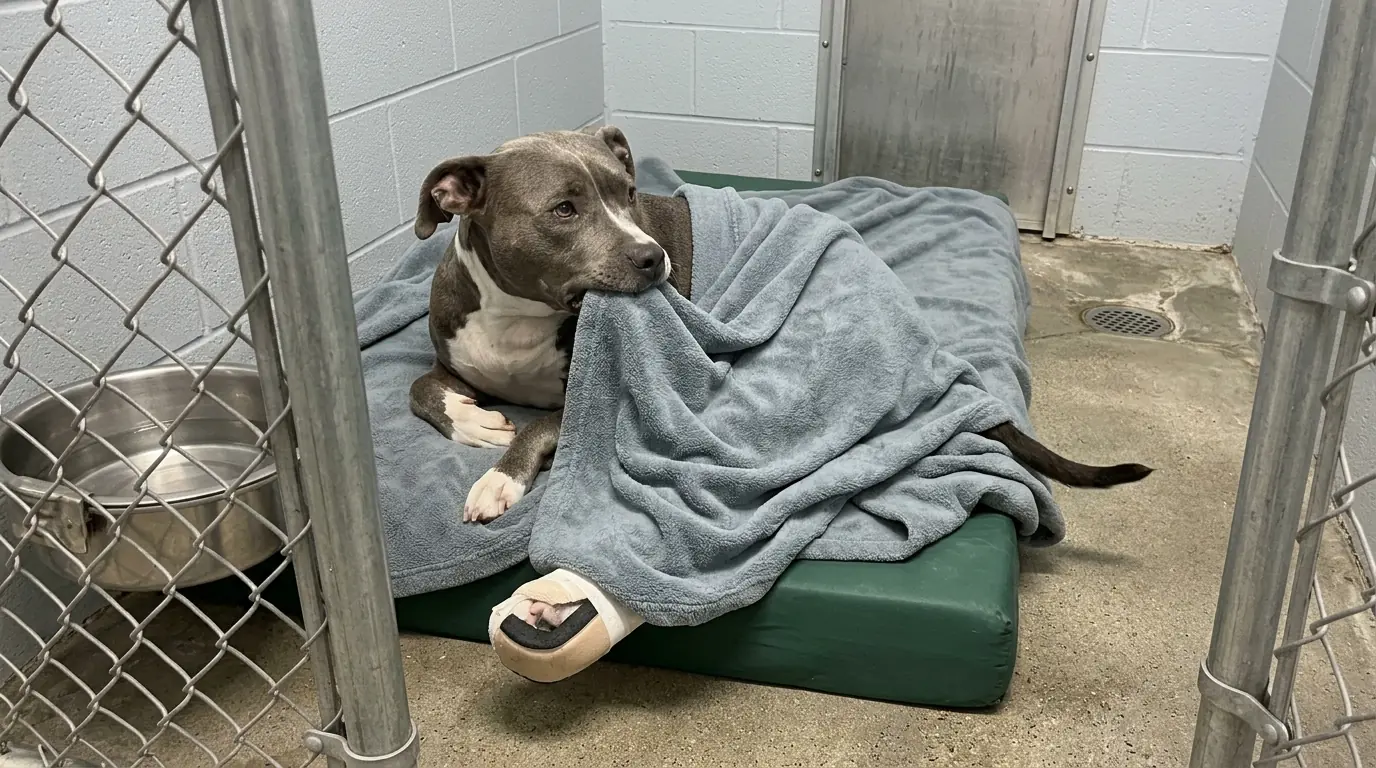
Daisy can hear someone coming before they reach her kennel.
Footsteps move through the medical wing.
Her head lifts from the bed.
Then the 7-year-old American Pit Bull Terrier does something staff have now seen over and over.
She lowers her muzzle toward her blanket.
Grips the edge.
And begins pulling it across her body.
But Daisy does not cover herself completely.
She works the fabric toward one specific place.
Her injured hind leg.
The leg has been shaved for treatment. A splint supports it, and several wounds around the area are still healing after a serious injury.
Daisy pulls until the leg disappears beneath the blanket.
Then she curls her body around it.
By the time the person reaches her kennel, almost nothing of the injured limb can be seen.
But something else is still moving.
Behind the blanket, Daisy's tail gives a small tap against the bed.
Then another.
Staff Initially Thought Daisy Was Simply Rearranging Her Bedding
Dogs move blankets constantly.
They dig at them.
Push them around with their noses.
Pull them underneath themselves.
Daisy was recovering in a medical kennel and spending much of her time resting, so some bedding adjustment was expected.
Then staff noticed when she did it.
The blanket did not always move when Daisy was alone.
It often moved when footsteps approached.
And the fabric repeatedly ended up over the same leg.
The Sequence Became Hard to Miss
Daisy would be resting with part of the injured limb visible.
Someone entered the medical wing.
Her ears moved.
She looked toward the hallway.
Then her nose went immediately to the blanket.
Pull.
Reposition.
Pull again.
Once the splinted leg was covered, Daisy curled toward it.
Only then would the person arrive.
That pattern raised a question the veterinary team could not answer from behavior alone.
Why did Daisy seem to cover the injured limb when people approached?
Pain Was an Obvious Possibility
A badly injured leg can remain sensitive even while wounds are healing.
Dressing changes.
Examinations.
Cleaning.
Repositioning.
All of those can involve handling around a painful area.
Daisy may have learned that people approaching the medical kennel sometimes meant her injured leg was about to be touched.
That was one possible explanation.
It was not something staff could assume as fact.
But it was important enough to consider.
The Leg Needed Care Whether Daisy Wanted It Covered or Not
A splint cannot simply disappear beneath a blanket and be forgotten.
Staff needed to monitor the limb.
They had to make sure the splint remained appropriately positioned and that the surrounding skin was protected.
Healing wounds needed observation.
Changes in swelling, discharge, odor, temperature, skin condition, or pain could matter.
Daisy's attempt to cover the area could not prevent necessary medical care.
But the way that care happened could still be adjusted around her behavior.
Staff Stopped Uncovering the Leg the Moment They Entered
Not every visit to Daisy's kennel required an examination.