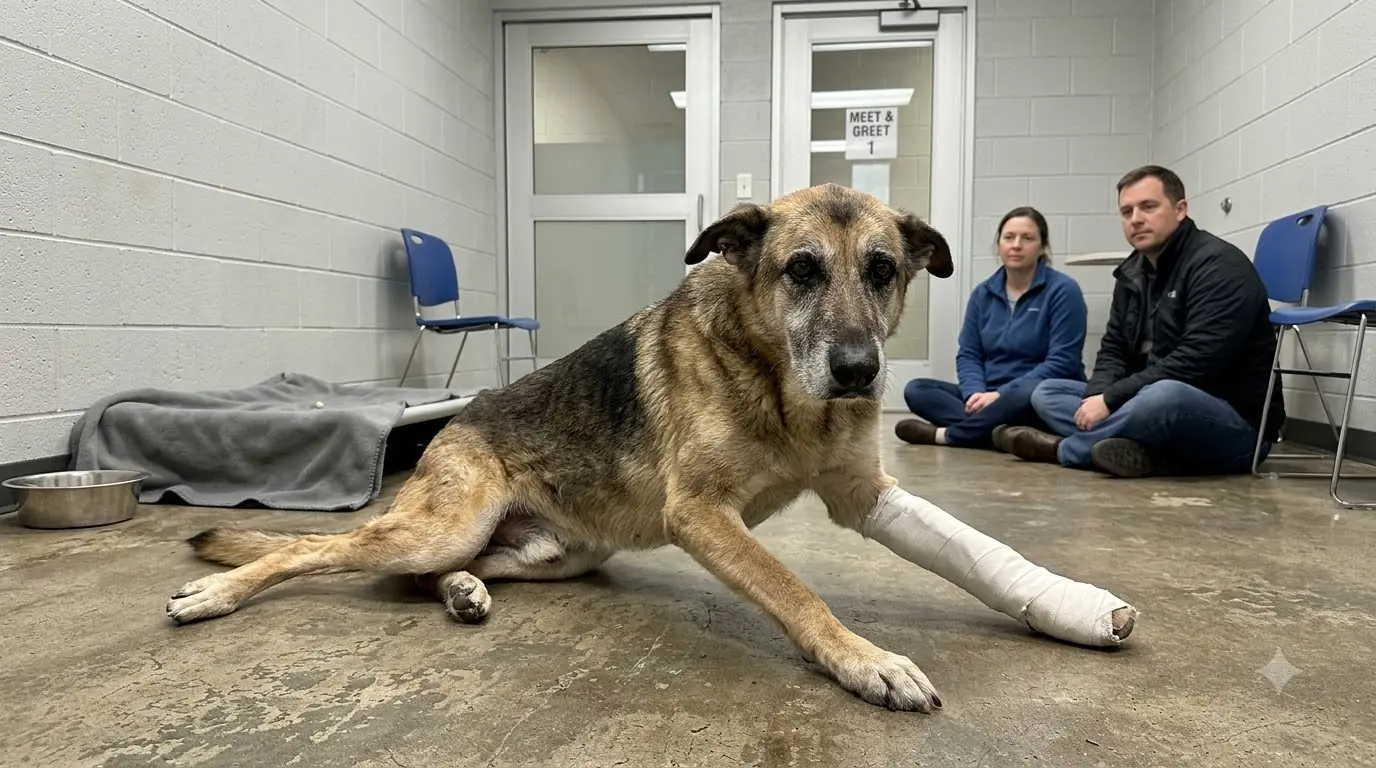
The family had been asked to sit on the floor and wait.
No calling him.
No patting the floor.
No reaching toward him.
No trying to convince him to come closer.
The senior Shepherd mix was recovering from an injury to one front leg, and weakness through both hind legs made even a short walk difficult. The rescue team wanted him to control the interaction himself.
So the family sat quietly at the far end of the meet-and-greet room.
For several seconds, the old dog simply watched them.
Then he tried to stand.
His stronger front paw planted firmly on the nonslip floor. The splinted front leg stayed stiff and slightly away from his body. His hind feet shifted beneath him as he pushed upward.
He made it.
Barely.
One step.
Then another.
By the third, his hindquarters began to sink.
His back legs folded beneath him, and he went down.
Everyone stayed where they were.
The dog could have remained there.
Instead, he lifted his chest.
He pushed through his stronger front leg, tried unsuccessfully to bring his hindquarters underneath himself again, and then began dragging himself forward.
A few inches at a time.
Toward the people waiting on the floor.
That was the moment the room changed.
Not because anyone knew what he was thinking.
Not because a senior shelter dog had somehow “chosen his family” in a single cinematic instant.
It was much simpler than that.
A dog who had been struggling to cross even small distances had been given the option to stop.
He did not stop.
Before the Meet-and-Greet
The rescue had known from intake that the Shepherd mix would need more support than the average senior dog.
His age could only be estimated.
His graying muzzle, worn teeth, reduced muscle mass, and general physical condition placed him clearly in the senior category, but without reliable records there was no responsible way to assign an exact birthday.
His mobility was the more immediate concern.
One front leg was injured and required stabilization with a splint while the veterinary team monitored healing.
At the same time, both hind legs appeared weak.
When he stood, his rear feet sometimes repositioned repeatedly before he found balance.
When he walked, his hind stride was shortened.
Turning was difficult.
Rising from the floor required several coordinated attempts.
On smooth surfaces, the problem became much worse.
Staff quickly learned that the difference between a floor with traction and one without it could determine whether he crossed a room comfortably or struggled after only a few steps.
The rescue did not know exactly how long he had been moving this way.
There was no reliable history explaining when the front-limb injury occurred or whether the hind-end weakness had developed gradually.
Those questions mattered medically.
But the team could not answer them by inventing a past for him.
They could only begin with the dog they had.
Four Limbs, Three Separate Problems
The splinted front leg was the most visible issue.
It was not necessarily the only one.
Because dogs redistribute weight when a limb hurts, an injured front leg can place additional demand on the remaining limbs. In a young, otherwise strong dog, that compensation may be manageable for a limited period.
For an older dog already experiencing hind-end weakness, compensation becomes much harder.
His veterinary examination therefore went beyond the splint.
The team observed him standing, walking, turning, sitting, and attempting to rise.
They assessed the injured front limb separately, checking the location of pain and swelling and evaluating whether the injury involved bone, joint, or surrounding soft tissue.
Appropriate imaging helped guide the treatment plan for the front leg.
His hindquarters required a different evaluation.
Veterinary staff checked muscle symmetry, joint range of motion, spinal discomfort, paw placement, reflex responses, and how consistently he knew where his hind feet were positioned.
They watched for signs that might distinguish primarily orthopedic weakness from a neurologic problem.
The findings did not support a dramatic overnight fix.
He was an older dog with reduced hind-end strength and mobility limitations that would require careful management while his front leg healed.
That meant rehabilitation would be measured in very small distances.
Sometimes only a few feet.
Standing Was Work
In the kennel, staff began noticing how much preparation went into something as ordinary as getting up.
He did not simply rise.
First, he shifted his chest forward.
Then he planted the stronger front paw.
The splinted leg remained more rigid.
His hind feet searched for traction.
Sometimes his first attempt failed.
His rear end would lift halfway and settle again.
He would wait.
Then try a second time.
Caregivers learned not to rush in immediately unless he was unsafe.
Whenever possible, they gave him a moment to organize his body.
A support harness was used when he needed assistance.
Nonslip runners were placed along his most common routes.
His bed was supportive but low enough that he did not have to climb over a high edge.
Food and water were positioned where he could reach them without repeatedly crossing the kennel.
Even those small changes conserved energy.
And energy mattered.
Because this dog rarely seemed to lack the desire to move.
What he lacked was a body that could reliably keep up.
His First Rehabilitation Sessions Were Very Short
There was no long walk down a hallway.
No dramatic exercise course.
No expectation that he would suddenly regain strength because people encouraged him.
Early rehabilitation focused on controlled, safe movement.
A supported stand could be useful.
So could several deliberate steps across a high-traction surface.
Caregivers monitored his posture and fatigue closely.
If his hindquarters began dropping or his paws started slipping, the session ended.
More was not automatically better.
The healing front leg also limited what could safely be asked of him.
He could not simply transfer all the work to his front end while his rear strengthened.
Every part of the plan had to account for every other part.
On good mornings, he might move surprisingly well.
Later the same day, he could appear much more tired.
That variation was expected.
Older bodies do not always provide the same performance from hour to hour.
He Became Interested in People Before He Became Stronger
His physical progress was slow.
His social behavior was easier to see.
At first, he watched caregivers from his bed.
He accepted food.
He tolerated necessary handling.
As routines became predictable, he began lifting his head when familiar people entered.
Eventually, he started making an effort to approach.
That effort could be inconvenient from a medical perspective.
A caregiver might enter to change water and suddenly find him trying to stand.
Someone kneeling several feet away could become a destination.
The team did not want to discourage voluntary social behavior.
They also did not want him repeatedly exhausting himself.
So they adjusted.
Instead of expecting him to cross the room for attention, people often came closer and sat at a comfortable distance.
If he chose to approach, he could.
If he stayed on the bed, interaction happened there.
His mobility limitations were not treated as a test of how badly he wanted companionship.
Then Someone Asked About Adopting Him
Senior dogs with significant mobility needs can be overlooked.
That reality shaped how the rescue approached placement.
His future home would need more than affection.
It would need traction.
A plan for veterinary follow-up.
Realistic expectations about mobility.
Possibly ramps rather than stairs.
Support during difficult days.
An understanding that improvement in strength would not make him young again.
The rescue was transparent about all of it.
The family who expressed interest did not receive a simplified description.
They were told about the splinted front leg.
They were told about his hind-end weakness.
They were told that he sometimes needed assistance standing.
They were told that the final extent of his long-term mobility could not yet be predicted with certainty.
And they still wanted to meet him.
The Room Was Prepared Around His Body
Before the meeting, staff looked at the room from the dog's perspective.
The floor mattered first.
Nonslip coverings were placed where he was most likely to travel.
The room was kept quiet.
There was enough open space for him to move without navigating around chairs.
The family was asked to sit low.
This was not about creating an emotional scene.
Standing adults could be physically and socially more difficult for a compromised senior dog to approach.
Sitting reduced pressure.
It also meant that if he chose to come closer, he would not need to crane his neck upward.
A caregiver remained nearby.
The support harness was available.
The dog entered slowly.
Then everyone waited.
He Looked at Them for a Long Time
He did not rush across the room.
For a while, he did almost nothing.
He stood near the caregiver.
Then he lowered himself.
His breathing settled.
He watched.
One member of the family shifted position slightly and then became still again.
The dog continued looking in their direction.
Nobody called him.
Eventually, he leaned forward.
His stronger front foot moved beneath him.
His hind legs repositioned.
The caregiver was ready to assist but did not immediately lift him.
He pushed himself up.
The effort was obvious.
Once standing, he paused.
Then he began walking.
Three Steps Were Enough
The first step looked reasonably controlled.
The second was shorter.
On the third, his rear feet failed to stay underneath him.
His hindquarters dropped.
Because one front leg was splinted, he could not correct the loss of balance normally.
He went down.
The family remained seated.
That part was important.
Nobody rushed forward and surrounded him.
Nobody tried to lift him by the chest.
Nobody turned the moment into a test he needed to pass.
He was given time.
His head remained up.
His attention stayed toward the far end of the room.
Then his stronger front paw moved forward.
He pulled.
His body shifted several inches.
The splinted leg stayed stiff to one side.
He stopped.
Then he pulled again.
Staff Intervened Before Determination Became Overexertion
It would have made a powerful video to let him continue all the way across the room.
It would not have been responsible care.
After several efforts, the caregiver stepped in.
The dog was supported through the harness and given enough assistance to prevent him from repeatedly dragging his hindquarters.
The family was invited to move closer instead.
They did.
Slowly.
They stopped several feet away.
The Shepherd mix was lowered into a comfortable position.
Then the choice returned to him.
He could move forward.
He could remain still.
He could disengage.
He moved forward.
Only a short distance this time.
Enough to reach them.
Nobody Needed to Pretend He Understood Adoption
It can be tempting to describe a moment like this as if a dog somehow understands the paperwork, the application, and the possibility of a home.
There was no evidence for that.
What staff could say was more grounded.
The dog repeatedly showed social interest in the people in front of him.
When distance separated them, he attempted to reduce that distance.
After losing his footing, he resumed moving toward them.
When given the opportunity to disengage, he remained near them.
Once they were within reach, he sniffed.
He accepted quiet touch.
He did not need to perform gratitude.
He did not need to recognize them as anything more than people he currently wanted to investigate and remain near.
That was enough.
The Meeting Became Much Quieter After That
Once he reached the family, there was very little action.
He stayed on the floor.
One person rested a hand where he could sniff it.
After he investigated, they touched the side of his neck.
His posture remained loose enough that the interaction continued.
He shifted his head closer.
Eventually, the effort of crossing even part of the room caught up with him.
His head lowered.
The family did not try to make him stand again.
For much of the remaining visit, they simply sat beside a tired old dog.
That gave staff more useful information than a dramatic greeting ever could.
Could the family remain patient when he did nothing?
Could they accept that sometimes a successful interaction would mean letting him rest?
Could they see mobility support as part of ordinary daily care rather than an inconvenience?
Those questions mattered much more than whether he could walk across a meet-and-greet room.
The Next Day, He Was Tired
The following morning was not one of his strongest.
His hindquarters were stiffer.
He took longer to rise.
His rehabilitation session was shortened.
That did not erase what had happened during the meeting.
It also did not mean the meeting had healed him.
Both truths could exist together.
He had made a determined effort to approach people.
His body still needed significant support.
The rescue continued treating the dog in front of them rather than the emotional version people might have wanted him to become.
His Front Leg Could Not Be Rushed
As the front-limb injury progressed through healing, the veterinary team reassessed it.
Splints are useful only when monitored carefully.
Padding, fit, skin condition, swelling, and comfort all require attention.
The team checked for pressure areas and changes in the limb.
As healing permitted, the plan was adjusted.
When it eventually became appropriate to reduce or discontinue rigid support, that transition was handled cautiously.
A leg that has spent time immobilized does not immediately return to normal strength.
The surrounding muscles need time.
So did the dog.
The first time the limb was less restricted, he did not suddenly trot.
He placed the foot.
Lifted it.
Placed it again.
That was progress.
His Hind Legs Remained the Larger Long-Term Question
Even as the front leg improved, the weakness behind him did not disappear.
That was important for prospective adopters to understand.
The rescue continued controlled strengthening and mobility work.
Short walks on stable surfaces.
Supported standing when necessary.
Careful transitions from lying to standing.
Rest before fatigue changed his gait.
His weight was monitored so that excess pounds would not add unnecessary strain.
Nails and paw fur were kept managed to help with traction.
The environment continued doing part of the work for him.
A dog with limited mobility should not have to fight the floor every time he wants water.
The Family Came Back
A second meeting looked different.
This time, staff did not place the family at the far end of the room.
There was no reason to repeat the same physical challenge just to recreate an emotional moment.
They sat closer.
The Shepherd mix entered with assistance.
He saw them.
His head lifted.
He moved forward.
The distance was only a few steps.
He still struggled.
But he did not collapse the way he had during the first meeting.
Once near them, he lowered himself onto a mat.
The family spent time learning practical things.
How to support him without pulling on his limbs.
How to recognize fatigue.
How to use a harness.
Why rugs and runners mattered.
Why slick floors could turn a relatively good day into a frustrating one.
What kinds of stairs would be difficult.
Why pain or sudden worsening of mobility would require veterinary reassessment rather than simply being dismissed as old age.
This was what adoption preparation for a medically complicated senior dog actually looked like.
Not only emotion.
Logistics.
He Still Tried to Do More Than His Body Could Manage
That remained part of his personality throughout recovery.
If a familiar person entered from across the room, he sometimes attempted to stand before anyone reached him.
If a door opened, he wanted to investigate.
If something smelled interesting, he could forget temporarily that getting there required four cooperating limbs.
Caregivers learned to anticipate those moments.
Sometimes they moved the interesting thing closer.
Sometimes they supported him.
Sometimes they prevented an unnecessary attempt.
Protecting him did not mean removing every choice.
It meant making sure his willingness to move did not repeatedly result in falls.
The Most Important Progress Was Not Distance
Weeks into care, he could travel farther than he had initially.
But distance was not the only measure.
He rose with fewer failed attempts.
His turns became more controlled.
He recovered more quickly after short walks.
He learned to wait for the support harness on difficult days instead of scrambling against the floor.
He rested comfortably on supportive bedding.
The healing front limb gradually became more useful.
His hind legs still weakened when he became tired.
Some mornings were better than others.
There was no moment when staff declared him “fixed.”
He was still a senior Shepherd mix with real physical limitations.
The goal had never been to turn him into a different dog.
The goal was to make movement safer, pain better controlled, and daily life less exhausting.
Placement Required a Different Definition of Independence
For him, independence did not mean doing everything without help.
It meant being able to make choices within a supportive environment.
He could choose where to lie down.
He could decide whether to approach someone.
He could walk short distances with assistance available.
He could stop when tired.
He could explore without being expected to keep pace with a younger dog.
A home that understood those needs could offer far more freedom than a physically demanding environment ever could.
The interested family understood that the dog they had met on the floor was the dog they were considering.
Not an imagined future version who would eventually climb stairs and run through a yard.
The senior dog in front of them.
When He Saw Them Again, He Tried to Stand
At a later visit, the Shepherd mix was already resting when the family entered.
His head came up.
His body shifted.
Then came the familiar sequence.
Strong front paw planted.
Hind feet adjusted.
Chest forward.
Push.
This time he stood on the first attempt.
The family was only several feet away.
He walked toward them.
His steps were slow.
The rear legs still lacked the strength of a younger dog.
The recovering front leg still altered his stride slightly.
But he remained upright.
He reached them without needing to pull himself across the floor.
Nobody celebrated loudly.
A sudden burst of excitement was the last thing he needed.
They simply made room for him.
He stood between them for a moment.
Then he lowered himself carefully onto the mat.
His Future Would Still Need Help
As placement planning continued, the rescue remained clear about what might not change.
Age would remain.
Hind-end weakness might remain to some degree.
He could need ongoing rehabilitation or mobility exercises.
Pain management might require adjustment over time under veterinary supervision.
A support harness could remain part of daily life.
Ramps and traction might always matter.
Future changes in strength, continence, coordination, or comfort would need medical attention.
Senior dogs do not stop aging because they enter rescue.
Good care does not promise that.
Good care tries to give them comfort, function, and dignity within the bodies they have.
He Does Not Have to Crawl the Whole Way Anymore
The image from that first meeting has stayed with the people who cared for him.
A family sitting quietly at the far end of a room.
An old Shepherd mix pushing himself upright.
A few uneven steps.
His hind legs folding.
Then his chest lifting again.
One front paw reaching forward.
The splinted leg held stiffly to the side.
His body sliding several inches closer.
Then another several inches.
What made the moment powerful was never the idea that he somehow understood he was meeting potential adopters.
Nobody could know that.
It was the observable choice he made after his body failed him.
He could stop.
He tried again.
His mobility is better now, but it is not perfect.
There are still days when standing takes longer.
There are still moments when his rear legs begin to sink and someone reaches for the harness.
He still needs surfaces that give his feet something to grip.
He still needs people who understand that a short walk can be a significant effort.
And when the family sits down near him now, he still often tries to get up.
The difference is that nobody waits at the opposite end of the room anymore.
They come closer.
He takes the steps he can manage.
Someone is there if his hindquarters begin to drop.
And on the days when his legs tell him that even those few steps are too much, he no longer has to plant his front paws against the floor and drag himself the rest of the way just to reach the people he wanted to be near.
They meet him where he is.