Tommy Elkins had been driving the Monday sanitation route long enough to know that people reveal themselves in small, repeatable ways.
Some houses always put out too many flattened boxes after Christmas and none the rest of the year. Some residents wheeled their trash carts to the road the night before and lined the lids up so neatly that even after wind or rain, the row still looked military. There were houses where the cans were never fully closed because a grandson threw away pizza boxes too large to fit, and houses where the recycling was so carefully sorted that Tommy sometimes wondered if the owner had once taught chemistry. He knew which porch light burned all winter, which mailbox leaned a little farther every spring, and which farm drive was likely to be blocked by a pickup angled the wrong way before daylight.
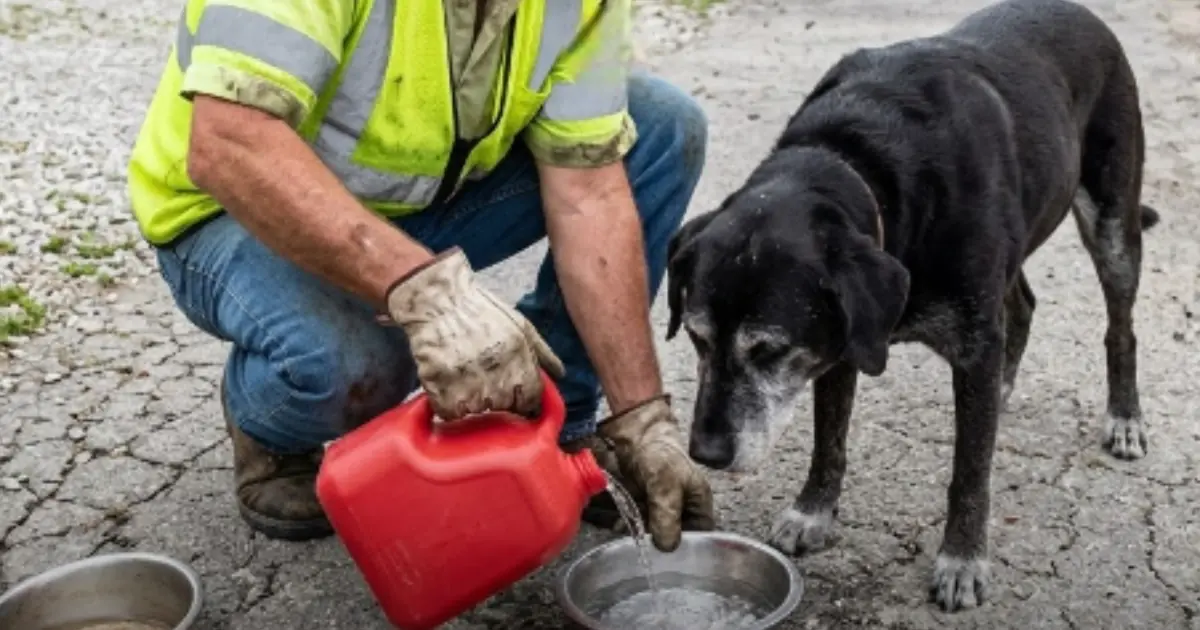
Most of all, he knew the dogs.
After sixteen years with Morrow County Sanitation and eleven on the same western route outside Mount Gilead, Ohio, Tommy could have named a surprising percentage of the dogs before he named the people. There was the beagle on Township Road 42 who hated only the hydraulic lift and not the truck itself. There was the pair of heelers south of Iberia that ran circles around one another whenever the arm reached for the cart. There was a solemn old Saint Bernard that no longer stood up for anything except the school bus and Tommy’s garbage truck, as if large vehicles on a schedule deserved formal acknowledgment.
And on County Road 18, at the small pale-yellow house with the white chain-link fence and two cracked cement planters by the porch, there was Buster.
Buster was a black Lab mix with a white chest, a boxy head gone gray around the muzzle, and the sort of bark that began deep in the ribs and seemed much larger than the dog himself. He had never chased the truck. He was too old, and perhaps too sensible, for that. What he did instead was trot from wherever he had been lying—sometimes under the porch swing, sometimes in the patch of shade near the fence—and make his way to the front corner of the yard in time to bark twice, sometimes three times, as Tommy slowed beside the trash cart.
That had been their arrangement for years.
Tommy pulled up. Buster announced him. Tommy grinned through the windshield and said, “Morning, pal,” whether the windows were open or not. Most weeks, Evelyn Cross, who owned the house and the dog, emerged a few seconds later to wave from the porch or to lift one hand from the walker she had begun using full-time the previous fall.
On the Monday in late May when Buster did not come to the fence, Tommy knew it before the truck had fully stopped.
The absence registered first as silence. Not complete silence—the route was never silent. There was always the diesel engine idling beneath him, the metallic clank of the lift, birds in the ditch grass, and the occasional dog farther down the road objecting to something else entirely. But there was a silence where Buster ought to have been, and that struck Tommy before he even looked toward the yard.
Then he noticed the cart.
It was still beside the garage instead of at the road.
Evelyn always wheeled it down herself on Sunday afternoons. If the weather was bad, she did it with the help of a granddaughter or a neighbor, but by Monday morning the cart was always where it needed to be. Tommy had seen her with one hand on the handle and one hand on her walker, moving slowly but stubbornly down the drive because, as she had once told him, “I’m not dead yet, Mr. Elkins.”
Now the cart sat halfway between the garage and the side door as if somebody had meant to move it and stopped.
Tommy stared a second longer than usual. The front blinds were shut. The porch swing hung still. The dog bowl by the steps was not where it usually sat.
He eased the truck forward, emptied the can from the next house, then the next one after that. By the time he reached the end of the short road and swung the truck wide to turn around, he had already made up his mind. He would finish the block, radio the office that he needed ten extra minutes, and go back.
His coworker that morning was a younger man named Luis Alvarez, thirty-one, quick with the hydraulic controls and quick with the kind of comments younger men think old coworkers enjoy more than they do.
“You forget one?” Luis asked when Tommy turned the truck around sooner than necessary.
“No.”
“Then what?”
Tommy kept his eyes on the drive ahead.
“Dog didn’t come out.”
Luis looked at him, waiting for the punch line.