Rosie had never understood the wheelchair as something tragic.
To her, it was simply where Walter was.
When he first began using it inside the house, she adapted almost immediately. She stopped cutting in front of him in narrow hallways. She learned to walk beside the larger rear wheel instead of crossing behind it. If Walter rolled into the kitchen, Rosie followed and settled near the refrigerator. If he stopped beside the front window, she stretched across the rug close enough that one paw sometimes touched the metal footrest.
At night, she slept beside the chair.
Not always on a dog bed. Not always comfortably. Walter bought her three beds over the years, including one his daughter described as “better padded than Dad’s mattress,” but Rosie often ignored them whenever the wheelchair was parked somewhere else.
She seemed to prefer knowing exactly where Walter was.
That habit had developed slowly enough that nobody in the family remembered when it started.
By the time Walter turned eighty-one, it had simply become part of the house.
Walter Bennett had not planned to own Rosie either.
Eleven years earlier, shortly after his wife Margaret died, his daughter Ellen found Rosie through a small rescue group outside Columbus. The dog was about two years old then, black with tan markings above her eyes and along her legs, with the sturdy body of a Rottweiler mix and the suspicious expression of an animal that had already learned not to rush toward strangers.
Ellen thought her father needed company.
Walter thought his daughter needed to stop making decisions for him.
“I’m not getting a dog,” he told her over the phone.
“You don’t have to get one. Just meet her.”
“That’s how people end up with dogs.”
Ellen brought Rosie over anyway.
The dog spent the first thirty minutes walking through Walter’s house without approaching him. She inspected Margaret’s old chair, sniffed beneath the kitchen table, looked briefly into every open doorway, then lay down near the front entrance.
Walter ignored her.
Rosie ignored him.
Ellen went to make coffee.
When she returned, Rosie had moved.
She was lying beside Walter’s recliner.
“That means nothing,” Walter said.
Two weeks later, he signed the adoption papers.
At first, Rosie’s role in Walter’s life was ordinary.
They walked twice a day.
She rode in the passenger seat of his pickup and barked at drive-through workers until they learned to hand Walter an extra dog biscuit. She slept in the hallway and appeared in the kitchen every time a package made even a remotely food-like sound.
Walter complained constantly.
“She sheds.”
Rosie stayed.
“She snores.”
Rosie stayed.
“She follows me into the garage and lies exactly where I need to stand.”
Rosie stayed.
Everyone understood quickly that complaining was simply Walter’s preferred language for affection.
The years after Margaret’s death had been harder on him than he admitted.
For forty-seven years, Walter had rarely eaten dinner alone. He and Margaret disagreed about everything from thermostat settings to what counted as “too many tomatoes” in the backyard garden. Their children had grown up, moved away, and built families of their own, but the two of them remained at the center of a routine that neither fully appreciated until one half disappeared.
After the funeral, Walter’s house became painfully organized.
Nothing moved unless he moved it.
No second coffee cup appeared beside the sink.
No television played from another room.
No one asked him whether he had remembered to call the plumber.
Rosie disrupted that silence immediately.
She scratched at the bedroom door at six every morning.
She dropped a tennis ball beside his chair.
She required walks in weather Walter would otherwise have used as an excuse to stay inside.
Most importantly, she made coming home feel different.
Walter once told Ellen that the strangest part of widowhood was opening the front door and realizing nobody knew whether he had been gone ten minutes or ten hours.
Rosie always knew.
At first, she met him at the door.
Later, as the years changed both of them, she waited farther inside.
But she always looked up.
There was no single diagnosis that transformed everything overnight. Arthritis made walking uncomfortable. Then came balance problems. A fall in the driveway resulted in a hospital stay and physical therapy. Doctors advised a cane, then a walker.
Rosie adjusted each time.
When Walter began using the walker, she stopped leaning against his legs while he stood.
When he paused on walks, she paused.
When their route became one block instead of four, she never pulled toward the old path.
Ellen noticed before Walter did.
“She knows.”
Walter looked down at Rosie.
“She knows I’m slow.”
“She knows more than that.”
“Don’t turn her into a therapist.”
Rosie yawned.
Within another year, Walter needed the wheelchair most days.
That transition upset him deeply.
The chair represented dependence in a way the cane had not. His home required ramps. Furniture had to be moved. The heavy oak table Margaret had chosen forty years earlier was pushed closer to the wall so Walter could pass comfortably through the dining room.
The upstairs bedrooms became mostly unreachable.
Walter moved permanently into a room on the first floor.
Rosie did not care about any of it.
She simply recalculated.
The first week Walter used the chair full-time, Rosie made the mistake of walking too close to one rear wheel.
Her paw was never caught, but the rubber brushed her leg and startled her.
After that, she learned exactly where the safe spaces were.
Beside the wheel.
Behind the footrest.
Under Walter’s hand.
She became so precise around the chair that visitors sometimes asked whether she had been trained.
She had not.
Walter had never taught her commands related to mobility. Rosie simply spent enough time beside him to learn the mechanics of his new life.
She also began sleeping near the chair more often.
Ellen assumed it was because Walter no longer walked around the house as much.
Then one night, she moved the wheelchair several feet away while helping her father into bed.
Rosie got up from her usual blanket.
She walked to the chair.
She lay beside it.
Ellen laughed.
“You know he’s over there, right?”
Rosie did not move.
The wheelchair had become part of Walter’s scent, part of his sound, and perhaps simply part of the map Rosie used to understand where he belonged.
Over the next several years, Walter’s world became smaller.
He stopped driving.
That loss hurt more than the wheelchair.
His pickup had represented independence long before Margaret died, and selling it made him unusually quiet for days. Ellen arranged grocery deliveries. Friends from church visited. A neighbor cut the lawn.
Rosie continued treating every day as if nothing essential had changed.
Breakfast still mattered.
The mailbox still required inspection.
Afternoon naps still happened in the living room.
Walter still dropped crumbs.
Life, in Rosie’s mind, remained full of important responsibilities.
The first serious discussion about long-term care happened after Walter fell transferring from the wheelchair to his bed.
He was alone except for Rosie.
The fall itself was not catastrophic, but Walter could not get up.
Rosie became agitated and began barking near the front window. A neighbor heard her and came over.
Walter spent three days in the hospital.
When he returned home, Ellen no longer felt comfortable pretending the current arrangement was sustainable.
They hired additional home-care help.
Walter resisted.
Then tolerated it.
For almost a year, the compromise worked.
Rosie adapted to the caregivers too.
She learned which one carried treats.
She disliked the vacuum used on Tuesdays.
She waited outside the bathroom when someone helped Walter shower.
But the falls continued.
Then came an infection.
Another hospital stay.
A period of rehabilitation.
By the time Walter returned home again, he required more assistance than the family could reliably provide.
Ellen approached the conversation carefully.
Walter understood immediately.
“No.”
“Dad.”
“No.”
“We’re running out of safe ways to do this.”
“I’ve lived here forty-nine years.”
“I know.”
“Your mother died in this house.”
“I know.”
Walter turned toward the window.
Rosie was lying beside the wheelchair.
Nobody said anything for a while.
Then Walter asked the question Ellen had been afraid of.
“What happens to her?”
Ellen had prepared answers about almost everything else.
Medication.
Furniture.
The nursing facility.
Insurance.
His clothes.
She had not prepared that answer well enough.
The long-term care facility they had chosen did not allow residents to keep personal dogs permanently. Animals could visit under certain conditions, but Rosie could not live in Walter’s room.
“She can stay with me,” Ellen said.
Walter looked at Rosie.
“She hates your cat.”
“My cat hates everybody. They’ll survive.”
Walter did not laugh.
Over the following two weeks, the move became real.
Ellen labeled clothing.
Furniture was measured.
A social worker called.
Walter became quieter.
Rosie noticed the boxes before she understood anything else.
Whenever Ellen packed, the dog followed.
She smelled each open bag.
If something belonging to Walter disappeared into a suitcase, Rosie returned to inspect it later.
The night before the move, she slept with her front paws touching the wheelchair.
Walter remained awake for a long time.
At one point he lowered his hand.
Rosie lifted her head.
He scratched behind her ear.
“I’m sorry, girl.”
Rosie leaned into his palm.
The following morning was gray and wet.
A light rain had passed shortly before Ellen arrived, leaving the driveway dark and slick. Walter wore a gray sweater and the plaid pajama pants he insisted were perfectly acceptable for travel because, in his words, “nobody at a nursing home is going to arrest me for fashion.”
Ellen laughed because she wanted him to keep joking.
Rosie knew something was wrong.
She followed Walter more closely than usual while a transport aide helped maneuver the wheelchair outside.
The moment the chair crossed the front door, Rosie became restless.
She moved beside Walter, then behind him, then back toward the doorway.
Her leash lay on the porch because Ellen planned to take her home after Walter was settled.
Walter reached down.
Rosie came close.
“Easy.”
The dog stood facing him.
Her tail moved slowly.
For several seconds, neither looked away.
Ellen would remember that part more clearly than anything else.
Walter’s hand rested against Rosie’s face.
The dog leaned into it.
Then the transport aide began moving the wheelchair toward the vehicle.
Rosie followed.
When Ellen took the leash and gently directed her toward the car, Rosie stopped.
She turned around.
Walter was farther away now.
Rosie whined.
Not loudly.
Just a small sound.
Then she pulled toward him.
Ellen waited until Walter was secured before allowing Rosie to approach again.
The dog smelled the wheelchair.
She placed her chin briefly against Walter’s knee.
Walter looked down.
“I’ll see you.”
Nobody knew whether he was reassuring Rosie or himself.
At the care facility, Ellen expected Rosie to be distracted by the new environment.
She was not.
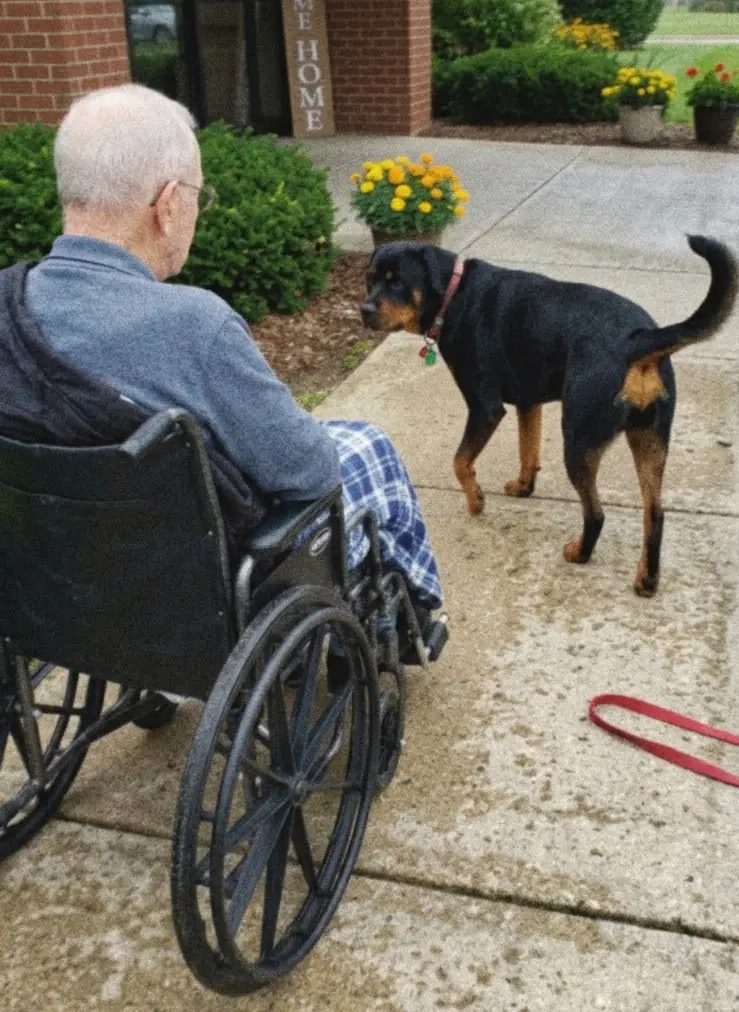
The brick building had flower pots beside the entrance and a wooden sign reading WELCOME HOME. Staff members came outside to greet Walter, but Rosie barely noticed them.
She stayed beside the wheelchair.
When the automatic doors opened, Walter was moved inside.
Rosie tried to follow.
Ellen held the leash.
The dog stopped at the threshold.
Walter looked back.
That was the moment captured in the photograph Ellen later kept on her phone.
An old man in a wheelchair.
A black-and-tan dog standing several feet behind him.
A red leash lying across wet pavement.
Nothing about the image showed what eleven years had looked like.
The morning walks.
The pickup rides.
Margaret’s empty chair.
Walter learning the wheelchair.
Rosie learning it too.
All the nights she had slept beside him.
But Ellen saw every one of those years inside it.
She led Rosie back toward the parking lot.
Rosie resisted.
Every few steps, she turned around.
At the car, she stopped and looked toward the building again.
Then she whimpered.
Ellen crouched beside her.
“I know.”
She did not know what else to say.
For the first several days at Ellen’s house, Rosie behaved almost normally during daylight.
She ate.
She walked.
She ignored the cat with only slightly more hostility than usual.
At night, everything changed.
She paced.
She checked the hallway.
She stood by the front door whenever a vehicle slowed outside.
Ellen moved Rosie’s bed into her bedroom.
The dog left it.
Instead, she chose a blanket Ellen had brought from Walter’s house.
The blanket had often covered his legs in the wheelchair.
Rosie smelled it for nearly a minute before lying down.
That became her sleeping place.
Walter was struggling too.
The nursing staff described him as polite but withdrawn. He answered questions, took medication, and participated in physical therapy only when sufficiently pressured.
He ate poorly.
He rarely entered the common room.
Most days he stayed near his window.
During Ellen’s first visit without Rosie, Walter looked toward the doorway after she arrived.
“Where is she?”
“At home.”
“Why didn’t you bring her?”
“I wanted to make sure everything was approved first.”
Walter looked disappointed.
“How is she?”
“She misses you.”
He looked toward the window.
“I miss her too.”
Ellen spoke with the nursing director.
The facility allowed pet visits with vaccination records, supervision, and approval from the resident’s care team. Rosie could not remain overnight, but there was no reason she could not visit regularly.
Ellen scheduled the first visit for that Saturday.
Rosie knew something was different the moment Ellen picked up Walter’s old blanket.
The dog followed her to the car without hesitation.
During the drive, Rosie stood several times and smelled the air near the window.
When Ellen turned into the facility driveway, the dog became completely alert.
She recognized something.
Perhaps the route.
Perhaps the building.
Perhaps only the collection of smells left from the day Walter arrived.
Ellen parked.
Rosie was already waiting at the door.
Inside, Walter had been told someone was coming to see him.
Staff wheeled him toward a small covered patio beside the garden.
He assumed Ellen was bringing grandchildren.
Then he heard nails clicking rapidly across the tile.
Walter turned.
Rosie appeared around the corner.
For one second, the dog stopped.
Walter said her name.
That was enough.
Rosie moved toward him so quickly Ellen almost dropped the leash. She did not jump onto Walter. Years around the wheelchair had taught her too much for that.
Instead, she went exactly where she had always gone.
Beside the right wheel.
Then under Walter’s hand.
Her body pressed against his knee while he bent forward as far as he safely could.
“Hey, girl.”
Rosie made a low whining sound.
Walter buried his hand in the fur around her neck.
Ellen looked away.
A nurse standing nearby did the same.
The reunion itself lasted less than a minute before something even more familiar happened.
Rosie circled the wheelchair.
She smelled the footrests.
Then she lowered herself onto the patio beside the right wheel.
Exactly where she had slept at home.
Walter looked down.
“There.”
His voice broke slightly.
“That’s where she goes.”
For the next hour, Rosie barely moved.
Walter talked more than he had during any visit since arriving at the facility.
He told Ellen about physical therapy.
He complained about breakfast.
He introduced Rosie to a nurse named Linda as though the dog required a formal social presentation.
“She’s eleven now.”
Linda smiled.
“She seems very devoted to you.”
Walter looked down.
“She’s had to put up with me a long time.”
After Rosie left, something changed.
The staff noticed Walter ate most of dinner that evening.
The next morning, he agreed to sit in the common room for coffee.
Nobody claimed one dog visit had transformed his health.
It had not.
Walter still needed long-term care.
His physical limitations remained.
There were still days when he was angry about where he lived.
But he now had something specific to anticipate.
Saturday.
Rosie.
The family created a routine.
Every Saturday afternoon, unless weather or Walter’s health made it impossible, Ellen brought Rosie.
The dog learned the schedule before anyone deliberately taught it.
On Saturdays, she began following Ellen around the house after lunch.
If Ellen picked up the red leash, Rosie went straight to the garage.
During the drive, she stopped pacing once they reached the familiar road.
At the nursing home, she walked through the entrance more confidently each week.
Staff members learned her name.
Residents did too.
A woman named Betty began keeping dog biscuits in her walker basket.
Walter accused Rosie of visiting only for the food.
Rosie accepted this insult while eating another biscuit.
The arrangement was not the life Walter wanted.
That distinction mattered.
No amount of sentiment could turn long-term care into the house he had shared with Margaret. Rosie did not sleep beside his wheelchair every night anymore. Walter did not wake to her nails crossing the kitchen floor.
But separation no longer meant disappearance.
That was the lesson both of them seemed to learn.
Rosie watched Walter disappear through the facility doors each week.
Then she returned the following Saturday and found him there.
Walter watched Ellen lead Rosie toward the parking lot after every visit.
Then, one week later, those familiar nails came clicking down the hallway again.
The goodbye became attached to a return.
Ellen noticed Rosie changing at home too.
She stopped pacing so much in the evenings.
She still slept on Walter’s old blanket, but she no longer rushed toward the door at every vehicle.
Sometimes she carried one of his old slippers around the house and left it beside her bed.
Ellen never took it away.
Several months after Walter moved, he developed pneumonia.
The illness frightened everyone.
He was transferred briefly to the hospital, where dogs could not visit during the acute phase.
Rosie missed two Saturdays.
By the second, the old restlessness returned.
She followed Ellen through the house.
She stood beside the garage door after lunch.
When the red leash did not appear, she lay down near Walter’s blanket.
Ellen sat beside her.
“He’s coming back.”
The words were meant for Rosie.
Ellen realized she needed to believe them too.
Walter did return to the nursing facility.
He was weaker.
The first visit afterward happened in his room because he was not strong enough to spend an hour on the patio.
Rosie entered slowly.
She saw Walter lying in bed instead of sitting in the wheelchair.
For a moment, she hesitated.
Then Walter moved one hand.
“Come here.”
Rosie approached.
She placed her chin on the edge of the mattress.
Walter stroked her forehead.
Ellen remembered the day Rosie first met him eleven years earlier, when the dog had walked through his house pretending not to care and eventually chosen the floor beside his recliner.
So much of their relationship had been built around where Rosie decided to lie.
Beside the recliner.
Beside the bed.
Beside the wheelchair.
Now beside a nursing-home bed.
Rosie stayed for forty minutes.
When she left, she looked back once from the doorway.
Walter lifted his hand.
A week later, he was back in the wheelchair.
The Saturday visits resumed.
By then, Rosie had become something more than Walter’s visitor.
Other residents waited for her too.
Some had owned dogs all their lives before moving into long-term care.
A former farmer named Earl asked to see Rosie every week even though he could never remember her name.
Betty still carried biscuits.
One resident who rarely spoke smiled whenever Rosie rested her head near her chair.
Walter complained that everyone was stealing his dog.
He secretly loved it.
The staff began referring to Saturday afternoons as “Rosie day.”
For Ellen, that mattered because Walter was no longer merely enduring the facility until the next family visit.
Rosie had brought part of his old identity into the new place.
He was still the man with the dog.
Still the person who knew which scratch behind Rosie’s ear made her back leg twitch.
Still the one she looked for first.
A year after Walter moved into long-term care, Ellen came across the photograph from the first day again.
Walter in the wheelchair.
Rosie standing behind him.
The nursing-home entrance in the background.
She remembered how final everything had felt.
At the time, she believed she was photographing a goodbye.
Looking at it now, she realized it had been the beginning of a different routine.
Walter could no longer share a house with Rosie.
That loss was real.
But their relationship had survived the change because the family stopped treating presence as something that required living under one roof.
Rosie needed consistency more than explanations.
Walter needed it too.
A familiar Saturday.
A familiar leash.
A familiar door.
A familiar dog turning the corner.
Two years into the arrangement, Rosie began slowing down.
Her muzzle turned gray.
She had difficulty climbing into Ellen’s SUV, so Ellen bought a small ramp.
The first time Rosie used it, Walter laughed when Ellen told him.
“Now both of us have equipment.”
Rosie developed arthritis.
Her visits became shorter.
Instead of walking around the garden, she spent most of her time lying beside Walter.
Neither appeared bothered by the reduced activity.
They had never needed entertainment from each other.
Presence had always been enough.
One afternoon, rain kept everyone indoors.
Walter sat near a window in the common room while Rosie slept beneath his hand.
A new aide asked Ellen whether Rosie had been trained as an emotional-support animal.
Walter answered before Ellen could.
“No.”
He looked down at the dog.
“She just stayed.”
The sentence was so simple that Ellen nearly missed what it contained.
Rosie had stayed after Margaret died.
She stayed when Walter’s walking became slower.
She stayed when the cane appeared.
She stayed when the walker replaced it.
She stayed when the wheelchair changed the shape of the house.
She stayed through hospital admissions, home-care workers, sold furniture, ramps, medication, and the long painful argument about nursing care.
The only time she had not stayed was when a door physically prevented her.
And even then, she learned how to come back.
Walter died at eighty-four, nearly three years after moving into the facility.
His decline at the end was gradual.
Ellen brought Rosie for one final visit when staff believed Walter might have only days left.
The dog was fourteen by then.
She walked slowly through the hallway.
Walter was sleeping when she entered.
Rosie approached the wheelchair first.
It was parked near the wall.
She smelled it.
Then she turned toward the bed.
Ellen helped position a blanket beside Walter so Rosie could sit safely close without climbing onto him.
For nearly an hour, the old dog remained there.
Walter opened his eyes once.
Ellen could not be certain how fully aware he was.
Rosie lifted her head.
Walter’s hand moved slightly.
Ellen guided his fingers toward her fur.
Rosie closed her eyes.
There was no dramatic farewell.
No sudden burst of strength.
Walter did not deliver a final speech.
A very old man rested his hand on a very old dog he had once insisted he did not want.
That was enough.
Walter died the following morning.
Rosie was at Ellen’s house.
For several Saturdays afterward, she still became alert around lunchtime.
The red leash had carried the same meaning for too long to disappear immediately.
Ellen found that part difficult.
The first Saturday, Rosie followed her to the garage.
Ellen sat down beside her.
“We’re not going today.”
Rosie waited.
Ellen cried.
Eventually Rosie lay down.
The next week was easier.
Then easier again.
Walter’s old blanket stayed beside Rosie’s bed.
Nobody removed it.
Months later, Ellen took Rosie back to the nursing home one final time.
Not because she believed the dog needed closure in a human sense.
The residents missed her.
Betty had asked.
Earl still called every visiting dog “Walter’s dog.”
Rosie walked slowly down the same hallway she had followed so many Saturdays.
When they passed Walter’s old room, she paused.
Ellen stopped too.
The room belonged to someone else now.
Rosie smelled the doorway for several seconds.
Then she continued walking.
Ellen followed.
That moment became more meaningful to her than the photograph from the first day.
Rosie had spent eleven years arranging herself around Walter’s life.
Then she spent nearly three more learning that love could survive a different address.
She never understood nursing homes.
She never understood why Walter could no longer live in the house where Margaret’s photographs still hung or why his wheelchair disappeared through a doorway she was not permitted to cross.
She did understand patterns.
Walter leaves.
Rosie returns.
Walter is there.
Again.
And again.
For years, the family had thought Rosie’s attachment to the wheelchair was almost funny. She slept beside it, followed it, and positioned herself around it with the precision of an animal that had made one piece of medical equipment part of her map of home.
Only later did Ellen understand that Rosie had never loved the chair.
The chair was simply where Walter was.
That was why the first day at the nursing home hurt so badly.
Rosie watched the thing she had learned to follow disappear into a building while someone held her back.
For the first time in eleven years, the map stopped making sense.
The family could not explain what had happened.
So they gave Rosie something explanations could never have provided.
A new pattern.
Saturday.
The red leash.
The drive.
The automatic doors.
Walter waiting on the other side.
Over time, the new pattern became strong enough that every goodbye no longer felt permanent.
And perhaps that was the greatest kindness they could offer either of them.
Not a promise that nothing would change.
Everything had already changed.
Only the promise, repeated through action, that separation did not always mean losing someone forever.
For almost three years, whenever Rosie watched Walter disappear behind that nursing-home door, she eventually learned one thing.
She would see him again.