The first Christmas Coco appeared, nobody in our family knew his name.
We had been living in the old brick house for only six months, long enough to replace the leaking kitchen faucet and repaint two bedrooms but not long enough to know every strange thing that happened around the property. The house sat at the edge of a small Ohio town, where backyards opened toward fields and wooded lots, and loose dogs were not entirely unusual. So when my daughter Hannah called from the kitchen on Christmas Eve and said there was a dog sitting outside, I expected to see somebody’s Labrador waiting to be collected.
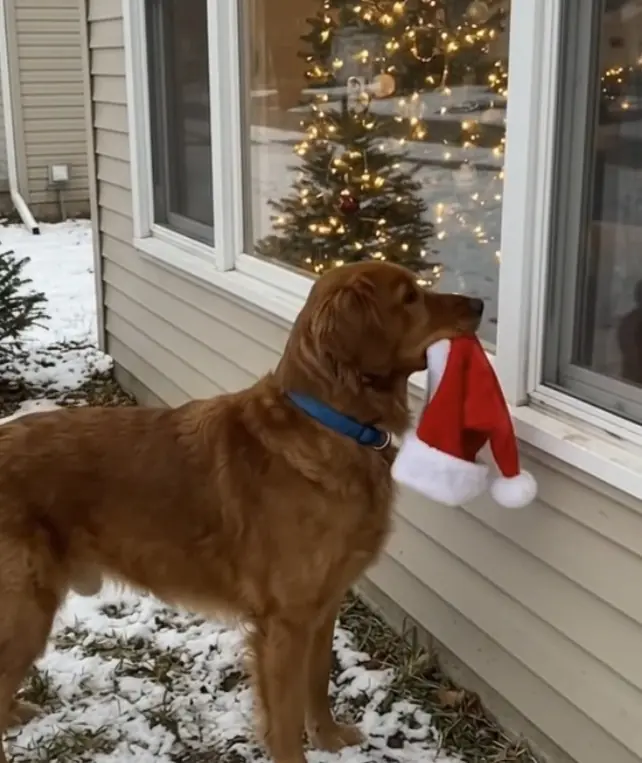
Instead, a thin brown-and-white dog was sitting beneath the porch light with a faded red Santa hat hanging from his mouth.
He did not bark.
He did not scratch at the door.
He simply sat on the wet concrete and looked through the glass.
The hat was almost comically large compared with his face. The white trim had turned gray from age, and one side of the red fabric was torn near the seam. It looked like the kind of cheap holiday hat sold in dollar stores every December, except this one had clearly survived many more winters than it was designed to.
My husband, David, opened the door a few inches.
The dog stood.
He did not rush inside.
David crouched.
“Hey, buddy.”
The dog’s tail moved once.
Hannah was already behind us.
“Can he come in?”
“No.”
David and I answered at the same time.
The dog was unfamiliar. We did not know whether he belonged to somebody, whether he was vaccinated, or how he behaved around children. We had two kids in the house and relatives arriving for dinner within an hour.
The responsible decision was obvious.
Then the dog placed the Santa hat carefully on the doormat.
Hannah looked at me.
David looked at me.
I hated both of them immediately.
Ten minutes later, the dog was in our mudroom eating from a mixing bowl.
He ate quickly but not frantically. He finished the kibble we had borrowed from a neighbor, drank half a bowl of water, and then stood near the kitchen doorway watching the activity beyond it. Every few minutes his eyes moved toward the front door as though he had not decided whether coming inside had been a mistake.
We kept him separated from the children at first.
That lasted approximately twenty minutes.
Hannah sat on the floor several feet away and rolled a tennis ball toward him. The dog watched it pass without moving. My younger son, Caleb, tried again.
The second time, the dog followed the ball.
By the third throw, his tail was moving.
By dinner, he was lying beneath the kitchen table.
We called the police non-emergency line, checked local lost-pet pages, and posted his picture in neighborhood groups. Nobody recognized him. He wore no collar, and because every veterinary clinic nearby was closed for Christmas, checking for a microchip had to wait.
My mother suggested we keep him in the garage overnight.
The dog solved that argument himself.
When everyone moved into the living room after dinner, he followed the children and lay directly beneath the Christmas tree.
He curled between wrapped gifts and fell asleep.
The Santa hat remained beside the front door.
That was how he spent his first Christmas Eve with us.
The next morning, he acted as though he had been part of the family for years.
He followed David outside while he shoveled a little snow from the walkway. He stood beside Hannah while she opened gifts and became fascinated by discarded wrapping paper. He accepted bits of turkey from my father despite repeated instructions that nobody should feed him from the table.
By afternoon, the children had named him Coco.
There was no particular reason.
Hannah liked the name.
Coco did not object.
Christmas Day passed with Coco moving comfortably through the house, sleeping wherever people gathered, and occasionally returning to the front entrance to smell the old Santa hat.
That night, he slept beneath the tree again.
The following morning, December 26, I expected him to be gone when I woke.
He was still there.
Coco ate breakfast, followed the children into the yard, and spent much of the afternoon on the living-room rug.
By then, I had started thinking beyond Christmas.
If nobody claimed him, could we keep him?
Would our landlord-style insurance have breed restrictions?
Was he house-trained?
Could we afford another animal?
I had not yet discussed any of that with David.
Coco made the question irrelevant the following morning.
On December 27, he stood beside the back door.
At first I assumed he needed to go outside.
I opened it.
Coco stepped onto the porch and looked back.
“Come on,” I said.
He did not return.
He walked across the yard.