Caleb Morgan had spent fourteen winters convincing himself that a man could live without needing anyone.
The mountains had made that lie easy.
A man could wake before sunrise, split enough wood for the day, feed his horse, check the cattle sheltered in the lower valley, repair a roof beam, hunt when meat ran low, and go to sleep without speaking a single word that another human being needed to hear.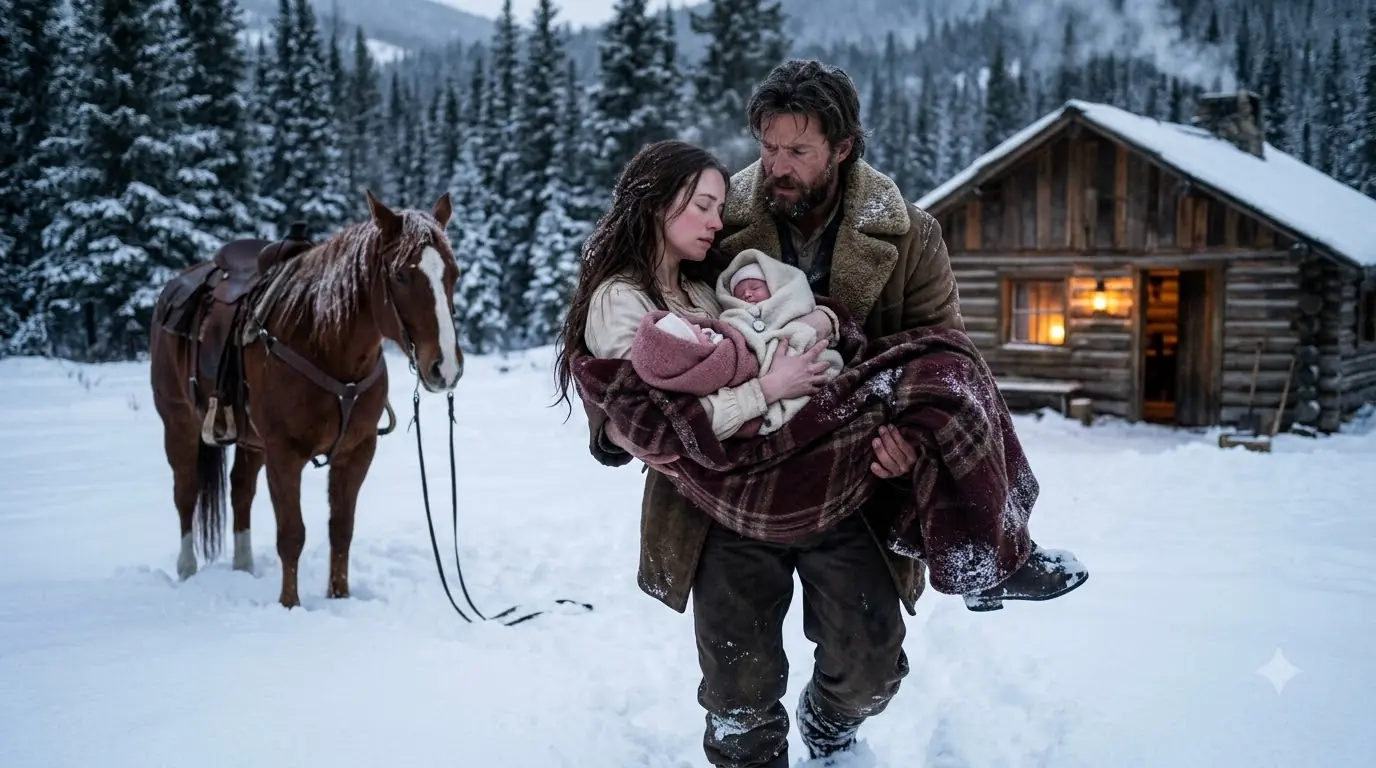
The mountains never asked whether he was lonely.
They never asked what happened to his family.
They never asked why a man who owned more than six hundred acres outside Cedar Ridge lived in a cabin no larger than a trapping shed.
Most importantly, they never asked about his younger brother.
So Caleb had stayed.
Then, on a December afternoon in 1887, with snow driving sideways across the northern Montana plains, he found a woman dying beneath the pines.
And after that, silence never belonged to him again.
He almost rode past her.
The storm had flattened everything into one white blur. Pines bent beneath ice, cattle trails disappeared, and even the familiar ridge above Caleb’s property had become little more than a dark shape behind the snow.
His horse suddenly stopped.
Caleb tightened the reins.
“What is it?”
The animal’s ears pointed toward the tree line.
Caleb followed the direction.
At first he saw nothing.
Then he noticed a patch of cloth where no cloth should have been.
Deep red.
Nearly buried.
He dismounted.
Snow reached halfway up his boots as he crossed the open ground.
The closer he came, the more certain he became that whatever lay there was human.
Then he saw the hand.
Small.
Bare.
Blue from cold.
Caleb dropped to one knee and swept snow aside.
A woman lay curled on her side.
Her long black-brown hair was frozen against her face. Her dress was torn at one shoulder, and the fabric across her back had darkened where someone had hurt her before abandoning her.
Caleb’s jaw tightened.
Then something moved beneath her arm.
A faint sound came from under the blanket.
Not one sound.
Two.
He pulled back the edge.
Two newborn girls lay pressed against the woman’s chest.
They were wrapped separately but held beneath the same outer blanket.
One wore a faded rose-colored bonnet.
The other a white knitted cap.
Their faces were frighteningly pale.
Caleb stopped breathing.
He had seen dead infants before.
The frontier showed a man things he wished it did not.
But these two were not dead.
The smaller child made another weak sound.
Caleb tore open his coat.
He lifted both babies, tucked them against the warmth of his chest beneath his wool shirt and heavy coat, then bent over the woman.
“Ma’am.”
No response.
He touched her neck.
A pulse.
Weak.
But there.
He looked around.
No wagon.
No horse.
No broken sleigh.
No tracks that the wind had not already begun erasing.
She could not have walked there after giving birth.
Someone had brought her.
Someone had left her.
Caleb felt an old kind of anger returning.
The kind he had spent years burying under work.
A howl sounded from beyond the ridge.
Caleb looked toward the trees.
Then back at the woman.
“All right.”
He slipped one arm behind her shoulders and the other under her knees.
She weighed almost nothing.
That frightened him more than if she had been heavy.
He lifted her.
Her head rolled against his chest.
Caleb led his horse rather than ride.
The babies remained tucked beneath his coat while he carried their mother.
Every hundred yards he stopped and listened.
The smaller twin whimpered once.
“Keep doing that.”
Caleb pushed forward.
“Make all the noise you want.”
The cabin appeared through the storm nearly an hour later.
The sight of smoke rising from its chimney felt like salvation.
Caleb kicked the door open.
His horse remained outside beneath the lean-to while Caleb carried the woman toward the stove.
He laid her on the bed.
Then he removed the infants from inside his coat.
One cried.
A thin, angry little sound.
Caleb had never heard anything more beautiful.
“Good.”
The other did not.
He rubbed her hands through the blanket.
Nothing.
He carried her closer to the stove, careful not to overheat her, and wrapped another piece of wool around her.
“Come on.”
The tiny mouth opened.
A weak breath.
Then another.
Finally, a whimper.
Caleb closed his eyes.
“Good girl.”
He found an old wooden produce box, lined it with folded blankets, and placed the twins together.
They immediately leaned toward each other.
Caleb stood over them.
Two infants.
A half-conscious woman.
A storm that could keep the road closed for days.
He had no milk.
No experience.
No idea what he had just brought into his house.
Then the woman stirred.
Her lips moved.
Caleb leaned down.
“What?”
“Babies.”
“Alive.”
Her eyes remained closed.
“Both?”
“Both.”
A tear escaped from beneath one eyelid.
Then she disappeared into unconsciousness again.
That first night became a battle against cold.