The Bald Eagle did not arrive in the neighborhood with a dramatic crash, and no one saw the moment it was injured. It simply appeared one morning near the edge of a residential property in northern Wisconsin and remained there long enough for the people living nearby to realize that something was wrong.
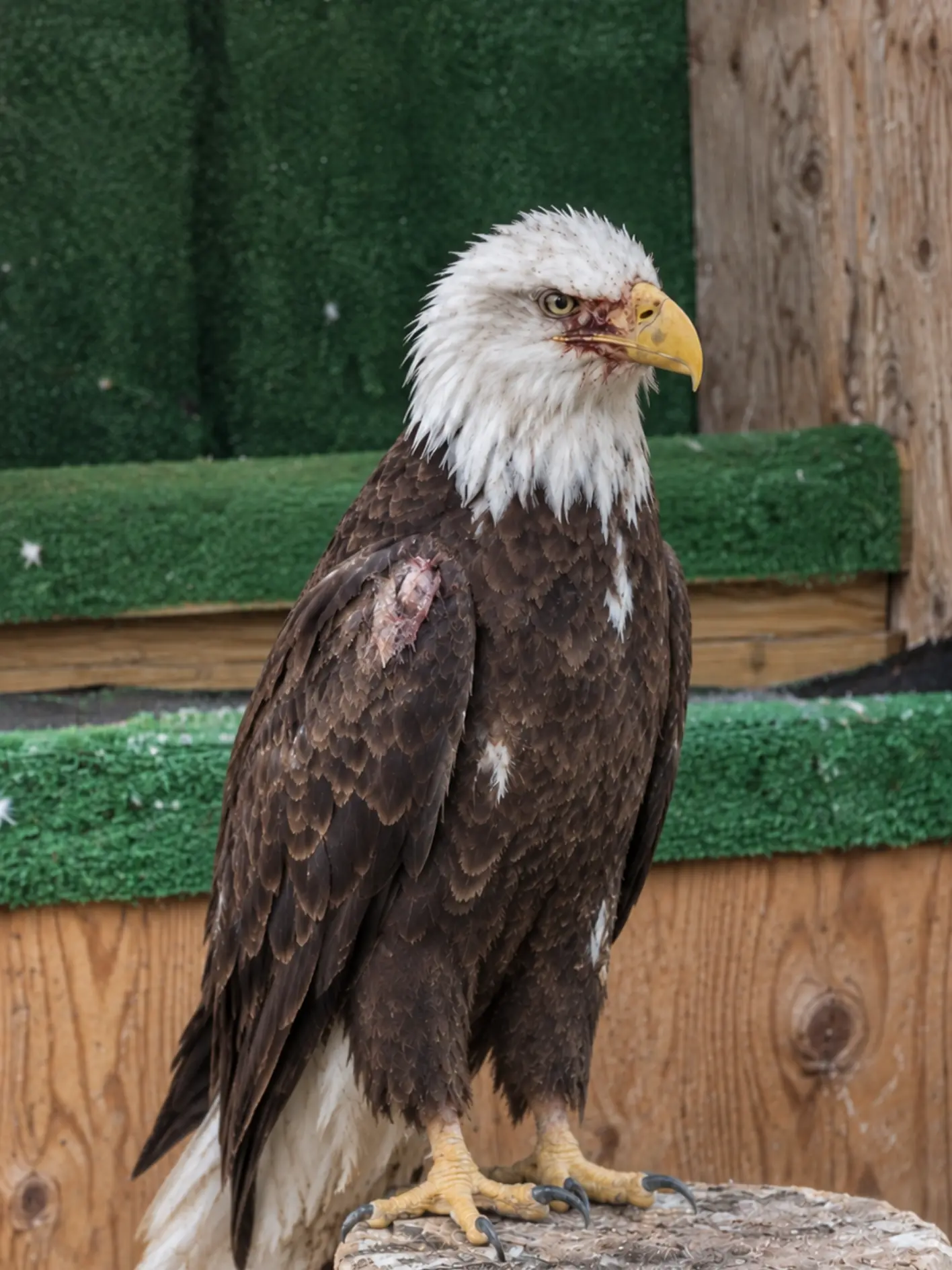
At first, the sight was remarkable but not necessarily alarming. Adult Bald Eagles are seen throughout the region, especially near rivers, lakes, wetlands, and wooded areas. A large eagle sitting on a fence post, utility structure, tree limb, or other elevated surface may simply be resting or watching for food.
This bird was different.
It stood on a low wooden structure only a short distance from several homes and remained there for much of the morning. It did not move to a higher perch. It did not fly toward the nearby tree line. It did not react strongly when people walked at a reasonable distance through the area.
The eagle watched them.
It shifted its feet occasionally.
It turned its head.
But it stayed.
After more than an hour, one resident began watching through a window with binoculars. That was when the first obvious signs of injury became visible. Blood stained the white feathers near the eagle’s beak and one side of its face. A patch of feathers over one shoulder appeared disturbed, and an area of exposed tissue could be seen beneath the damaged plumage.
The bird was clearly hurt.
What made the situation even more unusual was that it still did not leave.
To the people watching from the house, the scene almost looked as though the eagle had deliberately come close to people because it needed help.
Wildlife specialists would later explain that there was no way to know what the eagle intended. A severely injured wild animal does not necessarily understand that a house means medical care or that the people inside can help it. A much more likely explanation was that the bird had reached a point where it no longer had enough energy to keep moving and had simply stopped at the first relatively stable place it could use.
However, the emotional impression remained difficult to ignore.
A powerful adult Bald Eagle was standing only yards from people, visibly injured, and making almost no attempt to escape.
The residents decided not to wait any longer.
They brought their dogs inside, kept children away from the yard, and called a local wildlife rescue organization.
That call gave the bird its first real chance.
The Eagle’s Behavior Was More Concerning Than the Blood
When the wildlife rescue team arrived, the adult Bald Eagle was still standing on the same structure.
The responders stopped at a distance and observed before attempting to approach.
That first period of observation is important with injured raptors. A bird may appear weak while people are far away and then suddenly fly strongly when someone approaches. In other cases, the animal may be injured but still capable of defending itself aggressively with its talons.
This eagle remained almost motionless.
It watched the rescuers.
Its eyes were open and alert enough to follow movement.
One wing shifted slightly.
The feet remained wrapped around the wooden surface.
But there was no attempt to launch into the air.
There was no strong defensive posture.
There was no effort to increase distance between itself and the approaching people.
For the rescue team, that lack of normal avoidance behavior was more concerning than the visible blood.
A healthy adult Bald Eagle does not usually allow people to walk close enough to touch it.
Even an injured eagle will often attempt to fly, hop, run, or strike before accepting restraint.
This bird appeared to have reached a level of exhaustion where escape was no longer a realistic option.
“The fact that it stayed in place was immediately concerning,” fictional wildlife veterinarian Dr. Rebecca Collins later explained. “A wild adult eagle should want nothing to do with us. When one remains in a low, exposed location while people are nearby, we have to consider that it may simply be too weak or injured to leave.”
The rescue team prepared for capture.
An Injured Eagle Can Still Be Dangerous
The people who found the eagle had done exactly what wildlife professionals generally recommend in this type of situation. They had watched from a distance, kept pets and people away, and called for help instead of trying to catch the bird themselves.
That restraint mattered.
An adult Bald Eagle’s talons can cause serious injuries. Even a bird that looks exhausted may react suddenly when touched, and the feet are often more dangerous to the rescuer than the beak.
The responders approached using appropriate protective gloves and a large towel. Their first priority was to control the feet while preventing the eagle from falling or twisting the injured wing.
As one responder moved closer, the eagle opened its wings slightly and leaned away.
That was the strongest reaction anyone had seen from the bird all morning.
It did not take off.
The team placed the towel over the body, secured the legs and talons, then supported both wings against the torso.
The eagle struggled briefly.
Then it stopped.
Its lack of resistance was not trust.
It was exhaustion.
Once the bird was safely restrained, the rescuers could see the injuries more clearly. Blood was present around the beak and facial feathers. A wound over the shoulder had damaged several feathers and exposed tissue beneath them. The eagle felt thin beneath the plumage, and its overall posture suggested that the problem may have begun well before the residents discovered it.
The responders did not attempt to determine the full cause of the injuries in the yard.
The bird needed a hospital.
The Eagle Was Transported in Darkness and Quiet
Wild raptors are typically transported in a secure, darkened carrier because visual isolation helps reduce stress.
The eagle was placed on thick towels so that it would not slide across a hard surface during transport. The carrier was kept quiet, and the bird was handled only as much as necessary.
During the drive to the fictional Great Lakes Wildlife Rehabilitation Center, the rescue team monitored breathing and general responsiveness.
The eagle remained upright for part of the journey but eventually lowered its body onto the padded floor.
That change was not unexpected.
A bird can sometimes remain standing through stress and adrenaline at the capture site and then reveal the full extent of its weakness once the struggle is over.
The eagle continued watching movement through the small ventilation openings.
Its breathing remained stable.
No massive hemorrhage appeared during transport.
Those were encouraging signs, but the team knew that the absence of catastrophic bleeding did not mean the injuries were minor.
The hospital was notified that an adult Bald Eagle with facial and shoulder trauma was on the way.
The Intake Examination Began With the Whole Bird, Not Just the Visible Wound
When the eagle arrived, staff transferred it to a padded examination area.
The visible injuries immediately drew attention, but the medical team followed a full trauma protocol instead of focusing only on the shoulder wound.
Breathing was assessed first.
Circulation and hydration followed.
The team evaluated body temperature, neurologic responsiveness, both eyes, the beak, the wings, the legs, the feet, and the spine.
The eagle was conscious and visually responsive.
Both pupils reacted.
The bird could move both wings, although the injured side was held somewhat differently and appeared painful.
The feet were functional and capable of gripping.
That finding was important because severe neurologic injury was less likely if both legs and feet were working normally.
The most obvious external problems were concentrated around the face and shoulder.
The white feathers near the beak were stained with blood.
A small facial laceration extended near the cere and upper beak, although the beak itself remained aligned.
The shoulder wound showed feather loss, bruising, and damaged skin.
The bird was also mildly dehydrated and underweight.
None of these findings alone explained why an adult Bald Eagle had remained beside people for hours without attempting to leave.
The answer was probably the cumulative effect of pain, blood loss, fatigue, reduced body condition, and soft-tissue trauma.
The Photograph Captures the Moment After Rescue, Not the Cause
An early photograph of the eagle shows the bird standing upright on a low wooden structure inside a controlled enclosure.
The head remains white, but blood is visible around the face and beak. The shoulder injury is obvious, with damaged feathers and exposed tissue over one side.
The eagle is capable of standing.
That can make the bird look healthier than it actually was.
A photograph cannot show pain.
It cannot show dehydration.
It cannot show how much strength the bird has left after remaining injured for hours or possibly longer.
It also cannot establish the cause of the injuries.
The medical team considered several possibilities.
A vehicle strike was possible.
A collision with a building, fence, or other structure was possible.
A territorial encounter with another eagle was possible.
The wounds could even have resulted from more than one event.
No one had witnessed the original injury.
For that reason, the team documented the condition as traumatic injury of undetermined origin rather than inventing an explanation.
Radiographs Provided the First Significant Piece of Good News
Once the eagle was stable enough, radiographs were obtained.
The team paid particular attention to the shoulder because the external wound raised concern about fracture, joint damage, or deeper injury.
The images showed no major displaced wing fracture.
There was no obvious dislocation.
The bones of the shoulder girdle appeared intact enough that surgical stabilization was not immediately required.
No severe spinal trauma was identified.
That was encouraging.
It meant the injury was primarily soft tissue rather than a catastrophic skeletal problem.
However, soft-tissue injuries can still prevent flight.
Muscles, tendons, skin, and connective tissues all contribute to wing function. Pain alone can keep an eagle grounded even when the bones are normal.
The bird would therefore need time before anyone could meaningfully evaluate flight.
The Shoulder Wound Required Careful Cleaning
Feathers surrounding the injured shoulder were carefully moved aside so the veterinary team could see the full wound.
Dried blood and debris were removed.