The adult Bald Eagle arrived at the fictional Front Range Wildlife Conservation Center in northern Colorado wrapped in a heavy towel and supported by two people because its right wing could no longer be held normally against the body. Wildlife Care Supervisor Rachel Morgan was waiting when the transport vehicle pulled up at the center, located along the eastern foothills of the Rocky Mountains west of Fort Collins. By the time the carrier door opened, staff already knew the basic history. A resident had found the eagle on the ground beneath a line of cottonwoods near a drainage corridor earlier that morning. At first, the bird had looked alert enough that the finder assumed it was resting or feeding. The concern began when the eagle tried to leave. It opened both wings, took several running steps, and attempted to lift from the ground, but the right wing failed to generate normal power. Instead of climbing, the bird tipped toward one side, dropped back onto the grass, and remained there. The resident immediately backed away and contacted local wildlife authorities rather than trying to pick up the eagle. When trained responders arrived, the bird was still alert, its talons were strong, and the left wing functioned normally, but the right wing hung slightly lower and was clearly painful. The eagle was captured using protective gloves and a towel, placed in a padded transport crate, and driven to Front Range for emergency evaluation.
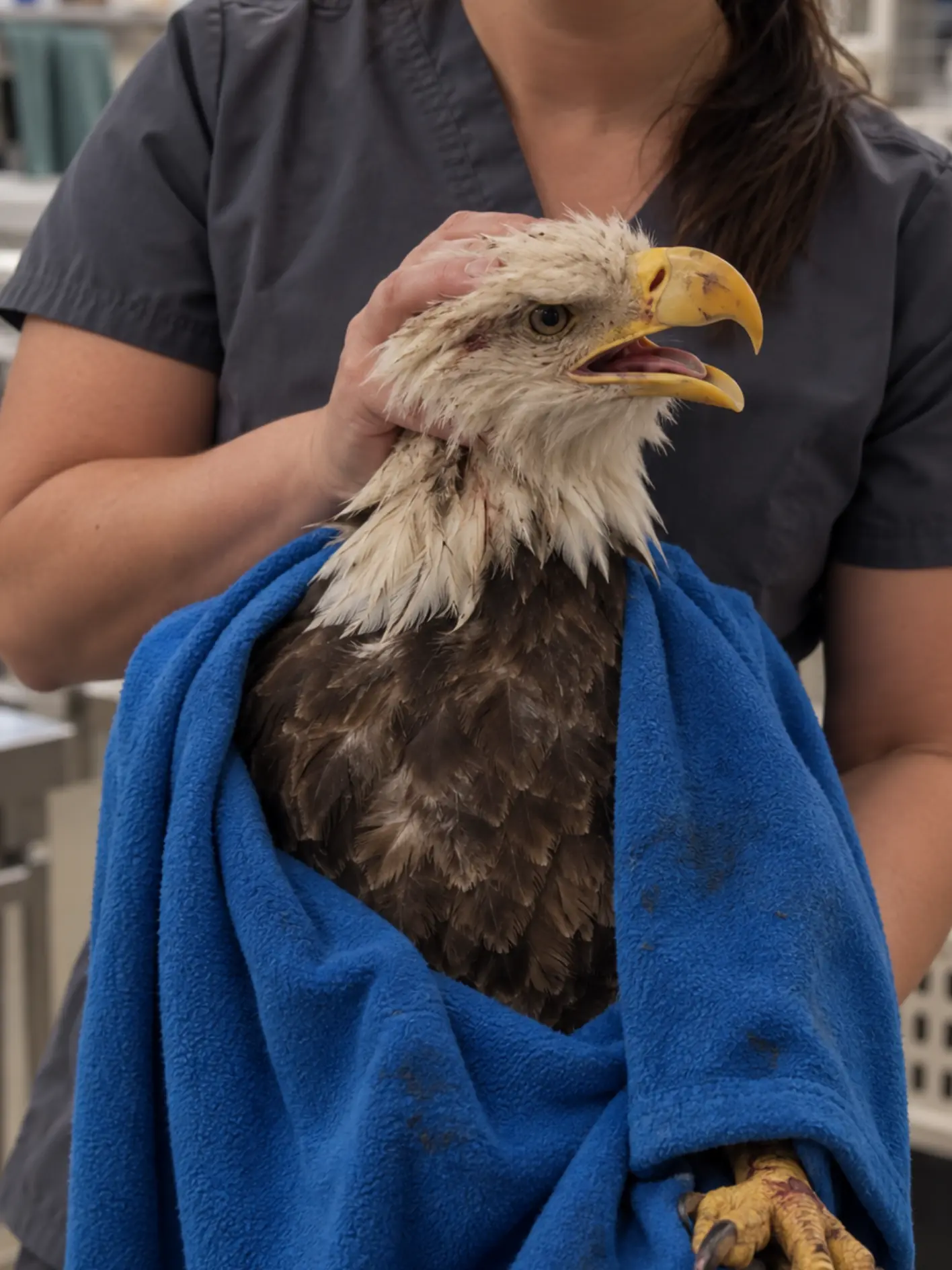
Rachel had handled many raptors during her years in wildlife rehabilitation, but a Bald Eagle always changed the rhythm of the treatment room. Staff jokingly referred to this patient as a “VIP,” not because it would receive better care than a hawk, owl, or smaller injured bird, but because everything about treating a large eagle required additional planning. The animal was heavy, powerful, federally protected, and capable of causing serious injury even while compromised. Its talons could not be treated casually, and the injured wing had to be protected every time the bird was moved. A Bald Eagle also has an exceptionally demanding standard for release. A songbird with a small healed injury may be able to function normally with only minor limitations, but an eagle that cannot produce full power with both wings cannot simply be returned to the wild and expected to adapt. It must be able to take off from the ground, climb, turn sharply, fly against wind, land accurately, hold its own in competition, and travel significant distances. Being alive would not be enough. Standing would not be enough. Even flapping both wings would not be enough. The right wing would eventually have to work as part of a complete flight system again.
When Rachel and the veterinary team removed the eagle from the carrier, they immediately noticed several injuries in addition to the abnormal wing position. There were superficial abrasions around the head and a small amount of dried blood near the crown and cheek. Feathers over the right shoulder were disturbed, and a patch of skin showed bruising beneath the plumage. The eagle was mildly dehydrated and somewhat exhausted from the ordeal, but its eyes remained clear and responsive. Both feet gripped strongly when the handlers repositioned the bird, which was encouraging. There was no obvious spinal abnormality, and the bird did not show signs of severe neurologic dysfunction. The right wing, however, reacted strongly to even gentle palpation. Staff could feel abnormal instability along the forearm portion of the wing, and the eagle immediately tried to pull away when pressure was applied near that area. The wing was supported against the body while the team completed the rest of the examination.
Radiographs provided the diagnosis. The eagle had sustained a fracture of the right ulna, one of the two long bones forming the forearm portion of the wing. The break was significant but not catastrophically displaced, and the radius remained intact. That mattered because the radius could provide some natural stability while the ulna healed. The shoulder joint itself remained aligned, and there was no evidence of a humeral fracture. The head abrasions were superficial, and no skull injury was visible on the initial imaging. There was also no major internal injury apparent on the first examination. For the veterinary team, this was an important combination of findings. The fracture was serious enough to explain why the bird could not fly, but it still appeared potentially repairable without a complicated orthopedic procedure if alignment could be maintained. The team elected to manage the injury with stabilization, strict activity restriction, pain control, and repeat imaging rather than immediately placing surgical hardware. The decision was based on the fracture configuration, the remaining stability provided by the other forearm bone, and the need to minimize additional trauma to a structure that would later have to withstand powerful flight forces.
The eagle was given carefully calculated fluids to address dehydration, and pain medication was started immediately. The wounds around the head and shoulder were cleaned and examined for contamination. None were deep enough to require extensive repair, but the veterinary team documented them because small wounds can become larger problems if infection develops beneath feathers. The right wing was positioned in a protective wrap that held it against the body without restricting breathing. Staff checked the wrap carefully to ensure that it supported the fracture while avoiding excess pressure on the chest and shoulder. Birds do not breathe like mammals, and anything wrapped around the body must allow normal movement of the sternum and air-sac system. A wrap that is too tight can create a new medical emergency while attempting to stabilize the original injury.
Once treatment was complete, the eagle was placed in a quiet indoor enclosure with thick padding and minimal opportunities for climbing. The goal during the first stage was simple: allow the fracture to remain as still as possible while the bird recovered from the initial trauma. The enclosure was intentionally smaller than the eagle would have preferred. A bird that begins feeling better will naturally attempt to climb, jump, or flap, and those movements can shift a fracture before it has developed enough healing tissue to remain stable. Rachel explained to new staff that one of the paradoxes of wildlife rehabilitation is that improvement can create risk. A weak bird rests because it has no choice. A stronger bird begins testing the injured body long before the veterinarian considers it ready.
During the first evening, the eagle remained relatively quiet. It stood for short periods but spent much of the time resting low. Food was offered in a way that required as little movement as possible. The eagle ate only a small amount. That was not unusual after capture and treatment. Stress alone can suppress appetite, and pain makes wild animals even less likely to feed normally in unfamiliar surroundings. By the following morning, however, the eagle had eaten more and was noticeably less tolerant of people entering the room. When Rachel approached the enclosure, the bird raised its body, watched her carefully, and shifted away. During a scheduled check of the wing wrap, the eagle resisted with far more strength than it had shown the previous day. Rachel considered that an encouraging change.
“The harder this bird becomes to handle, the happier we are,” she said. “A Bald Eagle that wants nothing to do with us is behaving like a Bald Eagle.”
That principle guided the entire rehabilitation plan. Staff minimized interaction whenever medical care did not require it. The eagle was not spoken to unnecessarily, hand-fed for convenience, or allowed to associate individual people with comfort. The center’s responsibility was to heal the body without altering the bird’s relationship with humans. A successful release would depend not only on the wing but on the eagle remaining wary, independent, and capable of functioning without assistance.
The first week was mostly a period of controlled waiting. The head abrasions began healing quickly, and the bruising around the shoulder gradually decreased. Hydration normalized. Appetite improved. The eagle could stand strongly on both feet and showed no neurologic abnormalities. The fracture itself could not be judged by appearance, so repeat radiographs were planned. Every bandage or wrap check was performed efficiently. The team looked for swelling in the distal wing, changes in feather position, pressure damage, abnormal circulation, or signs that the fracture had shifted. The staff also monitored the eagle’s posture because an uncomfortable wrap can cause a bird to hold the entire body differently. The wing remained stable.
At approximately ten days, follow-up radiographs showed that the fractured ulna had maintained acceptable alignment. Early callus formation was visible, indicating that the biological healing process had begun. This was encouraging but did not mean the bone was strong. Early callus is fragile. It represents the body building a bridge across the fracture site, but that bridge is not yet capable of tolerating the full load generated by flight. The team therefore continued restriction rather than immediately giving the eagle more space. Rachel knew this stage could be frustrating for people following a wildlife case because outwardly the bird often looks much better long before the injury is functionally healed. The eagle’s eyes were bright. Its posture was normal. Its feet were powerful. If someone saw only a photograph, they might assume it was ready to go. The X-ray told a different story.
One of the reasons wing fractures are treated so cautiously in raptors is that perfect or near-perfect alignment matters greatly for flight efficiency. A minor rotational deformity may have little effect on a terrestrial animal, but a bird’s wings operate as matched aerodynamic structures. If one wing heals at a different angle, if one segment becomes slightly shorter, or if a joint loses normal range of motion, the bird may compensate during a short flight while still being unable to sustain efficient movement over long distances. A wild Bald Eagle cannot afford that kind of disadvantage. It may need to fly into wind, pursue another bird, transport food, defend territory, or recover from an unexpected maneuver. Rehabilitation therefore aims not merely for a healed bone but for restored mechanics.
During the second week, the eagle’s behavior became increasingly difficult from a handling perspective, which was exactly what the team wanted. It moved away from staff, struck defensively toward gloves when restrained, and showed a strong preference for keeping maximum distance from people. The head wounds had almost completely closed, leaving only disturbed feathers and small healing areas. The shoulder injury no longer appeared painful. The right wing remained supported, and the bird was prevented from using it aggressively. Several staff members began calling the eagle “the boss” because every treatment session required careful coordination. Rachel reminded them that this was a compliment. A bird that still had the will and energy to resist was maintaining the wild behavior necessary for eventual release.