A juvenile bald eagle rescued from a rain-soaked field in Talbot County, Maryland, is receiving intensive care at a licensed raptor rehabilitation center on Maryland’s Eastern Shore after arriving with a fractured humerus and an extraordinarily poor body condition score of just 1 out of 5.
The young eagle was discovered grounded in an agricultural area after a member of the public noticed that it could not take normal flight. Wildlife rescue volunteer Megan Cole responded to assist with both capture and transport.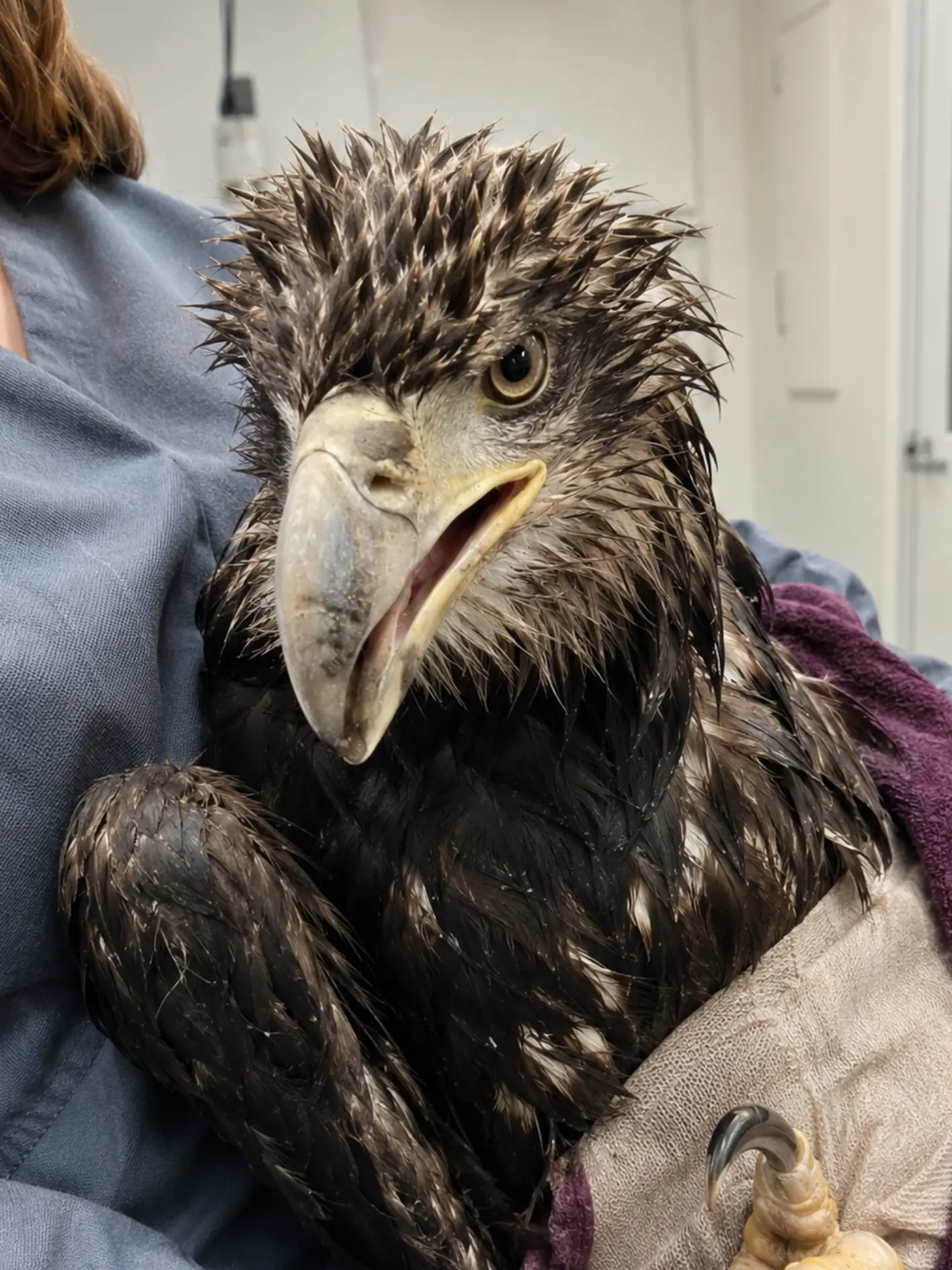
What followed was far more difficult than the bird’s physical condition initially suggested.
Despite severe muscle loss, a badly injured wing and soaked plumage, the juvenile still had enough strength — and enough instinct to avoid people — to move repeatedly across the muddy field as rain continued to fall.
Cole had to follow the eagle carefully through wet grass and soft ground, attempting to shorten the distance without forcing the already debilitated bird into unnecessary exertion.
“He was clearly in trouble, but he still had plenty of wild instinct left,” Cole recalled. “Every time I thought I had closed the distance, he found enough energy to move again through the mud.”
Eventually, the eagle was safely contained.
Its powerful feet were controlled first, the injured wing was supported against the body, and the bird was transferred into a secure carrier for transport to the rehabilitation center.
Staff immediately recognized that they were facing two significant medical problems at the same time.
The first was obvious: the eagle had a serious wing injury.
The second became apparent as soon as clinicians evaluated its body condition.
The bird was profoundly thin.
Veterinarians assigned it a body-condition score of 1 out of 5, indicating severe loss of pectoral muscle and minimal remaining energy reserves.
Radiographs then confirmed the orthopedic concern: a fracture of the humerus, the major bone between the shoulder and elbow.
The images have now been forwarded to a consulting veterinarian experienced in avian orthopedic surgery.
The question is not simply whether the broken bone can be stabilized.
It is whether it can be repaired in a way that gives this young eagle a realistic chance of flying normally again.
“The fracture is serious, but the body condition is equally important right now,” a veterinarian involved in the case said. “Before we can talk about surgery, we need to know that this bird is physiologically stable enough to tolerate it.”
The Rescue Began in a Muddy Talbot County Field
Talbot County lies within Maryland’s Eastern Shore, a landscape of agricultural fields, tidal creeks, wetlands and shoreline habitat connected to the Chesapeake Bay.
The region supports bald eagles throughout much of the year.
Juvenile birds may travel widely as they learn where to feed and how to navigate a landscape already occupied by older, more experienced eagles.
The rescued bird had not yet developed the bright white head and tail characteristic of a mature adult.
Its plumage was predominantly dark brown, with lighter mottling typical of an immature bald eagle.
When it was first spotted on the ground, something was clearly wrong.
The bird could move.
It could react to people.
But it could not leave normally.
That distinction is important.
A healthy juvenile bald eagle may be less experienced than an adult, but it should still be capable of powerful flight.
A bird remaining grounded despite nearby human activity warrants concern.
Cole arrived knowing that even a debilitated eagle could still be dangerous to approach.
The talons of a bald eagle are built to seize and restrain prey. A frightened bird may use them defensively even when one wing is badly injured.
The challenge was to secure the eagle without causing it to run or struggle until it collapsed.
Severe Weakness Did Not Eliminate Its Wild Instinct
The field conditions complicated everything.
Rain had soaked the vegetation and softened the soil.
The eagle’s feathers were wet.
The bird moved awkwardly, but it continued trying to maintain distance.
That behavior told rescuers something important.
Medically, the eagle was in poor condition.
Behaviorally, it remained wild.
Those two realities can coexist.
An animal can be profoundly debilitated and still use its final reserves to avoid capture.
In rehabilitation medicine, that response is often preferable to complete indifference toward people. It suggests that the bird remains aware of its surroundings and retains appropriate avoidance behavior.
But every additional attempt to escape also consumes energy.
For an animal with almost no body reserves left, that matters.
Cole therefore worked slowly, using the terrain to limit movement rather than chasing aggressively.
Eventually, she was able to close the remaining distance and restrain the bird safely.
A towel or similar barrier was used to help control the eagle while the feet were secured.
The injured wing was supported immediately.
Once the bird was in the carrier, the rescue shifted from field containment to medical stabilization.
The Intake Photograph Shows How Compromised the Bird Was
Photographs taken shortly after arrival show the juvenile eagle wrapped in towels while being supported by rehabilitation staff.
Its head feathers are wet and clumped from the rain.
The bird remains alert, with one eye open and focused on the surrounding activity.
One foot is visible outside the towels, the large black talons still capable of inflicting injury despite the bird’s poor overall condition.
The image captures an important feature of wildlife medicine.
A bird can look powerful at close range and still be critically depleted physiologically.
Bald eagles are large animals.
Their feathers can make them appear robust even after substantial loss of muscle.
The true severity of the body condition becomes much clearer when clinicians palpate the chest.
A Body-Condition Score of 1 Out of 5
The keel, or sternum, is the central bony structure along the underside of a bird’s chest.
Large pectoral muscles normally sit on either side of it.
Those muscles power flight.
In a healthy eagle, they should provide substantial muscular coverage.
In this juvenile, that coverage was dramatically reduced.
The keel was unusually prominent.
The surrounding muscle mass was severely diminished.
There was little evidence of useful fat reserve.
The bird was assigned a body-condition score of 1 out of 5, placing it at the lowest end of the scale used to describe nutritional and muscular condition.
That finding immediately changed the priorities of the case.
The eagle was not simply an otherwise healthy bird with a broken wing.
It was an emaciated orthopedic patient.
Why Severe Emaciation Matters
Low body condition affects almost every aspect of treatment.
A bird with limited energy reserves may have difficulty maintaining body temperature.
Healing can be slower.
Immune function may be compromised.
Muscle weakness can affect standing and breathing.
The bird may tolerate anesthesia less predictably.
Dehydration may coexist with weight loss.
Medication must be planned in the context of overall physiologic stability.
And if surgery becomes necessary, a bird in severe condition may need to be stabilized first rather than being taken immediately into an operating room.
This is why the rehabilitation team could not treat the humeral fracture in isolation.
“The orthopedic injury is very important,” the veterinarian said. “But the patient has to survive the treatment. When a bird comes in at a body-condition score of 1 out of 5, rebuilding basic stability becomes part of the fracture management.”
Why the Eagle Became So Thin Is Not Yet Known
The most obvious explanation is that the wing injury prevented the juvenile from feeding normally.
A bald eagle with a painful or unstable wing may be unable to hunt effectively.
It may struggle to travel between feeding areas.
It may be unable to compete with other eagles at carrion or fish remains.
If the fracture occurred several days before rescue, the bird could have been progressively losing body condition while surviving on very little food.
But the rehabilitation team cannot assume that sequence without evidence.
The juvenile may also have been debilitated by another medical condition before the wing injury occurred.
Systemic illness.
Toxic exposure.
Parasites.
A prolonged period of poor food availability.
Or another problem could theoretically have contributed.
That is why bloodwork and additional screening remain important even though the fracture is clearly visible on radiographs.
The Injured Wing Was Held Abnormally
During the hands-on examination, staff noted that one wing did not sit in the same position as the opposite side.
There was swelling and discomfort.
The bird resisted manipulation.
The location of the abnormality raised concern for injury involving the proximal portion of the wing.
Veterinarians palpated the humerus carefully.
The humerus extends from the shoulder toward the elbow and is one of the most mechanically important bones in avian flight.
Its location also means that injuries can be difficult to manage with simple external wrapping alone.
Radiographs were necessary.
X-Rays Confirmed a Humeral Fracture
Diagnostic imaging confirmed the suspicion.
The juvenile had sustained a fracture of the humerus.
For a bald eagle, this is a serious injury.
The wing does not function as a simple lever.
The humerus is integrated into a complex system involving the shoulder, elbow, powerful flight muscles, tendons, ligaments and precise feather positioning.
Any fracture that changes the length, rotation or alignment of the humerus can potentially change the entire geometry of the wingbeat.
A bird may survive such an injury.
The more difficult question is whether it can fly normally afterward.
“Healing” and “Flying” Are Not the Same Outcome
For a terrestrial animal, a fracture may be considered successful if the limb becomes comfortable and weight-bearing.
A free-ranging eagle has a different standard.
The repaired wing must generate enough force for takeoff.
It must extend through an appropriate range.
Both wings must beat symmetrically.
The eagle must climb.
Turn.
Brake.
Land.
And repeat those movements for long periods without pain or premature fatigue.
That means a fracture can technically unite and still produce a bird that cannot be released.
“With a humeral fracture, the question is not simply whether we can get the bone to heal,” the veterinarian said. “The question is whether it can heal with enough alignment and mobility for normal flight.”
That is precisely why the radiographs have been sent for specialist review.
The Consulting Veterinarian Must Evaluate More Than the Fracture Line
The orthopedic consultant will review several features of the X-rays.
Where is the break located?
How much displacement is present?
Is the bone rotated?
Are the fragments positioned in a way that could accept surgical fixation?
Is there already evidence that the injury is older than initially suspected?
Is surrounding soft tissue likely to remain functional?
Could an implant be placed without compromising critical structures?
These questions help determine whether surgery is technically possible.
But another question is even more important.
Would surgery create a realistic pathway back to flight?
A procedure that stabilizes the bone but leaves the wing permanently restricted may not achieve the primary goal of wildlife rehabilitation.
Timing Could Affect the Surgical Decision
Veterinarians also want to know how long the fracture may have been present.
Fresh fractures can sometimes be reduced more readily because scar tissue and early bone callus have not yet fixed the fragments into abnormal positions.
Older injuries may be more difficult.
Muscles can contract around the altered anatomy.
Scar tissue can develop.
Bone can begin healing in an incorrect configuration.
The longer a badly aligned fracture remains untreated, the more challenging reconstruction can become.
The eagle’s severely reduced body condition raises the possibility that the injury was not brand new.
But body condition alone cannot date the fracture.
Radiographic appearance and physical findings will provide better clues.
The Wing Was Stabilized While the Team Waits
For now, the injured wing has been supported to limit further movement.
Stabilization serves several purposes.
It reduces pain.
It prevents additional displacement.
It protects the soft tissues surrounding the fracture.
And it gives the medical team time to improve the eagle’s overall condition while specialist review continues.
The wrap must also be monitored carefully.
A bandage that is too tight can compromise circulation.
A wrap left unchanged for too long can create pressure problems.
The distal wing and surrounding tissues therefore require regular reassessment.
Immobilization is necessary.
But it is not without its own risks.
Stabilization Came Before Surgery
The bird’s extremely low body condition meant the first hours of care were focused heavily on physiologic support.
The eagle had been outside in rain with wet feathers and minimal energy reserves.
That combination increases the risk of heat loss.
Staff dried and supported the bird in a controlled environment.
Body temperature was monitored.
Stress was minimized.
Fluid therapy was considered according to hydration status.
Pain control was provided when appropriate.
The bird was placed somewhere quiet, away from unnecessary activity.
The objective was straightforward:
make the patient stronger before asking its body to tolerate anything more demanding.
Nutrition Had to Be Introduced Carefully
One of the immediate priorities was restoring nutritional intake.
A bird with a body-condition score of 1 out of 5 needs calories and protein.
But severely debilitated wildlife patients are not simply given unlimited food as quickly as possible.
The digestive system may not be functioning normally after prolonged poor intake.
Large meals can create additional metabolic stress.
The rehabilitation team therefore introduced nutrition in a controlled manner.
Small, appropriate portions could be provided initially, with intake increased as the bird demonstrated that it was tolerating food normally.
Depending on the eagle’s willingness and ability to eat, assisted feeding may be necessary during early stabilization.
The goal is gradual recovery, not rapid weight gain at any cost.
A Return of Voluntary Appetite Would Be a Major Milestone
One of the most encouraging developments staff could see would be the juvenile beginning to eat independently.
Voluntary feeding means more than calorie intake.
It suggests improved comfort.
Improved alertness.
Better gastrointestinal function.
Reduced stress.
And enough energy to express normal feeding behavior.
For a bird being considered for orthopedic surgery, those changes could also improve anesthetic candidacy.
Each day of successful feeding gives the body additional resources for tissue repair.
Bloodwork Is Part of the Pre-Surgical Evaluation
The eagle’s blood will be evaluated for abnormalities that could influence both prognosis and anesthesia.
A complete blood count can help assess:
- red blood cell status,
- inflammation,
- possible infection,
- and general hematologic condition.
Blood chemistry can provide information about organ function and metabolic stability.
Packed cell volume can help determine whether anemia is present.
Protein levels and other values may provide additional information about the degree of physiologic compromise.
The team needs to understand not only the wing but the entire patient.
Lead Screening Is Also Being Considered
Because the patient is a bald eagle, lead exposure is another condition worth evaluating.
Bald eagles frequently scavenge.