At First, We Thought Benny Was Just Playing With the Bowl
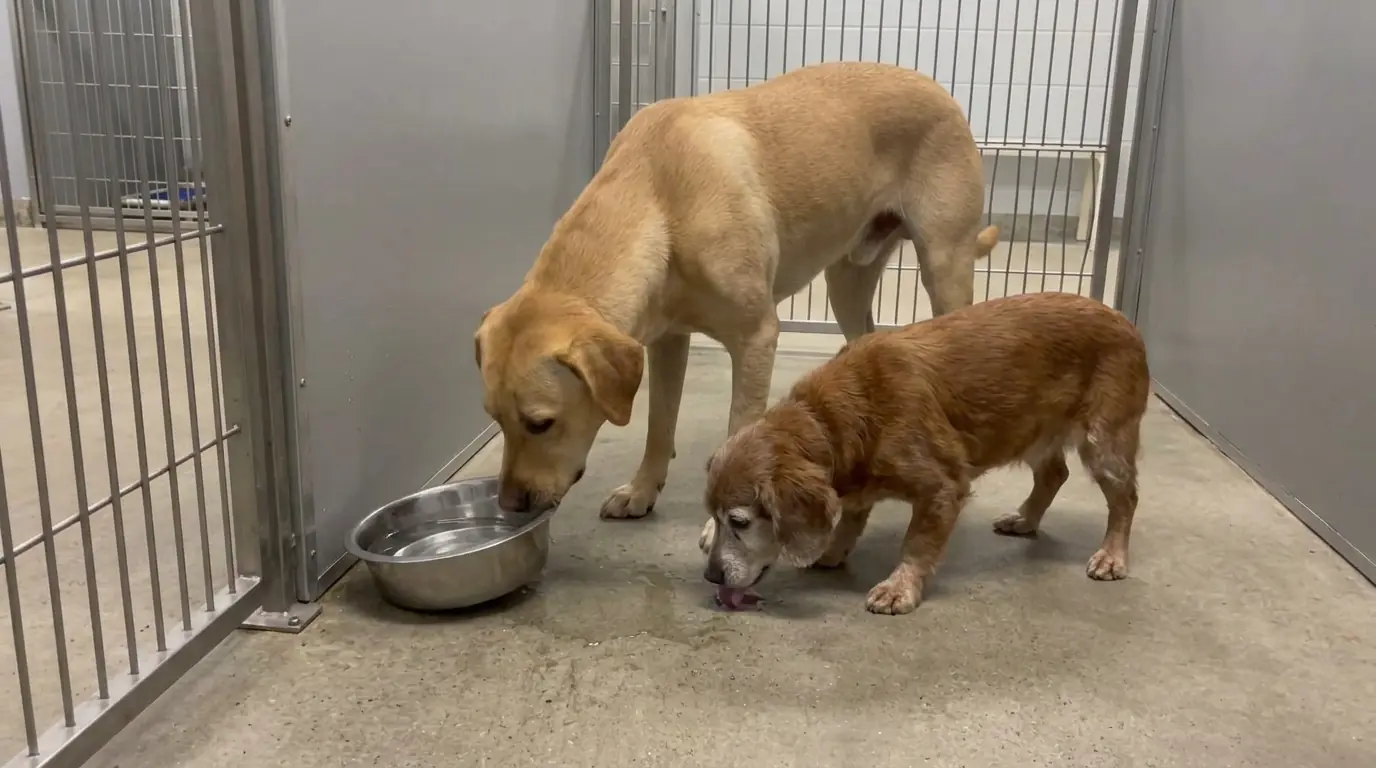
Benny and Rosie were sharing a kennel when staff first began noticing the puddles.
Benny was an adult Lab mix with the kind of broad muzzle that seemed to investigate everything.
Rosie was a much smaller senior Spaniel with significant stiffness through her neck and upper body.
Their water bowl was placed on the kennel floor.
That setup worked fine for Benny.
It did not work nearly as well for Rosie.
Whenever she approached the bowl, she tried to lower her head toward the water.
Her neck would bend only so far.
Then she stopped.
She widened her stance.
Sometimes she shifted one front paw forward and tried again from a slightly different angle.
The water remained several inches below where she could comfortably reach it.
That was when Benny often moved in.
He would press his muzzle against the rim of the stainless-steel bowl.
At first, staff assumed he was nosing it out of curiosity.
Labs are not exactly famous for leaving water bowls untouched.
But Benny did not simply splash.
He pushed.
The bowl tipped just enough for water to spill over the edge.
A shallow puddle spread across the floor.
Rosie immediately lowered her mouth toward it.
The distance was much smaller now.
She licked the water from the floor beside Benny’s front feet.
Benny stood there while she drank.
Then, usually, he went back to whatever he had been doing.
The first time could have been an accident.
The next few times made us pay closer attention.
Rosie’s Neck Was Limiting Something as Basic as Drinking
Rosie was an older dog, but her difficulty could not be dismissed as ordinary senior stiffness.
She could walk.
She could turn.
She could eat if her bowl was positioned properly.
But lowering her head toward floor level was clearly difficult.
That movement required flexion through a neck that had become rigid and uncomfortable.
When she tried to drink from the floor bowl, she often stopped before her nose reached the water.
She did not cry out.
She did not collapse.
She simply could not comfortably complete the motion.
For a senior dog, that can be easy to overlook.
A dog may still appear functional because she is walking through the kennel and responding to people.
But the ability to perform everyday movements matters enormously.
Drinking.
Eating.
Lying down.
Turning.
Looking behind the body.
Stepping over a threshold.
Rosie’s problem became obvious because water was something she could not simply avoid.
We Could Not Say Exactly Why Her Neck Had Become So Stiff
Rosie’s prior medical history was incomplete.
We did not know when the stiffness began.
We could not verify whether she had experienced an old injury.
We could not assume she had been untreated.
Senior dogs can develop cervical discomfort and reduced range of motion for many reasons.
Degenerative joint changes.
Disc disease.
Arthritis.
Muscle guarding.
Chronic orthopedic compensation.
Neurologic disease.
Sometimes more than one issue contributes.
So we did not attach a dramatic backstory to her posture.
We documented what we could see.
Rosie was elderly.
Her neck movement was severely limited.
Lowering her head was particularly difficult.
And the standard water bowl placement was making hydration harder than it needed to be.
Benny’s Behavior Was Useful, but It Was Not a Care Plan
The water-spilling behavior was remarkable to watch.
It also immediately raised an important question.
Was Rosie drinking enough?
A puddle created by another dog could not become her only reliable access to water.
Benny might not tip the bowl every time.
He might be removed for a walk.
He might eventually be housed elsewhere.
Rosie needed an independent solution.
So the first practical change was simple.
Her water was elevated.
A stable raised station brought the bowl high enough that she could reach it with much less neck flexion.
The height had to be appropriate.
Too high would create another awkward posture.
Too low would not solve the problem.
The bowl also needed to be secure enough that it could not slide or tip under light pressure.
Once the elevated setup was introduced, Rosie approached.
She hesitated.
Then she lowered her muzzle a much shorter distance.
She drank.
No puddle required.
That told us immediately that bowl height had been a major barrier.
We Still Kept Watching Benny
Changing Rosie’s setup reduced the need for Benny’s help.
It did not stop us from paying attention to their relationship.
The two dogs had been placed together because their behavior around one another was calm and compatible.
We did not automatically call them bonded.
That label needed evidence.
So we watched what they chose.
They often rested near each other.
Benny tended to settle closer to the kennel front.
Rosie preferred the side wall.
If one moved, the other usually looked up.
At meals, there was no significant guarding.
Benny ate faster, but he did not crowd Rosie away from her food.
Rosie tolerated his movement around her without becoming tense.
The water behavior added another repeated pattern.
Even after Rosie had access to an elevated bowl, Benny still occasionally nosed the floor bowl if one was temporarily present during cleaning or setup.
And when water spilled, Rosie often went toward it.
The old routine had not disappeared immediately.
Rosie Needed a Full Medical Assessment, Not Just a Higher Bowl
Environmental adaptation helped her drink.
It did not explain the medical problem.
Rosie received a careful veterinary examination focused on her neck, spine, neurologic function, gait, and general senior health.
Her range of motion was limited.
Pain assessment mattered because dogs with chronic discomfort do not always vocalize.
Some simply avoid movement.
Her front limbs and shoulders were also examined because pain in those areas can alter the way a dog lowers the head.
The veterinary team evaluated whether the problem appeared primarily musculoskeletal, neurologic, or mixed.
Baseline bloodwork was appropriate given her age and the likelihood that long-term medication might be considered.
Imaging was also justified because the restriction was substantial and chronic.
The findings were most consistent with advanced degenerative changes affecting the cervical region, contributing to significant stiffness and discomfort.
There was no simple procedure that would return her neck to youthful flexibility.
Management became the priority.
Pain Control Changed More Than Her Movement
Rosie’s treatment plan was built around comfort.
That included veterinary-directed pain management appropriate for a senior dog, taking into account her overall health and monitoring needs.
Medication was only part of it.
Her food and water needed to remain elevated.
She needed traction.
Her bed needed to support her without forcing her neck into an awkward angle.
Walks needed to stay gentle.
Sudden pulling on the leash had to be avoided.
A harness was preferable to pressure placed directly through the neck.
Even the way people approached her mattered.
Reaching over the head could encourage her to look upward or twist.
Caregivers learned to come in from the side.
Touch stayed around areas she tolerated well.
Rosie did not need to prove she could move her neck more.
She needed daily life arranged so she did not have to.
Drinking Became One of the Best Ways to Measure Her Comfort
Before treatment, Rosie approached water cautiously.
She often positioned her whole body around the bowl because the neck itself could not do the work.
After the bowl was raised and her pain plan was established, the sequence became easier.
Walk over.
Stop.
Lower muzzle slightly.
Drink.
That sounds ordinary.
For Rosie, ordinary was the goal.
We did not need a dramatic milestone.
A senior dog being able to hydrate without bracing her entire body was meaningful enough.
Her intake could also be monitored more accurately once she had reliable access.
That mattered because older dogs can become dehydrated more quickly if pain discourages drinking.
Benny Seemed Confused by the New Setup
For the first few days, Benny still investigated the water area.
He sniffed the raised bowl.
He nudged the stand.
He checked the floor beneath it.
The old floor bowl was gone.
There was nothing easy to tip.
Rosie could drink without him.
Benny eventually stopped searching for the same opportunity.
But then one afternoon, a shallow backup bowl was placed temporarily while the raised station was being cleaned.
Benny walked over.
He pushed the rim.
Water spilled.
Rosie, who was resting nearby, lifted her head.
She slowly stood.
Then she walked to the puddle and drank from the floor.
The behavior was still there.
It was one of the reasons we continued documenting how the two dogs interacted.
We Could Describe the Behavior Without Pretending to Know His Intent
It would have been easy to say Benny understood Rosie’s neck problem and deliberately created water for her.
That was more certainty than the evidence allowed.
Dogs can learn routines.
They can respond to the behavior of other dogs.
They can repeat actions that produce predictable outcomes.
What we could say was this:
Benny repeatedly pushed the bowl.
Water spilled.
Rosie repeatedly used the spill because it was easier for her to reach.
Benny did not immediately drink all of it himself.
He often remained beside her.
The sequence occurred often enough to be meaningful.
We did not need to assign human reasoning to make it emotional.
Rosie’s Eating Setup Needed the Same Adjustment
Water was only one problem.
Food placed at floor level required the same painful movement.
So her meals were also elevated.
The height was chosen so she could eat with her neck in a neutral, comfortable position.
The bowl was stabilized.
Her portion was measured.
Because she was a senior dog, maintaining an appropriate body condition was especially important.
Extra weight could increase strain through already compromised joints and make movement harder.
At the same time, over-restriction would risk loss of muscle.
Her nutrition plan aimed for stability.
The goal was a body light enough to move comfortably but strong enough to maintain function.
Her Sleep Position Told Us the Neck Was Affecting Rest Too
Rosie tended to sleep with her head slightly elevated.
If her bedding was completely flat, she often repositioned repeatedly before settling.
A small supportive bolster changed that.
She could rest her chin without forcing the neck into deep flexion.
The improvement was subtle.
She stopped adjusting as often.
Her eyes stayed closed longer.
She began sleeping on her side more frequently.
Chronic pain often reveals itself through sleep.
A dog who cannot find a comfortable position may never fully relax.
Rosie’s ability to rest became another marker of whether the care plan was helping.
Benny Was More Active Than Rosie
Their shared kennel did not mean they needed identical routines.
Benny was younger and more mobile.
He wanted longer walks.
He moved faster.
He was more interested in environmental exploration.
Rosie needed a slower pace.
If they were always walked together, one dog would inevitably compromise.
Either Benny would not get enough activity, or Rosie would be pushed beyond what her body could tolerate.
So they received individual outings too.
That gave us more information about their relationship.
Benny could leave the kennel.
Rosie could remain behind and rest.
She did not become frantic.
Benny could walk without her.
He explored normally.
When he returned, they usually acknowledged each other briefly and settled.
That was useful.
Their relationship appeared positive without becoming dysfunctional dependence.
We Started Seeing Other Small Patterns
The water bowl remained the most unusual behavior.
But over time, other repeated interactions appeared.
Benny usually gave Rosie space when she was getting up.
He did not rush over her.
When Rosie moved slowly through a doorway, Benny often passed only after there was room.
Sometimes he lay close enough that their backs touched.
Other times they chose separate beds.
Rosie occasionally followed Benny toward the kennel front when a familiar caregiver approached.
Benny did not seem to control her movement.
Rosie did not appear afraid of him.
Those details helped us feel more confident that the pairing was comfortable.
Rosie Had Harder Days
Chronic degenerative disease fluctuates.
Some mornings, Rosie drank easily from the raised bowl and moved through her routine without much hesitation.
On other days, her neck looked more guarded.
She turned her whole body rather than rotating her head.
She took longer to get comfortable.
She moved more slowly toward food.
Those days mattered.
A treatment plan should respond to patterns over time.
If stiffness increased significantly or new neurologic signs appeared, veterinary reassessment would be necessary.
Weakness.
Loss of coordination.
Knuckling.
Sudden severe pain.
Reluctance to move at all.
Those would not be dismissed as normal aging.
Rosie’s known diagnosis did not give us permission to ignore new changes.
Foster Care Offered a Better Test of Their Routine
Once both dogs were stable, a foster home gave them something the shelter could not: a quieter environment and more space.
The home was prepared around Rosie’s neck.
Her water station was raised.
Her food was raised.
Rugs provided traction.
A low bed with gentle head support was placed in the main living area.
A harness was used for walks.
Stairs were limited.
Benny had his own bed and space to move.
He also had opportunities for longer walks and enrichment separate from Rosie.
The goal was to preserve their relationship without turning Benny into her caretaker.
The First Water Spill Happened on Day Two
The foster family had already been told about the bowl behavior.
They did not expect to see it so soon.
A second low bowl had been placed outside on a patio during a supervised break.
Rosie approached it.
She tried to lower her head.
The same limitation appeared.
Before anyone could move the bowl, Benny stepped over.
He put his muzzle against the rim.
He pushed.
Water spilled onto the patio.
Rosie immediately drank from the shallow puddle.
The foster family moved the bowl to a raised platform afterward.
But the moment confirmed that the behavior was not tied to the shelter kennel.
It traveled with them.
Rosie Began Seeking the Raised Bowl First
As the days became predictable, Rosie stopped checking low bowls as often.
She learned where her elevated water was.
She walked to it directly.
That change reduced her dependence on accidents or Benny’s bowl tipping.
It also made hydration easier to monitor.
Her foster caregiver could see how much she drank.
The bowl stayed cleaner.
The floor stayed drier.
And Rosie no longer needed to lower her body toward a puddle to reach water.
From a medical standpoint, that was clearly better.
Benny’s Behavior Became Less Necessary
This was an important part of the story.
We did not want to preserve a touching behavior just because people found it emotional.
If Rosie could be made more independent, she should be.
The raised bowl did exactly that.
Benny tipped water less often because there were fewer low bowls available.
Rosie drank without waiting for him.
That was success.
A healthy bond should support independence, not replace it.
Their Relationship Still Showed Up Elsewhere
Even without the water ritual happening every day, Benny and Rosie continued choosing each other.
They often settled in the same room.
Rosie sometimes followed Benny into the yard.
Benny frequently returned indoors and checked the area where Rosie rested.
They did not need to touch constantly.
They did not panic during short separations.
But proximity appeared to be part of their preferred routine.
By then, there was enough repeated evidence to describe them as a closely attached pair.
That had practical implications for future placement.
Keeping them together, if possible, would preserve something both dogs appeared to value.
Rosie’s Neck Improved in Comfort, Not Flexibility
Treatment helped Rosie.
But it did not restore normal movement.
She remained stiff.
She still turned her body instead of freely rotating her head.
She still needed elevated bowls.
She still benefited from a harness.
She still required a carefully arranged sleeping area.
That was the realistic outcome.
The goal was never to make her neck normal.
It was to reduce pain and make the restricted movement less disruptive.
Over time, she became more willing to move around the home.
She spent longer periods awake without appearing uncomfortable.
She drank reliably.
She ate well.
She rested more deeply.
Those changes represented quality of life.
Benny Needed His Own Life
The foster family made a point of giving Benny experiences that had nothing to do with Rosie’s limitations.
He went on longer walks.
He played with toys.
He practiced basic cues.
He explored new environments at a reasonable pace.
Rosie remained home during activities that would have been too much for her.
Benny returned and settled normally.
This was important for the future.
Rosie’s needs could increase with age.
Benny could not be expected to spend his entire life moving at the pace of a senior Spaniel.
Supporting both dogs meant allowing their lives to overlap without making them identical.
Rosie Became More Confident About Water
One of the sweetest changes was also one of the simplest.
At intake, Rosie sometimes stood over the water bowl and gave up because she could not lower her head far enough.
In foster care, she began walking directly to her raised station.
There was no hesitation.
No repositioning.
No waiting.
She knew where the water would be.
She knew she could reach it.
Predictability removed a problem that her body could not solve on its own.
There Were Still Moments When the Old Pattern Returned
Occasionally, someone would set down a low bowl outside.
Benny noticed.
He would nose it.
Sometimes water spilled.
Rosie still occasionally drank from the puddle.
Those moments became less common, but they never completely disappeared.
The behavior had become part of their shared history.
It no longer had to be part of Rosie’s daily survival.
That distinction mattered.
Their Permanent Home Needed to Understand the Medical Reality
Rosie was not simply an older dog who preferred raised bowls.
She needed them.
Her cervical disease required long-term management.
A future family would need to continue veterinary follow-up.
Her medications might need adjustment over time.
Her mobility could change.
Any sudden increase in pain or neurologic symptoms would need prompt evaluation.
Her environment should remain easy to navigate.
Benny had fewer medical limitations, but he had his own exercise and enrichment needs.
A home taking both dogs needed to be prepared to care for two individuals at very different life stages.
The Puddle Became Less Important
Weeks passed.
The foster home routine settled.
Rosie’s raised water station became completely ordinary.
She used it every day.
Benny ignored it most of the time.
Then one afternoon, a small amount of water spilled while the bowl was being refilled.
A shallow puddle spread across the mat.
Rosie looked down.
She could have lowered herself toward it.
Instead, she stepped past it and drank from the raised bowl.
Benny stood nearby.
He did not push anything.
Nothing needed to happen.
Rosie No Longer Has to Wait for Water to Come Down to Her
The behavior that first made staff stop and watch was simple.
Rosie could not reach the water comfortably.
Benny pushed the bowl.
Water came to floor level.
Rosie drank beside his feet.
We still cannot say exactly what Benny understood.
Maybe he had learned that pushing the bowl produced a response from Rosie.
Maybe it began accidentally and became a repeated routine.
Maybe the two dogs had practiced some version of it before entering the shelter.
We do not know.
What we do know is that it happened repeatedly.
And it revealed a problem Rosie could not solve on her own.
Her neck was too stiff for the bowl setup she had been given.
So we changed the setup.
Now Rosie has water at the height her body can manage.
She can walk over and drink without bending into pain.
Benny no longer needs to spill anything for her.
He still stays nearby.
Sometimes he drinks from his own bowl and then lies beside her.
Sometimes he wanders off.
Sometimes Rosie rests while he explores.
Their relationship has not disappeared just because one unusual behavior became unnecessary.
That is exactly how we hoped the story would change.
Rosie still has a stiff neck.
Benny is still the bigger, more mobile dog beside her.
But these days, when she gets thirsty, she does not have to wait for him to tip the bowl.
The water is already where she can reach it.