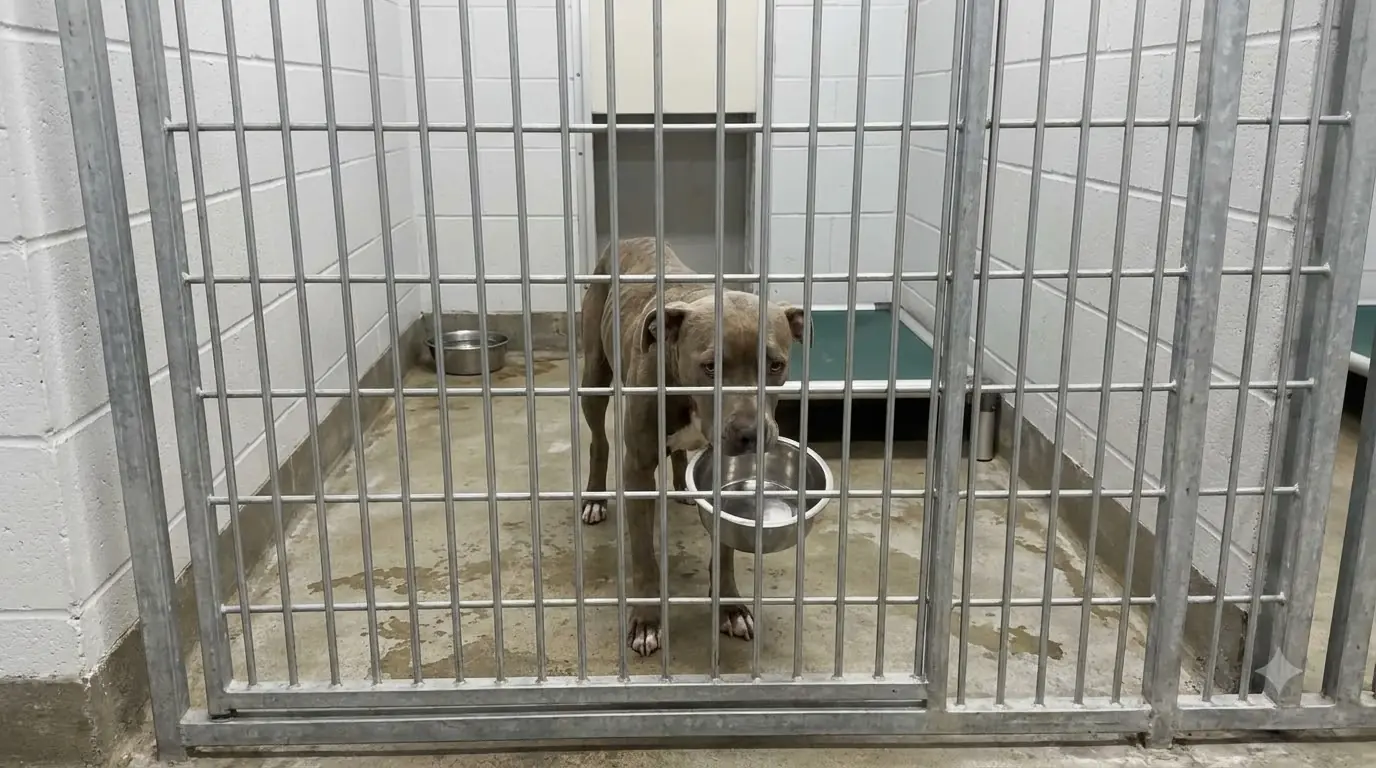
Luna’s bowl was already empty.
There was nothing left to eat.
The five-year-old American Pit Bull Terrier had licked the stainless steel clean, running her tongue across the bottom and around the rim until even the smallest trace of food was gone.
Staff had given her exactly what the rehabilitation plan allowed.
Not a full bowl.
Not as much as her appetite seemed to want.
A small measured portion.
That was intentional.
Luna had arrived at the shelter visibly underweight.
Her ribs showed clearly beneath her coat.
The muscles along her back and hindquarters had wasted.
Both elbows carried thick calluses that suggested she had spent long periods resting on hard surfaces before intake.
Her body needed nutrition.
It also needed that nutrition introduced carefully.
So staff fed her small recovery meals throughout the day.
Luna ate every one.
Then she did something nobody expected.
After finishing, she lowered her muzzle to the empty bowl.
Picked it up by the rim.
Turned toward the kennel door.
And carried it with her.
The distance was only several feet.
For Luna, even that was enough to show how weak she still was.
She reached the bars.
Placed the bowl on the floor between her front paws.
Then stood directly behind it.
Her head lowered.
Her eyes stayed toward the hallway.
The empty dish remained at her feet.
A staff member passed.
Luna watched.
Someone else stopped.
She lifted her head slightly.
But she did not leave the bowl.
After a while, her front legs began to look tired.
Her shoulders sank.
She shifted her weight.
Then, finally, Luna lowered herself beside the empty dish.
Her ribs rose and fell beneath the thin coat.
Her muzzle rested inches from the bowl she had carried there.
The next meal, she did it again.
At First, Staff Assumed She Was Simply Looking for More Food
That would have made sense.
Luna had arrived extremely hungry.
Food was one of the strongest things in her environment.
She watched bowls carefully.
She noticed food carts.
She became alert when staff approached at meal times.
So when she carried the empty bowl toward the front, the first assumption was simple.
She wanted another serving.
Maybe she had learned that people in the hallway meant food.
Maybe moving the bowl closer to them had been reinforced somewhere in her past.
No one could know.
But the behavior was consistent enough that staff began paying attention.
She Did It After Nearly Every Meal
Eat.
Lick.
Lift bowl.
Walk to gate.
Put it down.
Stand behind it.
Eventually lie beside it.
The repetition mattered.
One strange behavior can be random.
A repeated sequence becomes part of the dog’s current routine.
Staff began documenting it.
Not because they wanted to turn Luna into a sad story.
Because the behavior revealed how much of her attention was still organized around food.
Her Physical Condition Made That Understandable
Luna was not simply “a little thin.”
Her ribs were clearly visible.
Her waist was sharply tucked.
The muscles over the hindquarters were reduced.
The thick elbow calluses made the rest of her body look even more fragile.
Severe underweight changes how a dog moves.
There is less muscle to support joints.
Less reserve for standing.
Less energy for ordinary activity.
That is why Luna could carry the bowl to the gate and still become exhausted just standing beside it afterward.
The Shelter Did Not Refill It Every Time
That was one of the hardest parts for people to understand.
A thin dog.
An empty bowl.
A dog carrying it toward humans.
The emotional reaction is immediate.
Feed her again.
But nutritional rehabilitation has to be controlled.
A severely underfed dog may be at risk if large quantities of food are introduced too quickly.
So the veterinary team increased calories according to her condition and tolerance.
Measured portions.
Frequent meals.
Monitoring.
No sudden unlimited feeding simply because Luna still behaved hungry.
Her Appetite Was Excellent
That was encouraging.
Luna wanted food.
She finished meals.
She did not need to be coaxed.
But appetite alone does not determine how much a recovering body should receive at once.
The veterinary team monitored more than whether she cleaned the bowl.
Body weight.
Hydration.
Stool quality.
Vomiting.
Abdominal comfort.
Energy.
Laboratory values when appropriate.
The goal was safe recovery, not the fastest possible change in appearance.
Staff Also Needed to Rule Out Medical Causes of Weight Loss
Long-term inadequate feeding was one possibility.
It was not the only one.
Parasites.
Chronic gastrointestinal disease.
Dental disease.
Kidney or liver disease.
Endocrine conditions.
Cancer.
Other systemic illness.
All can contribute to weight loss.
Luna received a proper medical evaluation rather than being treated as though every visible rib had one obvious explanation.
The Elbow Calluses Needed Attention Too
Large dogs can develop thickened elbow skin after repeated pressure on hard flooring.
In Luna's case, staff checked whether the calluses were intact.
Cracked.
Inflamed.
Painful.
Infected.
Soft bedding became important immediately.
Her body did not need any more time on unforgiving surfaces.
That Created Another Problem
Luna had a padded bed.
But after meals, she kept leaving it to carry the bowl to the gate.
Then she would lie down there.
Sometimes directly on the harder section near the bars.
Staff found themselves dealing with two needs that seemed to compete.
Protect her body.
Respect the place she kept choosing.
The Solution Was Not Repeatedly Moving Luna Back
Instead, they changed the front of the kennel.
A low padded mat went near the gate.
A fleece layer covered the area where she usually settled.
Now, if Luna carried the bowl forward and eventually lay down, her elbows and hips did not land directly on concrete.
That was a better response than forcing her to remain on the bed at the back.
The Bowl Still Came Forward
The environmental change did not stop the behavior.
Luna finished.
Picked it up.
Carried it.
Set it down.
The difference was what happened once she tired.
Now she could lower herself onto padding.
Staff were glad.
The emotional image became less dramatic.
The care became better.
Her Standing Endurance Improved Slowly
At first, Luna might remain behind the bowl only briefly before lowering herself.
As calories increased safely and her body began recovering, she could stay upright longer.
That was one of the earliest functional signs of progress.
Not the ribs disappearing.
Not a dramatic before-and-after photograph.
Simply a dog able to stand several minutes without becoming exhausted.
Her Weight Gain Was Gradual
That was appropriate.
The shelter did not expect a five-year-old dog in poor condition to look normal after a few days.
The scale moved slowly.
The ribs stayed visible for a while.
Muscle returned even more slowly.
That was normal.
Fat can return before strength.
The veterinary team cared about both.
Luna Began Walking More Confidently
Early on, even short trips across the kennel cost energy.
Later, her gait became steadier.
Her hindquarters looked less hollow.
She recovered faster after exercise.
The food bowl still mattered.
Her world was simply expanding around it.
She Still Cleaned Every Meal Completely
That behavior stayed longer.
The tongue moved across the steel.
Again.
Again.
Even after no food remained.
Staff did not interpret that as proof she was still medically underfed.
They looked at the actual nutrition plan and body condition.
A dog can remain intensely food-motivated even while receiving the correct amount.
Predictability Became Part of Luna’s Treatment
Meals arrived on a consistent schedule.
Staff avoided teasing with bowls.
No pretending to feed.
No making her wait while holding food unnecessarily.
No random huge treats that disrupted the plan.
The goal was to make food reliable.
Boringly reliable.
The kind of routine that teaches through repetition rather than reassurance.
The Bowl May Have Been More Than a Food Object
As Luna settled into care, staff began noticing something.
Sometimes she carried the bowl to the gate even when she was no longer pacing or looking intensely for more food.
She would put it down.
Stand.
Watch people.
That raised another possibility.
Perhaps the bowl had also become connected with human activity.
Meal arrives with people.
People move through hallway.
Bowl goes to where people are.
Maybe.
No one could prove it.
Staff Refused to Say She Was “Begging to Be Fed”
That wording would have simplified too much.
The visible facts were stronger.
Luna repeatedly brought an empty food bowl to the front of her kennel after meals.
She remained beside it.
She watched the hallway.
Her body often tired before she chose to move away.
That was accurate.
The story did not need imagined thoughts.
Volunteers Started Sitting Near Her After Meals
Not with extra food.
Just company.
A person might sit outside the gate.
Luna would remain near the bowl.
Sometimes look at the person.
Sometimes lie down.
That helped separate social attention from feeding.
Not every human appearance needed to mean calories.
Luna Was Not Instantly Affectionate
That was important too.
She allowed care.
She accepted gentle handling.
But food was often more motivating than touch in the early days.
Some people expect neglected dogs to become immediately clingy.
Real animals do not owe humans gratitude performances.
Luna needed stability more than sentimental interaction.
Her Behavior Around Food Began Softening
Not dramatically.
One meal, she carried the bowl as usual.
The next, she picked it up but dropped it halfway.
Another day, she left it where she had eaten.
Then carried it again at dinner.
Recovery was inconsistent.
That was normal.
The First Time She Left the Bowl Behind, Staff Noticed
Luna finished breakfast.
Licked the bottom.
Lifted her head.
Looked toward the hallway.
Then walked to her bed.
The bowl stayed where it was.
No one called it a breakthrough.
One event is only one event.
But it was new.
The Next Meal, She Carried It Again
That prevented staff from oversimplifying.
Behavior changes gradually.
A dog does not erase a strong routine because one meal felt different.
The team looked for trends.
The Time She Spent Beside the Bowl Began Decreasing
That became clearer than whether she carried it.
Early on, Luna might remain at the gate for a long time.
Later, she carried the bowl.
Sat.
Then moved away after a minute.
That flexibility was meaningful.
The ritual had less control over what happened next.
Her Body Condition Continued Improving
The ribs became less sharp.
The back filled slightly.
The hindquarter muscles started returning.
The elbow calluses remained visible but stayed protected on soft bedding.
Luna no longer looked physically exhausted after every short movement.
The Shelter Added Non-Food Enrichment
Simple toys.
Sniffing.
Short walks.
Training.
Calm human contact.
At first, many of those things were less interesting than food.
Over time, that changed.
Luna began investigating toys more.
She spent longer sniffing outside.
She could engage with people without staring toward their hands constantly.
That was important.
Food Became Useful for Training
Once her medical feeding plan allowed appropriate rewards, small portions could be used thoughtfully.
Simple cues.
Handling.
Coming away from the gate.
Settling on the bed.
Nothing punitive.
The goal was not to make Luna less interested in food.
It was to give that motivation more flexible outlets.
Her Strength Made Exercise More Enjoyable
At intake, movement looked like work.
Later, short walks became actual enrichment.
Luna could sniff without immediately becoming tired.
She could stand long enough to investigate.
That was a meaningful quality-of-life improvement.
The Bowl Ritual Was Still Visible in the Shelter
Even after physical recovery began.
That suggested kennel context was part of it.
The gate was where people appeared.
Where leashes arrived.
Where meals came from.
Where the outside world existed.
Carrying the bowl there may have become part of how Luna interacted with that boundary.
Foster Care Offered a Better Test
A qualified foster eventually agreed to take her.
By then, Luna was medically more stable.
Her feeding plan had progressed.
She still needed predictable meals and monitoring.
But a home environment could answer a different question.
Would she still carry the empty bowl toward a barrier if there were no kennel bars?
The Foster Prepared Carefully
Same food initially.