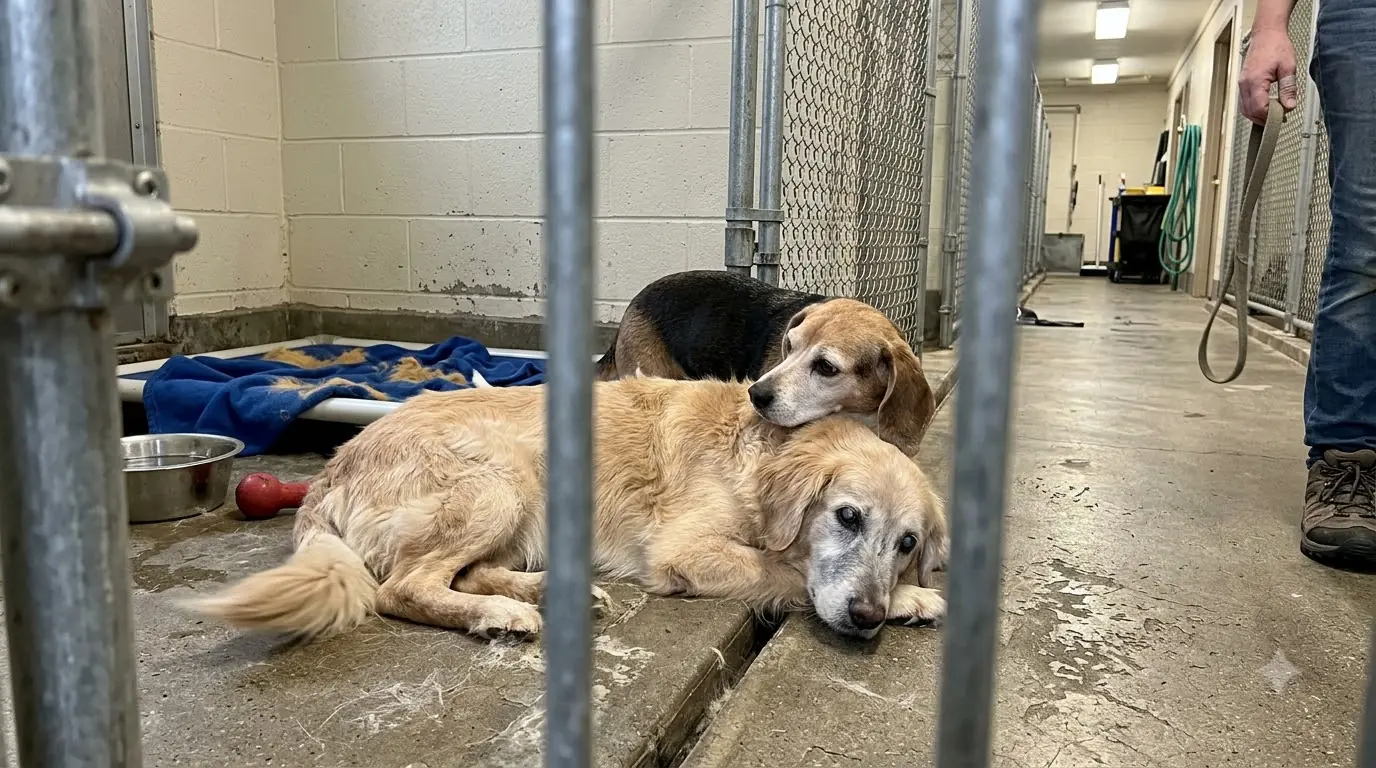
Maggie does not need to see Benji clearly to know when he is there.
Most nights, she does not see much at all.
At 11 years old, the Golden Retriever mix is nearly blind. In the shelter kennel she shares with Benji, a 7-year-old Beagle mix, her world is built more around sound, scent, touch, and routine than sight.
Benji has become part of all four.
He sleeps against Maggie's back.
When she wakes suddenly and seems unsure of where she is, he often gets up too.
Maggie begins searching.
Benji steps toward her.
Then he gently touches his nose to her face.
The change in Maggie can be immediate.
Her searching stops.
Her body relaxes.
She settles again.
Nobody taught Benji to do that inside the shelter.
It is simply one of the behaviors staff began noticing after the two dogs arrived together from the same home they had shared for years.
And one afternoon, when Benji left the kennel without her, staff saw just how much that familiar presence had become part of the way Maggie moves through an unfamiliar place.
They Came Into Care Together
Maggie and Benji did not meet at the shelter.
They had already spent years in the same home before circumstances changed and they entered care together.
That history matters.
For many dogs, arriving at a shelter means nearly everything familiar disappears at once.
The rooms are different.
The smells are different.
The flooring feels different.
Meal times may be different.
The voices belong to strangers.
Doors open in unfamiliar directions.
Dogs bark from places they cannot see.
For Maggie, those changes are especially significant because vision can no longer help her understand much of the environment.
Benji, however, came through the shelter doors with her.
He smelled the same.
His footsteps sounded the same.
His body beside hers felt the same.
The shelter was new.
Benji was not.
Staff noticed that difference almost immediately.
Maggie Learns a Room Differently
Because Maggie is nearly blind, she moves carefully through unfamiliar spaces.
She does not rush.
Her nose works constantly.
Her ears do much of the work her eyes once did.
In a kennel she has learned well, she can move with much more confidence. She knows roughly where the bed is. She knows where the water is kept. She knows where the gate begins.
But even familiar spaces can feel different after a dog wakes from a deep sleep or when something has been moved during cleaning.
Those are often the moments when Benji becomes important.
Maggie may lift her head and pause.
Sometimes she begins sniffing.
Sometimes she gets to her feet and turns slowly, trying to orient herself.
Benji usually notices.
He may have been sleeping.
He may have been resting nearby.
But when Maggie starts searching, he gets up.
He does not pull her.
He does not push her toward a bed.
He simply comes close.
Then comes the nose touch.
Benji's nose reaches Maggie's face.
Maggie pauses.
Often, that is enough.
The Way They Sleep Says a Lot
Maggie and Benji have room to rest without touching.
They rarely choose that arrangement at night.
Benji usually sleeps against Maggie's back.
Sometimes he curls tightly behind her.
Other times he stretches along one side.
The exact position changes, but the contact remains remarkably consistent.
For a dog who cannot rely on sight, that physical reference point may be especially familiar.
When Maggie wakes, she often knows exactly where Benji is before she begins moving.
And when she shifts position, Benji adjusts too.
The scene is not dramatic.
Two older adult dogs sleeping in a kennel rarely is.
But shelter staff learn to pay attention to repeated small choices.
Benji could sleep farther away.
He does not.
Maggie could move elsewhere once settled.
She usually stays close.
Night after night, they rebuild the same little arrangement.
Maggie in front.
Benji against her back.
Benji Is More Than a Guide
It would be easy to describe Benji as Maggie's guide dog.
That would not be accurate.
He is not trained for that role.
He does not perform formal guiding behaviors.
Shelter staff do not depend on him to manage Maggie's safety or medical needs.
Maggie's care is handled by people.
Her environment is kept predictable.
Her movement is monitored.
She is given time to navigate.
But Benji does appear to provide something no staff member can reproduce exactly.
Familiarity.
Maggie has known him for years.
His smell is not new.
His footsteps are not new.
The pressure of his body against hers is not new.
For a nearly blind senior dog in a shelter full of unfamiliar sensory information, that familiarity appears meaningful.
Benji does not need specialized training to offer it.
He simply needs to be Benji.
Maggie Gives Benji Something Too
Because Maggie's vision loss is easy to notice, people can quickly assume she is the only dog receiving something important from the relationship.
Daily shelter life suggests otherwise.
Benji repeatedly chooses her.
He does not merely tolerate sleeping against Maggie because she needs him nearby.
He seeks the space beside her.
When she settles, he often settles too.
When she stands, he pays attention.
When she becomes uncertain, he responds.
That level of awareness suggests Maggie is not simply a responsibility in Benji's world.
She is part of his routine.
Part of his resting place.
Part of how he organizes his own day.
He also appears calmer once she is settled.
When Maggie stops searching after he touches her face, Benji usually returns to resting as well.
Their routines are linked.
Not because either dog has lost all independence.
Because each seems to understand the other's presence as normal.
Shelter Mornings Begin With Familiar Sounds
Morning in a shelter rarely arrives quietly.
Kennel doors open.
Bowls move.
Staff talk.
Dogs begin waking.
Benji usually notices activity quickly.
Maggie listens.
Sometimes she lifts her head before standing.
Benji remains near her.
Once Maggie is fully awake, she begins moving through the kennel according to the map she has built through repetition.
Staff try to keep that map consistent.
Water stays in a predictable place.
Beds are returned to familiar positions after cleaning.
Unnecessary obstacles are avoided.
Benji becomes another landmark in that map.
Except unlike a water bowl or bed, he moves.
And Maggie tracks him.
Sometimes by scent.
Sometimes by sound.
Sometimes by touch.
Their Walks Show Their Differences
Outside the kennel, Benji becomes more visibly Beagle-like.
His nose takes over.
He wants to investigate.
He notices scents Maggie may not.
He has more visual information available to him too.
Maggie moves at a slower, more deliberate pace.
She listens.
She sniffs.
She feels her way through changing ground.
Staff make sure she is supported safely without assuming Benji will do that work for them.
Still, when the two dogs are out together, Maggie often seems more willing to move when Benji is nearby.
She hears him.
His tags may make a familiar sound.
His feet move over the ground.
He passes close enough for her to catch his scent.
Again, this is not formal guiding.
It is companionship expressed through familiar sensory cues.
The Afternoon Benji Left Alone
One afternoon, Benji needed to go outside for an evaluation.
It was routine.
There was no emergency.
No dramatic event.
The two dogs simply had to be apart for a period.
Benji left the kennel.
Maggie remained behind.
At first, she was asleep.
The bed felt normal.
The kennel was quiet enough for her to rest.
Then Maggie woke.
Normally, Benji would be there.
That afternoon, he was not.
Maggie lifted her head.
She began searching.
Maggie Checked the Bed First
Maggie got to her feet slowly.
Then she began moving around the bed.
She sniffed one edge.
Then another.
She checked the corners.
Her nose worked close to the bedding.
Benji's scent would still have been there, but his body was not.
Maggie continued around the bed.
She did not bark continuously.
She did not panic.
She did not throw herself against the gate.
Her behavior was quieter.
She searched.
And when Benji did not appear, she changed where she waited.
Maggie walked toward the kennel door.
Then she lowered herself beside it.
She put her nose near the narrow gap underneath.
And stayed there.
She Waited With the Door in Front of Her
Because Maggie is nearly blind, the image was especially striking.
She could not simply stare down the hallway the way a fully sighted dog might.
Instead, she used what she had.
Her nose.
Her ears.
The familiar smells moving through the gap beneath the door.
The sounds outside.
She remained positioned close to the place Benji had disappeared through.
The kennel still contained the bed they shared.
It still contained familiar bedding.
It still contained Benji's scent.
But Benji himself was somewhere beyond that door.
Maggie waited.
Staff did not need to interpret the behavior dramatically.
They simply recorded what they saw.
Maggie woke.
Searched the bed.
Moved to the door.
Pressed her nose close to the gap.
And remained there.
Separation Looks Different When Sight Is Limited
A sighted dog may watch a doorway.
Maggie listens to one.
She smells it.
That difference makes her relationship with Benji especially interesting to observe.
Maggie cannot depend on visual confirmation.
She identifies familiar things through other channels.
Benji is one of those things.
When he is in the kennel, she can find him.
When he touches her face, she recognizes him.
When he sleeps behind her, she can feel him.
When he moves nearby, she can hear him.
During the evaluation, all of those signals disappeared at once.
Except scent.
So Maggie waited in the place where scent and sound were most likely to reach her.
Near the door.
Then She Heard Him
Eventually, Benji's evaluation ended.
He began returning through the shelter.
Before he reached the kennel, Maggie reacted.
Her head lifted.
Then her tail began moving.
Slowly at first.
Then more clearly.
It thumped against the floor.
Benji was not yet beside her.
He had not touched her.
Maggie had not visually identified him from across the hallway.
She had heard something familiar.
Most likely footsteps, movement, or another sound she had learned over years of living with him.
Whatever cue reached her, Maggie recognized it before Benji was physically back inside the kennel.
Her tail continued thumping.
Then Benji arrived.
Benji Went Back to His Usual Place
Once Benji returned, the reunion itself was simple.
No frantic scene.
No exaggerated display.
He came back to Maggie.
Then he lay beside her again.
His body returned to the place Maggie knew.
Maggie settled.
The searching stopped.
The waiting stopped.
She went back to sleep.
For shelter staff, that was the part that stayed with them.
Maggie had spent Benji's absence trying to locate him.
Then waiting at the door.
She recognized his return before he reached her.
Once he was beside her again, she rested.
The behavior fit perfectly with what staff had already seen when Maggie woke confused in the kennel.
Benji's presence helped her orient.
Why Their Bond Matters in Adoption Planning
This is where Maggie and Benji's story becomes more complicated.
A nearly blind senior dog already requires a thoughtful home.
A bonded pair requires another level of consideration.
Finding one adopter prepared for either situation may be possible.
Finding one household prepared for both is harder.
Maggie is 11.
Benji is seven.
They have different ages.
Different physical abilities.
Different sensory needs.
Different long-term care timelines.
And one established relationship that appears to make shelter life easier for Maggie and meaningful for Benji.
That combination narrows the pool of possible homes.
Someone Might Be Ready for Benji Alone
Benji is younger.
At seven, he may appeal to someone looking for an adult dog who still has plenty of curiosity and activity.
His Beagle traits can be engaging.
He likes to investigate.
He may seem easier to understand immediately.
Someone could meet him and genuinely want to adopt him.
Then they learn about Maggie.
Now the decision changes.
Two dogs mean more space.
More expense.
More scheduling.
And in Maggie's case, specific accommodations for limited vision.
A person who can responsibly adopt Benji alone may not be able to take both.
That does not make them cruel.
It makes the placement more difficult.
Someone Might Love Maggie but Feel Unprepared
The opposite can happen too.
Some adopters are specifically drawn to senior dogs.
They may see Maggie's age and near blindness and feel comfortable with a quieter companion.
But Benji changes the equation.
He is younger.
More active.
He may need longer walks.
More scent-based enrichment.
More independent engagement.
A household built around Maggie's slower pace may not automatically suit Benji.
Again, the problem is not affection.
It is fit.
The right home must fit two dogs at once.
A Blind Senior Dog Needs Predictability
Maggie's ideal environment should be relatively consistent.
Furniture should not be moved constantly.
Pathways should remain clear.
Food and water should stay in predictable places.
Stairs, slippery floors, pools, balconies, and other hazards require thoughtful management.
An adopter should learn how to announce their presence so Maggie is not startled.
Touch should be predictable.
New spaces should be introduced gradually.
Routine matters.
Benji can help by being familiar.
But he cannot replace environmental safety.
That responsibility belongs to the humans in the home.
Benji Still Needs Independence
The shelter is equally careful not to make Maggie's needs Benji's entire identity.
He should not be expected to spend every moment beside her.
He deserves his own walks.
His own enrichment.
His own interactions with people.
His own opportunities to explore.
If Benji wants to sniff every inch of a yard while Maggie rests, he should be allowed to.
If he needs more activity, the household should provide it.
A successful adoption does not mean keeping the dogs physically touching all day.
It means allowing their relationship to continue while meeting individual needs.
The Shelter Watches for Healthy Independence
Staff continue giving both dogs brief individual experiences when appropriate.
That helps them understand how each behaves alone.
It also prevents every routine from becoming completely dependent on the pair functioning as a unit.
Maggie's response to Benji's absence is monitored carefully.
She may search.
She may wait.
But staff also help her build confidence through predictable human care.
Benji likewise benefits from experiences in which he is not required to respond to Maggie constantly.
That balance matters.
The goal is not dependency.
The goal is preserving a relationship that appears deeply familiar and comforting while helping both dogs function as individuals.
Their Shared Bed Is Still Their Favorite Place
After Benji returned from the evaluation, their usual pattern resumed.
Maggie lay down.
Benji settled against her back.
The kennel returned to its normal arrangement.
Staff continued with the day.
Meals came.
Cleaning happened.
People passed.
Nothing particularly dramatic followed.
That ordinary return to routine was exactly the point.
For Maggie, Benji's presence restored something predictable.
For Benji, Maggie remained the place he chose to rest.
Adoption Photos Need to Show More Than Maggie's Eyes
It would be easy to build Maggie's adoption story around blindness.
That would miss too much.
Her near blindness matters because it changes how she navigates.
But the emotional center is not simply that she cannot see well.
It is that she has spent years navigating life with Benji beside her.
A good adoption profile needs to show that.
Photos of them sleeping together.
Videos of Benji touching his nose to Maggie's face.
Clips of Maggie responding to his footsteps.
Those details help potential adopters understand why the shelter is trying to place them together.
Meet-and-Greets Take More Time
Someone meeting Maggie and Benji should not expect both dogs to interact the same way.
Benji may investigate first.
Maggie may need time to understand the new person's voice, scent, and movement.
A visitor should speak before touching her.
They should allow her to approach safely.
Benji's presence may help her settle, but patience is still necessary.
The best meet-and-greets are often quiet.
Less pressure.
More observation.
Time to see Benji explore.
Time to see Maggie orient.
Time to watch what happens when the two reconnect.
Practical Questions Matter More Than Emotional Reactions
The shelter appreciates when someone is moved by Maggie and Benji's story.
But emotion alone cannot sustain a joint adoption.
Practical questions are more important.
Can the household safely accommodate a nearly blind senior dog?
Can it also provide enough activity for Benji?
Are there stairs?
How will furniture be arranged?
Are there resident pets?
Can introductions be managed carefully?
Can the household afford routine and unexpected veterinary care for two dogs?
Will they be able to transport both?
Is someone home often enough during the adjustment period?
Those are not small details.
They determine whether the adoption can last.
Their Ages Will Matter More Over Time
Maggie is 11.
Benji is seven.
That four-year age difference means their needs may diverge further.
Maggie may slow down sooner.
She may develop additional senior-care needs.
Benji may remain more active.
A future household must be willing to adjust.
Perhaps both dogs begin a walk together.
Later, Maggie turns back while Benji continues.
Perhaps Maggie needs more rest.
Benji gets an extra sniffing session.
Keeping them together does not mean forcing identical routines.
It means giving both dogs what they need and allowing them to reconnect afterward.
The Right Home Has to Understand Maggie's World
Maggie experiences the environment differently.
A new home will initially be confusing.
She will need time to map it.
She will need consistent placement of food, water, beds, and doors.
She may bump into unfamiliar objects.
She may pause at thresholds.
She may wake unsure of exactly where she is.
Benji cannot eliminate that adjustment.
But his presence could give her one familiar reference point while everything else is changing.
His smell.
His footsteps.
His body beside her.
That matters.
And It Has to Understand Benji Too
Benji should not disappear inside Maggie's story.
He is not simply the dog who helps the blind senior.
He is a 7-year-old Beagle mix with his own personality.
His nose matters.
His activity level matters.
His preferences matter.
His relationship with future adopters matters.
He needs people who value him independently.
The ideal household wants Maggie because she is Maggie.
And Benji because he is Benji.
Their bond is part of the adoption, not the only reason for it.
Their Current Status
For now, Maggie and Benji remain together while the shelter continues searching for one home capable of meeting both dogs' needs.
There has been interest.
But responsible placement takes time.
Staff are not looking for the first person willing to take two dogs.
They are looking for the right environment.
One where Maggie can navigate safely.
One where Benji can remain active and engaged.
One where both dogs receive individual attention.
One where their familiar relationship is respected rather than disrupted unnecessarily.
Until then, their routine continues.
Maggie Still Wakes Sometimes
There are still moments when Maggie wakes and seems briefly unsure.
The shelter is still unfamiliar compared with the home she knew for years.
She may lift her head.
Pause.
Begin sniffing.
Benji notices.
He gets up.
He moves toward her.
His nose touches her face.
Maggie stops searching.
Then both dogs settle again.
Staff have seen the sequence enough times that it has become part of the rhythm of their kennel.
Benji's Evaluation Did Not End With a Dramatic Outcome
The afternoon Benji left did not end with an adoption.
There was no instant happy ending.
He returned to Maggie.
And that return gave staff useful information.
It showed how Maggie behaves when he is gone.
It showed how quickly she recognizes him.
It showed how much his familiar presence seems to help her settle.
Sometimes that kind of information matters more than a dramatic adoption announcement.
It helps the shelter make better decisions.
The Home They Actually Need
Maggie and Benji would do best with someone who understands both senior care and the practical realities of visual impairment.
The home should be reasonably predictable.
Safe pathways matter.
Outdoor access should be secure.
Major hazards should be managed carefully.
The adopter should be comfortable helping Maggie navigate without overhandling her.
Benji needs space to explore and enough enrichment to satisfy his Beagle instincts.
Both dogs need routine veterinary care.
Maggie's age means senior monitoring will be important.
Benji will have his own medical needs over time.
A household with resident animals would need careful introductions.
Children, if present, should be able to respect Maggie's limited vision and avoid startling her.
The exact ideal home is not about perfection.
It is about preparation.
The Sound Maggie Was Waiting For
That afternoon remains one of the clearest moments in their shelter story.
Maggie could not watch the hallway.
So she searched the bed.
Then she moved to the kennel door.
She lowered herself beside it.
Her nose stayed near the gap underneath.
Time passed.
Then something changed.
Before Benji reached her, Maggie heard him.
Her head lifted.
Her tail began thumping against the floor.
She knew.
Benji came through the door.
He moved back into the space beside her.
Then he lay against her again.
Maggie settled.
A few minutes later, she was asleep.
Benji was still pressed against her back.
And while the shelter continues looking for someone prepared to adopt two dogs instead of one, Maggie keeps making the reason easy to understand.
She may not be able to see much of the world anymore.
But when Benji comes back to her, she knows exactly where home feels closest.