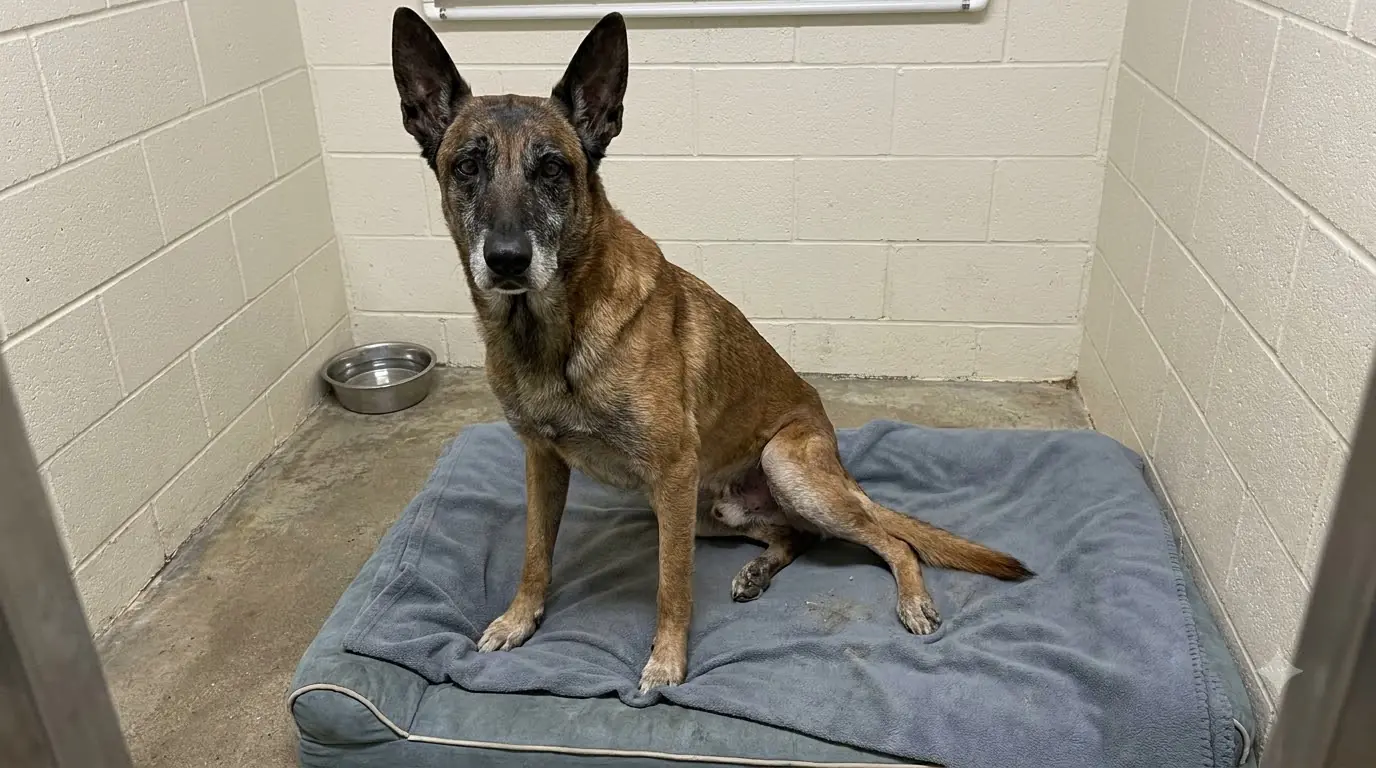
Most visitors to the senior rescue meet Major while he is lying down.
At 12 years old, the Belgian Malinois no longer has the body people might picture when they hear that he was once a working dog.
He is thinner now.
Severe arthritis has made his movements slow and uncomfortable, and his hind legs tremble when he tries to support himself.
Getting up is difficult enough that nobody asks Major to stand simply to greet them.
Then one day, a staff member said a word Major had not been asked to respond to since his earlier working life.
It was one of his old commands.
Major changed immediately.
His ears snapped upright.
His front paws came underneath him.
And before anyone realized what he was attempting, the elderly Malinois began pushing his chest away from the bed.
He sat up.
For several seconds, Major held himself remarkably straight.
Then his hind legs started shaking.
His hips slowly slipped sideways.
And the posture his mind still appeared able to recognize became more than his aging body could maintain.
Major sank back onto the bed.
Nobody Had Asked Him to Perform
That was what made the moment so unexpected.
The command had not been given as part of a training session.
A caregiver happened to say the familiar word while Major was resting nearby.
Until then, he had appeared relaxed and tired.
His head was down.
His hind legs were positioned comfortably on the bedding.
There had been no indication that he planned to move.
Then he heard the word.
His response was so immediate that the staff member stopped talking.
Major's head came up first.
His ears became sharply attentive.
Then he began arranging his front legs beneath himself.
For a dog with severe arthritis, even that required effort.
But Major kept going.
His Body Looks Very Different From the Dog He Used to Be
Major had spent part of his younger life as a working dog.
Belgian Malinois are athletic dogs, and working individuals are often trained through extensive repetition until particular cues are associated with very specific behaviors.
Major's working years were long behind him by the time he entered senior rescue.
Age had changed what he could physically do.
His body condition had declined.
His joints had become severely arthritic.
His hindquarters were particularly weak.
When Major attempted to rise, staff could see the tremor begin in his rear legs as they struggled to support his weight.
Some days he could manage more movement.
Other days he preferred to remain on his bed unless he needed something.
The rescue had adapted to the dog Major was now.
Nobody expected the senior Malinois to behave like the working dog he had once been.
Apparently, one old cue could still produce a glimpse of that dog.
Then Major Tried to Sit at Attention
After pushing himself upright, Major adjusted his front paws.
His chest rose.
His ears remained high.
For a few seconds, the tired posture staff normally saw disappeared.
He was sitting straight.
Not perfectly.
His weakened hindquarters could not support the position the way they once had.
But the difference was unmistakable.
Then the trembling became stronger.
One rear leg began sliding outward.
Major tried to compensate with his front legs.
It worked for another moment.
Then his hips slowly shifted across the bedding.
His body tilted.
And Major lowered back onto his side.
The entire response lasted only seconds.
But it immediately changed how staff thought about the commands Major had learned years earlier.
They Did Not Ask Him to Do It Again
It would have been easy to repeat the word.
People were curious.
Would Major respond exactly the same way?
Did he remember other commands?
Could they capture the behavior again?
But Major's physical condition mattered more than satisfying that curiosity.
The first attempt had already shown how much effort sitting upright required.
His hind legs had trembled throughout it.
Once he was lying down again, Major needed time to rest.
So staff did not turn his old training into a performance.
They let him settle.
The command had revealed something interesting about Major.
There was no reason to make his arthritic body prove it twice.
The Word Had Outlasted His Ability to Perform It Comfortably
Major could not explain what the cue meant to him.
Nobody at the rescue could know what he remembered when he heard it.
They could not responsibly claim that Major believed he was back on duty or mentally returned to a particular moment from his working years.
What they could see was a learned response that had apparently remained recognizable.
The word arrived.
Major's posture changed.
He attempted the behavior associated with it.
Years may have passed since the cue was part of his regular routine, but the physical response began almost immediately.