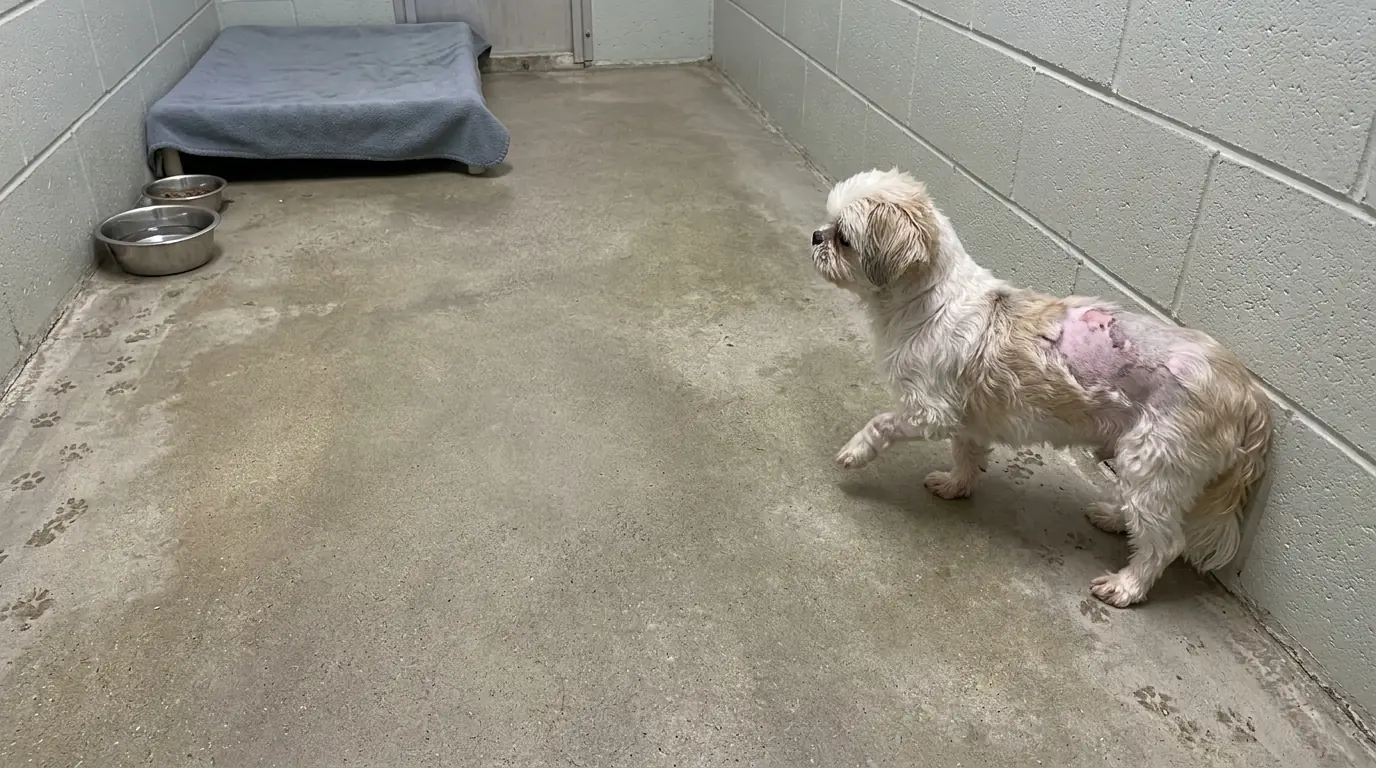
That is what makes her behavior so noticeable.
The six-year-old Shih Tzu moves around her shelter kennel without needing to be carried. She can reach her water. She can find her bed. She can walk toward the front gate when the environment is quiet enough.
But there is one part of the kennel she seems unwilling to enter.
The middle.
Instead, Mochi follows the walls.
Her small body stays close to the perimeter as she moves from one end of the kennel to the other.
When she reaches a corner, she turns with it.
When she needs to reach something on the opposite side, she takes the longer route around.
And if circumstances leave her facing the open stretch of floor in the center, Mochi stops.
Her body becomes rigid.
She stares ahead.
Then, rather than taking a few steps across, she turns around and retreats to the wall.
Physically, nothing is blocking her.
But Mochi survived something that changed much more than her coat.
She was rescued from a house fire.
The burns along one side of her body have healed, although the fur has not completely grown back.
Now the wounds are closed.
Mochi can move.
Yet every day inside the kennel, she behaves as though crossing an exposed patch of floor is still something her body cannot make itself do.
Mochi’s Burns Had Healed Before Her Behavior Did
The fire left visible evidence.
Along one side of Mochi's body, her coat remained thin and incomplete.
Areas that would normally be covered by long Shih Tzu hair were still exposed or only beginning to grow back.
The skin underneath had healed.
There were no fresh flames to escape.
No smoke filled the kennel.
No emergency surrounded her.
Still, Mochi's behavior suggested that physical healing had not returned her immediately to normal confidence.
That distinction matters.
A wound can close before an animal behaves as though the danger is over.
Her Kennel Wasn't Large
The distance Mochi avoided was only a few feet.
For most dogs, crossing it would take seconds.
Mochi could easily cover more distance by following the perimeter.
And she did.
That made physical inability alone seem unlikely to explain the pattern.
If she needed to travel from the front of the kennel toward the back, she walked beside one wall.
If she changed direction, she followed another.
Her route formed an invisible border around the room.
The center remained empty.
Staff Initially Thought It Might Be Coincidence
Dogs often prefer walking along edges.
A wall can provide a sense of security.
Kennel layouts can naturally influence movement.
Seeing Mochi take the perimeter once was not remarkable.
Then she did it again.
And again.
Staff began noticing that she was not simply choosing the wall when it was convenient.
She seemed to organize nearly all of her movement around avoiding the center.
That became clearest when something she wanted was positioned across the open floor.
A Few Feet Could Stop Her Completely
Mochi might approach the edge of the open area.
Then she froze.
Her feet remained planted.
Her body lowered slightly.
Sometimes she looked toward the destination.
Then toward the wall.
The direct route was shorter.
Mochi still would not take it.
Instead, she turned.
She followed the perimeter until she could reach the same general area without crossing through the middle.
The behavior was remarkably consistent.
Mochi was solving the problem.
She was just solving it without stepping into the space she appeared to fear.
No One Could Ask Her What She Saw There
The center of the kennel looked ordinary.
Sealed floor.
Open space.
Nothing moving.
Nothing physically separating it from the floor along the walls.
To a person, there was no obvious reason one section should feel different.
Mochi's behavior said otherwise.
That did not mean staff could claim exactly why.
Her history of surviving a house fire was significant.
But it did not give anyone access to her memories.
Perhaps exposure felt unsafe.
Perhaps certain surfaces, open spaces, or movement patterns had become associated with fear.
Perhaps something entirely different was influencing her behavior.
The shelter could observe the pattern.
It could not invent Mochi's explanation.
The Fire Had Been a Major Physical Event
House fires expose animals to several possible dangers.
Heat and direct flames can cause burns.
Smoke and inhaled irritants can affect the respiratory system.
Hot debris and damaged surfaces can create additional injuries.
The severity depends on the individual circumstances.
Mochi had survived with burns significant enough to leave visible changes along one side of her body.
Those wounds required time to heal.
Even after the skin closed, the coat did not immediately return.
Hair regrowth after skin injury can vary depending on the depth of damage and the condition of hair follicles.
Some areas may take much longer.
Some may never look exactly as they did before.
For Mochi, the uneven coat remained a visible reminder of an event that was already physically behind her.
The Exposed Side Made Her Look More Fragile Than She Moved
From one angle, Mochi still looked like a small fluffy Shih Tzu.
From the other, the interrupted coat changed her appearance.
Patches of shorter regrowth revealed where the burns had been.
Yet Mochi could walk reasonably well.
She could turn.
She could step over small changes in bedding.
She could navigate the kennel perimeter.
The issue was not that she could not move through space.
It was where she was willing to move.
The Walls Seemed to Give Her Something the Center Didn't
Mochi often walked so close to the perimeter that her coat nearly brushed the wall.
She did not need to look in every direction.
One side of her body remained beside a solid surface.
When she reached a corner, two walls briefly surrounded her.
Then she followed the next one.
Whether the physical boundary actually made her feel safer could not be proven.
But it clearly shaped her route.
The center offered no such boundary.
And Mochi repeatedly chose extra distance rather than enter it.
Fear Can Make a Small Space Feel Much Larger
To people watching from outside the kennel, the problem seemed tiny.
Take four steps.
Cross the floor.
Done.
But fear does not measure distance in feet.
A short route can become extremely difficult if an animal perceives the environment as unsafe.
Mochi's hesitation was not improved by the fact that the middle was objectively harmless.
Her body still responded.
She stiffened.
She stopped.
Then she returned to the route she knew she could manage.
Forcing Her Across Could Make the Problem Worse
It would have been physically easy for a person to pick up a Shih Tzu and place her in the middle.
That would prove nothing.
Mochi's legs were already capable of reaching the center.
The issue was voluntary movement.
Pulling her across with a leash could also increase fear, especially if she struggled or felt trapped.
The goal was not to make Mochi's paws touch a particular square of floor.
It was to help her reach a point where she could choose to cross without becoming overwhelmed.
That required a very different approach.
Her Ability to Turn Away Was Important
When Mochi reached the edge of her comfort zone, staff allowed her to retreat.
That might seem counterintuitive.
But forcing an intensely fearful dog to remain in a situation can create more distress.
Mochi needed opportunities to investigate without discovering that every hesitation would result in someone pushing her farther.
Choice mattered.
If she stepped forward, she could step backward.
If she approached the center, she was not trapped there.
That predictability could become part of rebuilding confidence.
Food Was Easier Near the Wall
Mochi would accept food in places she considered safer.
A small treat near the perimeter was manageable.
Move the same reward farther into the open floor and the situation changed.
Mochi might stretch her neck toward it without moving her feet.
She might take one cautious step.
But if the distance became too great, she stopped.
Sometimes she simply turned away.
That response offered useful information.
Food was valuable.
Safety was more valuable.
The Goal Was Not to Lure Her Into Panic
Using food to encourage movement can be helpful when the dog remains comfortable enough to choose.
But there is a difference between encouraging exploration and tempting an animal beyond its coping ability.
Mochi's body language mattered more than whether she reached the treat.
If she became rigid, lowered herself, stopped taking food, or immediately retreated, the exercise had become too difficult.
Progress needed to happen before that point.
One Paw Into the Open Could Be Enough
For Mochi, improvement did not need to look dramatic.
Perhaps she stood six inches farther from the wall.
Perhaps she stepped diagonally instead of following the exact perimeter.
Perhaps one paw entered the open space before she returned.
Those tiny changes could matter.
Confidence often grows through manageable experiences repeated many times.
Mochi did not need one heroic crossing.
She needed many moments in which nothing frightening happened when she moved slightly beyond her familiar path.
Her Bed Became an Interesting Test
Mochi liked resting on her bedding.
When it stayed near the wall, reaching it was easy.
If it shifted slightly toward the center during normal kennel activity, Mochi noticed.
Sometimes she approached.
Then stopped.
The bed was familiar.
The route was not.
That contrast revealed how powerful the spatial avoidance had become.
Even something associated with rest could become difficult to reach if getting there required entering the open floor.
She Was Not Simply Afraid of the Floor Material
That was another important observation.
The same type of flooring extended throughout the kennel.
Mochi walked on it beside the walls.
She avoided it primarily when it became open space.
That did not completely rule out a surface-related concern, especially because lighting, reflections, traction, or other subtle differences can affect dogs.
But it suggested staff needed to look beyond the simple idea that she disliked the floor itself.
Location mattered.
Her Vision and Physical Health Still Needed Consideration
Behavioral explanations should not replace medical evaluation.
Dogs may avoid areas for reasons people initially interpret as fear.
Vision changes can make surfaces or shadows difficult to interpret.
Pain can affect willingness to move.
Neurologic problems can alter confidence or coordination.
Slippery flooring can be challenging.
Mochi's history of serious injury made a complete assessment especially important.
The fact that she could move along the walls was useful information.
It was not enough to rule out every physical contributor.
Her Burned Skin Could Still Require Monitoring
Healed does not always mean forgotten medically either.
Areas affected by significant burns may remain different from unaffected skin.
Hair regrowth can be incomplete.
Scarred areas may require observation for irritation or other changes.
Mochi's exposed patches also had less protection from the full coat that normally covered her body.
Her skin needed appropriate care while her behavior received attention.
Both parts of her recovery mattered.
Shelter Life Added New Challenges
Mochi had survived one overwhelming environment and entered another unfamiliar one.
A shelter was safe from fire.
It was not necessarily easy for a fearful dog.
Dogs barked.
Doors opened.
People passed.
Cleaning happened.
Smells changed.
Objects moved.
For a dog already reluctant to enter exposed space, unpredictability could reinforce the desire to remain near boundaries.
Staff therefore needed to consider the whole environment rather than treating the center of the kennel as an isolated problem.
Quiet Periods Revealed More Curiosity
When activity decreased, Mochi sometimes became more adventurous.
She sniffed.
Her posture loosened.
She spent longer looking away from the wall.
Once in a while, she stood with her body angled into the kennel rather than perfectly parallel to the perimeter.
Those were small differences.
But they suggested that Mochi's world could expand when she was not overwhelmed.
Curiosity was still there.
Fear was simply louder much of the time.
One Afternoon, Mochi Took a Shortcut
Her water was on one side of the kennel.
Mochi was on another.
Normally, she would have followed the walls.
This time, she started along the familiar route.
Then she stopped.
She looked across the floor.
One front paw moved diagonally away from the wall.
Then the other.
For a moment, Mochi was standing farther into the open than staff usually saw her.
She froze.
No one moved toward her.
Nothing was placed behind her.
Nothing forced the next step.
Mochi stood there.
Then she took another.
She did not cross the entire kennel.
Halfway through, she turned and hurried back toward the perimeter.
But something had changed.
For several seconds, Mochi had chosen the middle herself.
The Next Day, She Avoided It Again
That was expected.
Recovery is rarely a clean progression.
A dog can accomplish something one afternoon and be unable to repeat it the next morning.
Noise may be different.
Energy may be different.
Stress accumulated earlier in the day may matter.
Mochi returning to the wall did not erase the steps she had taken.
It simply showed that the new behavior was not yet secure.
The perimeter was still her default.
Staff Began Looking at the Empty Center Differently
At first, it was the place Mochi refused to enter.
Eventually, it became a way to measure how much choice she was gaining.
Would she stand slightly farther from the wall?
Could she cross one corner diagonally?
Would she follow a treat several inches into the open and remain relaxed?
Could she pause there without immediately retreating?
Would she eventually choose the shortest route to something she wanted?
Each question was smaller than “Will Mochi cross the kennel?”
That made progress easier to see.
The Fire Could Explain Context Without Explaining Everything
Mochi's known history mattered.
Surviving a house fire was a significant event.
Her body still showed evidence of it.
But staff did not need to claim that Mochi was “reliving the fire” every time she avoided the center of the kennel.
No one could know that.
What they knew was simpler.
Mochi had experienced a serious emergency.
She had healed physically enough to walk.
She now displayed a consistent pattern of avoiding exposed space.
Those facts could guide compassionate care without turning uncertainty into a dramatic certainty.
Her Scars Were Visible, but Her Fear Was Visible in Movement
The burns could be photographed.
The missing patches of coat could be seen immediately.
The behavioral part of Mochi's recovery required watching longer.
Watch her leave the bed.
Watch which route she chooses.
Watch what happens when the direct path crosses open floor.
That is when the other part becomes visible.
Her body stiffens.
Her paws stop.
Her head lowers.
Then she turns toward the nearest wall.
Physical Recovery Was Only One Kind of Recovery
Mochi's wounds had closed.
That achievement mattered.
Her skin no longer needed to be treated like a fresh burn.
But returning to normal life involves more than closing wounds.
A dog also needs to eat comfortably.
Sleep.
Explore.
Move through an environment.
Feel secure enough to make choices.
Mochi's reluctance to cross a few feet of empty floor showed how much work could remain after the most obvious injury was already considered healed.
Eventually, the Goal Is for the Middle to Become Boring
Mochi does not need to love open spaces.
She does not need to stand proudly in the center of every room.
The ideal outcome is much less dramatic.
The middle of the kennel should become ordinary.
Just floor.
A place she can cross if something she wants is on the other side.
A space that does not require a decision.
A few steps she barely notices taking.
That kind of boring normality would represent something significant for Mochi.
For Now, She Still Chooses the Long Way Around
Mochi rises from her bedding.
Her partially regrown coat reveals the healed areas along one side of her body.
Across the kennel is something she wants.
The shortest route runs directly through the center.
Mochi looks toward it.
One paw moves forward.
Then she stops.
Her body stiffens.
Nothing is physically blocking her.
The room is quiet.
The floor is empty.
Still, Mochi cannot make herself continue.
She turns.
Her shoulder moves close to the wall.
Then she begins walking along the perimeter.
Around one corner.
Along another wall.
The route takes longer, but Mochi keeps moving because the wall stays beside her.
Eventually, she reaches the other side.
To anyone else, she has simply taken an unnecessarily long path across a small kennel.
For Mochi, the route appears to make all the difference.
The flames that injured her are gone.
Her burns have closed.
Her fur is slowly returning.
But every time Mochi reaches the edge of that empty floor, freezes, and turns back toward the safety of the wall, one question remains unanswered:
What will it take for her body to finally believe that there is nothing waiting for her in the middle anymore?