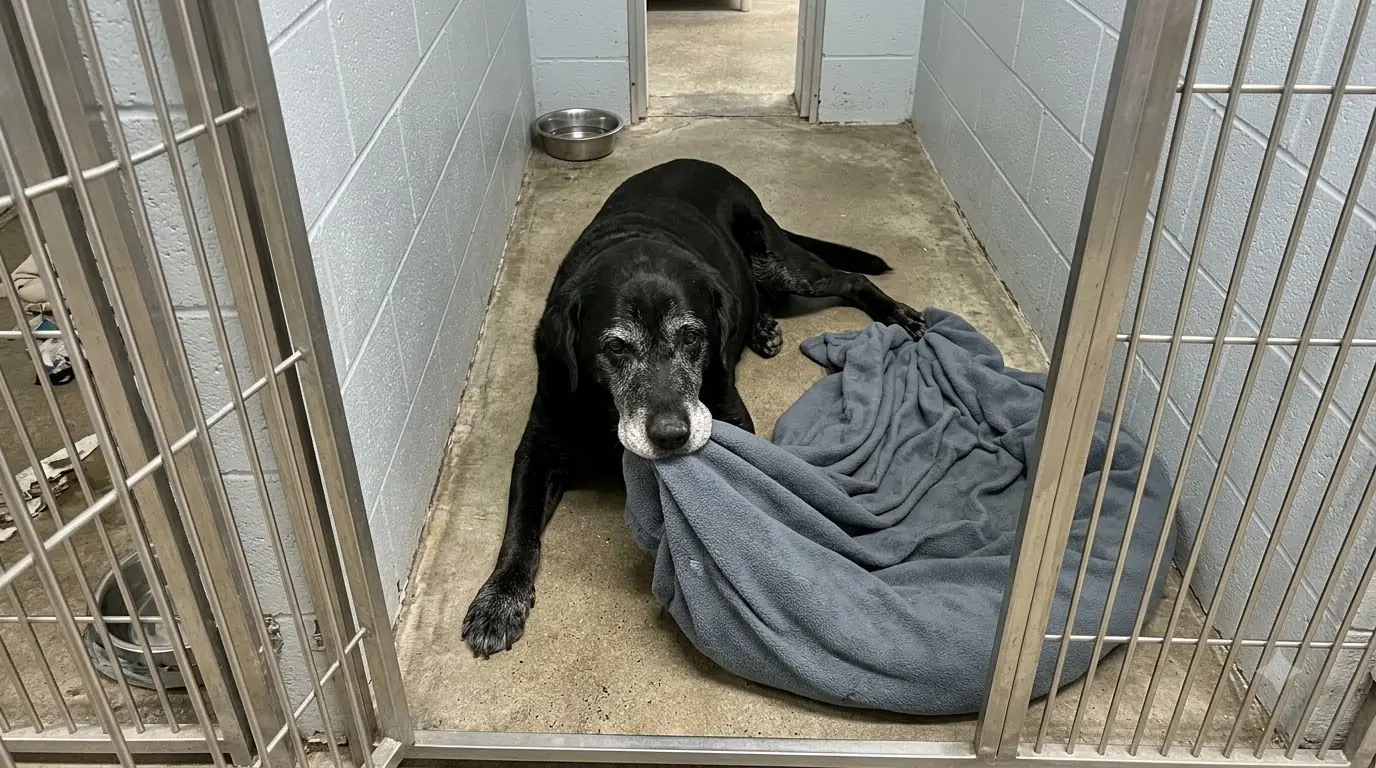
Every evening, shelter staff leave Murphy's fleece bed toward the back of his kennel.
It is a deliberate choice.
At 11 years old, the Labrador Retriever has severe arthritis and heart failure. His hind legs tire quickly, and most of his day is now spent lying down.
The bed gives his aging body a softer place to rest.
But by morning, it is almost never where staff left it.
Murphy moves it.
He grips the edge of the fleece with his teeth.
Pulls.
Stops.
Then pulls again.
The bed slides only a few inches each time.
For a healthy dog, moving it across a kennel would be easy.
For Murphy, it can become an entire evening's effort.
Sometimes he reaches the gate.
Sometimes his body gives out before the bed gets there.
When that happens, Murphy simply lies down on whatever portion he has managed to move.
Then he rests his head against the metal bars.
From there, he can see the hallway.
At First, Staff Thought Murphy Was Just Rearranging His Bed
Dogs move bedding all the time.
They paw at blankets.
Turn beds around.
Push them into corners.
So the first time staff found Murphy's fleece bed near the kennel entrance, nobody thought much of it.
They returned it to the back.
The next morning, it was near the gate again.
Then it happened again.
Eventually, someone saw the process.
Murphy was not casually pushing the bed around while settling.
He was working to move it in one specific direction.
Toward the front.
Moving It Was Harder Than It Looked
Murphy's arthritis already made ordinary movement difficult.
Standing required time.
Turning could be stiff.
His hind legs lost strength quickly once they were supporting his weight.
Heart failure added another reason to avoid unnecessary exertion.
For a dog with serious cardiac disease, caregivers pay close attention to things such as breathing, fatigue, exercise tolerance and overall comfort.
Murphy therefore spent much of his day resting.
Yet each evening, he was using some of his limited energy to relocate the very bed intended to help him conserve it.
He would bite the fleece.
Lean backward.
Pull.
Then pause.
Sometimes he remained standing.
Other times his hindquarters lowered to the floor while he still held the bed in his mouth.
After resting, he tried again.