A postmortem examination of an adult Bald Eagle recovered from a wooded area near Chesapeake Bay in Maryland found that the bird died from extensive internal hemorrhage, with toxicological findings raising serious concern that exposure to an anticoagulant rodenticide contributed to the fatal bleeding.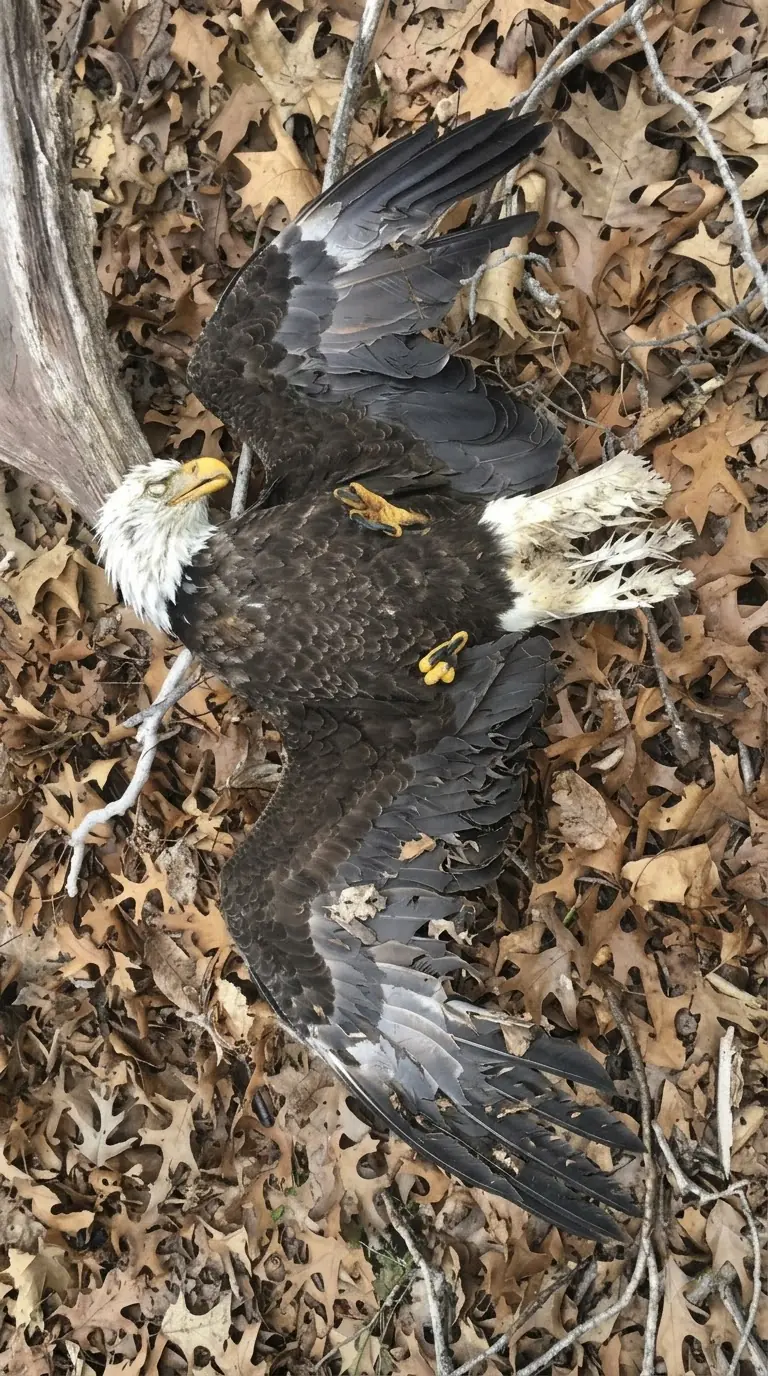
When the eagle was first discovered lying among fallen leaves beneath a stand of mature trees, there was no single catastrophic external injury that immediately explained its death.
Both wings were spread away from the body. The bird appeared to have collapsed where it was found, but there was no obvious open fracture, severe laceration or penetrating wound visible from a distance.
That uncertainty prompted wildlife officials to submit the eagle for a complete necropsy.
What veterinarians found internally told a very different story.
The eagle had suffered extensive hemorrhage involving multiple tissues and internal areas. The amount and distribution of bleeding were far greater than would have been expected from the limited external trauma observed when the bird was recovered.
There was no major fracture or single traumatic injury capable of explaining the degree of blood loss.
Instead, the pattern raised concern that the eagle’s ability to form normal blood clots had been severely impaired.
Toxicological testing subsequently identified evidence considered consistent with exposure to an anticoagulant rodenticide — a class of chemicals designed to kill rodents by disrupting the body’s normal clotting mechanisms.
“The amount of hemorrhage was the most important finding,” the veterinary pathologist involved in the case said. “We were not looking at one localized injury that had simply bled heavily. The bleeding was widespread, which immediately raised concern for a systemic clotting problem.”
For wildlife specialists, the case illustrates one of the most difficult aspects of secondary poisoning.
The eagle may never have touched rodent bait directly.
It may never have been anywhere near the location where the poison was originally placed.
It may simply have eaten another animal that had already consumed it.
The Eagle Was Found With No Obvious Explanation for Its Death
The adult Bald Eagle was discovered in a wooded area near the Chesapeake Bay watershed.
The bird was lying on the forest floor with its wings partly extended.
From the outside, there was little to indicate exactly what had happened.
There were no obvious signs of a severe vehicle collision.
No major wing fracture was immediately apparent.
No large gunshot wound or other penetrating injury could be identified by visual inspection alone.
The eagle’s body condition also did not immediately suggest prolonged starvation.
That made a postmortem examination necessary.
A necropsy — the veterinary equivalent of a human autopsy — allows pathologists to examine structures that cannot be assessed from photographs or an external examination.
The purpose is not simply to identify visible trauma.
It is to reconstruct the physiological process that led to death.
The Necropsy Revealed Widespread Bleeding
During the examination, veterinarians identified extensive hemorrhage in multiple areas of the body.
Blood had accumulated internally.
Additional bleeding was present within soft tissues and muscles.
Bruising extended beyond what would normally be expected from minor trauma associated with collapse or movement shortly before death.
The distribution was important.
A bird that suffers a major collision may develop severe internal bleeding, but veterinarians would generally expect to identify corresponding traumatic damage such as ruptured organs, fractures or significant tissue disruption.
Those findings were not sufficient to explain what was seen in this eagle.
Instead, the overall pattern suggested that bleeding itself had become a systemic problem.
“What stood out was that there was no single injury that accounted for everything,” the pathologist said. “The bird had hemorrhaged extensively, but the anatomical damage we found did not support trauma alone as the explanation.”
That observation shifted the investigation toward possible coagulopathy — an impairment of the blood’s normal ability to clot.
Anticoagulant Rodenticides Became a Major Concern
Anticoagulant rodenticides are designed to interfere with vitamin K-dependent clotting factors.
Vitamin K plays an essential role in the body’s ability to produce several proteins required for normal coagulation.
When those pathways are disrupted, even relatively small injuries to blood vessels can continue bleeding.
Over time, the blood loss may become severe.
The process can occur largely inside the body.
An affected animal may not have a dramatic external wound.
Instead, it may gradually become:
weak,
lethargic,
anemic,
short of breath,
unable to stand normally,
or unable to fly.
By the time a wild raptor is found on the ground, significant hemorrhage may already have occurred.
In severe cases, collapse and death can follow before anyone realizes the animal has been exposed.
Toxicology Helped Narrow the Cause
Samples collected during necropsy were submitted for toxicological analysis.
The findings supported concern for exposure to an anticoagulant rodenticide.
The results were interpreted together with the postmortem evidence rather than in isolation.
That distinction matters.
Detecting a toxicant does not automatically prove that it caused death.
Veterinarians consider:
the concentration,
the distribution of lesions,
the clinical or postmortem findings,
and whether another explanation better accounts for the animal’s condition.
In this case, the extensive hemorrhage combined with toxicological evidence made anticoagulant rodenticide exposure the leading suspected underlying cause.
The conclusion was therefore not based simply on finding a chemical.
It was based on the way the chemical finding matched what had happened inside the eagle’s body.
The Fatal Injury Was Largely Invisible From the Outside
This is one of the reasons anticoagulant poisoning can be difficult to recognize in wildlife.
The eagle did not need to have a large external wound.
Its blood simply needed to lose enough of its normal ability to clot.
Small blood vessels can rupture during normal movement.
Minor impacts can produce larger-than-expected bruising.
A natural interaction with another animal can trigger bleeding that would ordinarily stop.
Once coagulation is severely compromised, those small events may accumulate into a life-threatening loss of blood.
That means a Bald Eagle can appear externally intact while its physiological condition is deteriorating rapidly.
By the time the bird becomes too weak to fly, the window for treatment may already be narrow.
The Eagle May Have Been a Secondary Victim
The suspected route of exposure is one of the most important parts of the case.
Bald Eagles are not typical targets of rodent-control programs.
They are unlikely to intentionally seek out blocks of rodent bait.
But they are opportunistic predators and scavengers.
If a rat or mouse consumes anticoagulant rodenticide, that animal may carry residues in its body.
As poisoning progresses, the rodent may become slower.
Its coordination may deteriorate.
It may leave cover.
It may remain exposed during periods when a healthy rodent would normally hide.
Those changes can make it easier prey.
An owl may catch it.
A hawk may catch it.
A fox may eat it.
Or an eagle may take advantage of what appears to be an unusually easy meal.
The predator behaves normally.
The exposure is hidden.
“The Poison Does Not Necessarily Stop With the Rodent”
“The poison does not necessarily stop with the animal it was intended to kill,” the rehabilitation director said. “Once that rodent moves back into the food web, any predator or scavenger that consumes it may also be exposed.”
This concept is known as secondary poisoning.
The first animal consumes the toxicant.
A second animal consumes the first.
The second animal was never the intended target, yet it becomes part of the toxicological chain.
That pathway is especially concerning for predators that may consume multiple rodents over time.
Repeated exposure can potentially increase the amount of toxicant reaching the predator.
Bald Eagles Do Not Survive on Fish Alone
The public often associates Bald Eagles almost exclusively with fish.
Fish are an important food source in many regions, but Bald Eagles are highly adaptable.
They also consume:
waterfowl,
small mammals,
carrion,
road-killed animals,
and food taken from other predators or scavengers.
That flexibility helped the species recover across a wide range of American landscapes.
It also means Bald Eagles can encounter hazards associated with multiple food sources.
An eagle living near a river may feed on fish one day and scavenge a mammal the next.
A bird nesting near suburban development may forage across wetlands, agricultural land and residential areas.
That movement can connect wildlife with toxicants placed far from the nest itself.
Why Poisoned Rodents May Be More Likely to Be Eaten
The behavior of an affected rodent may actually increase the predator’s exposure risk.
A healthy rodent is difficult to catch.
It tends to remain close to cover.
It moves quickly.
It reacts strongly to predators.
A poisoned rodent may do the opposite.
It may walk slowly across open ground.
It may appear confused.
It may remain outside during unusual hours.
It may not react quickly enough to escape.
To a predator, that is not a warning sign.
It is an opportunity.
The very process intended to kill the rodent can make it more available to wildlife before it dies.
Not All Rodenticides Work the Same Way
Wildlife specialists are careful to distinguish between different classes of rodenticides.
The term “rat poison” can refer to multiple chemical groups with different mechanisms of toxicity.
The hemorrhagic syndrome described in this case is associated specifically with anticoagulant rodenticides.
Other rodenticides may affect the nervous system, calcium metabolism or other physiological processes.
That distinction is important because different compounds produce different clinical signs and may require different treatment approaches.
In this eagle, the pattern of widespread hemorrhage made an anticoagulant mechanism particularly relevant.
Why a Necropsy Matters Even When the Animal Cannot Be Saved
By the time this eagle was recovered, treatment was no longer possible.
But examining the body still had value.
A necropsy can reveal hazards that remain active in the landscape.
It can distinguish trauma from disease.
It can identify toxic exposure.
It can uncover patterns that may affect other wildlife in the same region.
One dead eagle may therefore become an important surveillance case.
If similar cases appear repeatedly in the same geographic area, wildlife agencies may begin looking for a shared environmental source.
Without postmortem investigation, those connections can remain invisible.
Investigators Also Had to Consider Other Causes
Internal hemorrhage is not specific to rodenticide exposure.
Veterinarians also consider other possibilities, including:
severe trauma,
certain infectious diseases,
primary clotting disorders,
other toxicants,
and organ damage.
That is why the physical examination, necropsy and toxicology have to be interpreted together.
In this case, there was not enough traumatic damage to explain the hemorrhage by itself.
The bleeding pattern suggested abnormal coagulation.
Toxicological findings then provided additional evidence supporting anticoagulant rodenticide exposure.
That combination made secondary poisoning the leading explanation.
The Bird May Have Become Weak Before It Collapsed
Another possible part of the sequence is that the eagle was already physiologically compromised before it reached the ground.
Progressive blood loss reduces the amount of oxygen available to the brain and muscles.
An eagle that is becoming severely anemic may lose:
flight endurance,
coordination,
grip strength,
and the ability to maintain normal posture.
It may land somewhere it would not ordinarily choose.
Eventually it may become unable to take off again.
A bird found on the ground may therefore appear as though it has suffered a fall or collision when the underlying problem began earlier.
In some cases, poisoning may even make secondary trauma more likely because a weakened bird is less capable of navigating safely.
Raptors Can Hide Illness Until They Are Extremely Sick
Wild birds often conceal weakness.
There is an evolutionary advantage to doing so.
An obviously compromised animal may attract predators or lose access to territory and food.
As a result, raptors may continue functioning until their physiological reserves are nearly exhausted.
That creates a challenge for rescuers.
By the time an eagle allows close human approach, it may already be critically ill.
In anticoagulant poisoning, that delay can be particularly dangerous because internal bleeding may have progressed for hours or days.
Treatment Is Possible if Exposure Is Identified in Time
Not every anticoagulant rodenticide case is fatal.
If a living bird reaches veterinary care early enough, treatment may include supportive care and vitamin K1 therapy when clinically indicated.
Veterinarians may also monitor:
packed cell volume,
clotting function,
hydration,
respiratory status,
and evidence of continued hemorrhage.
Severe anemia may require more intensive intervention.
But treatment becomes increasingly difficult once extensive blood loss has already occurred.
This eagle was found too late for that opportunity.
The necropsy was able to explain what had happened, but it could not reverse it.
The Case Raises Broader Concerns for Other Predators
Bald Eagles are only one part of the food web potentially affected by secondary exposure.
Other species may include:
Great Horned Owls,
Barred Owls,
Red-tailed Hawks,
foxes,
coyotes,
and other mammalian or avian predators.
Scavengers can also be exposed when they consume contaminated carcasses.
Because many of these animals move over large territories, the place where a poisoned predator is found may not be the place where the original bait was used.
That makes tracing the source difficult.
Prevention Begins With Making Properties Less Attractive to Rodents
Wildlife professionals encourage prevention-based rodent management whenever practical.
Reducing food and shelter can lower rodent numbers without introducing toxic prey into the surrounding ecosystem.
Steps may include:
sealing openings into buildings,
keeping garbage containers secure,
removing accessible pet food,
cleaning spilled bird seed,
reducing clutter around structures,
and eliminating other reliable food sources.
Mechanical trapping can also be considered where it can be used safely and appropriately.
No single method works in every setting.
The broader goal is to reduce reliance on anticoagulant toxicants when effective alternatives are available.
Homeowners May Not Realize What Happens After a Rodent Leaves the Property
Many people who use rodenticide are trying to solve a legitimate problem.
They may be dealing with contamination, property damage or rodents entering buildings.
The conservation concern is not that users intentionally want to harm wildlife.
It is that the affected rodent does not necessarily die where the bait was placed.
It may leave the building.
It may cross a yard.
It may enter nearby woods.
And before it dies, it may be captured by a predator.
The secondary victim can therefore appear far removed from the original control site.
One Eagle Can Represent a Much Larger Environmental Story
This individual Bald Eagle is one animal.
But its necropsy may reveal something about the landscape shared by many species.
That is why wildlife diagnostic work matters.
The body becomes evidence.
The organs show what happened physiologically.
The toxicology identifies compounds that cannot be seen externally.
Together, those findings can turn an unexplained wildlife death into a conservation warning.
There Was No Dramatic External Wound to Explain the Loss
Perhaps the most striking part of this case is what was absent.
There was no shattered wing.
No obvious catastrophic collision.
No large external wound that immediately told investigators how the bird died.
The real damage was largely hidden.
Inside, the eagle had lost blood extensively.
Its clotting system appears to have failed.
And by the time the consequences became visible as weakness and collapse, the process was already advanced.
The Necropsy Provided the Answer the Scene Could Not
When the bird was first found on the forest floor, the scene offered only questions.
Had it struck something?
Had another eagle attacked it?
Had it been shot?
Was it sick?
The necropsy eliminated some possibilities and elevated another.
The body showed widespread hemorrhage.
The severity of that bleeding could not be explained by trauma alone.
Toxicology then supported concern for an anticoagulant rodenticide.
The most likely story became one that had begun somewhere else entirely.
A rodent encountered poison.
The rodent returned to the environment.
A predator encountered the rodent.
The chemical moved through the food web.
And eventually, a Bald Eagle was found dead beneath the trees.
The Final Victim May Be Miles From the Original Bait
That is what makes secondary poisoning particularly difficult to recognize.
There may be no poisoned rodents lying beside the eagle.
No bait station nearby.
No obvious connection between the dead predator and a human rodent-control program.
The eagle may have flown miles after feeding.
The prey may have traveled beyond the property where the toxicant was used.
By the time the eagle becomes sick, the original source may be impossible to identify.
The chemical leaves no visible trail.
A Preventable Risk Hidden Inside Normal Predator Behavior
The eagle did not need to make an unusual ecological choice.
It may have simply done what Bald Eagles have always done.
It found food.
It ate.
The danger was not the behavior.
The danger was hidden within the prey.
That distinction is important because wildlife cannot learn to avoid a toxicant it cannot detect.
Reducing the risk therefore depends largely on decisions made before contaminated prey enters the food web.
A Death That Can Still Provide Information
Nothing discovered during the necropsy can bring this eagle back.
But the case can still serve a purpose.
It can help wildlife officials understand why a protected raptor died.
It can add to broader monitoring of environmental toxicants.
And it can remind communities that pest-control decisions sometimes extend beyond the species they are intended to affect.
“The outcome for this bird was tragic, but determining the cause matters,” the veterinary pathologist said. “When we understand how wildlife is being exposed, we have a better chance of preventing the same thing from happening again.”
For this Bald Eagle, the fatal process was almost completely hidden from view.
The bird was found on the forest floor without a catastrophic external wound.
Only after the necropsy did the scale of the problem become clear.
Extensive hemorrhage had occurred throughout the body.
Trauma could not adequately explain it.
And toxicological evidence pointed toward anticoagulant rodenticide exposure as the leading suspected cause.
The eagle may never have touched the poison itself.
It may simply have eaten an animal that had.
That is the central warning contained in this case:
the poison does not always stop with the species it was intended to kill.