When Ollie first became available for adoption, shelter employees assumed his stay would be brief. The young tricolor hound mix had the long ears, dark saddle, white chest, and steady brown eyes that made visitors stop almost automatically when they reached his kennel. He was neither especially large nor difficult to approach, and unlike several dogs around him, he rarely spent the day jumping against the bars or barking at everyone who passed. He usually sat close to the gate and watched, waiting to see whether the person on the other side intended to stay.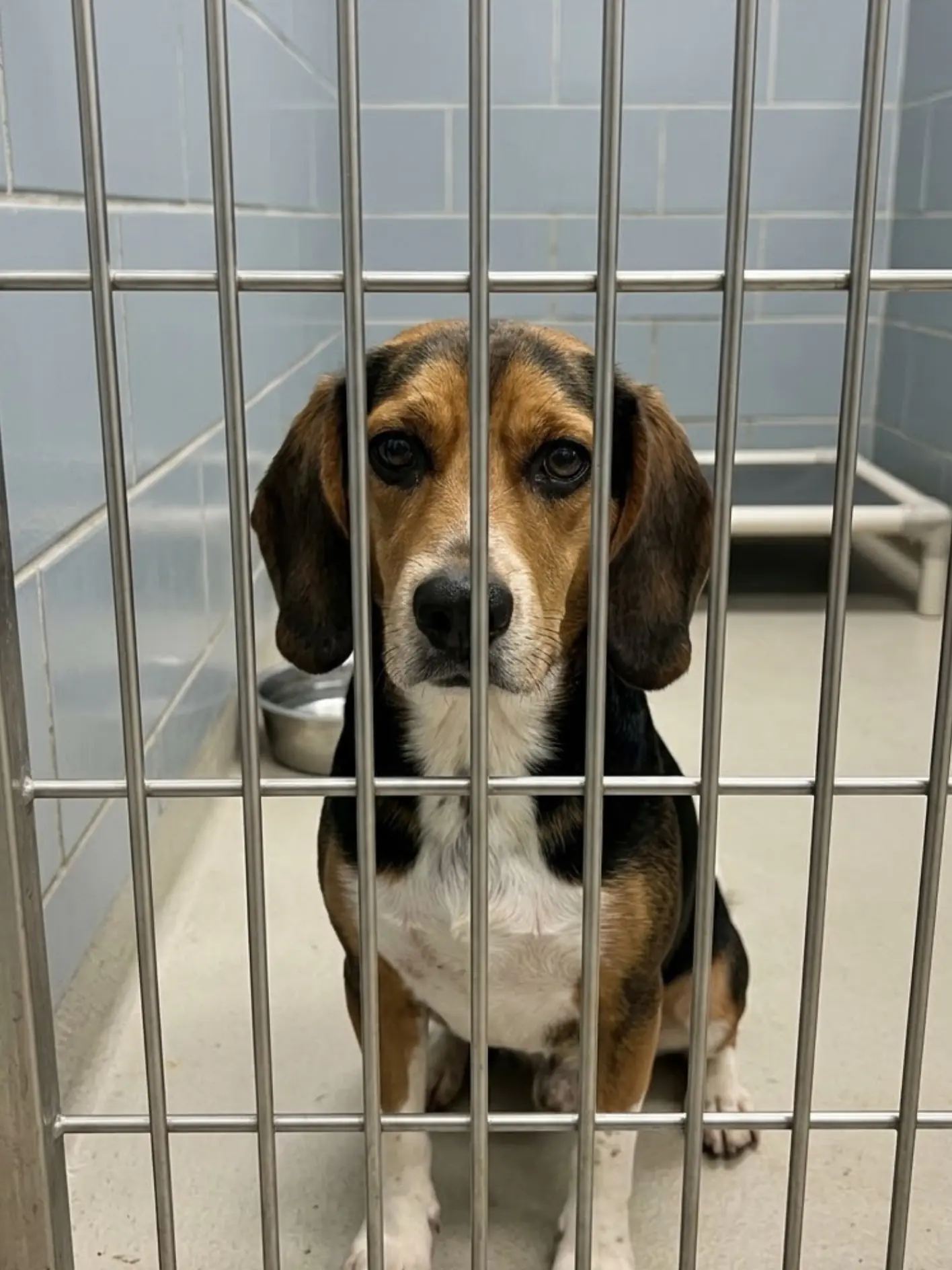
For the first few days, plenty of people did stay. Families crouched beside his kennel, children pointed toward his long ears, and several visitors asked staff whether he might be part Beagle. Employees could not confirm his exact breed history, but his appearance and tendency to investigate every interesting scent made “hound mix” a reasonable description. More than once, someone remarked that Ollie looked like exactly the kind of dog who should disappear from the adoption floor within a weekend.
The first weekend passed.
Ollie was still there.
He had entered the shelter after being found outside a closed convenience store early one morning. A delivery driver had noticed him near the edge of the parking lot and initially assumed an owner was nearby, but the dog remained there through several deliveries. When animal-control officers arrived, Ollie did not run far. He moved away cautiously, then allowed himself to be secured once food was offered.
He wore a faded collar but had no identification that immediately connected him to a family. Staff followed the available process for locating an owner, but no one came forward during the holding period. There was no reliable way to know whether Ollie had wandered farther than someone realized, been deliberately left behind, or belonged to a person whose circumstances had suddenly changed. The shelter avoided building a dramatic story around those missing facts.
What employees could evaluate was the dog in front of them.
Ollie accepted routine handling, appeared familiar with a leash, and showed no known bite history during his shelter stay. He was young enough to enjoy activity but mature enough that staff suspected he had already spent time living around people. During his first walks, one volunteer noticed that he seemed to understand basic household expectations unusually quickly. He waited briefly when doors opened, did not immediately jump on every person he met, and appeared comfortable walking beside adults once the initial excitement faded.
Those qualities seemed encouraging.
The difficulty was that Ollie did not behave like a dog trying to sell himself.
When the kennel hallway became busy, he often sat quietly and watched. Some dogs immediately pressed against their gates when visitors approached, tails moving so quickly that strangers felt connected within seconds. Ollie was slower. He might stand when someone stopped, but he usually needed more time before moving close enough to accept attention.
That difference sounds minor.
Inside a shelter, it can decide which kennel door opens.
The first serious adopter was a young couple who had recently purchased their first home and wanted a dog to join them on weekend hikes. They had seen Ollie online and arrived specifically to meet him. Outside the kennel, he relaxed noticeably, following them around the exercise yard and eventually accepting treats from both.
The couple liked him enough to begin discussing the adoption process.
Then they explained that both worked outside the home and were regularly gone for ten or eleven hours at a time.
Staff did not tell them Ollie could never manage that schedule. They simply could not guarantee that a young dog leaving a shelter would immediately be comfortable spending an entire workday alone. His complete household history was unknown, and the first few weeks might require considerably more supervision.
The couple thought about it and decided they needed a dog with a more established history of being left alone.
They adopted an older dog several kennels away.
Ollie returned to his run.
A second possibility appeared three days later. A woman in her fifties met him twice and seemed ready to adopt until she mentioned that her elderly mother lived with her and used a walker. Ollie was not aggressive around the mobility aid during a controlled meeting, but his enthusiasm on leash made the woman question whether she could safely manage him while also assisting her mother.
She left apologizing.
Nobody at the shelter blamed her.
A responsible adoption has to work after the emotional moment of meeting a dog. If a household recognizes a genuine limitation before taking an animal home, that decision can prevent a return days later.
For Ollie, however, every responsible no meant another night in the same place.
By his second week, a volunteer named Erin had begun walking him regularly. She noticed that Ollie seemed to carry two different personalities depending on where people met him. In the kennel, he was quiet and sometimes almost expressionless. Outdoors, his nose immediately went to work. He investigated every patch of grass, every fence post, and every route another dog had recently traveled, then gradually shifted his attention toward the person holding the leash.
After ten or fifteen minutes, the dog who had appeared distant behind the bars became easier to understand. He checked back toward Erin, accepted treats gently, and occasionally leaned close enough that his shoulder touched her leg when they stopped walking.
Erin started telling people that Ollie was not uninterested in them.
He simply needed enough time to realize they were not passing through.
That explanation helped produce more meetings.
It did not produce a home.
One family loved him but already had three cats, and the shelter did not have enough information to guarantee safe compatibility. Another visitor wanted a dog that could accompany him everywhere immediately, including crowded restaurants and busy outdoor events, and became disappointed when staff explained that shelter dogs often need a quiet adjustment period first.
A man scheduled an appointment after exchanging several messages with staff.
He never came.
Ollie continued waiting.
As his stay lengthened, people online began asking a question shelter volunteers heard constantly.
“How is he still there?”
The question sounded compassionate, but it gradually became frustrating because almost everyone asking it expected another person to provide the answer.
Erin took new photographs of Ollie outside the kennel. In one, his ears were relaxed and his nose was pointed toward her hand. In another, he was walking beside her rather than sitting behind steel bars. The shelter updated his profile and explained that he appeared quieter in the kennel than he did after several minutes outside.
The new images spread quickly.
Hundreds of people saw them.
Comments filled with praise.
“He’s beautiful.”
“Someone please take this baby.”
“If I were closer, he’d be mine.”
“Surely he has applications already.”
That final assumption was the dangerous one.
Ollie did not have an application.
He did not have a foster.
He did not have a rescue commitment.
He had attention.
Attention and placement are not the same thing.
A social media post with hundreds of comments can create the impression that a dog is surrounded by options. One person sees ten strangers expressing interest and assumes somebody must already be driving to the shelter. Another notices several rescue organizations tagged beneath the photograph and believes one of them has probably agreed to take the animal.
Someone who genuinely has room to foster may scroll past because the dog looks safer than another animal receiving less attention.
Meanwhile, the shelter record remains unchanged.
Ollie was still occupying the same kennel.
The situation became more serious when intake increased.
Several stray dogs arrived over a single weekend, including animals whose owners still needed time to locate and reclaim them. Two dogs came in after their family was evicted, while another animal required medical separation and temporarily removed one kennel from normal use.
Employees began counting available spaces differently.
A kennel that looked comfortably available earlier in the month was suddenly part of a much tighter system.
Ollie had done nothing wrong.
He had not developed a serious illness.
There had been no bite or major behavioral incident that caused staff to reconsider him.
The building around him had simply become fuller.
This is one of the hardest parts of public animal sheltering to explain through a single photograph. A shelter can care about a dog and still reach a point where physical capacity becomes critical. Lost animals continue arriving. Emergency cases still need somewhere safe. Housing problems, hospitalizations, and financial crises do not stop because every kennel is occupied.
The system depends on dogs leaving safely as well.
Adoption opens space.
Foster care opens space.
Rescue transfer opens space.
Reunification with an owner opens space.
When intake continues while those exits slow, time becomes increasingly important for every animal still inside.
Ollie became one of the dogs staff began discussing as needing accelerated placement.
Rescue organizations were contacted before his case became critical.
One hound rescue reviewed his information and liked him but already had several dogs waiting for foster homes. Another organization agreed to share his photographs but did not operate its own kennel facility. Without an available volunteer foster, it had nowhere to put Ollie.
A third group thought it might be able to help if the shelter found someone willing to keep him temporarily.
Volunteers began asking specifically for foster help.
A possible placement appeared within two days.
A college instructor who worked from home during the summer contacted the shelter and said she could foster Ollie temporarily. She owned her house, had no children, and appeared prepared to work through an adjustment period.
For the first time in days, Erin believed they had found the missing piece.
Then another problem emerged.
The woman had two rabbits living inside the home.
Nobody could confidently say how Ollie would respond to them.
Because of his strong interest in moving scents outdoors and his uncertain history around small animals, the rescue and shelter did not believe placing him directly into that environment without a safe separation plan was responsible.
The woman’s house did not have a practical way to divide the animals permanently.
She withdrew.
It was the correct decision.
It still left Ollie behind.
Another offer came from a family willing to keep him in their backyard until a permanent adopter appeared. They had a secure fence, but their plan involved leaving Ollie outdoors for most of the day with little access to the home.
Staff did not consider that an appropriate foster arrangement.
Someone online accused the shelter of being “too picky.”
Erin found the criticism difficult to read.
The objective was not to make the kennel empty for one afternoon. Moving Ollie into an unsuitable environment only to have him returned could leave him in an even more precarious position later.
Urgency mattered.
So did placement quality.
The shelter continued searching.
Weeks of kennel life slowly changed how Ollie presented himself. He remained cooperative with familiar employees, but he became more animated whenever the hallway was crowded. He barked more frequently at dogs passing close to his gate and sometimes paced before settling.
Outside, Erin still saw much of the dog she had known from the beginning.
He sniffed.
He walked.
He relaxed.
The contrast reinforced something shelter professionals see regularly: kennel behavior is influenced by confinement. A dog becoming louder after weeks in a kennel does not automatically mean the same dog will spend all day barking inside a home.
Likewise, a quiet shelter dog is not guaranteed to remain quiet once comfortable.
The environment matters.
Erin updated his profile again rather than hiding the change. Potential adopters were told that Ollie had become more vocal in the kennel but generally settled after leaving the building.
That honesty narrowed the audience.
It also made the remaining inquiries more realistic.
One man met Ollie and appeared genuinely prepared for him. He had a fenced yard, previous hound experience, and no small animals. After nearly an hour together, staff believed the adoption might finally happen.
The man said he needed to speak with his wife first.
Nobody objected.
A dog should not arrive unexpectedly in a household where another adult has not agreed.
The next morning, he called back.
His wife said no.
Another possibility disappeared.
Ollie stayed.
By then, the shelter had entered one of its most crowded periods of the month.
Staff were informed that several longer-stay dogs needed immediate placement because space was becoming critical.
Ollie’s name was among them.
The first warning did not automatically mean euthanasia. It meant volunteers and staff needed to intensify every realistic path out.
Erin shared him again.
This time the language was more urgent.
People responded almost immediately.
Someone offered to pay his adoption fee.
Another person offered money toward training.
A woman in another state wanted to adopt but needed transportation arranged.
The shelter appreciated the support, but the fundamental problem remained physical.
Ollie needed somewhere to go.
Money could help once a placement existed.
It could not become the placement.
The regional rescues were contacted again.
Still full.
No fosters.
Can share.
Will ask.
The same answers returned.
Then intake increased again.
Staff eventually received the notice they had been trying to prevent.
Unless Ollie had an appropriate adopter, foster, or rescue commitment secured today, he was scheduled for euthanasia because of space.
Today.
The word landed heavily on the people who had spent weeks assuming one more day would always exist.
For Ollie, nothing changed.
His breakfast arrived.
His water bowl was replaced.
He stood when Erin approached with a leash.
The fact that people were suddenly counting hours existed entirely outside his understanding.
Dogs do not know what an euthanasia list is.
They know routine.
Ollie knew Erin meant he would probably get to leave the kennel for a while.
She opened the gate.
They walked outside.
Erin deliberately followed their usual route. She did not want to transform the morning into a goodbye ceremony for a dog who had no concept of why she would suddenly behave differently.
Ollie spent several minutes investigating the fence line, then moved toward the patch of grass he always seemed to prefer. After the initial excitement passed, his pace slowed.
Erin sat on a bench.
Ollie stood near her.
Eventually, he sat too.
Nothing remarkable happened.
That was what made the moment difficult.
He was not dramatically begging to survive.
He was simply being the same dog he had been yesterday.
Erin was the one who knew tomorrow had stopped being guaranteed.
She stayed outside longer than usual.
Then they returned.
Ollie walked into his kennel.
The gate closed.
The final-day post went online.
It was deliberately clear.
Ollie had only today.
There was still no confirmed adopter, foster, or rescue despite weeks of attention.
People were asked to contact the shelter directly if they could realistically help rather than assuming someone else had already done so.
The comments multiplied.
By midmorning, several new leads had appeared.
One family wanted Ollie but lived in an apartment that required management approval. That process could take days.